


Homework Answers
Request Answer!
We need at least 10 more requests to produce the answer.
0 / 10 have requested this problem solution
The more requests, the faster the answer.
Add Answer to:
please help
1) The following potential energy diagram best represents which type of reaction? (a pt...
Answer the following questions about the reaction diagram below TS TS2 E SM P Reaction coordinate...
 Answer the following questions about the reaction diagram below TS TS2 E SM P Reaction coordinate a. Which of the following are represented by the reaction diagram above? Circle all that apply. Sn1, S2, E1, E2, None the b. Doubling the concentration of the nucleophile or base will rate of the reaction C. The best substrate (electrophile) for the reaction diagram above is, Methyl, 1°, 2°, 3° (Circle One)
What is the activation energy for the reaction B -> A in the following diagram? PLEASE EXPLAIN! 1) (1.5 pt) Wha...
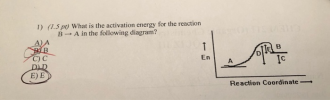 What is the activation energy for the reaction B -> A in the
following diagram?
PLEASE EXPLAIN!
1) (1.5 pt) What is the activation energy for the reaction B A in the following diagram? A)A B B C) C DID E) E En Reaction Coordinate
What is the activation energy for the reaction B -> A in the
following diagram?
PLEASE EXPLAIN!
1) (1.5 pt) What is the activation energy for the reaction B A in the following diagram? A)A B B C) C DID E) E En Reaction Coordinate
1. Give IUPAC names for the following: 2. Draw the complete mechanism for the reaction if...
 1. Give IUPAC names for the following:
2. Draw the complete mechanism for the reaction if HBr
with 2-methylcyclohepta-1,3-diene. Label the Lewis acid, Lewis
base, nucleophile and electrophile in each step. Finally, identify
the 1,2 and 1,4 products and name each product.
E. We were unable to transcribe this image
1. Give IUPAC names for the following:
2. Draw the complete mechanism for the reaction if HBr
with 2-methylcyclohepta-1,3-diene. Label the Lewis acid, Lewis
base, nucleophile and electrophile in each step. Finally, identify
the 1,2 and 1,4 products and name each product.
E. We were unable to transcribe this image
Question 1 1 pt Which of the following is/are accurate statements concerning the mechanism shown ...
 Question 1 1 pt Which of the following is/are accurate statements concerning the mechanism shown below? Assume that liquid ammonia and enough HCI to make sufficient NH4 ion are present in the reaction mixture. Select all that apply. n The collapse of the tetrahedral intermediate represented by step 3 is incorrect because under the acid-catalyzed conditions, hydroxide ion will not be a viable leaving group. Leaving aside the issue of whether hydroxide ion would be present or not, the electron...
please answer these questions 1: Which of the following is true for the reaction of (1R,...
please answer these questions 1: Which of the following is true for the reaction of (1R, 2R)-1-tert-butyl-1-fluoro-2-methylcyclohexane with potassium hydroxide? a: The product is (E)(6R)-1-tert-butyl-6-methyl-1-cyclohexene b: The product is (Z)(6R)-1-tert-butyl-6-methyl-1-cyclohexene c: The product is (Z)(6S)-1-tert-butyl-6-methyl-1-cyclohexene d: The product is (E)(6S)-1-tert-butyl-6-methyl-1-cyclohexene 2: Which of the following is not true for regioselective reactions? a: Generally, the selectivity lies to toward the Saytzeff product in elimination reactions. b: In a regioselective reaction, there is one product that predominates. c: The transition states of...
1) For the following reaction, which of the following is a conjugate acid-base pair? HC20(aq)+ H20)...
 1) For the following reaction, which of the following is a conjugate acid-base pair? HC20(aq)+ H20) H:0 (aq) C0,(aq) a. HC20 and H20 b. H20 and C202 c. HC20 and H30 d. HCzOr and C20 2) The pH of a solution of hydrochloric acid is 1.5. What is the concentration of the acid? a. 0.22 mol/dm b. 0.32 mol/dm3 c. 3.2x 10² mol/dm d. 2.2x 10⁻³ mol/dm 3) Which of the following diagrams represents the acid with the highest pH?...
____ 1. The diagram below represents serine, a polar, uncharged amino acid. Which functional group gives...
 ____ 1. The diagram below represents serine, a polar, uncharged
amino acid. Which functional group gives serine its
distinct property?
a. H3
b. CH2OH
c. –H
d. COO–
____ 2. The monomers shown below are monomers for which of the
following natural polymers?
a. polysaccharides
b. plastics
c. DNA
d. proteins
____ 3. Which of the following processes illustrates the production
of a protein?
a. specific code for amino acids --> amino acid chain -->
gene --> DNA --> specific...
____ 1. The diagram below represents serine, a polar, uncharged
amino acid. Which functional group gives serine its
distinct property?
a. H3
b. CH2OH
c. –H
d. COO–
____ 2. The monomers shown below are monomers for which of the
following natural polymers?
a. polysaccharides
b. plastics
c. DNA
d. proteins
____ 3. Which of the following processes illustrates the production
of a protein?
a. specific code for amino acids --> amino acid chain -->
gene --> DNA --> specific...
1.1 In which of the following solvents would the reaction of 1-bromobutane with sodium azide,NaN3, proceed...
 1.1 In which of the following solvents would the reaction of
1-bromobutane with sodium azide,NaN3, proceed the fastest?
a.aceticacid
b.ethanol
c.water
d.acetonitrile
1.2 Which of the following solvents is the best choice for the
reaction of 1-chlorohexane with sodium bromide?
a.dimethylsulfoxide
b.water
c.hexane
d.toluene,PhCH3
1.3 Which of the following is most likely to undergo
rearrangement during reaction with methanol?
1.4 Name which energy diagrams represents the course of an
exothermic SN1, SN2,E1, or E2 reaction?
1.5 Which of the following...
1.1 In which of the following solvents would the reaction of
1-bromobutane with sodium azide,NaN3, proceed the fastest?
a.aceticacid
b.ethanol
c.water
d.acetonitrile
1.2 Which of the following solvents is the best choice for the
reaction of 1-chlorohexane with sodium bromide?
a.dimethylsulfoxide
b.water
c.hexane
d.toluene,PhCH3
1.3 Which of the following is most likely to undergo
rearrangement during reaction with methanol?
1.4 Name which energy diagrams represents the course of an
exothermic SN1, SN2,E1, or E2 reaction?
1.5 Which of the following...
1) Choose the correct structures for X and Y. 2) The following aldol reaction can produce...
 1) Choose the correct structures for X and
Y.
2) The following aldol reaction can produce 4 products. Select
the structure that is not a possible product of the following
reaction.
3) Choose the major compounds present after the following ketone
is treated with dilute aqueous base.
4) Draw the alkyl bromide(s) that is(are) needed to prepare the
following ketone using the acetoacetic ester synthesis.
O Br LDA TMS-CI CH3-Li Br Х Y -78 °C NEt3 1 2 3 A....
1) Choose the correct structures for X and
Y.
2) The following aldol reaction can produce 4 products. Select
the structure that is not a possible product of the following
reaction.
3) Choose the major compounds present after the following ketone
is treated with dilute aqueous base.
4) Draw the alkyl bromide(s) that is(are) needed to prepare the
following ketone using the acetoacetic ester synthesis.
O Br LDA TMS-CI CH3-Li Br Х Y -78 °C NEt3 1 2 3 A....
please write legible 1. Identify each of the following reactions as a precipitation reaction, an acid-base...
 please write legible
1. Identify each of the following reactions as a precipitation reaction, an acid-base reaction, or as a redox reaction + a. Pb(NO3)2 (aq) + 2 HCl(aq) PbCl (s) + 2 HNO, (aq) b. 2 Hxe + O2 + 2 H2O c. HNO, (aq) + KOH(aq) KNO, (aq) + H20 (1) d. Zna + 2HCl(a) - ZnClaraq) + Halle e. Ba?'(aq) + 2 Br(aq) + 2 Na(aq) + SO/"(aq) BaSO. (s) + 2 Na'(aq) + 2 Br" (aq)...
please write legible
1. Identify each of the following reactions as a precipitation reaction, an acid-base reaction, or as a redox reaction + a. Pb(NO3)2 (aq) + 2 HCl(aq) PbCl (s) + 2 HNO, (aq) b. 2 Hxe + O2 + 2 H2O c. HNO, (aq) + KOH(aq) KNO, (aq) + H20 (1) d. Zna + 2HCl(a) - ZnClaraq) + Halle e. Ba?'(aq) + 2 Br(aq) + 2 Na(aq) + SO/"(aq) BaSO. (s) + 2 Na'(aq) + 2 Br" (aq)...
 Answer the following questions about the reaction diagram below TS TS2 E SM P Reaction coordinate a. Which of the following are represented by the reaction diagram above? Circle all that apply. Sn1, S2, E1, E2, None the b. Doubling the concentration of the nucleophile or base will rate of the reaction C. The best substrate (electrophile) for the reaction diagram above is, Methyl, 1°, 2°, 3° (Circle One)
 What is the activation energy for the reaction B -> A in the
following diagram?
PLEASE EXPLAIN!
1) (1.5 pt) What is the activation energy for the reaction B A in the following diagram? A)A B B C) C DID E) E En Reaction Coordinate
What is the activation energy for the reaction B -> A in the
following diagram?
PLEASE EXPLAIN!
1) (1.5 pt) What is the activation energy for the reaction B A in the following diagram? A)A B B C) C DID E) E En Reaction Coordinate
 1. Give IUPAC names for the following:
2. Draw the complete mechanism for the reaction if HBr
with 2-methylcyclohepta-1,3-diene. Label the Lewis acid, Lewis
base, nucleophile and electrophile in each step. Finally, identify
the 1,2 and 1,4 products and name each product.
E. We were unable to transcribe this image
1. Give IUPAC names for the following:
2. Draw the complete mechanism for the reaction if HBr
with 2-methylcyclohepta-1,3-diene. Label the Lewis acid, Lewis
base, nucleophile and electrophile in each step. Finally, identify
the 1,2 and 1,4 products and name each product.
E. We were unable to transcribe this image
 Question 1 1 pt Which of the following is/are accurate statements concerning the mechanism shown below? Assume that liquid ammonia and enough HCI to make sufficient NH4 ion are present in the reaction mixture. Select all that apply. n The collapse of the tetrahedral intermediate represented by step 3 is incorrect because under the acid-catalyzed conditions, hydroxide ion will not be a viable leaving group. Leaving aside the issue of whether hydroxide ion would be present or not, the electron...
 1) For the following reaction, which of the following is a conjugate acid-base pair? HC20(aq)+ H20) H:0 (aq) C0,(aq) a. HC20 and H20 b. H20 and C202 c. HC20 and H30 d. HCzOr and C20 2) The pH of a solution of hydrochloric acid is 1.5. What is the concentration of the acid? a. 0.22 mol/dm b. 0.32 mol/dm3 c. 3.2x 10² mol/dm d. 2.2x 10⁻³ mol/dm 3) Which of the following diagrams represents the acid with the highest pH?...
 ____ 1. The diagram below represents serine, a polar, uncharged
amino acid. Which functional group gives serine its
distinct property?
a. H3
b. CH2OH
c. –H
d. COO–
____ 2. The monomers shown below are monomers for which of the
following natural polymers?
a. polysaccharides
b. plastics
c. DNA
d. proteins
____ 3. Which of the following processes illustrates the production
of a protein?
a. specific code for amino acids --> amino acid chain -->
gene --> DNA --> specific...
____ 1. The diagram below represents serine, a polar, uncharged
amino acid. Which functional group gives serine its
distinct property?
a. H3
b. CH2OH
c. –H
d. COO–
____ 2. The monomers shown below are monomers for which of the
following natural polymers?
a. polysaccharides
b. plastics
c. DNA
d. proteins
____ 3. Which of the following processes illustrates the production
of a protein?
a. specific code for amino acids --> amino acid chain -->
gene --> DNA --> specific...
 1.1 In which of the following solvents would the reaction of
1-bromobutane with sodium azide,NaN3, proceed the fastest?
a.aceticacid
b.ethanol
c.water
d.acetonitrile
1.2 Which of the following solvents is the best choice for the
reaction of 1-chlorohexane with sodium bromide?
a.dimethylsulfoxide
b.water
c.hexane
d.toluene,PhCH3
1.3 Which of the following is most likely to undergo
rearrangement during reaction with methanol?
1.4 Name which energy diagrams represents the course of an
exothermic SN1, SN2,E1, or E2 reaction?
1.5 Which of the following...
1.1 In which of the following solvents would the reaction of
1-bromobutane with sodium azide,NaN3, proceed the fastest?
a.aceticacid
b.ethanol
c.water
d.acetonitrile
1.2 Which of the following solvents is the best choice for the
reaction of 1-chlorohexane with sodium bromide?
a.dimethylsulfoxide
b.water
c.hexane
d.toluene,PhCH3
1.3 Which of the following is most likely to undergo
rearrangement during reaction with methanol?
1.4 Name which energy diagrams represents the course of an
exothermic SN1, SN2,E1, or E2 reaction?
1.5 Which of the following...
 1) Choose the correct structures for X and
Y.
2) The following aldol reaction can produce 4 products. Select
the structure that is not a possible product of the following
reaction.
3) Choose the major compounds present after the following ketone
is treated with dilute aqueous base.
4) Draw the alkyl bromide(s) that is(are) needed to prepare the
following ketone using the acetoacetic ester synthesis.
O Br LDA TMS-CI CH3-Li Br Х Y -78 °C NEt3 1 2 3 A....
1) Choose the correct structures for X and
Y.
2) The following aldol reaction can produce 4 products. Select
the structure that is not a possible product of the following
reaction.
3) Choose the major compounds present after the following ketone
is treated with dilute aqueous base.
4) Draw the alkyl bromide(s) that is(are) needed to prepare the
following ketone using the acetoacetic ester synthesis.
O Br LDA TMS-CI CH3-Li Br Х Y -78 °C NEt3 1 2 3 A....
 please write legible
1. Identify each of the following reactions as a precipitation reaction, an acid-base reaction, or as a redox reaction + a. Pb(NO3)2 (aq) + 2 HCl(aq) PbCl (s) + 2 HNO, (aq) b. 2 Hxe + O2 + 2 H2O c. HNO, (aq) + KOH(aq) KNO, (aq) + H20 (1) d. Zna + 2HCl(a) - ZnClaraq) + Halle e. Ba?'(aq) + 2 Br(aq) + 2 Na(aq) + SO/"(aq) BaSO. (s) + 2 Na'(aq) + 2 Br" (aq)...
please write legible
1. Identify each of the following reactions as a precipitation reaction, an acid-base reaction, or as a redox reaction + a. Pb(NO3)2 (aq) + 2 HCl(aq) PbCl (s) + 2 HNO, (aq) b. 2 Hxe + O2 + 2 H2O c. HNO, (aq) + KOH(aq) KNO, (aq) + H20 (1) d. Zna + 2HCl(a) - ZnClaraq) + Halle e. Ba?'(aq) + 2 Br(aq) + 2 Na(aq) + SO/"(aq) BaSO. (s) + 2 Na'(aq) + 2 Br" (aq)...
Most questions answered within 3 hours.
-
Where is the error in this code sequence?
String s1 = "Hello";
String s2 = "ello";...
asked 10 months ago -
Financial data for Joel de Paris, Inc., for last year
follow:
Joel de Paris, Inc.
Balance...
asked 10 months ago -
Consider this reaction:
Al2(SO4)3 (aq)+ BaCl3
(aq) Al2Cl6 (aq)- +
3BaSO4(s) . What is the...
asked 10 months ago -
Suppose that Savneet is considering increasing her
recent random sample from 20 car rentals to 40...
asked 10 months ago -
Trucks arrive at an unloading terminal at an average rate of 120
per hour.
Trucks arrive...
asked 10 months ago -
Why are methanol and ethanol completely soluble in water while
octanol is not very little soluble....
asked 10 months ago -
A facilities manager at a university reads in a research report
that the mean amount of...
asked 10 months ago -
When the CuSO4 is rehydrated by adding water to the anhydrous
compound, is this an endothermic...
asked 10 months ago -
A ray of sunlight is passing from diamond into crown glass; the
angle of incidence is...
asked 10 months ago -
A block of mass 0.249 kg is placed on top of a light, vertical
spring of...
asked 10 months ago -
how do the kidneys compensate in the presences of acidosis
a) trigger hyperventilate
b) reserve acid...
asked 10 months ago -
Question 501 pts
The rental rate of capital to the firm increases. Which of the
following...
asked 10 months ago