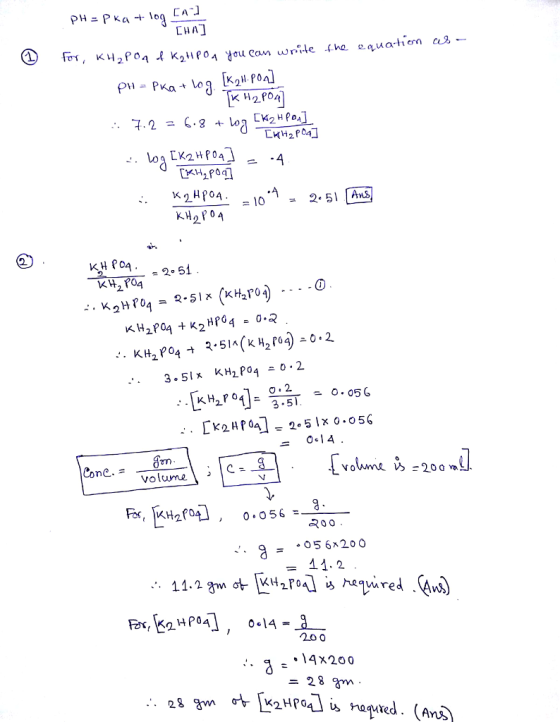
![Henderson-Hasselbach equation: pH- pKa log (IA-|/IHA]) 1. Phosphate buffer is a mixture of KH2PO4 and K2HPO4. Note that KH2PO4 has one additional proton. The pKa of the acid is 6.8. Use the Henderson-Hasselbach equation (above) to calculate the ratio of [K2HPO41[KH2PO4] needed to make a solution that is pH 7.2 2. To make a solution that is 0.2 M phosphate, the concentration of KH2PO4 and K2HPO4 must add up to 0.2 M. Use the ratio you calculated above, and the equations below to calculate the number of grams needed to make 200 ml of 0.2 M phosphate buffer. (HINT: you can solve for the concentrations of each, since you have two equations and two unknowns. Once you have the concentrations, figure out how many grams of each you need to make 200 ml) [K2HPO4]/[KH2PO4]-? (answer from above) [KH2PO4] +[K2HPO4] 0.2 M 3. How many grams of mannitol (MW 182.17) is needed to make 200 ml of 0.3 M mannitol?](http://img.homeworklib.com/questions/7f1c5e00-84d7-11ec-a3ea-3917064367ce.png?x-oss-process=image/resize,w_560)
Homework Answers
 Do Give a thumbs up.
Add Answer to:
Henderson-Hasselbach equation: pH- pKa log (IA-|/IHA]) 1. Phosphate buffer is a mixture of KH2PO4 and K2HPO4....
The Henderson-Hasselbalch equation relates the pH of a buffer solution to the pKa of its conjugat...
The Henderson-Hasselbalch equation relates the pH of a buffer solution to the pKa of its conjugate acid and the ratio of the concentrations of the conjugate base and acid. The equation is important in laboratory work that makes use of buffered solutions, in industrial processes where pH needs to be controlled, and in medicine, where understanding the Henderson-Hasselbalch equation is critical for the control of blood pH. Part A As a technician in a large pharmaceutical research firm, you need...
Question 7 1 pts Which term in the Henderson-Hasselbach equation determines how much the pH will...
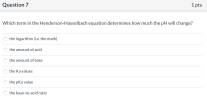 Question 7 1 pts Which term in the Henderson-Hasselbach equation determines how much the pH will change? the logarithm (i.e. the math) the amount of acid the amount of base the Ka values the pka value the base-to-acid ratio Question 8 1 pts What determines the buffer capacity for a buffer? the logarithm (i.e. the math) the amount of acid and base 0 0 öö the Ka or pKa value the base-to-acid ratio
Prepare 2 liter of 0.1 M potassium phosphate buffer, pH = 7.5. Use the Henderson-Hasselbalch equation...
 Prepare 2 liter of 0.1 M potassium phosphate buffer, pH = 7.5. Use the Henderson-Hasselbalch equation to calculate the amounts required of the relevant chemicals. Assume the pKa2 of H3PO4 is 7.2. The buffer can be prepared in any one of several ways. (2) Start with KH2PO4 (solid) and convert a portion of it to K2HPO4 by adding KOH. Ką and pK, for Polyprotic Acids Acid Name Ка pK Phosphoric acid, H3PO4 2.15 1st 2nd 3rd 7.1 x 10⁻³ 6.3...
a 50 mM buffer of monosodium dihydrogen phosphate and disodium monohydrogen phosphate at pH 7. The...
a 50 mM buffer of monosodium dihydrogen phosphate and disodium monohydrogen phosphate at pH 7. The relevant pKa is 6.8. You'll have to figure out the concentrations of all the ionic species before computing the ionic strength. -Solve the problem using the Henderson-Hasselbalch equation to find the concentrations, use the two equations with two unknowns to solve. HPO4 = 0.031M, and H2PO4=0.019M. Then do the ionic strength. It's supposed to be u=0.096M, but I don't understand how this works. I'm...
In our experiment, we will be using a portion of the phosphate buffer system that is...
In our experiment, we will be using a portion of the phosphate buffer system that is based upon the following equilibrium: H2PO4- HPO42- + H+ pKa = 7.2 In this case, H2PO4- will act as the acid and HPO42- will act as the base. Materials: 1M NaOH: 40.01 g/L of solution 1M HCl: 83 mL conc. HCl/L of solution Potassium phosphate, dibasic, K2HPO4, MW= 174.18 Potassium phosphate, monobasic, KH2PO4 MW= 136.09 **I already preformed this lab, but I struggled a...
please show all work 12. Using the Henderson-Hasselbalch equation: [Α] pH = pka + log Calculate...
 please show all work
12. Using the Henderson-Hasselbalch equation: [Α] pH = pka + log Calculate what relative amounts of sodium dihydrogen phosphate and sodium monohydrogen phosphate are required to make a buffer solution with pH = 7.9.
please show all work
12. Using the Henderson-Hasselbalch equation: [Α] pH = pka + log Calculate what relative amounts of sodium dihydrogen phosphate and sodium monohydrogen phosphate are required to make a buffer solution with pH = 7.9.
please show all work 12. Using the Henderson-Hasselbalch equation: [Α] pH = pka + log Calculate...
 please show all work
12. Using the Henderson-Hasselbalch equation: [Α] pH = pka + log Calculate what relative amounts of sodium dihydrogen phosphate and sodium monohydrogen phosphate are required to make a buffer solution with pH = 7.9.
please show all work
12. Using the Henderson-Hasselbalch equation: [Α] pH = pka + log Calculate what relative amounts of sodium dihydrogen phosphate and sodium monohydrogen phosphate are required to make a buffer solution with pH = 7.9.
Phosphate buffer (pH range 5.8 – 8.0). Assume you have prepared two separate stock solutions: Solution...
Phosphate buffer (pH range 5.8 – 8.0). Assume you have prepared two separate stock solutions: Solution A: 0.1M solution of monobasic potassium phosphate (KH2PO4) and Solution B: 0.1M solution of dibasic potassium phosphate (K2HPO4) The equilibrium: H2PO4 - H+ + HPO4 2-; pKa= 6.86 In order to get 200 mL of the desired buffer, you take 50 mL of solution A, add to it some amount of solution B, and then adjust the total volume to 200 mL by adding...
Show how to make: A) 1.000 L of 0.0500 M potassium phosphate buffer (pH=7.00) Both salts...
Show how to make: A) 1.000 L of 0.0500 M potassium phosphate buffer (pH=7.00) Both salts must to be used. The pKa is 7.21. K2HPO4•3H2O = 228.22 g/mol KH2PO4 = 136.086 g/mol B) 50 mL of 1 mg/ml myoglobin in the buffer. Myoglobin = 17 kDa (17,000 g/mol) C) 1.00 L of 6 M guanidinium hydrochloride in the buffer Guanidinium hydrochloride = 95.53 g/mol
1)Which expression is the correct form of the Henderson-Hasselbalch equation? pH = pKa + log([base]/[acid]) pKa...
1)Which expression is the correct form of the Henderson-Hasselbalch equation? pH = pKa + log([base]/[acid]) pKa = pH + log([base]/[acid]) pH = pKa − log([base]/[acid]) pH = pKa + log([acid]/[base]) 2) Use the Henderson-Hasselbalch equation to calculate the pH of a buffer solution prepared by mixing equal volumes of 0.220 M NaHCO3 and 9.00×10⁻² M Na2CO3. (Ka values are given in Appendix C.) Express your answer using three significant figures.
 Question 7 1 pts Which term in the Henderson-Hasselbach equation determines how much the pH will change? the logarithm (i.e. the math) the amount of acid the amount of base the Ka values the pka value the base-to-acid ratio Question 8 1 pts What determines the buffer capacity for a buffer? the logarithm (i.e. the math) the amount of acid and base 0 0 öö the Ka or pKa value the base-to-acid ratio
 Prepare 2 liter of 0.1 M potassium phosphate buffer, pH = 7.5. Use the Henderson-Hasselbalch equation to calculate the amounts required of the relevant chemicals. Assume the pKa2 of H3PO4 is 7.2. The buffer can be prepared in any one of several ways. (2) Start with KH2PO4 (solid) and convert a portion of it to K2HPO4 by adding KOH. Ką and pK, for Polyprotic Acids Acid Name Ка pK Phosphoric acid, H3PO4 2.15 1st 2nd 3rd 7.1 x 10⁻³ 6.3...
 please show all work
12. Using the Henderson-Hasselbalch equation: [Α] pH = pka + log Calculate what relative amounts of sodium dihydrogen phosphate and sodium monohydrogen phosphate are required to make a buffer solution with pH = 7.9.
please show all work
12. Using the Henderson-Hasselbalch equation: [Α] pH = pka + log Calculate what relative amounts of sodium dihydrogen phosphate and sodium monohydrogen phosphate are required to make a buffer solution with pH = 7.9.
 please show all work
12. Using the Henderson-Hasselbalch equation: [Α] pH = pka + log Calculate what relative amounts of sodium dihydrogen phosphate and sodium monohydrogen phosphate are required to make a buffer solution with pH = 7.9.
please show all work
12. Using the Henderson-Hasselbalch equation: [Α] pH = pka + log Calculate what relative amounts of sodium dihydrogen phosphate and sodium monohydrogen phosphate are required to make a buffer solution with pH = 7.9.
Most questions answered within 3 hours.
-
Where is the error in this code sequence?
String s1 = "Hello";
String s2 = "ello";...
asked 11 months ago -
Financial data for Joel de Paris, Inc., for last year
follow:
Joel de Paris, Inc.
Balance...
asked 11 months ago -
Consider this reaction:
Al2(SO4)3 (aq)+ BaCl3
(aq) Al2Cl6 (aq)- +
3BaSO4(s) . What is the...
asked 11 months ago -
Suppose that Savneet is considering increasing her
recent random sample from 20 car rentals to 40...
asked 11 months ago -
Trucks arrive at an unloading terminal at an average rate of 120
per hour.
Trucks arrive...
asked 11 months ago -
Why are methanol and ethanol completely soluble in water while
octanol is not very little soluble....
asked 11 months ago -
A facilities manager at a university reads in a research report
that the mean amount of...
asked 11 months ago -
When the CuSO4 is rehydrated by adding water to the anhydrous
compound, is this an endothermic...
asked 11 months ago -
A ray of sunlight is passing from diamond into crown glass; the
angle of incidence is...
asked 11 months ago -
A block of mass 0.249 kg is placed on top of a light, vertical
spring of...
asked 11 months ago -
how do the kidneys compensate in the presences of acidosis
a) trigger hyperventilate
b) reserve acid...
asked 11 months ago -
Question 501 pts
The rental rate of capital to the firm increases. Which of the
following...
asked 11 months ago