

Homework Answers
1. Stabilization energy
Each compound has a theoritical and an experimental value of heat of hydrogenation.
Here, theoritical value of 1,3-pentadiene can be calculated using the heat of hydrogenation of 1-pentene and trans-2-pentene.
From the table, we have the theoritical value of heat of hydrogenation of 1,3-pentadiene =
-(126+115)kJ/mol. = -241kJ/mol
And , the experimetal value was given is -226 kJ/mol
Hence, the stabilization energy will be =
| difference between theoritical and experimental values| kJ/mol
= 15kJ/mol.(Ans.)
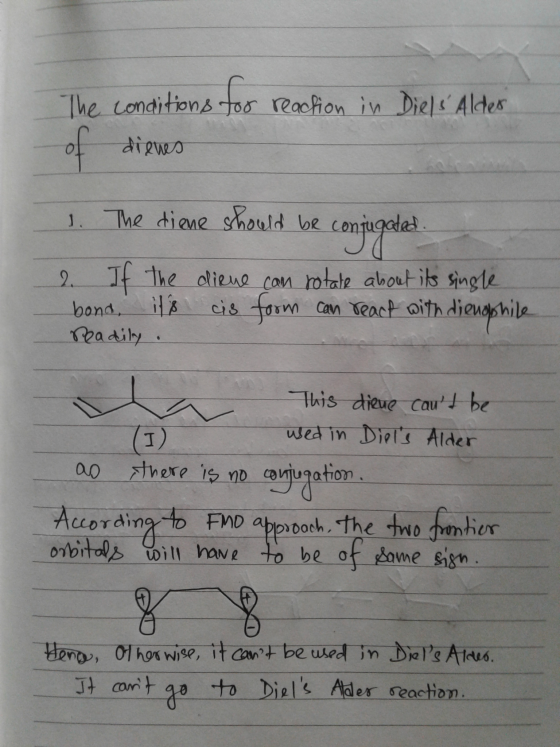
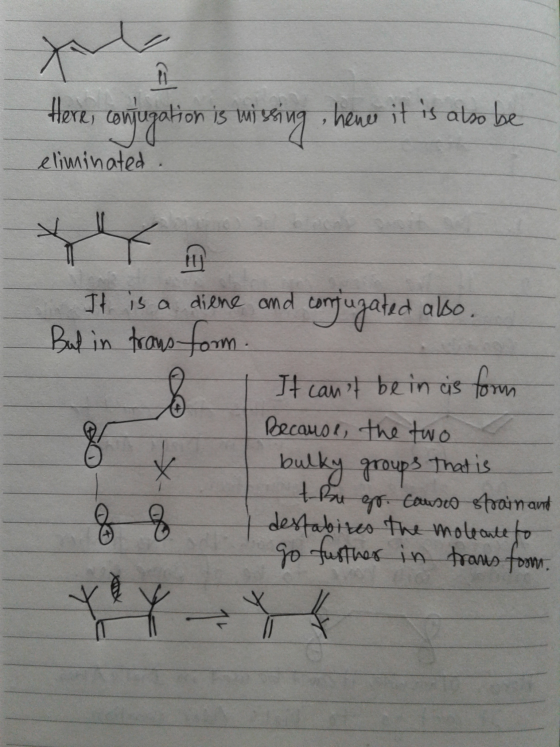
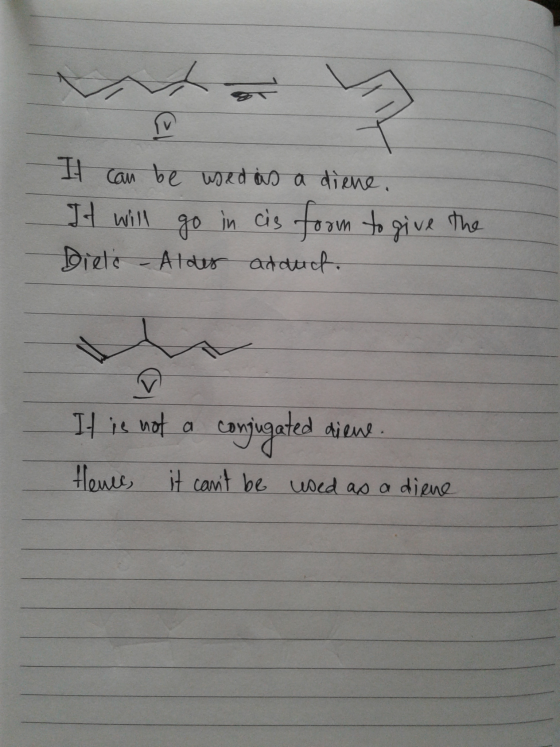
2. The diene of Diels Alder reaction will be
only str. (IV)
Add Answer to:
Estimate the stabilization energy for 1,3-pentadiene using the heats of hydrogenation in Table 1. Table 1....
compound C. H。Br gave a 1H NMR spectrum consisting of a a doublet at 81.7, and...
 compound C. H。Br gave a 1H NMR spectrum consisting of a a doublet at 81.7, and ·1H), (3H) What is a reasonable strueture for the at δ·1 a multiplet at81.8, - CH, CH2 CHBrCH b. CH, CH CB, CH, BE CHj CBr e. None of these 19. Estimate the stabilization energy for 1,3-butadiene using the tollowing heats of hydrogenation: Compound K2 | △H (kJ mol-1) Moles 1-Butene 1-Pentene 1,3-Butadiene 1,3-Pentadiene -127 -126 -239 -226 a. 13 kJ mol- b. 15...
Passage 11 (Questions 1-9) Dienes, a special group of alkenes, can be classified as conjugated or...
 Passage 11 (Questions 1-9) Dienes, a special group of alkenes, can be classified as conjugated or isolated. Conjugated dienes are alkenes with alternating double and single bonds. Isolated dienes have double bonds separated by more than one single bond. One explanation for this observation is the hybridization theory. According to the hybridization theory, the stability of conjugated dienes comes from the hybridization of the orbitals forming the carbon-carbon single bonds. For example, in 1,4-pentadiene, the C-C single bonds result from...
QUESTION 10 Identify the product for the following sigmatropic rearrangement. O A. 0 B. II O...
 QUESTION 10 Identify the product for the following sigmatropic rearrangement. O A. 0 B. II O C.III O D.IV O E. None of the above are correct. QUESTION 9 Predict the product for the following sigmatropic Claisen rearrangement. он OH IV O A. - OB. II O C. III O D. IV O O E. V QUESTION 8 Which diene and dienophile would react to give the following Diels-Alder product? 공동 10H 우 우 이에 그 OAT B. II oooo...
Estimate the ΔH° for the following reaction in kJ at 25°C using the table of bond...
 Estimate the ΔH° for the following reaction in kJ at
25°C using the table of bond energies provided
below:
CH. Estimate the AH° for the following reaction in kJ at 25°C using the table of bond CH energies provided below: CH,-¢-CH, -hy, CH3-C=CH2 Он Just enter a number (no units). This is an elimination reaction converting an alcohol to an alkene. Ignore the water above the reaction arrow. The water is what is being eliminated. Table 9.2 Average Bond Energies...
Estimate the ΔH° for the following reaction in kJ at
25°C using the table of bond energies provided
below:
CH. Estimate the AH° for the following reaction in kJ at 25°C using the table of bond CH energies provided below: CH,-¢-CH, -hy, CH3-C=CH2 Он Just enter a number (no units). This is an elimination reaction converting an alcohol to an alkene. Ignore the water above the reaction arrow. The water is what is being eliminated. Table 9.2 Average Bond Energies...
I need some help to answer these following questions. Thanks. 66. Which molecule is the strongest base? O-CH3 H2N Cl H2 What is the order of increasing reactivity in an SN1 reaction for these compoun...
 I need some help to answer these following questions.
Thanks.
66. Which molecule is the strongest base? O-CH3 H2N Cl H2 What is the order of increasing reactivity in an SN1 reaction for these compounds? 67. Br Br Br I < 11 < 111 (C) 68. What is the starting material for this reaction? NH3, H+ NaBH3CN NH2 он COCI согн Which compound will be protonated to the greatest extent in 1.0 x 10⁻³ mol/L aqueous HC1? 69. NH 2...
I need some help to answer these following questions.
Thanks.
66. Which molecule is the strongest base? O-CH3 H2N Cl H2 What is the order of increasing reactivity in an SN1 reaction for these compounds? 67. Br Br Br I < 11 < 111 (C) 68. What is the starting material for this reaction? NH3, H+ NaBH3CN NH2 он COCI согн Which compound will be protonated to the greatest extent in 1.0 x 10⁻³ mol/L aqueous HC1? 69. NH 2...
Estimate the A Hº for the following reaction in kJ at 25°C using the table of...
 Estimate the A Hº for the following reaction in kJ at 25°C using the table of bond energies provided CH3-CH-CH, SO CH3-C-CH, below: OH 2-propanol 2-propanone Just enter a number (no units). This is an oxidation reaction converting an alcohol to a ketone (specifically nail polish remover). Ignore the compounds above and below the reaction arrow; they are the inorganic reagents needed for this acid-catalyzed reaction to proceed. Table 9.2 Average Bond Energles (kJ/mol) and Bond Lengths (pm) Bond Energy...
Inside a catalytic reactor at 400 K and 1 bar, equilibrium is established for pentane isomerization...
 Inside a catalytic reactor at 400 K and 1 bar, equilibrium is established for pentane isomerization reactions among n-C5, 1-C5, and neo-Cs. To study the equilibrium composition, we can consider the following two reactions. We have also found a source that provides the standard-state Gibbs free energy of formation, AGYI, for the three isomers whose values in kJ/mol at 400 K are listed below. (1) n-C,(9) Hi-C (g) Species AG,400K (kJ/mol) (II) i-C, (g) neo-C (g) n-pentane 40.17 i-pentane 34.31...
A mixture of gases has the composition given in Table 1. It has a total mass...
A mixture of gases has the composition given in Table 1. It has a total mass of 3.46 kg, and has an initial volume and temperature of 1.273 m3 and 300 K respectively. The mixture undergoes polytropic compression to a final volume of 0.5 m3. The polytropic index for this process is known to be 1.2. Table 1: Volumetric analysis of a mixture of gases Constituent Gas Chemical Symbol Volumetric Analysis ViV Molar Mass m˜i [kg/kmol] Specific Heat Capacity at...
T(N)=352 please I need the answer urgent Question 1 The following gas phase reaction produces ethanol...
 T(N)=352 please I need the answer urgent
Question 1 The following gas phase reaction produces ethanol (C2H5OH) by catalytic hydrogenation of acetaldehyde (CH3CHO). The reaction reaches equilibrium at a temperature of T= T(N) and a pressure of 3 bar: CH,CHO(g) + H, (g) C,H,OH (8) The reactive system initially contains 1.5 moles of Hydrogen (Ha) for each mole of acetaldehyde (CH3CHO). The mixture is assumed to be an ideal gas. T(N) is the temperature corresponding to the student number as...
T(N)=352 please I need the answer urgent
Question 1 The following gas phase reaction produces ethanol (C2H5OH) by catalytic hydrogenation of acetaldehyde (CH3CHO). The reaction reaches equilibrium at a temperature of T= T(N) and a pressure of 3 bar: CH,CHO(g) + H, (g) C,H,OH (8) The reactive system initially contains 1.5 moles of Hydrogen (Ha) for each mole of acetaldehyde (CH3CHO). The mixture is assumed to be an ideal gas. T(N) is the temperature corresponding to the student number as...
 compound C. H。Br gave a 1H NMR spectrum consisting of a a doublet at 81.7, and ·1H), (3H) What is a reasonable strueture for the at δ·1 a multiplet at81.8, - CH, CH2 CHBrCH b. CH, CH CB, CH, BE CHj CBr e. None of these 19. Estimate the stabilization energy for 1,3-butadiene using the tollowing heats of hydrogenation: Compound K2 | △H (kJ mol-1) Moles 1-Butene 1-Pentene 1,3-Butadiene 1,3-Pentadiene -127 -126 -239 -226 a. 13 kJ mol- b. 15...
 Passage 11 (Questions 1-9) Dienes, a special group of alkenes, can be classified as conjugated or isolated. Conjugated dienes are alkenes with alternating double and single bonds. Isolated dienes have double bonds separated by more than one single bond. One explanation for this observation is the hybridization theory. According to the hybridization theory, the stability of conjugated dienes comes from the hybridization of the orbitals forming the carbon-carbon single bonds. For example, in 1,4-pentadiene, the C-C single bonds result from...
 QUESTION 10 Identify the product for the following sigmatropic rearrangement. O A. 0 B. II O C.III O D.IV O E. None of the above are correct. QUESTION 9 Predict the product for the following sigmatropic Claisen rearrangement. он OH IV O A. - OB. II O C. III O D. IV O O E. V QUESTION 8 Which diene and dienophile would react to give the following Diels-Alder product? 공동 10H 우 우 이에 그 OAT B. II oooo...
 Estimate the ΔH° for the following reaction in kJ at
25°C using the table of bond energies provided
below:
CH. Estimate the AH° for the following reaction in kJ at 25°C using the table of bond CH energies provided below: CH,-¢-CH, -hy, CH3-C=CH2 Он Just enter a number (no units). This is an elimination reaction converting an alcohol to an alkene. Ignore the water above the reaction arrow. The water is what is being eliminated. Table 9.2 Average Bond Energies...
Estimate the ΔH° for the following reaction in kJ at
25°C using the table of bond energies provided
below:
CH. Estimate the AH° for the following reaction in kJ at 25°C using the table of bond CH energies provided below: CH,-¢-CH, -hy, CH3-C=CH2 Он Just enter a number (no units). This is an elimination reaction converting an alcohol to an alkene. Ignore the water above the reaction arrow. The water is what is being eliminated. Table 9.2 Average Bond Energies...
 I need some help to answer these following questions.
Thanks.
66. Which molecule is the strongest base? O-CH3 H2N Cl H2 What is the order of increasing reactivity in an SN1 reaction for these compounds? 67. Br Br Br I < 11 < 111 (C) 68. What is the starting material for this reaction? NH3, H+ NaBH3CN NH2 он COCI согн Which compound will be protonated to the greatest extent in 1.0 x 10⁻³ mol/L aqueous HC1? 69. NH 2...
I need some help to answer these following questions.
Thanks.
66. Which molecule is the strongest base? O-CH3 H2N Cl H2 What is the order of increasing reactivity in an SN1 reaction for these compounds? 67. Br Br Br I < 11 < 111 (C) 68. What is the starting material for this reaction? NH3, H+ NaBH3CN NH2 он COCI согн Which compound will be protonated to the greatest extent in 1.0 x 10⁻³ mol/L aqueous HC1? 69. NH 2...
 Estimate the A Hº for the following reaction in kJ at 25°C using the table of bond energies provided CH3-CH-CH, SO CH3-C-CH, below: OH 2-propanol 2-propanone Just enter a number (no units). This is an oxidation reaction converting an alcohol to a ketone (specifically nail polish remover). Ignore the compounds above and below the reaction arrow; they are the inorganic reagents needed for this acid-catalyzed reaction to proceed. Table 9.2 Average Bond Energles (kJ/mol) and Bond Lengths (pm) Bond Energy...
 Inside a catalytic reactor at 400 K and 1 bar, equilibrium is established for pentane isomerization reactions among n-C5, 1-C5, and neo-Cs. To study the equilibrium composition, we can consider the following two reactions. We have also found a source that provides the standard-state Gibbs free energy of formation, AGYI, for the three isomers whose values in kJ/mol at 400 K are listed below. (1) n-C,(9) Hi-C (g) Species AG,400K (kJ/mol) (II) i-C, (g) neo-C (g) n-pentane 40.17 i-pentane 34.31...
 T(N)=352 please I need the answer urgent
Question 1 The following gas phase reaction produces ethanol (C2H5OH) by catalytic hydrogenation of acetaldehyde (CH3CHO). The reaction reaches equilibrium at a temperature of T= T(N) and a pressure of 3 bar: CH,CHO(g) + H, (g) C,H,OH (8) The reactive system initially contains 1.5 moles of Hydrogen (Ha) for each mole of acetaldehyde (CH3CHO). The mixture is assumed to be an ideal gas. T(N) is the temperature corresponding to the student number as...
T(N)=352 please I need the answer urgent
Question 1 The following gas phase reaction produces ethanol (C2H5OH) by catalytic hydrogenation of acetaldehyde (CH3CHO). The reaction reaches equilibrium at a temperature of T= T(N) and a pressure of 3 bar: CH,CHO(g) + H, (g) C,H,OH (8) The reactive system initially contains 1.5 moles of Hydrogen (Ha) for each mole of acetaldehyde (CH3CHO). The mixture is assumed to be an ideal gas. T(N) is the temperature corresponding to the student number as...
Most questions answered within 3 hours.
-
Where is the error in this code sequence?
String s1 = "Hello";
String s2 = "ello";...
asked 10 months ago -
Financial data for Joel de Paris, Inc., for last year
follow:
Joel de Paris, Inc.
Balance...
asked 10 months ago -
Consider this reaction:
Al2(SO4)3 (aq)+ BaCl3
(aq) Al2Cl6 (aq)- +
3BaSO4(s) . What is the...
asked 10 months ago -
Suppose that Savneet is considering increasing her
recent random sample from 20 car rentals to 40...
asked 10 months ago -
Trucks arrive at an unloading terminal at an average rate of 120
per hour.
Trucks arrive...
asked 10 months ago -
Why are methanol and ethanol completely soluble in water while
octanol is not very little soluble....
asked 10 months ago -
A facilities manager at a university reads in a research report
that the mean amount of...
asked 10 months ago -
When the CuSO4 is rehydrated by adding water to the anhydrous
compound, is this an endothermic...
asked 10 months ago -
A ray of sunlight is passing from diamond into crown glass; the
angle of incidence is...
asked 10 months ago -
A block of mass 0.249 kg is placed on top of a light, vertical
spring of...
asked 10 months ago -
how do the kidneys compensate in the presences of acidosis
a) trigger hyperventilate
b) reserve acid...
asked 10 months ago -
Question 501 pts
The rental rate of capital to the firm increases. Which of the
following...
asked 10 months ago