The pulley shown (Figure 1) has a moment of inertia IA = 0.625 kg⋅m2 , a radius r = 0.250 m , and a mass of 20.0 kg. A cylinder is attached to a cord that is wrapped around the pulley. Neglecting bearing friction and the cord’s mass, express the pulley’s final angular velocity in terms of the magnitude of the cord’s tension, T (measured in N), 4.00 s after the system is released from rest. Use the principle of angular impulse and momentum.

Homework Answers
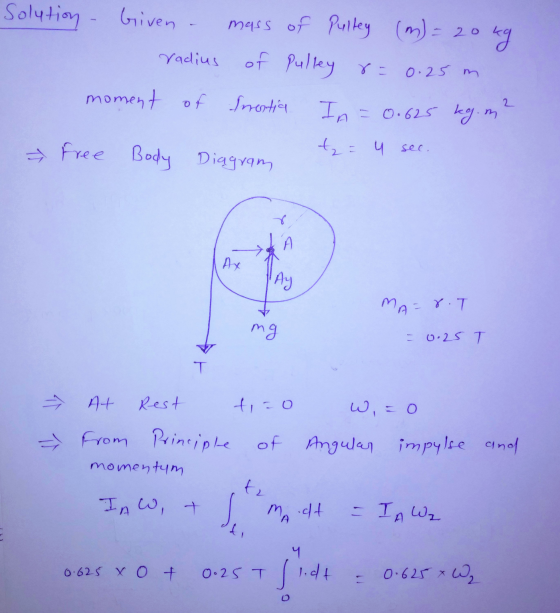
![0.62 ХО б. 625 0, (озят) 4] « (ч-о) о: 2г Тх о: 42 0, О-2 xчx T L, - 662 у Со, - 1. 6 Т. Ang](http://img.homeworklib.com/questions/64a887d0-8c37-11ec-af22-3f69ec684dc9.png?x-oss-process=image/resize,w_560)
Add Answer to:
The pulley shown (Figure 1) has a moment of inertia IA = 0.625
kg⋅m2 , a...
037 CH 19.2 1 of 4> Principle of Impulse and Momentum Constants Part A - Angular velocity of the pulley Learning Goal The pulley shown (Figure 1) has a moment of inertia IA 0.900 kg m2, a radius r...
 037 CH 19.2 1 of 4> Principle of Impulse and Momentum Constants Part A - Angular velocity of the pulley Learning Goal The pulley shown (Figure 1) has a moment of inertia IA 0.900 kg m2, a radius r 0.300 m, and a mass of 20.0 kg A cylinder is attached to a cord that is wrapped around the pulley. Neglecting bearing friction and the cord's mass express the pulley's final angular velocity in terms of the magnitude of the...
Principle of Impulse and Momentum 307 > Part A - Angular velocity of the pulley Learning...
 Principle of Impulse and Momentum 307 > Part A - Angular velocity of the pulley Learning Goal: To be able to solve problems involving force, moment, velocity and time by applying the principle of impulse and momenturn to rigid bodies The principle of impulse and momentum states that the sum of all impulses created by the external forces and moments that act on a rigid body during a time interval is equal to the change in the linear and angular...
3. The 0.5 kg pulley with moment of inertia lo 6.25 x 10 kg m2 is...
 3. The 0.5 kg pulley with moment of inertia lo 6.25 x 10 kg m2 is released from rest at time t -0. There is no slipping of the cord, which is wrapped over the pulley. Neglect the weight of the cord and find: a. ?, the angular acceleration of the pulley b. T~ T, the tensions on each side of the pulley c·?, the angular velocity at t-3 [s] 250 1P Toog
A 1-kg block hanging from a cord wrapped around a cylinder pulley. The moment of inertia...
A 1-kg block hanging from a cord wrapped around a cylinder pulley. The moment of inertia of pulley is 1 kg m2 and the radius of pulley is 0.2 m. What is the angular acceleration of the pulley and the free fall acceleration of the block? PLEASE SHOW ALL WORK. CORRECT ANSWER IS 5 rad/s/s & 1 m/s/s
Each of the double pulleys shown has a centroidal mass moment of inertia of 0.25 kg-m2....
 Each of the double pulleys shown has a centroidal mass moment of inertia of 0.25 kg-m2. an inner radius of 100 mm, and an outer radius of 150 mm. The mass m - 12.1 kg and the bearing friction is neglected Required information Determine the tension in the cord connecting the pulleys. (Round the final answer to two decimal places.) The tension in the cord connecting the pulleys is N.
Each of the double pulleys shown has a centroidal mass moment of inertia of 0.25 kg...
 Each of the double pulleys shown has a centroidal mass moment of inertia of 0.25 kg m?, an inner radius of 100 mm, and an outer radius of 150 mm. The mass 14.9 kg and the bearing friction is neglected bo Required into 00 Determine the velocity of the cylinder 3 s after the system is released from rest (Round the final answer to two decimal places) (You must provide an answer before moving to the next part) The velocity...
3) A 10dm diameter pulley of moment of inertia 8.00x10 kg m2 has weights attached by...
3) A 10dm diameter pulley of moment of inertia 8.00x10 kg m2 has weights attached by strings to it on either side and one exerts a force of-10.0 N k on it at a position -8 cm i and the other exerts a force of -20.0 N k on it at a position +8 cm i. The pulley was initially at rest and these torques and no others act on it for 200 milliseconds. What is the angular velocity of...
1. The pulley has a radius of 2.70 m and a moment of inertia of 39.0...
1. The pulley has a radius of 2.70 m and a moment of inertia of 39.0 kg·m2. The hanging mass is 4.20 kg and it exerts a force tangent to the edge of the pulley. What is the angular acceleration of the pulley? (answer needed in rad/s^2 2. A string is wound tight around the spindle of a top, and then pulled to spin the top. While it is pulled, the string exerts a constant torque of 0.150 N·m on...
A 2.20 kg mass is attached to a light cord that is wrapped around a pulley...
A 2.20 kg mass is attached to a light cord that is wrapped around a pulley of radius 4.35 cm, which turns with negligible friction. The mass falls at a constant acceleration of 2.05 m/s2. Find the moment of inertia of the pulley.
A 1.60 kg mass is attached to a light cord that is wrapped around a pulley...
A 1.60 kg mass is attached to a light cord that is wrapped around a pulley of radius 4.75 cm, which turns with negligble friction. The mass falls at a constant acceleration of 3.40 m/s^2. Find the moment of inertia of the pulley.
 037 CH 19.2 1 of 4> Principle of Impulse and Momentum Constants Part A - Angular velocity of the pulley Learning Goal The pulley shown (Figure 1) has a moment of inertia IA 0.900 kg m2, a radius r 0.300 m, and a mass of 20.0 kg A cylinder is attached to a cord that is wrapped around the pulley. Neglecting bearing friction and the cord's mass express the pulley's final angular velocity in terms of the magnitude of the...
 Principle of Impulse and Momentum 307 > Part A - Angular velocity of the pulley Learning Goal: To be able to solve problems involving force, moment, velocity and time by applying the principle of impulse and momenturn to rigid bodies The principle of impulse and momentum states that the sum of all impulses created by the external forces and moments that act on a rigid body during a time interval is equal to the change in the linear and angular...
 3. The 0.5 kg pulley with moment of inertia lo 6.25 x 10 kg m2 is released from rest at time t -0. There is no slipping of the cord, which is wrapped over the pulley. Neglect the weight of the cord and find: a. ?, the angular acceleration of the pulley b. T~ T, the tensions on each side of the pulley c·?, the angular velocity at t-3 [s] 250 1P Toog
 Each of the double pulleys shown has a centroidal mass moment of inertia of 0.25 kg-m2. an inner radius of 100 mm, and an outer radius of 150 mm. The mass m - 12.1 kg and the bearing friction is neglected Required information Determine the tension in the cord connecting the pulleys. (Round the final answer to two decimal places.) The tension in the cord connecting the pulleys is N.
 Each of the double pulleys shown has a centroidal mass moment of inertia of 0.25 kg m?, an inner radius of 100 mm, and an outer radius of 150 mm. The mass 14.9 kg and the bearing friction is neglected bo Required into 00 Determine the velocity of the cylinder 3 s after the system is released from rest (Round the final answer to two decimal places) (You must provide an answer before moving to the next part) The velocity...
Most questions answered within 3 hours.
-
Where is the error in this code sequence?
String s1 = "Hello";
String s2 = "ello";...
asked 11 months ago -
Financial data for Joel de Paris, Inc., for last year
follow:
Joel de Paris, Inc.
Balance...
asked 11 months ago -
Consider this reaction:
Al2(SO4)3 (aq)+ BaCl3
(aq) Al2Cl6 (aq)- +
3BaSO4(s) . What is the...
asked 11 months ago -
Suppose that Savneet is considering increasing her
recent random sample from 20 car rentals to 40...
asked 11 months ago -
Trucks arrive at an unloading terminal at an average rate of 120
per hour.
Trucks arrive...
asked 11 months ago -
Why are methanol and ethanol completely soluble in water while
octanol is not very little soluble....
asked 11 months ago -
A facilities manager at a university reads in a research report
that the mean amount of...
asked 11 months ago -
When the CuSO4 is rehydrated by adding water to the anhydrous
compound, is this an endothermic...
asked 11 months ago -
A ray of sunlight is passing from diamond into crown glass; the
angle of incidence is...
asked 11 months ago -
A block of mass 0.249 kg is placed on top of a light, vertical
spring of...
asked 11 months ago -
how do the kidneys compensate in the presences of acidosis
a) trigger hyperventilate
b) reserve acid...
asked 11 months ago -
Question 501 pts
The rental rate of capital to the firm increases. Which of the
following...
asked 11 months ago