Lipoamide is a coenzyme prosthetic group for several enzymes,
including the pyruvate dehydrogenase complex. In the pyruvate
dehydrogenase reaction the prosthetic group cycles through three
distinct structural forms: the oxidized form, the reduced form, and
the reduced form with an acetyl group bound. Modify the three
partial structures below to represent these three structural forms.
R–NH represents a lysine amino residue of the dihydrolipoyl
transacetylase subunit of pyruvate dehydrogenase, to which the
lipoamide is attached.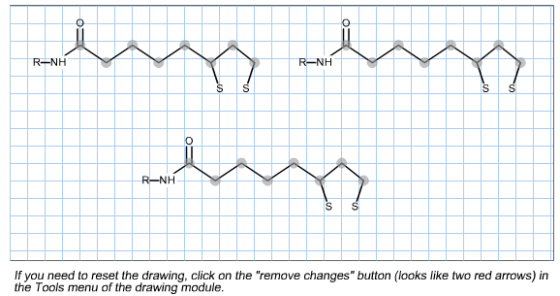
Homework Answers

Add Answer to:
Lipoamide is a coenzyme prosthetic group for several enzymes,
including the pyruvate dehydrogenase complex. In the...
A) Acetyl coA is made from pyruvate in the [ Select ] ["mitochondrial matrix", "cytoplasm", "",...
A) Acetyl coA is made from pyruvate in the [ Select ] ["mitochondrial matrix", "cytoplasm", "", ""] by [ Select ] ["pyruvate dehydrogenase", "succinate dehydrogenase"] complex. In this process, the acetyl group is moved between enzymes within the complex by the [ Select ] ["lipoamide", "TPP"] . The [ Select ] ["dihydrolipoyl transacetylase", "pyruvate dehydrogenase component"] is the enzyme in which acetyl coA is actually formed. The [ Select ] ["FADH2", "lipoamide"] in the dihydrolipoyl dehydrogenase donates two electrons to...
15. Genetic defect in pyruvate dehydrogenase complex lead a. maple syrup urine disease b. phenyike d....
 15. Genetic defect in pyruvate dehydrogenase complex lead a. maple syrup urine disease b. phenyike d. lactic acidemia e. pellagra syrup urine disease b, phenylketonuria c. galactosemia 10. Chemical modification by phosphorylation of pyruvate dehydros a. deactivates the enzyme b. activates the enzyme lation of pyruvate dehydrogenase complex : 17. Pyruvate carboxylase is positively ated through the allosteric mechanism by : a. ATP b. NADH c. Acetyl-SCOA d. TPP e. Biotin 18. Which of the listed coenzymes does not particip...
Please complete for Tuesday, we will go through the questions and mark them in class. pg 156 - 4.23,...
 Please complete for Tuesday, we will go through the questions and mark them in class. pg 156 - 4.23, 4.24, 4.26 pg 170 - 4.29, 4.31, pg 171-4.36 pg 175 - 4.59 pg 176- 4.74, 4.75, 4.80 pg 177-4.81, 4.82 pg 188- 5.1, 5.4, 5.5, 5.6, 5.11 - Using Table 5.1 pg 198-5.22, 5.25 pg 203 - 5.29 pg 206 - 5.37 pg 209 - 5.39 pg 2.14 5.61 pg 235-6.11, 6.14, 6.16 156 CHAPTER 4 Introduction to Organic Compounds...
 15. Genetic defect in pyruvate dehydrogenase complex lead a. maple syrup urine disease b. phenyike d. lactic acidemia e. pellagra syrup urine disease b, phenylketonuria c. galactosemia 10. Chemical modification by phosphorylation of pyruvate dehydros a. deactivates the enzyme b. activates the enzyme lation of pyruvate dehydrogenase complex : 17. Pyruvate carboxylase is positively ated through the allosteric mechanism by : a. ATP b. NADH c. Acetyl-SCOA d. TPP e. Biotin 18. Which of the listed coenzymes does not particip...
 Please complete for Tuesday, we will go through the questions and mark them in class. pg 156 - 4.23, 4.24, 4.26 pg 170 - 4.29, 4.31, pg 171-4.36 pg 175 - 4.59 pg 176- 4.74, 4.75, 4.80 pg 177-4.81, 4.82 pg 188- 5.1, 5.4, 5.5, 5.6, 5.11 - Using Table 5.1 pg 198-5.22, 5.25 pg 203 - 5.29 pg 206 - 5.37 pg 209 - 5.39 pg 2.14 5.61 pg 235-6.11, 6.14, 6.16 156 CHAPTER 4 Introduction to Organic Compounds...
Most questions answered within 3 hours.
-
Where is the error in this code sequence?
String s1 = "Hello";
String s2 = "ello";...
asked 10 months ago -
Financial data for Joel de Paris, Inc., for last year
follow:
Joel de Paris, Inc.
Balance...
asked 10 months ago -
Consider this reaction:
Al2(SO4)3 (aq)+ BaCl3
(aq) Al2Cl6 (aq)- +
3BaSO4(s) . What is the...
asked 10 months ago -
Suppose that Savneet is considering increasing her
recent random sample from 20 car rentals to 40...
asked 10 months ago -
Trucks arrive at an unloading terminal at an average rate of 120
per hour.
Trucks arrive...
asked 10 months ago -
Why are methanol and ethanol completely soluble in water while
octanol is not very little soluble....
asked 10 months ago -
A facilities manager at a university reads in a research report
that the mean amount of...
asked 10 months ago -
When the CuSO4 is rehydrated by adding water to the anhydrous
compound, is this an endothermic...
asked 10 months ago -
A ray of sunlight is passing from diamond into crown glass; the
angle of incidence is...
asked 10 months ago -
A block of mass 0.249 kg is placed on top of a light, vertical
spring of...
asked 10 months ago -
how do the kidneys compensate in the presences of acidosis
a) trigger hyperventilate
b) reserve acid...
asked 10 months ago -
Question 501 pts
The rental rate of capital to the firm increases. Which of the
following...
asked 10 months ago