Urine is concentrated a) in the ureters. b) by active secretion in the loop of Henle....
Urine is concentrated a) in the ureters. b) by active secretion in the loop of Henle. c) by facilitated diffu sion in the collecting ducts. d) by reabsorption in the proximal tubule.
Homework Answers
Urine is concentrated byc) facilitated diffusion in the collecting ducts.
The collecting duct concentrates it by water reabsorption through facilitated diffusion when ADH is present.The permeability of the collecting ducts for water leads to a concentration of the urine up to the fivefold osmolarity of the plasma.The permeability of the collecting ducts is regulated with ADH.
Add Answer to:
Urine is concentrated a) in the ureters. b) by active secretion
in the loop of Henle....
1. Which of these statements about the renal pyramids is false? a. They are located in...
 1. Which of these statements about the renal pyramids is false? a. They are located in the medulla. b. They contain glomeruli. c. They contain collecting ducts. d. They empty urine into the calyces. 2. Aldosterone stimulates sodium reabsorption and potassium secretion in a. the proximal convoluted tubule. b. the descending limb of the loop. c. the ascending limb of the loop. d. the cortical collecting duct. 3. About 65% of the glomerular ultrafiltrate is reabsorbed in a. the proximal...
answer all pls Urine exits the kidneys through the: Bladder Urethra Ureters Collecting ducts Filtration of...
 answer all pls
Urine exits the kidneys through the: Bladder Urethra Ureters Collecting ducts Filtration of blood in the kidney nephron begins in the: Loop of Henle Proximal convoluted tubule Bowman's Capsule Distal convoluted tubule Most aquatic animals secrete nitrogenous wastes in the form of ____, but land animals convert this into other Chemicals that are less toxic. Urea Uric acid Ammonia Proteins When fats are digested: their breakdown products are absorbed into the bloodstream from the vill of the...
answer all pls
Urine exits the kidneys through the: Bladder Urethra Ureters Collecting ducts Filtration of blood in the kidney nephron begins in the: Loop of Henle Proximal convoluted tubule Bowman's Capsule Distal convoluted tubule Most aquatic animals secrete nitrogenous wastes in the form of ____, but land animals convert this into other Chemicals that are less toxic. Urea Uric acid Ammonia Proteins When fats are digested: their breakdown products are absorbed into the bloodstream from the vill of the...
If somehow loop of Henle were removed - that is if the proximal tubule was connected...
If somehow loop of Henle were removed - that is if the proximal tubule was connected to the distal tubule, would the kidney be able to produce concentrated urine? Explain
In the proximal tubule, active reabsorption and secretion occur. Which of the following solutes are fructose...
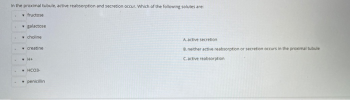 In the proximal tubule, active reabsorption and secretion occur. Which of the following solutes are fructose galactose choline A active secretion + creatine B. neither active reabsorption or secretion occurs in the proximal tubule + H+ C.active reabsorption HCO3- - penicillin
How can urine contain a higher concentration of waste than the blood Answers pls Bio 102...
 How can urine contain a higher concentration of waste
than the blood
Answers pls
Bio 102
A How can urine contain a higher concentration of win the verton) than the the A Urine mot since the process is elve diffusion B Reabsorption of water in the loop of the nephron and collecting ducts leaves behind a more concentrated urine. C. All stages in the kidney involve active transport . Une can be hypertonic for small moleculesidit is v on for...
How can urine contain a higher concentration of waste
than the blood
Answers pls
Bio 102
A How can urine contain a higher concentration of win the verton) than the the A Urine mot since the process is elve diffusion B Reabsorption of water in the loop of the nephron and collecting ducts leaves behind a more concentrated urine. C. All stages in the kidney involve active transport . Une can be hypertonic for small moleculesidit is v on for...
QUESTION 18 Which structure passes urine to the renal pelvis? a. Proximal tubule b. Glomerulus c....
 QUESTION 18 Which structure passes urine to the renal pelvis? a. Proximal tubule b. Glomerulus c. Bowman's capsule d. Loop of Henle e. Collecting ducts QUESTION 19 Which of the following structures in the nephron contains transport epithelium that is impermeable to water? a. The proximal tubule b. The distal tubule c. The collecting duct d. The ascending loop of Henle Oe. The descending loop of Henle QUESTION 20 Processing of filtrate in the proximal and distal tubules accomplishes what...
Slide19 Ascending loop of Henle..... Bowman's capsule Collecting duct Descending loop of Henle. Glomerulus Proximal convoluted...
 Slide19 Ascending loop of Henle..... Bowman's capsule Collecting duct Descending loop of Henle. Glomerulus Proximal convoluted tubule Procedure D THE PICTURE AND Question, WHERE DO THEY BELONG, AN EXAMPLE IF GLOMER ulus BELONG TO A OR C, THAT HIS WHAT THE QUESTION IS ABOUT
The process where solutes in the peritubular capillaries are actively transported into the loop of Henle...
 The process where solutes in the peritubular capillaries are actively transported into the loop of Henle and the distal convoluted tubule (DCT) is called: A. Excretion B. Filtration C. Reabsorption D. Secretion E. Diffusion
The process where solutes in the peritubular capillaries are actively transported into the loop of Henle...
 The process where solutes in the peritubular capillaries are actively transported into the loop of Henle and the distal convoluted tubule (DCT) is called: A. Excretion B. Filtration C. Reabsorption D. Secretion E. Diffusion
To increase thirst 48) Angiotensin II increases blood pressure by A) causing the hypothalamus B) ...
 to increase thirst 48) Angiotensin II increases blood pressure by A) causing the hypothalamus B) stimulating the adrenal cortex to secrete aldosterone C) stimulating the release of ADH D) all of these E) none of these which increases sodium absorption 49) When the kidney does not perform its filtration function, the person will develop A) septicemia B) bulimia C) uremia D) toxemia E) none of these 50) The major calyces feed into A) the minor calyces B) the pyramids C)...
 1. Which of these statements about the renal pyramids is false? a. They are located in the medulla. b. They contain glomeruli. c. They contain collecting ducts. d. They empty urine into the calyces. 2. Aldosterone stimulates sodium reabsorption and potassium secretion in a. the proximal convoluted tubule. b. the descending limb of the loop. c. the ascending limb of the loop. d. the cortical collecting duct. 3. About 65% of the glomerular ultrafiltrate is reabsorbed in a. the proximal...
 answer all pls
Urine exits the kidneys through the: Bladder Urethra Ureters Collecting ducts Filtration of blood in the kidney nephron begins in the: Loop of Henle Proximal convoluted tubule Bowman's Capsule Distal convoluted tubule Most aquatic animals secrete nitrogenous wastes in the form of ____, but land animals convert this into other Chemicals that are less toxic. Urea Uric acid Ammonia Proteins When fats are digested: their breakdown products are absorbed into the bloodstream from the vill of the...
answer all pls
Urine exits the kidneys through the: Bladder Urethra Ureters Collecting ducts Filtration of blood in the kidney nephron begins in the: Loop of Henle Proximal convoluted tubule Bowman's Capsule Distal convoluted tubule Most aquatic animals secrete nitrogenous wastes in the form of ____, but land animals convert this into other Chemicals that are less toxic. Urea Uric acid Ammonia Proteins When fats are digested: their breakdown products are absorbed into the bloodstream from the vill of the...
 In the proximal tubule, active reabsorption and secretion occur. Which of the following solutes are fructose galactose choline A active secretion + creatine B. neither active reabsorption or secretion occurs in the proximal tubule + H+ C.active reabsorption HCO3- - penicillin
 How can urine contain a higher concentration of waste
than the blood
Answers pls
Bio 102
A How can urine contain a higher concentration of win the verton) than the the A Urine mot since the process is elve diffusion B Reabsorption of water in the loop of the nephron and collecting ducts leaves behind a more concentrated urine. C. All stages in the kidney involve active transport . Une can be hypertonic for small moleculesidit is v on for...
How can urine contain a higher concentration of waste
than the blood
Answers pls
Bio 102
A How can urine contain a higher concentration of win the verton) than the the A Urine mot since the process is elve diffusion B Reabsorption of water in the loop of the nephron and collecting ducts leaves behind a more concentrated urine. C. All stages in the kidney involve active transport . Une can be hypertonic for small moleculesidit is v on for...
 QUESTION 18 Which structure passes urine to the renal pelvis? a. Proximal tubule b. Glomerulus c. Bowman's capsule d. Loop of Henle e. Collecting ducts QUESTION 19 Which of the following structures in the nephron contains transport epithelium that is impermeable to water? a. The proximal tubule b. The distal tubule c. The collecting duct d. The ascending loop of Henle Oe. The descending loop of Henle QUESTION 20 Processing of filtrate in the proximal and distal tubules accomplishes what...
 Slide19 Ascending loop of Henle..... Bowman's capsule Collecting duct Descending loop of Henle. Glomerulus Proximal convoluted tubule Procedure D THE PICTURE AND Question, WHERE DO THEY BELONG, AN EXAMPLE IF GLOMER ulus BELONG TO A OR C, THAT HIS WHAT THE QUESTION IS ABOUT
 The process where solutes in the peritubular capillaries are actively transported into the loop of Henle and the distal convoluted tubule (DCT) is called: A. Excretion B. Filtration C. Reabsorption D. Secretion E. Diffusion
 The process where solutes in the peritubular capillaries are actively transported into the loop of Henle and the distal convoluted tubule (DCT) is called: A. Excretion B. Filtration C. Reabsorption D. Secretion E. Diffusion
 to increase thirst 48) Angiotensin II increases blood pressure by A) causing the hypothalamus B) stimulating the adrenal cortex to secrete aldosterone C) stimulating the release of ADH D) all of these E) none of these which increases sodium absorption 49) When the kidney does not perform its filtration function, the person will develop A) septicemia B) bulimia C) uremia D) toxemia E) none of these 50) The major calyces feed into A) the minor calyces B) the pyramids C)...
Most questions answered within 3 hours.
-
Where is the error in this code sequence?
String s1 = "Hello";
String s2 = "ello";...
asked 10 months ago -
Financial data for Joel de Paris, Inc., for last year
follow:
Joel de Paris, Inc.
Balance...
asked 10 months ago -
Consider this reaction:
Al2(SO4)3 (aq)+ BaCl3
(aq) Al2Cl6 (aq)- +
3BaSO4(s) . What is the...
asked 10 months ago -
Suppose that Savneet is considering increasing her
recent random sample from 20 car rentals to 40...
asked 10 months ago -
Trucks arrive at an unloading terminal at an average rate of 120
per hour.
Trucks arrive...
asked 10 months ago -
Why are methanol and ethanol completely soluble in water while
octanol is not very little soluble....
asked 10 months ago -
A facilities manager at a university reads in a research report
that the mean amount of...
asked 10 months ago -
When the CuSO4 is rehydrated by adding water to the anhydrous
compound, is this an endothermic...
asked 10 months ago -
A ray of sunlight is passing from diamond into crown glass; the
angle of incidence is...
asked 10 months ago -
A block of mass 0.249 kg is placed on top of a light, vertical
spring of...
asked 10 months ago -
how do the kidneys compensate in the presences of acidosis
a) trigger hyperventilate
b) reserve acid...
asked 10 months ago -
Question 501 pts
The rental rate of capital to the firm increases. Which of the
following...
asked 10 months ago