
Homework Answers
Add Answer to:
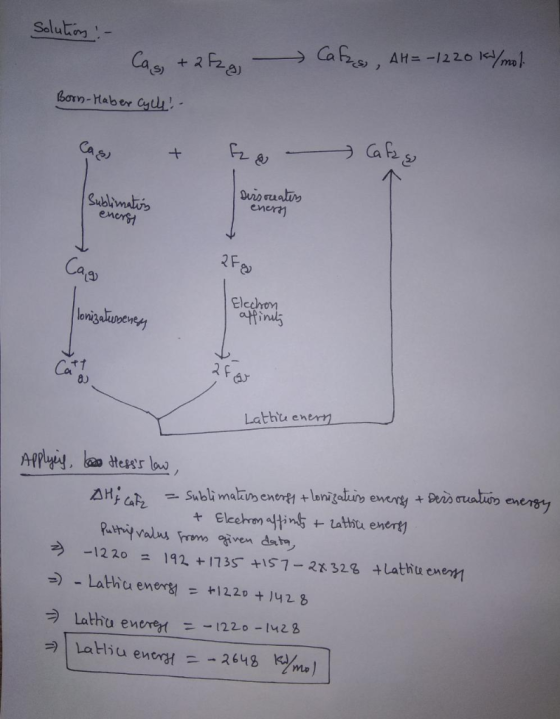
4) Calculate the lattice enthalpy for calcium fluoride using the Born-Haber cycle method, using the provided...
Calculate the enthalpies of formation, ΔHfo, of the following group 1 fluoride compounds from their elements...
 Calculate the enthalpies of formation, ΔHfo, of the following
group 1 fluoride compounds from their elements using the Born–Haber
cycle.
NaF RbF Number Number kJ ol kJ mol AHO, kJ/mol Sublimation of Na(s) 108 86 Sublimation of Rb(s) 158 Dissociation of F2(g Ionization energy of Na(g) 496 ionization energy of Rb(g) 403 Electron affinity of F(g) -322 Lattice enthalpy of NaF(s) 926 Lattice enthalpy of RbF(s) 789
Calculate the enthalpies of formation, ΔHfo, of the following
group 1 fluoride compounds from their elements using the Born–Haber
cycle.
NaF RbF Number Number kJ ol kJ mol AHO, kJ/mol Sublimation of Na(s) 108 86 Sublimation of Rb(s) 158 Dissociation of F2(g Ionization energy of Na(g) 496 ionization energy of Rb(g) 403 Electron affinity of F(g) -322 Lattice enthalpy of NaF(s) 926 Lattice enthalpy of RbF(s) 789
Using the Born Haber cycle in the previous question, and the following energies, calculate the standard...
 Using the Born Haber cycle in the previous question, and the following energies, calculate the standard energy of formation for Srl2 Enthalpy of sublimation of Sr(s) = 164 kJ/mol 1st ionization energy of Sr(g) = 549 kJ/mol 2nd ionization energy of Sr(g) - 1064 kJ/mol Enthalpy of sublimation of 12(s) = 62 kJ/mol Bond dissociation energy of 12(g) - 153 kJ/mol 1st electron affinity of l(g) = -295 kJ/mol Lattice energy of Srlz(s) = -1960 kJ/mol *Note: Do not include...
Using the thermodynamic quantities shown below: construct a Born-Haber cycle for the following reaction: Li(s) +...
 Using the thermodynamic quantities shown below: construct a
Born-Haber cycle for the following reaction: Li(s) + 1/2
F2(g)
LiF(s); calculate the lattice energy of LiF.
Vaporization of Li(s): +159
F2 bond enthalpy: +155
Li ionization energy: +520
F- electron affinity: +328
LiF(s) heat of formation: -616
Using the thermodynamic quantities shown below: construct a
Born-Haber cycle for the following reaction: Li(s) + 1/2
F2(g)
LiF(s); calculate the lattice energy of LiF.
Vaporization of Li(s): +159
F2 bond enthalpy: +155
Li ionization energy: +520
F- electron affinity: +328
LiF(s) heat of formation: -616
1)a. Using the Born Haber cycle, determine the enthalpy for lattice formation of MgO. Mg (s),...
1)a. Using the Born Haber cycle, determine the enthalpy for lattice formation of MgO. Mg (s), ΔHsub = +148 kJ/mol bond dissociation energy for O2 = +499 kJ/mol 1st ionization energy for Mg = +738 kJ/mol 1st electron affinity for O = –141 kJ/mol 2nd ionization energy for Mg = +1450 kJ/mol 2nd electron affinity for O = +844 kJ/mol MgO(s), enthalpy of formation = –602 kJ/mol 1)b. Calculate the lattice formation energy of MgO using the Madelung constant....
Given the following information, construct a Born-Haber cycle to calculate the lattice energy of CaC2(s): Net...
Given the following information, construct a Born-Haber cycle to calculate the lattice energy of CaC2(s): Net energy change for the formation of CaC2(s)=−60kJ/mol Heat of sublimation for Ca(s)=+178kJ/mol Ei1 for Ca(g)=+590kJ/mol Ei2 for Ca(g)=+1145kJ/mol Heat of sublimation for C(s)=+717kJ/mol Bond dissociation energy for C2(g)=+614kJ/mol Eea1 for C2(g)=−315kJ/mol Eea2 for C2(g)=+410kJ/mol Express your answer using four sig figs
Find the experimental lattice energy of Magnesium Chloride (MgCl2) using a Born-Haber cycle. Draw the Born-Haber...
Find the experimental lattice energy of Magnesium Chloride (MgCl2) using a Born-Haber cycle. Draw the Born-Haber cycle and indicate the involved steps of the cycle. Label the cycle carefully. Some information that might be useful. Electron affinity of Cl:EA1 = -348.6kJ/mol, EA2 = +750kJ/mol. Heat of sublimation for Magnesium = 147.7 kJ/mol, Bond Dissociation Energy of Cl2 = 242 kJ/mol, Lattice energy due to electrostatic interactions in MgCl2 = -2524 kJ/mol. Ionization energy of Mg: Ei2 = 1451 kJ/mol.
Knowing the enthalpy of formation of calcium fluoride is -1228 KJ / mol, the enthalpy of...
Knowing the enthalpy of formation of calcium fluoride is -1228 KJ / mol, the enthalpy of the sublimation of calcium is 168kj/mole, the bond enthalpy of fluorine is 155kj/mole, the electron affinity of fluorine is -328 kj/mole, the first ionization enthalpy of calcium is 590kj/mole and the second ionization enthaply is 1145kj/mole, calculate the lattice enthalpy of calcium fluoride.
Structure with an (8,4) coordination unit cell (0) Given the b. Calcium fluorite (CaF2) has a...
 Structure with an (8,4) coordination unit cell (0) Given the b. Calcium fluorite (CaF2) has a fluorite structure with an (8,4) coordina Given the following data, use Born-Haber cycle to calculate the lattice enthalpy of CaF2 AH KJ/mol +178 +1228 Sublimation of Ca(s) Decomposition of CaF2(s) Dissociation of F2(g) lonisation of Ca(s) lonisation of Ca (8) Electron gain of F(b) +79 +590 +1145 -328 Given the following data d* = 0.345x10⁻¹¹m, K=1.20 MJÅ. mol-, e = 1.602x10⁻¹⁹ C, N =...
Draw the Born-Haber Cycle with these values and calculate lattice energy. Problem 1: Label each reaction...
 Draw the Born-Haber Cycle with these values and calculate
lattice energy.
Problem 1: Label each reaction listed below for the Born-Haber cycle in the formation of Cao lattice and calculate the lattice energy of Cal given the following information. AH KD) Ca(s) + Ca(8) 193 Calg) - Cat (8) + e 590 Cat (8) - Cat (8) + e- 2 O(g) + O2(g) O(8) + e- O (8) -141 O (8) + e- O (8) 878 Ca(s) + O2(g) →...
Draw the Born-Haber Cycle with these values and calculate
lattice energy.
Problem 1: Label each reaction listed below for the Born-Haber cycle in the formation of Cao lattice and calculate the lattice energy of Cal given the following information. AH KD) Ca(s) + Ca(8) 193 Calg) - Cat (8) + e 590 Cat (8) - Cat (8) + e- 2 O(g) + O2(g) O(8) + e- O (8) -141 O (8) + e- O (8) 878 Ca(s) + O2(g) →...
7. Use the Born Haber cycle and the given information to determine the net energy change...
 7. Use the Born Haber cycle and the given information to determine the net energy change (in kJ/mol) that takes place in the formation of KF(s) from the elements: Ks) + F2@KFS) Heat of sublimation of K = 89.2 kJ/mol Bond dissociation energy for F2 = 158 kJ/mol Lattice Energy of KF = 821 kJ/mol Eca for F = -328 kJ/mol E; for K = 418.8 kJ/mol
 Calculate the enthalpies of formation, ΔHfo, of the following
group 1 fluoride compounds from their elements using the Born–Haber
cycle.
NaF RbF Number Number kJ ol kJ mol AHO, kJ/mol Sublimation of Na(s) 108 86 Sublimation of Rb(s) 158 Dissociation of F2(g Ionization energy of Na(g) 496 ionization energy of Rb(g) 403 Electron affinity of F(g) -322 Lattice enthalpy of NaF(s) 926 Lattice enthalpy of RbF(s) 789
Calculate the enthalpies of formation, ΔHfo, of the following
group 1 fluoride compounds from their elements using the Born–Haber
cycle.
NaF RbF Number Number kJ ol kJ mol AHO, kJ/mol Sublimation of Na(s) 108 86 Sublimation of Rb(s) 158 Dissociation of F2(g Ionization energy of Na(g) 496 ionization energy of Rb(g) 403 Electron affinity of F(g) -322 Lattice enthalpy of NaF(s) 926 Lattice enthalpy of RbF(s) 789
 Using the Born Haber cycle in the previous question, and the following energies, calculate the standard energy of formation for Srl2 Enthalpy of sublimation of Sr(s) = 164 kJ/mol 1st ionization energy of Sr(g) = 549 kJ/mol 2nd ionization energy of Sr(g) - 1064 kJ/mol Enthalpy of sublimation of 12(s) = 62 kJ/mol Bond dissociation energy of 12(g) - 153 kJ/mol 1st electron affinity of l(g) = -295 kJ/mol Lattice energy of Srlz(s) = -1960 kJ/mol *Note: Do not include...
 Using the thermodynamic quantities shown below: construct a
Born-Haber cycle for the following reaction: Li(s) + 1/2
F2(g)
LiF(s); calculate the lattice energy of LiF.
Vaporization of Li(s): +159
F2 bond enthalpy: +155
Li ionization energy: +520
F- electron affinity: +328
LiF(s) heat of formation: -616
Using the thermodynamic quantities shown below: construct a
Born-Haber cycle for the following reaction: Li(s) + 1/2
F2(g)
LiF(s); calculate the lattice energy of LiF.
Vaporization of Li(s): +159
F2 bond enthalpy: +155
Li ionization energy: +520
F- electron affinity: +328
LiF(s) heat of formation: -616
 Structure with an (8,4) coordination unit cell (0) Given the b. Calcium fluorite (CaF2) has a fluorite structure with an (8,4) coordina Given the following data, use Born-Haber cycle to calculate the lattice enthalpy of CaF2 AH KJ/mol +178 +1228 Sublimation of Ca(s) Decomposition of CaF2(s) Dissociation of F2(g) lonisation of Ca(s) lonisation of Ca (8) Electron gain of F(b) +79 +590 +1145 -328 Given the following data d* = 0.345x10⁻¹¹m, K=1.20 MJÅ. mol-, e = 1.602x10⁻¹⁹ C, N =...
 Draw the Born-Haber Cycle with these values and calculate
lattice energy.
Problem 1: Label each reaction listed below for the Born-Haber cycle in the formation of Cao lattice and calculate the lattice energy of Cal given the following information. AH KD) Ca(s) + Ca(8) 193 Calg) - Cat (8) + e 590 Cat (8) - Cat (8) + e- 2 O(g) + O2(g) O(8) + e- O (8) -141 O (8) + e- O (8) 878 Ca(s) + O2(g) →...
Draw the Born-Haber Cycle with these values and calculate
lattice energy.
Problem 1: Label each reaction listed below for the Born-Haber cycle in the formation of Cao lattice and calculate the lattice energy of Cal given the following information. AH KD) Ca(s) + Ca(8) 193 Calg) - Cat (8) + e 590 Cat (8) - Cat (8) + e- 2 O(g) + O2(g) O(8) + e- O (8) -141 O (8) + e- O (8) 878 Ca(s) + O2(g) →...
 7. Use the Born Haber cycle and the given information to determine the net energy change (in kJ/mol) that takes place in the formation of KF(s) from the elements: Ks) + F2@KFS) Heat of sublimation of K = 89.2 kJ/mol Bond dissociation energy for F2 = 158 kJ/mol Lattice Energy of KF = 821 kJ/mol Eca for F = -328 kJ/mol E; for K = 418.8 kJ/mol
Most questions answered within 3 hours.
-
Where is the error in this code sequence?
String s1 = "Hello";
String s2 = "ello";...
asked 10 months ago -
Financial data for Joel de Paris, Inc., for last year
follow:
Joel de Paris, Inc.
Balance...
asked 10 months ago -
Consider this reaction:
Al2(SO4)3 (aq)+ BaCl3
(aq) Al2Cl6 (aq)- +
3BaSO4(s) . What is the...
asked 10 months ago -
Suppose that Savneet is considering increasing her
recent random sample from 20 car rentals to 40...
asked 10 months ago -
Trucks arrive at an unloading terminal at an average rate of 120
per hour.
Trucks arrive...
asked 10 months ago -
Why are methanol and ethanol completely soluble in water while
octanol is not very little soluble....
asked 10 months ago -
A facilities manager at a university reads in a research report
that the mean amount of...
asked 10 months ago -
When the CuSO4 is rehydrated by adding water to the anhydrous
compound, is this an endothermic...
asked 10 months ago -
A ray of sunlight is passing from diamond into crown glass; the
angle of incidence is...
asked 10 months ago -
A block of mass 0.249 kg is placed on top of a light, vertical
spring of...
asked 10 months ago -
how do the kidneys compensate in the presences of acidosis
a) trigger hyperventilate
b) reserve acid...
asked 10 months ago -
Question 501 pts
The rental rate of capital to the firm increases. Which of the
following...
asked 10 months ago