The assembly consists of two blocks A and B which have a mass of 15 kg...
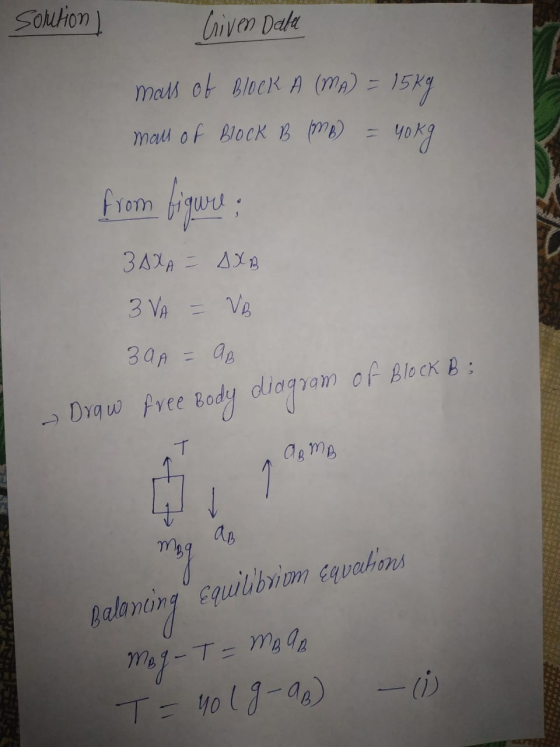
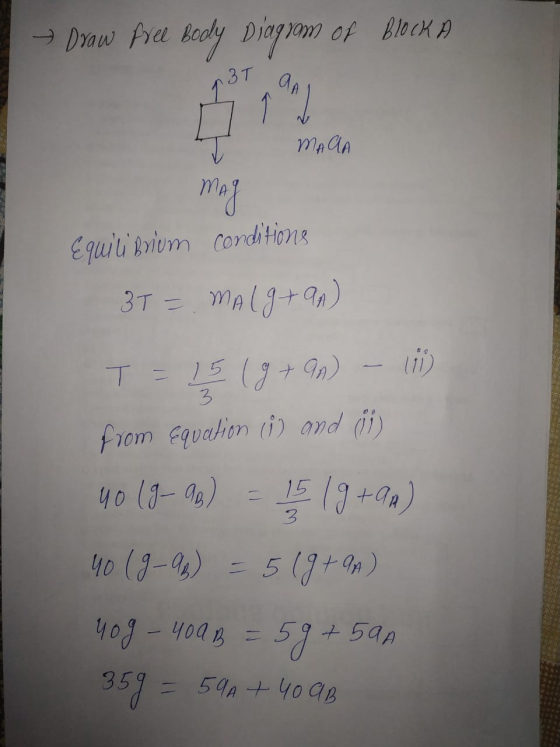
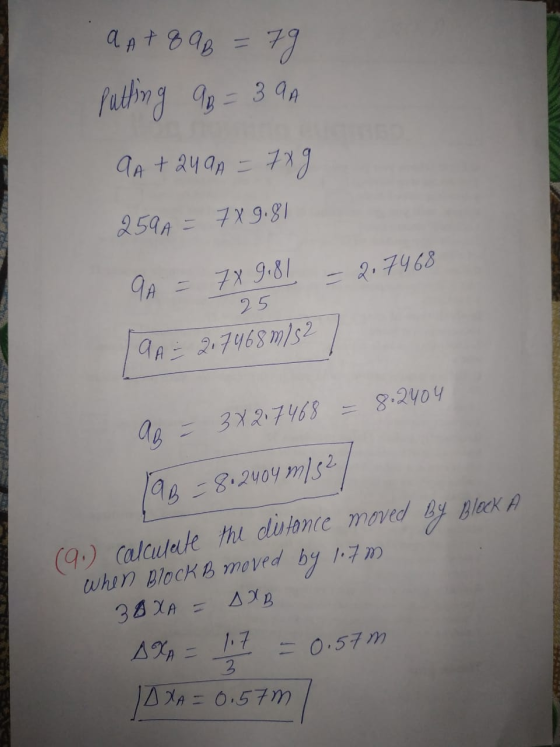
The assembly consists of two blocks A and B which have a mass of 15 kg and 40 kg , respectively. The blocks are released from rest. Neglect the mass of the pulleys and cords. (Figure 1)
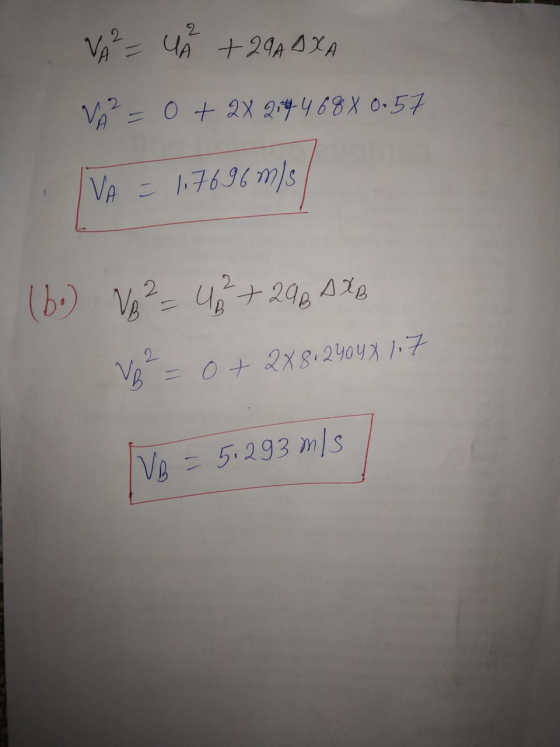
a) Determine the speed of block A when B descends 1.7 m .
b) Determine the speed of block B when it descends 1.7 m .
Homework Answers
Please Thumb's Up..........////////
Add Answer to:
The assembly consists of two blocks A and B
which have a mass of 15 kg...
Determine the speed of block A when B descends 1.4 m. The assembly consists of two...
 Determine the speed of block A when B descends 1.4 m. The assembly consists of two blocks A and B which have a mass of 25 kg and 30 kg, respectively. The blocks are released from rest. Neglect the mass of the pulleys and cords. (Figure 1) Express your answer to three significant figures and include the appropriate units. UA= 1.76 Pexios Ane Resauest Anawe Submit Incorrect; Try Again; 3 attempts remaining Part B Determine the speed of block B...
3. [15 points) The double pulley consists of two wheels which are attached to one another...
 3. [15 points) The double pulley consists of two wheels which are attached to one another and turn at the same rate. The radii of the inner andouter pulleys are 0.1 m and 0.3 m respectively as shown. The pulley has a mass of 30 kg and a radius of gyration of ko = 0.2 m. The block A has a mass of 10 kg. A force F is applied to the rope wrapped around the inner hub of the...
2. Two blocks of mass mA 40 kg and m-35 kg are initially at rest. Neglecting...
 2. Two blocks of mass mA 40 kg and m-35 kg are initially at rest. Neglecting the masses of the pulleys and the effeet of friction in the pulleys, and given coefficients of friction between block A and the horizontal surface are As -0.25 and 0.15 determine, a) whether or not the blocks will move b) if motion is impending, find the acceleration of each block c) the tension in the cable
Q4) Determine the required mass of block A so that when it is released from rest...
 Q4) Determine the required mass of block A so that when it is released from rest it moves the 5-kg block B 0.75 m up along the inclined plane, where the coefficient of friction is 0.15, in 2 second. Neglect the mass of the pulleys and cords. 60°
Two identical blocks are released from rest. Neglecting the mass of the pulleys and knowing that...
 Two identical blocks are released from rest. Neglecting the mass of the pulleys and knowing that the coefficient of friction is 0.20, determine by the principle of work and energy:
(a) The speed of Block B after having descended 1 m, in the direction of the inclined plane.
(b) The tension in cable B.
(c) The acceleration of block B.
2 kg 2 kg | 72° 68
2 kg 2 kg | 72° 68
Two identical blocks are released from rest. Neglecting the mass of the pulleys and knowing that the coefficient of friction is 0.20, determine by the principle of work and energy:
(a) The speed of Block B after having descended 1 m, in the direction of the inclined plane.
(b) The tension in cable B.
(c) The acceleration of block B.
2 kg 2 kg | 72° 68
2 kg 2 kg | 72° 68
Question 3. Two blocks having mass m (2 kg) and m, (5 kg) are connected by...
 Question 3. Two blocks having mass m (2 kg) and m, (5 kg) are connected by a string passing over a pulley as shown in the figure. The pulley (in cylindrical disc shape) has a radius R (0.4 m) and mass (0.5 kg). The string does not slip on the pulley and the system is released from rest. Find the translational speeds of the blocks after mass 2 descends through a distance h (1.0 m) and find the angular speed...
Blocks A (mass 2kg), B(mass 5 kg), and C (mass 15 kg) are connected by two...
 Blocks A (mass 2kg), B(mass 5 kg), and C (mass 15 kg) are connected by two cables as shown. The system is released from rest. First show that the blocks will move (hint: right at the limit of static equilibrium, A is about to move up, B to the right, and C'down), then find the acceleration of the blocks and the tensions in the cables. The coefficient of static and kinetic friction between block B and the surface are both...
Two blocks, A and B (with mass 60 kg and 115 kg, respectively), are connected by...
 Two blocks, A and B (with mass 60 kg and 115 kg, respectively), are connected by a string, as shown in the figure below. The pulley is frictionless and of negligible mass. The coefficient of kinetic friction between block A and the incline is ur = 0.27. Determine the change in the kinetic energy of block A as it moves from © to D, a distance of 24 m up the incline (and block B drops downward a distance of...
PROBLEM: Blocks A and B shown in Fig. 14–14a have a mass of 10 kg and...
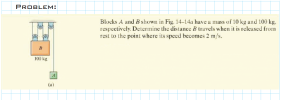 PROBLEM: Blocks A and B shown in Fig. 14–14a have a mass of 10 kg and 100 kg, respectively. Determine the distance B travels when it is released from rest to the point where its speed becomes 2 m/s. a B 100 kg А For this problem, only determine the dependent motion equations for the blocks. Express how the position, velocity, acceleration of each is related to the other, dependent on the other p,v,a of the other.
Review The two blocks A and B have weights WA = 68 lb and WB =...
 Review The two blocks A and B have weights WA = 68 lb and WB = 10 lb (Figure 1) Part A If the kinetic coefficient of friction between the incline and block A is He = 0.2, determine the speed of A after it moves 3 ft down the plane starting from rest. Neglect the mass of the cord and pulleys. Express your answer to three significant figures and include the appropriate units. Figure < 1 of 1 >...
 Determine the speed of block A when B descends 1.4 m. The assembly consists of two blocks A and B which have a mass of 25 kg and 30 kg, respectively. The blocks are released from rest. Neglect the mass of the pulleys and cords. (Figure 1) Express your answer to three significant figures and include the appropriate units. UA= 1.76 Pexios Ane Resauest Anawe Submit Incorrect; Try Again; 3 attempts remaining Part B Determine the speed of block B...
 3. [15 points) The double pulley consists of two wheels which are attached to one another and turn at the same rate. The radii of the inner andouter pulleys are 0.1 m and 0.3 m respectively as shown. The pulley has a mass of 30 kg and a radius of gyration of ko = 0.2 m. The block A has a mass of 10 kg. A force F is applied to the rope wrapped around the inner hub of the...
 2. Two blocks of mass mA 40 kg and m-35 kg are initially at rest. Neglecting the masses of the pulleys and the effeet of friction in the pulleys, and given coefficients of friction between block A and the horizontal surface are As -0.25 and 0.15 determine, a) whether or not the blocks will move b) if motion is impending, find the acceleration of each block c) the tension in the cable
 Q4) Determine the required mass of block A so that when it is released from rest it moves the 5-kg block B 0.75 m up along the inclined plane, where the coefficient of friction is 0.15, in 2 second. Neglect the mass of the pulleys and cords. 60°
 Two identical blocks are released from rest. Neglecting the mass of the pulleys and knowing that the coefficient of friction is 0.20, determine by the principle of work and energy:
(a) The speed of Block B after having descended 1 m, in the direction of the inclined plane.
(b) The tension in cable B.
(c) The acceleration of block B.
2 kg 2 kg | 72° 68
2 kg 2 kg | 72° 68
Two identical blocks are released from rest. Neglecting the mass of the pulleys and knowing that the coefficient of friction is 0.20, determine by the principle of work and energy:
(a) The speed of Block B after having descended 1 m, in the direction of the inclined plane.
(b) The tension in cable B.
(c) The acceleration of block B.
2 kg 2 kg | 72° 68
2 kg 2 kg | 72° 68
 Question 3. Two blocks having mass m (2 kg) and m, (5 kg) are connected by a string passing over a pulley as shown in the figure. The pulley (in cylindrical disc shape) has a radius R (0.4 m) and mass (0.5 kg). The string does not slip on the pulley and the system is released from rest. Find the translational speeds of the blocks after mass 2 descends through a distance h (1.0 m) and find the angular speed...
 Blocks A (mass 2kg), B(mass 5 kg), and C (mass 15 kg) are connected by two cables as shown. The system is released from rest. First show that the blocks will move (hint: right at the limit of static equilibrium, A is about to move up, B to the right, and C'down), then find the acceleration of the blocks and the tensions in the cables. The coefficient of static and kinetic friction between block B and the surface are both...
 Two blocks, A and B (with mass 60 kg and 115 kg, respectively), are connected by a string, as shown in the figure below. The pulley is frictionless and of negligible mass. The coefficient of kinetic friction between block A and the incline is ur = 0.27. Determine the change in the kinetic energy of block A as it moves from © to D, a distance of 24 m up the incline (and block B drops downward a distance of...
 PROBLEM: Blocks A and B shown in Fig. 14–14a have a mass of 10 kg and 100 kg, respectively. Determine the distance B travels when it is released from rest to the point where its speed becomes 2 m/s. a B 100 kg А For this problem, only determine the dependent motion equations for the blocks. Express how the position, velocity, acceleration of each is related to the other, dependent on the other p,v,a of the other.
 Review The two blocks A and B have weights WA = 68 lb and WB = 10 lb (Figure 1) Part A If the kinetic coefficient of friction between the incline and block A is He = 0.2, determine the speed of A after it moves 3 ft down the plane starting from rest. Neglect the mass of the cord and pulleys. Express your answer to three significant figures and include the appropriate units. Figure < 1 of 1 >...
Most questions answered within 3 hours.
-
Where is the error in this code sequence?
String s1 = "Hello";
String s2 = "ello";...
asked 10 months ago -
Financial data for Joel de Paris, Inc., for last year
follow:
Joel de Paris, Inc.
Balance...
asked 10 months ago -
Consider this reaction:
Al2(SO4)3 (aq)+ BaCl3
(aq) Al2Cl6 (aq)- +
3BaSO4(s) . What is the...
asked 10 months ago -
Suppose that Savneet is considering increasing her
recent random sample from 20 car rentals to 40...
asked 10 months ago -
Trucks arrive at an unloading terminal at an average rate of 120
per hour.
Trucks arrive...
asked 10 months ago -
Why are methanol and ethanol completely soluble in water while
octanol is not very little soluble....
asked 10 months ago -
A facilities manager at a university reads in a research report
that the mean amount of...
asked 10 months ago -
When the CuSO4 is rehydrated by adding water to the anhydrous
compound, is this an endothermic...
asked 10 months ago -
A ray of sunlight is passing from diamond into crown glass; the
angle of incidence is...
asked 10 months ago -
A block of mass 0.249 kg is placed on top of a light, vertical
spring of...
asked 10 months ago -
how do the kidneys compensate in the presences of acidosis
a) trigger hyperventilate
b) reserve acid...
asked 10 months ago -
Question 501 pts
The rental rate of capital to the firm increases. Which of the
following...
asked 10 months ago