
Homework Answers
Add Answer to:
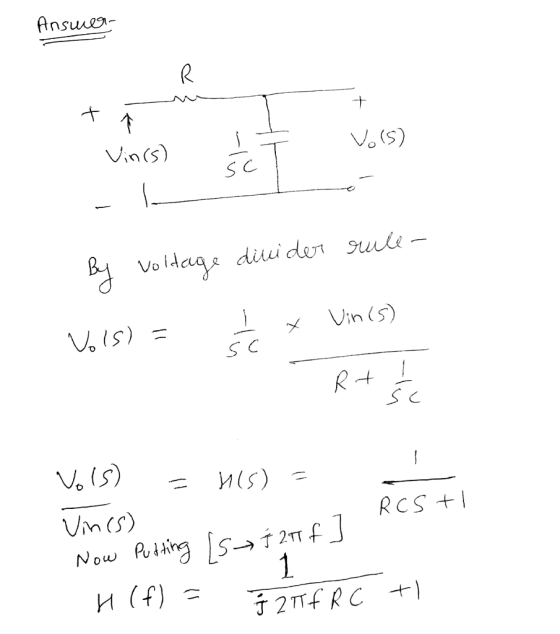
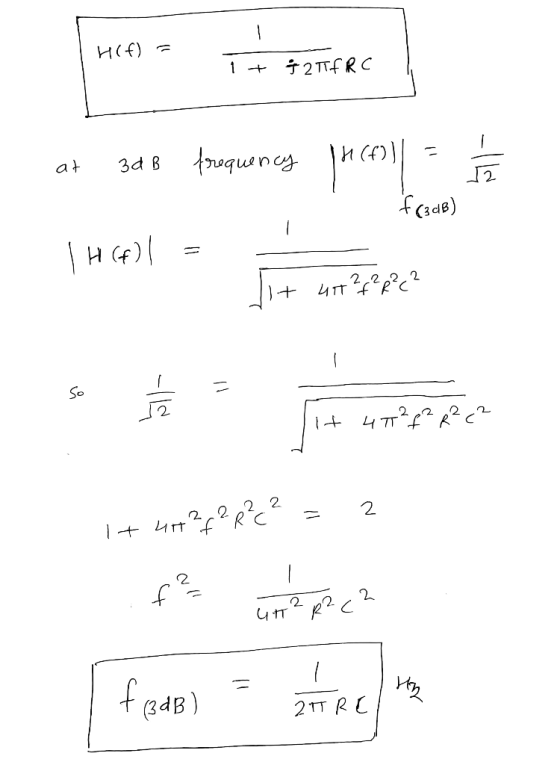
(15 pts) A channel is represented by the circuit below. Find the transfer function H(f) and...
Find the transfer function H(jω) for the circuit above as a function of jω. (Leave R...
 Find the transfer function H(jω) for the
circuit above as a function of jω. (Leave R and L as variables).
Assume V R to be the output and V S to be the input.
С L RVR(t) vs (t) A. Find the transfer function H(jo) for the circuit above as a function of jaw. (Leave R and L as variables). Assume V to be the output and V to be the input. S R B. Find the Magnitude and Phase...
Find the transfer function H(jω) for the
circuit above as a function of jω. (Leave R and L as variables).
Assume V R to be the output and V S to be the input.
С L RVR(t) vs (t) A. Find the transfer function H(jo) for the circuit above as a function of jaw. (Leave R and L as variables). Assume V to be the output and V to be the input. S R B. Find the Magnitude and Phase...
Pre-Laboratory Task 4: Derive an expression for the magnitude of the transfer function, H(Go)Vout(jo)/Wn(j, and the phase of the transfer function LH (ja) for the LCR circuit in Figure 4. Plot H(ja)l...
 Pre-Laboratory Task 4: Derive an expression for the magnitude of the transfer function, H(Go)Vout(jo)/Wn(j, and the phase of the transfer function LH (ja) for the LCR circuit in Figure 4. Plot H(ja)l and H(jo) vs. frequency (o) in the form of a Bode plot indicating the damping frequency and the value of |H(jo)| at the damping frequency. Also determine the 3dB frequency and the roll off rate for Ir(ja)1 when ω > ω3dB. Vounlius R 470Ω C 100 nF Figure...
Identify the transfer function 10/; of the RL circuit shown below. Express the transfer function using...
 Identify the transfer function 10/; of the RL circuit shown below. Express the transfer function using Wo= RIL. i(t) R ele L O H (@) II = WO j + 1 O H(@) = 1+ Wo O H (0) jo 1+ W0 1 O H(0) = 00 1+.
Identify the transfer function 10/; of the RL circuit shown below. Express the transfer function using...
 Identify the transfer function 10/; of the RL circuit shown below. Express the transfer function using Wo= RIL. i(t) R ele L O H (@) II = WO j + 1 O H(@) = 1+ Wo O H (0) jo 1+ W0 1 O H(0) = 00 1+.
Question # 1 : Find the transfer function represented by: ??(?) ?? + 5 ?(?) =...
 Question # 1
: Find the transfer function represented by:
??(?) ?? + 5 ?(?) = 2 ?(?)
Then, find the response, c(t) to an input, r(t) = u(t) a unit
step, assuming zero initial conditions. Draw the block diagram and
write the transfer function inside it, and show the i/p and o/p
signals on the block diagram.
Question #1: Find the transfer function represented by: dc(t) + 5 c(t) = 2 r(t) dt Then, find the response, c(t) to...
Question # 1
: Find the transfer function represented by:
??(?) ?? + 5 ?(?) = 2 ?(?)
Then, find the response, c(t) to an input, r(t) = u(t) a unit
step, assuming zero initial conditions. Draw the block diagram and
write the transfer function inside it, and show the i/p and o/p
signals on the block diagram.
Question #1: Find the transfer function represented by: dc(t) + 5 c(t) = 2 r(t) dt Then, find the response, c(t) to...
The time-variant transfer function of a WSSUS channel is given by: (a) Does the channel exhibit f...
 The time-variant transfer function of a WSSUS channel is given by: (a) Does the channel exhibit frequency-selective fading or flat fading? Explain. (b) Derive the channel impulse response h(r,t). (c) Given the transmitted signal is s(), derive the received signal r) in the absence of background noise.
The time-variant transfer function of a WSSUS channel is given by: (a) Does the channel exhibit frequency-selective fading or flat fading? Explain. (b) Derive the channel impulse response h(r,t). (c) Given the transmitted...
The time-variant transfer function of a WSSUS channel is given by: (a) Does the channel exhibit frequency-selective fading or flat fading? Explain. (b) Derive the channel impulse response h(r,t). (c) Given the transmitted signal is s(), derive the received signal r) in the absence of background noise.
The time-variant transfer function of a WSSUS channel is given by: (a) Does the channel exhibit frequency-selective fading or flat fading? Explain. (b) Derive the channel impulse response h(r,t). (c) Given the transmitted...
Find the transfer function T(jw) for the circuit below. Also find the magnitude response, 0 OP000...
 Find the transfer function T(jw) for the circuit below. Also find the magnitude response, 0 OP000 + + C R 1 phase response and draw the bode plots for the above circuit and derived transfer function. (10 points)
27. (a) The circuit below has transfer function H(s)--out . It is known that L =0.5...
 27. (a) The circuit below has transfer function H(s)--out . It is known that L =0.5 H ist andRI = 4 Ω and R2=2Q. (i) Compute the transfer function. (ii) Compute the COMPLETE range of for which the circuit is BIBO stable. R2 out C : 0.25 F. Compute H(s)-out ) Determ ne the complete range of m for which Vin(s) (b) Let R= 2 Ω the circuit is BIBO stable in out mvtt) out
Problem 4 (50 pts): Consider the electrical circuit represented in figure, with R = 102, C...
 Problem 4 (50 pts): Consider the electrical circuit represented in figure, with R = 102, C = 1 F and L=1 H. Assume V (t) as input and i(t) as output E ER V.(t) a) (5 pts) Determine the differential equation of the system b) (5 pts) Find the transfer function of the system c) (20 pts) Write the symbolic expressions of magnitude and phase of the transfer function d) (20 pts) Determine the expression of steady-state response of the...
 Find the transfer function H(jω) for the
circuit above as a function of jω. (Leave R and L as variables).
Assume V R to be the output and V S to be the input.
С L RVR(t) vs (t) A. Find the transfer function H(jo) for the circuit above as a function of jaw. (Leave R and L as variables). Assume V to be the output and V to be the input. S R B. Find the Magnitude and Phase...
Find the transfer function H(jω) for the
circuit above as a function of jω. (Leave R and L as variables).
Assume V R to be the output and V S to be the input.
С L RVR(t) vs (t) A. Find the transfer function H(jo) for the circuit above as a function of jaw. (Leave R and L as variables). Assume V to be the output and V to be the input. S R B. Find the Magnitude and Phase...
 Pre-Laboratory Task 4: Derive an expression for the magnitude of the transfer function, H(Go)Vout(jo)/Wn(j, and the phase of the transfer function LH (ja) for the LCR circuit in Figure 4. Plot H(ja)l and H(jo) vs. frequency (o) in the form of a Bode plot indicating the damping frequency and the value of |H(jo)| at the damping frequency. Also determine the 3dB frequency and the roll off rate for Ir(ja)1 when ω > ω3dB. Vounlius R 470Ω C 100 nF Figure...
 Identify the transfer function 10/; of the RL circuit shown below. Express the transfer function using Wo= RIL. i(t) R ele L O H (@) II = WO j + 1 O H(@) = 1+ Wo O H (0) jo 1+ W0 1 O H(0) = 00 1+.
 Identify the transfer function 10/; of the RL circuit shown below. Express the transfer function using Wo= RIL. i(t) R ele L O H (@) II = WO j + 1 O H(@) = 1+ Wo O H (0) jo 1+ W0 1 O H(0) = 00 1+.
 Question # 1
: Find the transfer function represented by:
??(?) ?? + 5 ?(?) = 2 ?(?)
Then, find the response, c(t) to an input, r(t) = u(t) a unit
step, assuming zero initial conditions. Draw the block diagram and
write the transfer function inside it, and show the i/p and o/p
signals on the block diagram.
Question #1: Find the transfer function represented by: dc(t) + 5 c(t) = 2 r(t) dt Then, find the response, c(t) to...
Question # 1
: Find the transfer function represented by:
??(?) ?? + 5 ?(?) = 2 ?(?)
Then, find the response, c(t) to an input, r(t) = u(t) a unit
step, assuming zero initial conditions. Draw the block diagram and
write the transfer function inside it, and show the i/p and o/p
signals on the block diagram.
Question #1: Find the transfer function represented by: dc(t) + 5 c(t) = 2 r(t) dt Then, find the response, c(t) to...
 The time-variant transfer function of a WSSUS channel is given by: (a) Does the channel exhibit frequency-selective fading or flat fading? Explain. (b) Derive the channel impulse response h(r,t). (c) Given the transmitted signal is s(), derive the received signal r) in the absence of background noise.
The time-variant transfer function of a WSSUS channel is given by: (a) Does the channel exhibit frequency-selective fading or flat fading? Explain. (b) Derive the channel impulse response h(r,t). (c) Given the transmitted...
The time-variant transfer function of a WSSUS channel is given by: (a) Does the channel exhibit frequency-selective fading or flat fading? Explain. (b) Derive the channel impulse response h(r,t). (c) Given the transmitted signal is s(), derive the received signal r) in the absence of background noise.
The time-variant transfer function of a WSSUS channel is given by: (a) Does the channel exhibit frequency-selective fading or flat fading? Explain. (b) Derive the channel impulse response h(r,t). (c) Given the transmitted...
 Find the transfer function T(jw) for the circuit below. Also find the magnitude response, 0 OP000 + + C R 1 phase response and draw the bode plots for the above circuit and derived transfer function. (10 points)
 27. (a) The circuit below has transfer function H(s)--out . It is known that L =0.5 H ist andRI = 4 Ω and R2=2Q. (i) Compute the transfer function. (ii) Compute the COMPLETE range of for which the circuit is BIBO stable. R2 out C : 0.25 F. Compute H(s)-out ) Determ ne the complete range of m for which Vin(s) (b) Let R= 2 Ω the circuit is BIBO stable in out mvtt) out
 Problem 4 (50 pts): Consider the electrical circuit represented in figure, with R = 102, C = 1 F and L=1 H. Assume V (t) as input and i(t) as output E ER V.(t) a) (5 pts) Determine the differential equation of the system b) (5 pts) Find the transfer function of the system c) (20 pts) Write the symbolic expressions of magnitude and phase of the transfer function d) (20 pts) Determine the expression of steady-state response of the...
Most questions answered within 3 hours.
-
Where is the error in this code sequence?
String s1 = "Hello";
String s2 = "ello";...
asked 10 months ago -
Financial data for Joel de Paris, Inc., for last year
follow:
Joel de Paris, Inc.
Balance...
asked 10 months ago -
Consider this reaction:
Al2(SO4)3 (aq)+ BaCl3
(aq) Al2Cl6 (aq)- +
3BaSO4(s) . What is the...
asked 10 months ago -
Suppose that Savneet is considering increasing her
recent random sample from 20 car rentals to 40...
asked 10 months ago -
Trucks arrive at an unloading terminal at an average rate of 120
per hour.
Trucks arrive...
asked 10 months ago -
Why are methanol and ethanol completely soluble in water while
octanol is not very little soluble....
asked 10 months ago -
A facilities manager at a university reads in a research report
that the mean amount of...
asked 10 months ago -
When the CuSO4 is rehydrated by adding water to the anhydrous
compound, is this an endothermic...
asked 10 months ago -
A ray of sunlight is passing from diamond into crown glass; the
angle of incidence is...
asked 10 months ago -
A block of mass 0.249 kg is placed on top of a light, vertical
spring of...
asked 10 months ago -
how do the kidneys compensate in the presences of acidosis
a) trigger hyperventilate
b) reserve acid...
asked 10 months ago -
Question 501 pts
The rental rate of capital to the firm increases. Which of the
following...
asked 10 months ago