Translational galloping
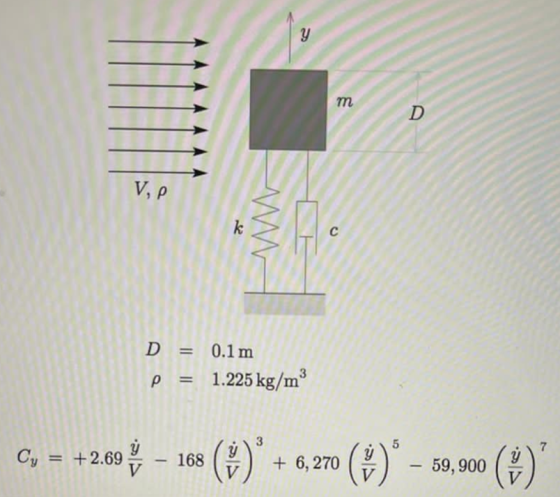
Consider a square rigid body mounted on a linear elastic spring and a linear damper. The system is submerged in lateral fluid flow as shown in Figure 1.
The structural mass is m = 0.45 kg, the damping is c = 0.05 N/ (m s) and the stiffness is k = 0.8 N/m.
The fluid density ƿ, the side length of the square body D and an expression for the aerodynamic coefficient Cy are given in the figure. Ignore the added mass effect.
• Calculate the critical velocity Vcrit for galloping oscillations.
• Calculate the natural frequency of the system for Vcrit.
• Consider the fluid velocity V1 = 0.4 m/s.
Based on the trapezoidal rule time integration scheme described in the lecture notes, compute the displacement Y25 obtained at t = 25Δt = 1.0 s with the time step size Δt = 0.04 s.
Use the initial conditions Y (0) = 0 m and dY(0) = 0.2 m/s, where
dY(t) = dY/dt.
Compute the maximum amplitude Ymax for V1 = 0.4 m/s and V2 = 1.4 m/s, respectively.
Homework Answers
Request Answer!
We need at least 10 more requests to produce the answer.
0 / 10 have requested this problem solution
The more requests, the faster the answer.
3. The motion of a 1DOF mass-spring-damper system (see Figure 1) is modeled by the following seco...
 3. The motion of a 1DOF mass-spring-damper system (see Figure 1) is modeled by the following second order linear ODE: dx,2 dt n dt2 (0) C dt where is the damping ratio an wn is the natural frequency, both related to k, b, and m (the spring constant, damping coefficient, and mass, respectively) (a) Use the forward difference approximations of (b) Using Δt andd to obtain a finite difference formula for x(t+ 2Δ) (like we did in class for the...
63 Figure P6.3 shows a mass-damper system (no stiffness, Problem 2.3). Displacement x is measured...
 63 Figure P6.3 shows a mass-damper system (no stiffness, Problem 2.3). Displacement x is measured from an equilibrium position where the damper is at the "neutral" position. The external force () is a short-duration pulse function: f(!)-5N for 0SS002 s, and f,() = 0 for t > 0.02 s. The system parameters are mass m-0.5kg and viscous friction coefficient b 3 N-s/m and the system is initially at rest. Usc Simulink to determine the system response and plot displacement xit)...
For the system shown below, a 20Kg mass is sitting on a spring-damper system on a foundation. The system is operating a...
 For the system shown below, a 20Kg mass is sitting on a spring-damper system on a foundation. The system is operating at a frequency of 20 rad/s with only one unbalanced mass, m. For the maximum transmissibility at (=0.2, use the chart provided below to determine the suitable values for the spring and the damper constants If a second mass is added to the system (m2=m) at an angle 90 degrees behind the first mass, What is the maximum force...
solve using Matlab , write the matlab code please 2.95. A DVD drive is mounted chassis...
 solve using Matlab , write the matlab code please
2.95. A DVD drive is mounted chassis and is modeled as a single-degree-of-freedom on a spring, mass, and damper. During normal operation, the drive (having a mass of 0.4 kg) is subject to a harmonic force of 1 N at 10 rad/s. Because of material considerations and static deflection, the stiffness is fixed at 500 N/m and the natural damping in the system is 10 kg/s. The DVD player starts and...
solve using Matlab , write the matlab code please
2.95. A DVD drive is mounted chassis and is modeled as a single-degree-of-freedom on a spring, mass, and damper. During normal operation, the drive (having a mass of 0.4 kg) is subject to a harmonic force of 1 N at 10 rad/s. Because of material considerations and static deflection, the stiffness is fixed at 500 N/m and the natural damping in the system is 10 kg/s. The DVD player starts and...
7. Figure 4 shows a cannon. When the gun is fired, high pressure gasses accelerate the...
 7. Figure 4 shows a cannon. When the gun is fired, high pressure gasses accelerate the projectile. The reaction force pushes the gun barrel in the opposite direction to the projectile. The gun barrel is made to translate backwards against a critically damped spring-damper system called the recoil mechanism. The mass of the gun barrel the recoi mechanism is 500 kg and the recoil spring stiffness is 10 kN/m. Upon firing, the gun recoils 0.4 m. Find (a) the damping...
Figure 2 shows a translating mass on a friction-less surface, acted on by an input force...
 Figure 2 shows a translating mass on a friction-less surface,
acted on by an input force fa(t). The mass m is connected to ground
via a linear damper b and spring k, arranged in series. The
coordinate z2 tracks the relative position of the mass-less node
between the damper and mass, shown with a small dark circle. The
relative position of the mass (from rest/equilibrium) is z1. This
lumped-element model could serve, for example, as a basic model of
linear...
Figure 2 shows a translating mass on a friction-less surface,
acted on by an input force fa(t). The mass m is connected to ground
via a linear damper b and spring k, arranged in series. The
coordinate z2 tracks the relative position of the mass-less node
between the damper and mass, shown with a small dark circle. The
relative position of the mass (from rest/equilibrium) is z1. This
lumped-element model could serve, for example, as a basic model of
linear...
please answer in detail 1.18. A particle P of mass m can slide without friction on...
 please answer in detail
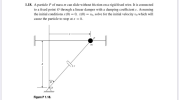
1.18. A particle P of mass m can slide without friction on a rigid fixed wire. It is connected to a fixed point o through a linear damper with a damping coefficient c. Assuming the initial conditions x(0) = 0, (0) = vo, solve for the initial velocity vo which will cause the particle to stop at x = h. Figure P 1.18.
please answer in detail
1.18. A particle P of mass m can slide without friction on a rigid fixed wire. It is connected to a fixed point o through a linear damper with a damping coefficient c. Assuming the initial conditions x(0) = 0, (0) = vo, solve for the initial velocity vo which will cause the particle to stop at x = h. Figure P 1.18.
pls write down clearly thanks -2 SKMM2313 QUESTION 1 (a) A compressible fluid flows through a...
 pls
write down clearly thanks
-2 SKMM2313 QUESTION 1 (a) A compressible fluid flows through a compressor that increases the density from 1 kg/m2 to 5 kg/m. The cross-sectional area of the inlet pipe is 3 m2 and that of the discharge pipe is 1 m2. Determine the relation between the discharge velocity V2 and the inlet velocity Vi (2 marks) In Figure Q1, determine the rate of change of h(t) if the fluid is water. (b) Take V.-10 m/s...
pls
write down clearly thanks
-2 SKMM2313 QUESTION 1 (a) A compressible fluid flows through a compressor that increases the density from 1 kg/m2 to 5 kg/m. The cross-sectional area of the inlet pipe is 3 m2 and that of the discharge pipe is 1 m2. Determine the relation between the discharge velocity V2 and the inlet velocity Vi (2 marks) In Figure Q1, determine the rate of change of h(t) if the fluid is water. (b) Take V.-10 m/s...
A quarter-car suspension model consisting of a spring and a damper is shown in Figure 1....
 A quarter-car suspension model consisting of a spring and a damper is shown in Figure 1. An active suspension element produces an input force F. Draw a free-body diagram for the sprung mass m, and hence derive a differential equation relating the input force F to the sprung mass displacement x. (a) (5 marks) (b) Assuming a mass m-250kg, spring coefficient k 100Nm-1 and damping coefficient of c-50Nsm1, show that the transfer function from the input force F to the...
The mass of uniform bar ABC is MBAR = 30 kg and its overall length is...
 The mass of uniform bar ABC is MBAR = 30 kg and its overall length is L=1.6 m. The bar rotates around point 0 and force F(t) is being to the end of the bar at C. The masses of pistons A and B are ma = 5 kg and mg = 8 kg , respectively. k= 20000 N/m for each spring and c=500 N-s/m for the damper connected to piston A. Coordinate e locates the bar, coordinate x, locates...
 3. The motion of a 1DOF mass-spring-damper system (see Figure 1) is modeled by the following second order linear ODE: dx,2 dt n dt2 (0) C dt where is the damping ratio an wn is the natural frequency, both related to k, b, and m (the spring constant, damping coefficient, and mass, respectively) (a) Use the forward difference approximations of (b) Using Δt andd to obtain a finite difference formula for x(t+ 2Δ) (like we did in class for the...
 63 Figure P6.3 shows a mass-damper system (no stiffness, Problem 2.3). Displacement x is measured from an equilibrium position where the damper is at the "neutral" position. The external force () is a short-duration pulse function: f(!)-5N for 0SS002 s, and f,() = 0 for t > 0.02 s. The system parameters are mass m-0.5kg and viscous friction coefficient b 3 N-s/m and the system is initially at rest. Usc Simulink to determine the system response and plot displacement xit)...
 For the system shown below, a 20Kg mass is sitting on a spring-damper system on a foundation. The system is operating at a frequency of 20 rad/s with only one unbalanced mass, m. For the maximum transmissibility at (=0.2, use the chart provided below to determine the suitable values for the spring and the damper constants If a second mass is added to the system (m2=m) at an angle 90 degrees behind the first mass, What is the maximum force...
 solve using Matlab , write the matlab code please
2.95. A DVD drive is mounted chassis and is modeled as a single-degree-of-freedom on a spring, mass, and damper. During normal operation, the drive (having a mass of 0.4 kg) is subject to a harmonic force of 1 N at 10 rad/s. Because of material considerations and static deflection, the stiffness is fixed at 500 N/m and the natural damping in the system is 10 kg/s. The DVD player starts and...
solve using Matlab , write the matlab code please
2.95. A DVD drive is mounted chassis and is modeled as a single-degree-of-freedom on a spring, mass, and damper. During normal operation, the drive (having a mass of 0.4 kg) is subject to a harmonic force of 1 N at 10 rad/s. Because of material considerations and static deflection, the stiffness is fixed at 500 N/m and the natural damping in the system is 10 kg/s. The DVD player starts and...
 7. Figure 4 shows a cannon. When the gun is fired, high pressure gasses accelerate the projectile. The reaction force pushes the gun barrel in the opposite direction to the projectile. The gun barrel is made to translate backwards against a critically damped spring-damper system called the recoil mechanism. The mass of the gun barrel the recoi mechanism is 500 kg and the recoil spring stiffness is 10 kN/m. Upon firing, the gun recoils 0.4 m. Find (a) the damping...
 Figure 2 shows a translating mass on a friction-less surface,
acted on by an input force fa(t). The mass m is connected to ground
via a linear damper b and spring k, arranged in series. The
coordinate z2 tracks the relative position of the mass-less node
between the damper and mass, shown with a small dark circle. The
relative position of the mass (from rest/equilibrium) is z1. This
lumped-element model could serve, for example, as a basic model of
linear...
Figure 2 shows a translating mass on a friction-less surface,
acted on by an input force fa(t). The mass m is connected to ground
via a linear damper b and spring k, arranged in series. The
coordinate z2 tracks the relative position of the mass-less node
between the damper and mass, shown with a small dark circle. The
relative position of the mass (from rest/equilibrium) is z1. This
lumped-element model could serve, for example, as a basic model of
linear...
 please answer in detail
1.18. A particle P of mass m can slide without friction on a rigid fixed wire. It is connected to a fixed point o through a linear damper with a damping coefficient c. Assuming the initial conditions x(0) = 0, (0) = vo, solve for the initial velocity vo which will cause the particle to stop at x = h. Figure P 1.18.
please answer in detail
1.18. A particle P of mass m can slide without friction on a rigid fixed wire. It is connected to a fixed point o through a linear damper with a damping coefficient c. Assuming the initial conditions x(0) = 0, (0) = vo, solve for the initial velocity vo which will cause the particle to stop at x = h. Figure P 1.18.
 pls
write down clearly thanks
-2 SKMM2313 QUESTION 1 (a) A compressible fluid flows through a compressor that increases the density from 1 kg/m2 to 5 kg/m. The cross-sectional area of the inlet pipe is 3 m2 and that of the discharge pipe is 1 m2. Determine the relation between the discharge velocity V2 and the inlet velocity Vi (2 marks) In Figure Q1, determine the rate of change of h(t) if the fluid is water. (b) Take V.-10 m/s...
pls
write down clearly thanks
-2 SKMM2313 QUESTION 1 (a) A compressible fluid flows through a compressor that increases the density from 1 kg/m2 to 5 kg/m. The cross-sectional area of the inlet pipe is 3 m2 and that of the discharge pipe is 1 m2. Determine the relation between the discharge velocity V2 and the inlet velocity Vi (2 marks) In Figure Q1, determine the rate of change of h(t) if the fluid is water. (b) Take V.-10 m/s...
 A quarter-car suspension model consisting of a spring and a damper is shown in Figure 1. An active suspension element produces an input force F. Draw a free-body diagram for the sprung mass m, and hence derive a differential equation relating the input force F to the sprung mass displacement x. (a) (5 marks) (b) Assuming a mass m-250kg, spring coefficient k 100Nm-1 and damping coefficient of c-50Nsm1, show that the transfer function from the input force F to the...
 The mass of uniform bar ABC is MBAR = 30 kg and its overall length is L=1.6 m. The bar rotates around point 0 and force F(t) is being to the end of the bar at C. The masses of pistons A and B are ma = 5 kg and mg = 8 kg , respectively. k= 20000 N/m for each spring and c=500 N-s/m for the damper connected to piston A. Coordinate e locates the bar, coordinate x, locates...
Most questions answered within 3 hours.
-
Where is the error in this code sequence?
String s1 = "Hello";
String s2 = "ello";...
asked 10 months ago -
Financial data for Joel de Paris, Inc., for last year
follow:
Joel de Paris, Inc.
Balance...
asked 10 months ago -
Consider this reaction:
Al2(SO4)3 (aq)+ BaCl3
(aq) Al2Cl6 (aq)- +
3BaSO4(s) . What is the...
asked 10 months ago -
Suppose that Savneet is considering increasing her
recent random sample from 20 car rentals to 40...
asked 10 months ago -
Trucks arrive at an unloading terminal at an average rate of 120
per hour.
Trucks arrive...
asked 10 months ago -
Why are methanol and ethanol completely soluble in water while
octanol is not very little soluble....
asked 10 months ago -
A facilities manager at a university reads in a research report
that the mean amount of...
asked 10 months ago -
When the CuSO4 is rehydrated by adding water to the anhydrous
compound, is this an endothermic...
asked 10 months ago -
A ray of sunlight is passing from diamond into crown glass; the
angle of incidence is...
asked 10 months ago -
A block of mass 0.249 kg is placed on top of a light, vertical
spring of...
asked 10 months ago -
how do the kidneys compensate in the presences of acidosis
a) trigger hyperventilate
b) reserve acid...
asked 10 months ago -
Question 501 pts
The rental rate of capital to the firm increases. Which of the
following...
asked 10 months ago