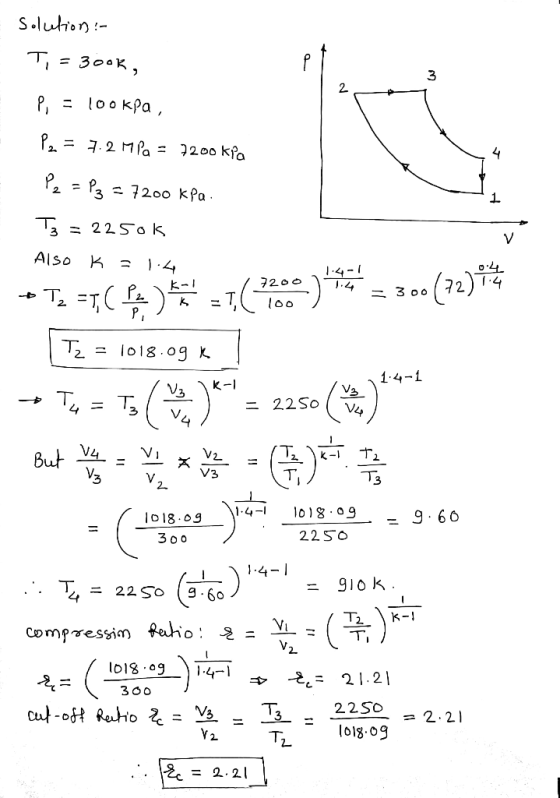
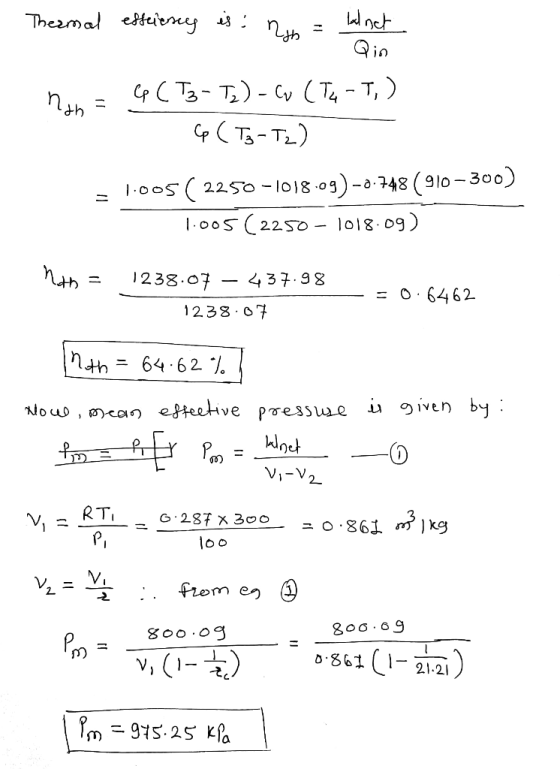
he pressure and temperature at the beginning of compression of a cold air-standard Diesel cycle are...
he pressure and temperature at the beginning of compression of a
cold air-standard Diesel cycle are 100 kPa and 300 K, respectively.
At the end of the heat addition, the pressure is 7.2 MPa and the
temperature is 2250 K. Assume constant specific heats evaluated at
300 K.
Determine:
(a) the compression ratio.
(b) the cutoff ratio.
(c) the percent thermal efficiency of the cycle.
(d) the mean effective pressure, in kPa.
Homework Answers
Add Answer to:
he pressure and temperature at the beginning of compression of a
cold air-standard Diesel cycle are...
At the beginning of the compression process of a Cold air-standard Diesel cycle operating with a...
At the beginning of the compression process of a Cold air-standard Diesel cycle operating with a compression ratio of 18, the temperature is 300 K and the pressure is 0.1 MPa. The cutoff ratio for the cycle is 2. Determine: a) The temperature and pressures at the end of each process of the cycle. b) The thermal efficiency. c) The mean effective pressure, in MPa. Using the Cold Air-Standard Analysis, solve the problem for the compression ratio of 14 and...
At the beginning of the compression process of an air standard Diesel cycle, the pressure is 109 ...
 At the beginning of the compression process of an air standard
Diesel cycle, the pressure is 109 kPa and the temperature is 284 K.
The volume of state 1 is 800.0 cm3. The compression ratio for the
Diesel cycle is 12 and cut-off-ratio is 1.95. Determine: a) the
heat addition, in kJ kJ b) the net work, in kJ kJ c) the thermal
efficiency % d) the mean effective pressure, in kPa kPa
At the beginning of the compression process...
At the beginning of the compression process of an air standard
Diesel cycle, the pressure is 109 kPa and the temperature is 284 K.
The volume of state 1 is 800.0 cm3. The compression ratio for the
Diesel cycle is 12 and cut-off-ratio is 1.95. Determine: a) the
heat addition, in kJ kJ b) the net work, in kJ kJ c) the thermal
efficiency % d) the mean effective pressure, in kPa kPa
At the beginning of the compression process...
An air-standard Diesel cycle has a compression ratio of 16 and a cutoff ratio of 2....
 An air-standard Diesel cycle has a compression ratio of 16 and a cutoff ratio of 2. At the beginning of the com pression process, air is at 95 kPa and 27℃ Accounting for the variation of specific heats with temperature, determine (a) the temperature after the heat-addition process, (b) the thermal efficiency, and (c) the mean effective pressure
Diesel Cycle a. The pressure and temperature at each state in this cycle. b. The compression ratio. c. The cutoff ratio. d. The thermal efficiency. e. The MEP (mean effective pressure.) Consider an a...
 Diesel Cycle
a. The pressure and temperature at each state in this cycle.
b. The compression ratio.
c. The cutoff ratio.
d. The thermal efficiency.
e. The MEP (mean effective pressure.)
Consider an air-standard Diesel cycle (this means use variable specific heats). The inlet state to the compression process is at 95 kPa and 300 K. At the end of the heat addition process, the temperature is 2150 K and the pressure is 7200 kPa. Accounting for the variation of...
Diesel Cycle
a. The pressure and temperature at each state in this cycle.
b. The compression ratio.
c. The cutoff ratio.
d. The thermal efficiency.
e. The MEP (mean effective pressure.)
Consider an air-standard Diesel cycle (this means use variable specific heats). The inlet state to the compression process is at 95 kPa and 300 K. At the end of the heat addition process, the temperature is 2150 K and the pressure is 7200 kPa. Accounting for the variation of...
Q1. At the beginning of the compression process of an air-standard Diesel cycle operating with a...
 Q1. At the beginning of the compression process of an air-standard Diesel cycle operating with a compression ratio of 18, the temperature is 300 K and the pressure is 0.1 MPa. The cutoff ratio (pre-expansion ratio) for the cycle is 2. Determine: (a) the temperature and pressure at the end of each process of the cycle, (b) the thermal efficiency, (c) the mean effective pressure, in MPa.
Also find thermal efficiency and the mean effective pressure please! Required information An air standard Diesel...
 Also find thermal efficiency and the mean effective
pressure please!
Required information An air standard Diesel cycle has a compression ratio of 16 and a cutoff ratio of 2. At the beginning of the compression process air is at 91 kPa and 27C. Account for the variation of specific heats with temperature. The gas constant of air is R-0.287 kJ/kg K. Determine the temperature after the heat addition process. (You must provide an answer before moving on to the next...
Also find thermal efficiency and the mean effective
pressure please!
Required information An air standard Diesel cycle has a compression ratio of 16 and a cutoff ratio of 2. At the beginning of the compression process air is at 91 kPa and 27C. Account for the variation of specific heats with temperature. The gas constant of air is R-0.287 kJ/kg K. Determine the temperature after the heat addition process. (You must provide an answer before moving on to the next...
Required information An air-standard Diesel cycle has a compression ratio of 16 and a cutoff rati...
 Required information An air-standard Diesel cycle has a compression ratio of 16 and a cutoff ratio of 2. At the beginning of the compression process, air is at 103 kPa and 27℃. Assume constant specific heats. The properties of air at room temperature are Cp-1.005 kJ/kg-K, cv-0718 kJ/kg.K, R= 0.287 kJ/kg-K, and k = 1.4 Determine the mean effective pressure The mean effective pressure is「 kPa.
Required information An air-standard Diesel cycle has a compression ratio of 16 and a...
Required information An air-standard Diesel cycle has a compression ratio of 16 and a cutoff ratio of 2. At the beginning of the compression process, air is at 103 kPa and 27℃. Assume constant specific heats. The properties of air at room temperature are Cp-1.005 kJ/kg-K, cv-0718 kJ/kg.K, R= 0.287 kJ/kg-K, and k = 1.4 Determine the mean effective pressure The mean effective pressure is「 kPa.
Required information An air-standard Diesel cycle has a compression ratio of 16 and a...
5) Otto Cycle In this problem, you will analyze the performance of an air-standard Otto cycle for...
 5) Otto Cycle In this problem, you will analyze the performance of an air-standard Otto cycle for two cases: 1) variable specific heats of air and 2) constant specific heats of air evaluated at 300 K. The following information is given for the cycle: .The pressure and temperature, respectively, are 100 kPa and 300 K at the beginning of compressionn The compression ratio is 9 . The heat addition per unit mass of air is 1350 kJ/kg For each case,...
A cold standard air Diesel cycle has a compression ratio of 18. The heat transferred to...
A cold standard air Diesel cycle has a compression ratio of 18. The heat transferred to the working fluid per cycle is 2000 kJ / kg. At the beginning of the compression process cycle, the pressure is 100 kPa and the temperature is 25 ° C. Determine (a) The pressure in each state of the cycle, (b) The cut-off ratio, (c) The thermal efficiency, (d) The net work per unit of mass and (e) the effective mean pressure.
9.31 The state at the beginning of compression of an air-standard Diesel cycle is fixed by...
 9.31 The state at the beginning of compression of an air-standard Diesel cycle is fixed by pi = 100 kPa and T1 = 310 K. The compression ratio is 15. For cutoff ratios rc = 2, determine (a) the maximum temperature, in K. (b) the pressure at the end of the expansion, in kPa. (c) the net work per unit mass of air, in kJ/kg. (d) the thermal efficiency.
 At the beginning of the compression process of an air standard
Diesel cycle, the pressure is 109 kPa and the temperature is 284 K.
The volume of state 1 is 800.0 cm3. The compression ratio for the
Diesel cycle is 12 and cut-off-ratio is 1.95. Determine: a) the
heat addition, in kJ kJ b) the net work, in kJ kJ c) the thermal
efficiency % d) the mean effective pressure, in kPa kPa
At the beginning of the compression process...
At the beginning of the compression process of an air standard
Diesel cycle, the pressure is 109 kPa and the temperature is 284 K.
The volume of state 1 is 800.0 cm3. The compression ratio for the
Diesel cycle is 12 and cut-off-ratio is 1.95. Determine: a) the
heat addition, in kJ kJ b) the net work, in kJ kJ c) the thermal
efficiency % d) the mean effective pressure, in kPa kPa
At the beginning of the compression process...
 An air-standard Diesel cycle has a compression ratio of 16 and a cutoff ratio of 2. At the beginning of the com pression process, air is at 95 kPa and 27℃ Accounting for the variation of specific heats with temperature, determine (a) the temperature after the heat-addition process, (b) the thermal efficiency, and (c) the mean effective pressure
 Diesel Cycle
a. The pressure and temperature at each state in this cycle.
b. The compression ratio.
c. The cutoff ratio.
d. The thermal efficiency.
e. The MEP (mean effective pressure.)
Consider an air-standard Diesel cycle (this means use variable specific heats). The inlet state to the compression process is at 95 kPa and 300 K. At the end of the heat addition process, the temperature is 2150 K and the pressure is 7200 kPa. Accounting for the variation of...
Diesel Cycle
a. The pressure and temperature at each state in this cycle.
b. The compression ratio.
c. The cutoff ratio.
d. The thermal efficiency.
e. The MEP (mean effective pressure.)
Consider an air-standard Diesel cycle (this means use variable specific heats). The inlet state to the compression process is at 95 kPa and 300 K. At the end of the heat addition process, the temperature is 2150 K and the pressure is 7200 kPa. Accounting for the variation of...
 Q1. At the beginning of the compression process of an air-standard Diesel cycle operating with a compression ratio of 18, the temperature is 300 K and the pressure is 0.1 MPa. The cutoff ratio (pre-expansion ratio) for the cycle is 2. Determine: (a) the temperature and pressure at the end of each process of the cycle, (b) the thermal efficiency, (c) the mean effective pressure, in MPa.
 Also find thermal efficiency and the mean effective
pressure please!
Required information An air standard Diesel cycle has a compression ratio of 16 and a cutoff ratio of 2. At the beginning of the compression process air is at 91 kPa and 27C. Account for the variation of specific heats with temperature. The gas constant of air is R-0.287 kJ/kg K. Determine the temperature after the heat addition process. (You must provide an answer before moving on to the next...
Also find thermal efficiency and the mean effective
pressure please!
Required information An air standard Diesel cycle has a compression ratio of 16 and a cutoff ratio of 2. At the beginning of the compression process air is at 91 kPa and 27C. Account for the variation of specific heats with temperature. The gas constant of air is R-0.287 kJ/kg K. Determine the temperature after the heat addition process. (You must provide an answer before moving on to the next...
 Required information An air-standard Diesel cycle has a compression ratio of 16 and a cutoff ratio of 2. At the beginning of the compression process, air is at 103 kPa and 27℃. Assume constant specific heats. The properties of air at room temperature are Cp-1.005 kJ/kg-K, cv-0718 kJ/kg.K, R= 0.287 kJ/kg-K, and k = 1.4 Determine the mean effective pressure The mean effective pressure is「 kPa.
Required information An air-standard Diesel cycle has a compression ratio of 16 and a...
Required information An air-standard Diesel cycle has a compression ratio of 16 and a cutoff ratio of 2. At the beginning of the compression process, air is at 103 kPa and 27℃. Assume constant specific heats. The properties of air at room temperature are Cp-1.005 kJ/kg-K, cv-0718 kJ/kg.K, R= 0.287 kJ/kg-K, and k = 1.4 Determine the mean effective pressure The mean effective pressure is「 kPa.
Required information An air-standard Diesel cycle has a compression ratio of 16 and a...
 5) Otto Cycle In this problem, you will analyze the performance of an air-standard Otto cycle for two cases: 1) variable specific heats of air and 2) constant specific heats of air evaluated at 300 K. The following information is given for the cycle: .The pressure and temperature, respectively, are 100 kPa and 300 K at the beginning of compressionn The compression ratio is 9 . The heat addition per unit mass of air is 1350 kJ/kg For each case,...
 9.31 The state at the beginning of compression of an air-standard Diesel cycle is fixed by pi = 100 kPa and T1 = 310 K. The compression ratio is 15. For cutoff ratios rc = 2, determine (a) the maximum temperature, in K. (b) the pressure at the end of the expansion, in kPa. (c) the net work per unit mass of air, in kJ/kg. (d) the thermal efficiency.
Most questions answered within 3 hours.
-
Where is the error in this code sequence?
String s1 = "Hello";
String s2 = "ello";...
asked 10 months ago -
Financial data for Joel de Paris, Inc., for last year
follow:
Joel de Paris, Inc.
Balance...
asked 10 months ago -
Consider this reaction:
Al2(SO4)3 (aq)+ BaCl3
(aq) Al2Cl6 (aq)- +
3BaSO4(s) . What is the...
asked 10 months ago -
Suppose that Savneet is considering increasing her
recent random sample from 20 car rentals to 40...
asked 10 months ago -
Trucks arrive at an unloading terminal at an average rate of 120
per hour.
Trucks arrive...
asked 10 months ago -
Why are methanol and ethanol completely soluble in water while
octanol is not very little soluble....
asked 10 months ago -
A facilities manager at a university reads in a research report
that the mean amount of...
asked 10 months ago -
When the CuSO4 is rehydrated by adding water to the anhydrous
compound, is this an endothermic...
asked 10 months ago -
A ray of sunlight is passing from diamond into crown glass; the
angle of incidence is...
asked 10 months ago -
A block of mass 0.249 kg is placed on top of a light, vertical
spring of...
asked 10 months ago -
how do the kidneys compensate in the presences of acidosis
a) trigger hyperventilate
b) reserve acid...
asked 10 months ago -
Question 501 pts
The rental rate of capital to the firm increases. Which of the
following...
asked 10 months ago