
Homework Answers
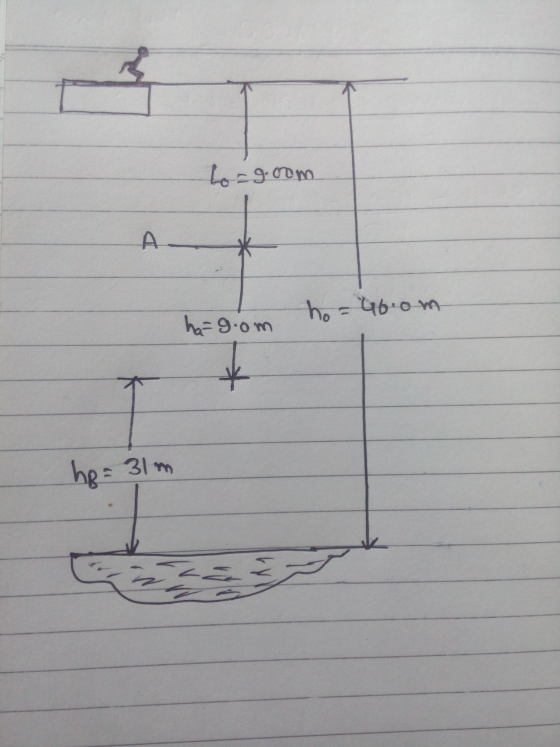
h0 = 46m
Ha = 9m
Hb = 31m
k = 66 N/m^2 and g =9.80m/s^2 , m= 68 kg
a) Speed after falling 9m
1/2 m(Va^2) + mg(Ha) = mg(h0)
Va = Root (2g (h0-Ha))
= Root [2*9.8m/s^2 (46m-9m)]
Va = 26.9 m/s
b) Speed after falling 31m
mg(h0) =mg(Hb)+k[(Ha)-(Hb)]^2/2 +mVb^2/2
68kg*9.8m/s^2*46m = 68kg * 9.8m/s^2 (31m) + 66N/m[9-31]^2 /2 + 68*Vb^2 /2
30654.4 = 9996+31944+ 34Vb^2
Vb^2 = (30654.4-9996-31944)/34 = -331.92
Vb = 18.21 m/s
c) sketch are attached below
Add Answer to:
A 68 kg bungee jumper is standing on a platform 46 m above the ground. The...
A 65.2-kg bungee jumper is standing on a tall platform (h_0 = 46.2 m), as indicated...
 A 65.2-kg bungee jumper is standing on a tall platform (h_0 = 46.2 m), as indicated in the figure. The bungee cord has a natural length of L_0 = 8.40 m and, when stretched, behaves like an ideal spring with a spring constant of k = 48.3 N/m. The jumper falls from rest, and it is assumed that the only forces acting on him are his weight and, for the latter part of the descent, the elastic force of the...
An 80.0 kg bungee jumper drops from rest off a bridge that is 200.0 m above...
 An 80.0 kg bungee jumper drops from rest off a bridge that is 200.0 m above a river. As he falls, air resistance is negligible, and the unstretched bungee cord attached to him uncoils. The mass of the bungee cord is negligible. When the jumper is 50.0 m below the bridge, the bungee cord is completely uncoiled and forms a straight line. Below that point, the bungee cord acts as a spring, obeying Hooke's law as it is stretched beyond...
A bungee jumper who has a mass of 85.0 kg leaps off a very high platform....
A bungee jumper who has a mass of 85.0 kg leaps off a very high platform. A crowd excitedly watches as the jumper free-falls, reaches the end of the bungee cord, then gets "yanked" up by the elastic cord, again and again. One observer measures the time between the low points for the jumper to be 9.30 s. Another observer realizes that simple harmonic motion can be used to describe the process because several of the subsequent bounces for the...
EXAMPLE 6.3 Bungee Jumper A bungee jumper locates a suitable bridge that is 75.0 m above...
 EXAMPLE 6.3 Bungee Jumper A bungee jumper locates a suitable bridge that is 75.0 m above the river below, as shown in Figure 6.14. The jumper has a mass of m-80.0 kg and a height of Ljumper 1.85 m, we can think of a bungee cord as a spring. The spring constant of the bungee cord is k-50.0 N/m. Assume that the mass of the bungee cord is negligible compared with the jumper's mass Lo PROBLENM The jumper wants to...
A bungee jumper plans to bungee jump from a bridge 53.0 m above the ground. He...
A bungee jumper plans to bungee jump from a bridge 53.0 m above the ground. He plans to use a uniform elastic cord, tied to a harness around his body, to stop his fall at a point 12.0 m above the water. Model his body as a particle and the cord as having negligible mass and obeying Hooke's law. In a preliminary test he finds that when hanging at rest from a 5.00 m length of the cord, his body...
7. A bungee jumper with mass m 50 kg leaps fron a bridge. The jumper is...
 7. A bungee jumper with mass m 50 kg leaps fron a bridge. The jumper is attached to the bridge by an elastic cord with axial stiffness k = 0.10 kN m-1. The cord unravels to its ful unstretched length 3.0s after the jumper has left the bridge. Starting from when the jumper leaves the bridge, determine the earliest time at which the elastic cord reaches its maximum extension. Neglect air resistance.[15
10) A bungee cord measures 30 m when relaxed and has negligible mass. When it is...
10) A bungee cord measures 30 m when relaxed and has negligible mass. When it is stretched, it can be modeled as a spring with spring constant k = 68 N/m. (This means the elastic energy in the cord is given by Usp = 1 2 kx2 , where x = L−30 m; in other words, x is the additional distance the cord is stretched beyond its “natural length” 30 m.) A 80-kg jumper secured to this cord wants to...
Consider a bungee jumper dropping vertically in freefall from a bridge 80 m above the ground....
Consider a bungee jumper dropping vertically in freefall from a bridge 80 m above the ground. After three seconds, the elastic cord connecting the jumper to the bridge starts to stretch, which changes the jumper's acceleration to 15 m/s2 upwards. a) Sketch (without doing any math) the position vs time, velocity vs. time, and acceleration vs. time graphs for the bungee jumper from the moment they start to fall to the moment they reach the closest to the ground. b)...
Design a "bungee jump" apparatus for adults. A bungee jumper falls from a high platform with...
Design a "bungee jump" apparatus for adults. A bungee jumper falls from a high platform with two elastic cords tied to the ankles. The jumper falls freely for a while, with the cords slack. Then the jumper falls an additional distance with the cords increasingly tense. Assume that you have cords that are 9 m long, and that the cords stretch in the jump an additional 25 m for a jumper whose mass is 80 kg, the heaviest adult you...
A bungee jumper of mass 75kg is attached to a bungee cord of length L=35m. She...
A bungee jumper of mass 75kg is attached to a bungee cord of length L=35m. She walks off a platform (with no initial speed), reaches a height of 72m below the platform, and continues to oscillate. While air resistance eventually slows her to a stop, assume there is no air resistance for these calculations. 1. What is the spring constant of her bungee cord? 2. What is her speed when she is 35m below the platform (i.e., just before the...
 A 65.2-kg bungee jumper is standing on a tall platform (h_0 = 46.2 m), as indicated in the figure. The bungee cord has a natural length of L_0 = 8.40 m and, when stretched, behaves like an ideal spring with a spring constant of k = 48.3 N/m. The jumper falls from rest, and it is assumed that the only forces acting on him are his weight and, for the latter part of the descent, the elastic force of the...
 An 80.0 kg bungee jumper drops from rest off a bridge that is 200.0 m above a river. As he falls, air resistance is negligible, and the unstretched bungee cord attached to him uncoils. The mass of the bungee cord is negligible. When the jumper is 50.0 m below the bridge, the bungee cord is completely uncoiled and forms a straight line. Below that point, the bungee cord acts as a spring, obeying Hooke's law as it is stretched beyond...
 EXAMPLE 6.3 Bungee Jumper A bungee jumper locates a suitable bridge that is 75.0 m above the river below, as shown in Figure 6.14. The jumper has a mass of m-80.0 kg and a height of Ljumper 1.85 m, we can think of a bungee cord as a spring. The spring constant of the bungee cord is k-50.0 N/m. Assume that the mass of the bungee cord is negligible compared with the jumper's mass Lo PROBLENM The jumper wants to...
 7. A bungee jumper with mass m 50 kg leaps fron a bridge. The jumper is attached to the bridge by an elastic cord with axial stiffness k = 0.10 kN m-1. The cord unravels to its ful unstretched length 3.0s after the jumper has left the bridge. Starting from when the jumper leaves the bridge, determine the earliest time at which the elastic cord reaches its maximum extension. Neglect air resistance.[15
Most questions answered within 3 hours.
-
Where is the error in this code sequence?
String s1 = "Hello";
String s2 = "ello";...
asked 10 months ago -
Financial data for Joel de Paris, Inc., for last year
follow:
Joel de Paris, Inc.
Balance...
asked 10 months ago -
Consider this reaction:
Al2(SO4)3 (aq)+ BaCl3
(aq) Al2Cl6 (aq)- +
3BaSO4(s) . What is the...
asked 10 months ago -
Suppose that Savneet is considering increasing her
recent random sample from 20 car rentals to 40...
asked 10 months ago -
Trucks arrive at an unloading terminal at an average rate of 120
per hour.
Trucks arrive...
asked 10 months ago -
Why are methanol and ethanol completely soluble in water while
octanol is not very little soluble....
asked 10 months ago -
A facilities manager at a university reads in a research report
that the mean amount of...
asked 10 months ago -
When the CuSO4 is rehydrated by adding water to the anhydrous
compound, is this an endothermic...
asked 10 months ago -
A ray of sunlight is passing from diamond into crown glass; the
angle of incidence is...
asked 10 months ago -
A block of mass 0.249 kg is placed on top of a light, vertical
spring of...
asked 10 months ago -
how do the kidneys compensate in the presences of acidosis
a) trigger hyperventilate
b) reserve acid...
asked 10 months ago -
Question 501 pts
The rental rate of capital to the firm increases. Which of the
following...
asked 10 months ago