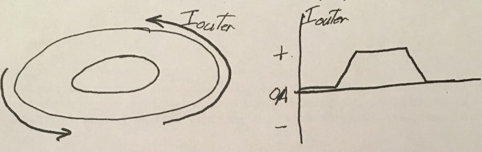
The figure below shows two concentric, conducting loops. We will define a counterclockwise current (viewed from...
Homework Answers

Add Answer to:
The figure below shows two concentric, conducting loops. We will define a counterclockwise current (viewed from...
1) Find the total resistance in the circuit. 52 min quim 10211 102 M W 1022...
 1) Find the total resistance in the circuit. 52 min quim 10211 102 M W 1022 2) An electron is moving to the right in a magnetic field that points upward. What is the direction of the magnetic force? 3) A typical MRI solenoid has a length of about 1 meter and a diameter of about 1 meter. A typical field inside such a solenoid is about 1 T. How many turns of wire must the solenoid have to produce...
The figure shows two parallel loops of wire having a common axis. The smaller loop (radius...
 The figure shows two parallel loops of wire having a common axis. The smaller loop (radius r) is above the larger loop (radius R) by a distance x >>R. Consequently, the magnetic field due to the counterclockwise current in the larger loop is nearly constant throughout the smaller loop. R (a) Find an expression for the magnetic flux through the area of the smaller loop as a function of 1 Select one: a. b. d. BA The figure shows two...
The figure shows two parallel loops of wire having a common axis. The smaller loop (radius...
 The figure shows two parallel loops of wire having a common axis. The smaller loop (radius r) is above the larger loop (radius R) by a distance x >> R. Consequently, the magnetic field due to the counterclockwise current i in the larger loop is nearly constant throughout the smaller loop. Suppose that i, the current in the larger loop is shut off, and decreases at the constant rate di/dt. R in the smaller loop, find (c) the direction of...
Two concentric, circular wire loops of radii r1 = 18.0 cm and r2 = 27.7 cm,...
 Two concentric, circular wire
loops of radii r1 = 18.0 cm and r2 = 27.7 cm, are located in an xy
plane; each carries a clockwise current of 10.2 A (see the figure
below). (a) Find the magnitude of the net magnetic dipole moment of
the system. (b) Repeat for reversed current in the inner loop.
Chapter 28, Problem 055 Two concentric, circular wire loops of radii r1 = 18.0 cm and r2 = 27.7 cm, are located in an...
Two concentric, circular wire
loops of radii r1 = 18.0 cm and r2 = 27.7 cm, are located in an xy
plane; each carries a clockwise current of 10.2 A (see the figure
below). (a) Find the magnitude of the net magnetic dipole moment of
the system. (b) Repeat for reversed current in the inner loop.
Chapter 28, Problem 055 Two concentric, circular wire loops of radii r1 = 18.0 cm and r2 = 27.7 cm, are located in an...
You are looking down at two conducting loops that lie on the table in front of...
You are looking down at two conducting loops that lie on the table in front of you. The one of the left has a power supply that runs current through it that is clockwise. While the current increases, the induced current in the right loop is zero - A. there is no induced current. B. runs counterclockwise. C. runs clockwise.
The figure shows two parallel loops of wire having a common axis. The smaller loop (radius)...
 The figure shows two parallel loops of wire having a common axis. The smaller loop (radius) is above the larger loop (radius R) by a distance x >> R. Consequently, the magnetic field due to the counterclockwise currenti in the larger loop is nearly constant throughout the smaller loop. Suppose that r, the radius of the smaller loop is increasing as the loop heats up, at the constant rate dr/dt. R in the smaller loop, find (c) the direction of...
3 part question? The figure shows two parallel loops of wire having a common axis. The...
 3 part question?
The figure shows two parallel loops of wire having a common axis. The smaller loop (radius r) is above the larger loop (radius R) by a distance x >> R. Consequently, the magnetic field due to the counterclockwise current i in the larger loop is nearly constant throughout the smaller loop. х R (a) Find an expression for the magnetic flux through the area of the smaller loop as a function of i. Select one: a. MoiR2...
3 part question?
The figure shows two parallel loops of wire having a common axis. The smaller loop (radius r) is above the larger loop (radius R) by a distance x >> R. Consequently, the magnetic field due to the counterclockwise current i in the larger loop is nearly constant throughout the smaller loop. х R (a) Find an expression for the magnetic flux through the area of the smaller loop as a function of i. Select one: a. MoiR2...
The figure shows two parallel loops of wire having a common axis. The smaller loop (radius...
The figure shows two parallel loops of wire having a common axis. The smaller loop (radius r) is above the larger loop (radius R) by a distance x>>R. Consequently, the magnetic field due to the counterclockwise current i in the larger loop is nearly constant throughout the smaller loop. Suppose that x is increasing at the constant rate dx/dt = v. (a) Find an expression for the magnetic flux through the area of the smaller loop as a function of...
The figure shows two parallel loops of wire having a common axis. The smaller loop (radius...
 The figure shows two parallel loops of wire having a common
axis. The smaller loop (radius r ) is above the larger
loop (radius R) by a distance x >> R.
Consequently, the magnetic field due to the counterclockwise
current i in the larger loop is nearly constant throughout
the smaller loop.
Suppose that i, the current in the larger loop is shut
off, and decreases at the constant rate
di/dt.
(a) Find an expression for the magnetic flux
through...
The figure shows two parallel loops of wire having a common
axis. The smaller loop (radius r ) is above the larger
loop (radius R) by a distance x >> R.
Consequently, the magnetic field due to the counterclockwise
current i in the larger loop is nearly constant throughout
the smaller loop.
Suppose that i, the current in the larger loop is shut
off, and decreases at the constant rate
di/dt.
(a) Find an expression for the magnetic flux
through...
1. The conducting loop in the figure is moving into the region between the magnetic poles...
 1. The conducting loop in the figure is moving into the region between the magnetic poles shown.Is the induced current (viewed from above) clockwise or counterclockwise?A. clockwiseB. counterclockwise
2. Is there an attractive magnetic force that tends to pull the loop in, like a magnet pulls on a paper clip? Or do you need to push the loop in against a repulsive force?
A.
You need to push the loop in against a repulsive force.
B.
There is an...
1. The conducting loop in the figure is moving into the region between the magnetic poles shown.Is the induced current (viewed from above) clockwise or counterclockwise?A. clockwiseB. counterclockwise
2. Is there an attractive magnetic force that tends to pull the loop in, like a magnet pulls on a paper clip? Or do you need to push the loop in against a repulsive force?
A.
You need to push the loop in against a repulsive force.
B.
There is an...
 1) Find the total resistance in the circuit. 52 min quim 10211 102 M W 1022 2) An electron is moving to the right in a magnetic field that points upward. What is the direction of the magnetic force? 3) A typical MRI solenoid has a length of about 1 meter and a diameter of about 1 meter. A typical field inside such a solenoid is about 1 T. How many turns of wire must the solenoid have to produce...
 The figure shows two parallel loops of wire having a common axis. The smaller loop (radius r) is above the larger loop (radius R) by a distance x >>R. Consequently, the magnetic field due to the counterclockwise current in the larger loop is nearly constant throughout the smaller loop. R (a) Find an expression for the magnetic flux through the area of the smaller loop as a function of 1 Select one: a. b. d. BA The figure shows two...
 The figure shows two parallel loops of wire having a common axis. The smaller loop (radius r) is above the larger loop (radius R) by a distance x >> R. Consequently, the magnetic field due to the counterclockwise current i in the larger loop is nearly constant throughout the smaller loop. Suppose that i, the current in the larger loop is shut off, and decreases at the constant rate di/dt. R in the smaller loop, find (c) the direction of...
 Two concentric, circular wire
loops of radii r1 = 18.0 cm and r2 = 27.7 cm, are located in an xy
plane; each carries a clockwise current of 10.2 A (see the figure
below). (a) Find the magnitude of the net magnetic dipole moment of
the system. (b) Repeat for reversed current in the inner loop.
Chapter 28, Problem 055 Two concentric, circular wire loops of radii r1 = 18.0 cm and r2 = 27.7 cm, are located in an...
Two concentric, circular wire
loops of radii r1 = 18.0 cm and r2 = 27.7 cm, are located in an xy
plane; each carries a clockwise current of 10.2 A (see the figure
below). (a) Find the magnitude of the net magnetic dipole moment of
the system. (b) Repeat for reversed current in the inner loop.
Chapter 28, Problem 055 Two concentric, circular wire loops of radii r1 = 18.0 cm and r2 = 27.7 cm, are located in an...
 The figure shows two parallel loops of wire having a common axis. The smaller loop (radius) is above the larger loop (radius R) by a distance x >> R. Consequently, the magnetic field due to the counterclockwise currenti in the larger loop is nearly constant throughout the smaller loop. Suppose that r, the radius of the smaller loop is increasing as the loop heats up, at the constant rate dr/dt. R in the smaller loop, find (c) the direction of...
 3 part question?
The figure shows two parallel loops of wire having a common axis. The smaller loop (radius r) is above the larger loop (radius R) by a distance x >> R. Consequently, the magnetic field due to the counterclockwise current i in the larger loop is nearly constant throughout the smaller loop. х R (a) Find an expression for the magnetic flux through the area of the smaller loop as a function of i. Select one: a. MoiR2...
3 part question?
The figure shows two parallel loops of wire having a common axis. The smaller loop (radius r) is above the larger loop (radius R) by a distance x >> R. Consequently, the magnetic field due to the counterclockwise current i in the larger loop is nearly constant throughout the smaller loop. х R (a) Find an expression for the magnetic flux through the area of the smaller loop as a function of i. Select one: a. MoiR2...
 The figure shows two parallel loops of wire having a common
axis. The smaller loop (radius r ) is above the larger
loop (radius R) by a distance x >> R.
Consequently, the magnetic field due to the counterclockwise
current i in the larger loop is nearly constant throughout
the smaller loop.
Suppose that i, the current in the larger loop is shut
off, and decreases at the constant rate
di/dt.
(a) Find an expression for the magnetic flux
through...
The figure shows two parallel loops of wire having a common
axis. The smaller loop (radius r ) is above the larger
loop (radius R) by a distance x >> R.
Consequently, the magnetic field due to the counterclockwise
current i in the larger loop is nearly constant throughout
the smaller loop.
Suppose that i, the current in the larger loop is shut
off, and decreases at the constant rate
di/dt.
(a) Find an expression for the magnetic flux
through...
 1. The conducting loop in the figure is moving into the region between the magnetic poles shown.Is the induced current (viewed from above) clockwise or counterclockwise?A. clockwiseB. counterclockwise
2. Is there an attractive magnetic force that tends to pull the loop in, like a magnet pulls on a paper clip? Or do you need to push the loop in against a repulsive force?
A.
You need to push the loop in against a repulsive force.
B.
There is an...
1. The conducting loop in the figure is moving into the region between the magnetic poles shown.Is the induced current (viewed from above) clockwise or counterclockwise?A. clockwiseB. counterclockwise
2. Is there an attractive magnetic force that tends to pull the loop in, like a magnet pulls on a paper clip? Or do you need to push the loop in against a repulsive force?
A.
You need to push the loop in against a repulsive force.
B.
There is an...
Most questions answered within 3 hours.
-
Where is the error in this code sequence?
String s1 = "Hello";
String s2 = "ello";...
asked 10 months ago -
Financial data for Joel de Paris, Inc., for last year
follow:
Joel de Paris, Inc.
Balance...
asked 10 months ago -
Consider this reaction:
Al2(SO4)3 (aq)+ BaCl3
(aq) Al2Cl6 (aq)- +
3BaSO4(s) . What is the...
asked 10 months ago -
Suppose that Savneet is considering increasing her
recent random sample from 20 car rentals to 40...
asked 10 months ago -
Trucks arrive at an unloading terminal at an average rate of 120
per hour.
Trucks arrive...
asked 10 months ago -
Why are methanol and ethanol completely soluble in water while
octanol is not very little soluble....
asked 10 months ago -
A facilities manager at a university reads in a research report
that the mean amount of...
asked 10 months ago -
When the CuSO4 is rehydrated by adding water to the anhydrous
compound, is this an endothermic...
asked 10 months ago -
A ray of sunlight is passing from diamond into crown glass; the
angle of incidence is...
asked 10 months ago -
A block of mass 0.249 kg is placed on top of a light, vertical
spring of...
asked 10 months ago -
how do the kidneys compensate in the presences of acidosis
a) trigger hyperventilate
b) reserve acid...
asked 10 months ago -
Question 501 pts
The rental rate of capital to the firm increases. Which of the
following...
asked 10 months ago