![ercise 3A 8. What is actually diffusing blocks? [Hint: It causes the color change of the agar into the agar blocks] 9. Keep the following on your control for the experiment the A. The agar questions in mind when deciding 1 x 10⁻⁷. If you calculate blocks start with a concentration of H+ ions of pH, is it acidic, basic or neutral? B. hat other common substance concentration of H+ as the agar blocks has a similar at the beginning of the experiment? C. If the concentration of H+ ions inside of a cell equals the concentration of H ions outside of a cell, what happens to the diffusion of H+? D. Therefore, the color of the agar block will be 10. What is the purpose of a trial in an experiment?](http://img.homeworklib.com/questions/08644620-a00c-11ec-b248-7528da743ad3.png?x-oss-process=image/resize,w_560)

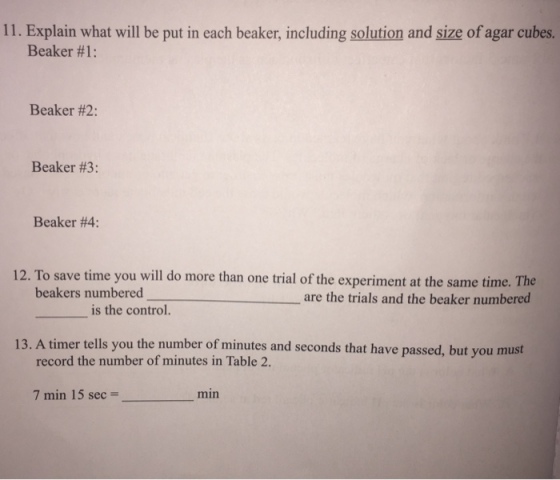
11. Explain what will be put in each beaker, including solution and size of agar cubes.
-Beaker 1:
-Beaker 2:
-Beaker 3:
-Beaker 4:
12. To save time you will do more than one trail of the experiment at the same time. The beakers numbered _______ are the trails and the beaker numbered _______ is the control.
(Fill in the blanks)
13. A timer tell you the number of minutes and seconds that have passed, but you must record the number of minutes in Table 2.
7min 15sec = ___________ min
(Fill in blank)
Homework Answers
Method
- Cut cubes of agar to the following dimensions (use a knife and tweezers to make each as accurate as possible): 5, 10, 15, 20 mm3.
- Add enough dilute hydrochloric acid to a test tube or small beaker so that when one of the agar blocks is placed in it, it will be totally submerged.
- Place one of the agar blocks into the test tube or beaker containing the hydrochloric acid, and immediately start timing.
- Record in a table, how long it takes for all the red colour in the block to disappear (indicating the time it takes the acid to reach the centre of the block).
- Repeat for all the other block sizes.
- If time allows, repeat the experiment as many times as possible.
Here,we can two either 2 sizes,such as 5 mm in 2 beakers and 20mm in 2 beakers.
so, beaker 1:dilute Hcl+5 mm agar cubes+phenol red
beaker 2:5 mm agar cubes+phenol red
beaker 3:dilute Hcl+20 mm agar cubes+phenol red
beaker 4:20 mm agar cubes+phenol red
12.beaker 1 and 3 are samples and 2 and 4 are controls.
13.7.15 min
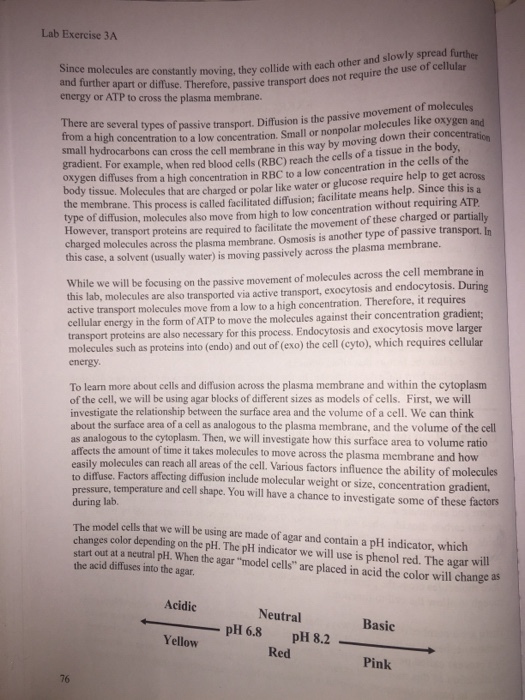
8.dil Hcl is diffusing into agar blocks which converts the phenol red to yellow.
10.to minimise the errors,especially to find out the agar cubes have some sort of pH changes in them
7). The colour change in the agar occurs due to the phenolphtaline indicator, which appears yellow under acidic and pink under basic conditions. As the acidic vinegar diffuses through the agar, the colour change occurs to yellow.
Add Answer to:
11. Explain what will be put in each beaker, including solution
and size of agar cubes....
Experiment 2: Diffusion Concentration Gradients and Membrane Permeability Data Tables Table 2: Indicator Reagent Data Indicator...
 Experiment 2: Diffusion Concentration Gradients and Membrane
Permeability
Data Tables
Table 2: Indicator Reagent Data
Indicator
Starch Positive
Starch Negative
Glucose Positive
Glucose Negative
Glucose Test Strip
n/a
n/a
green
yellow
IKI Solution
dark blue
light brown
n/a
n/a
Table 3: Diffusion of Starch and Glucose Over
Time
Indicator
Dialysis Bag After 60 Minutes
Beaker Water After 60 Minutes
Glucose Test Strip
yellow
green ( if all glucose passed to the beaker from the bag)
IKI
from incolore changed to...
Experiment 2: Diffusion Concentration Gradients and Membrane
Permeability
Data Tables
Table 2: Indicator Reagent Data
Indicator
Starch Positive
Starch Negative
Glucose Positive
Glucose Negative
Glucose Test Strip
n/a
n/a
green
yellow
IKI Solution
dark blue
light brown
n/a
n/a
Table 3: Diffusion of Starch and Glucose Over
Time
Indicator
Dialysis Bag After 60 Minutes
Beaker Water After 60 Minutes
Glucose Test Strip
yellow
green ( if all glucose passed to the beaker from the bag)
IKI
from incolore changed to...
CRITICAL THINKING QUESTIONS 1. A pre-weighed dialysis bag which contained a solution of 10% glucose was...
 CRITICAL THINKING QUESTIONS 1. A pre-weighed dialysis bag which contained a solution of 10% glucose was placed in a beaker containing a solution of 20% glucose. After one hour, the bag was weighed again a. Calculate the % mass change of this dialysis bag from the following information: • Mass of bag before experiment: 15.39 • Mass of bag after experiment: 12.79 b. Determine the tonicity of the beaker when it is compared to the dialysis bag: 2. facell had...
If a potato core is allowed to dehydrate by sitting in open air, would the water potential of the potato cells decrease or increase
If a potato core is allowed to dehydrate by sitting in open air, would the water potential of the potato cells decrease or increase? i think it decreases but i'm not sure. and if a plant cell has a lower water potential than its surroundings and if pressure=0, is the cell hypertonic(in terms of solute concentration) or hypotonic to its environment? will the cell gain or lose water? any ideas...?http://en.wikipedia.org/wiki/Water_potentialanalysis queswhat is water potential?Osmosis Lab /27819 Name: ________________________________ Date: ___________...
I don't understand what calculations I would have made to create the buffer solution from Part...
 I don't understand what calculations I would have made to create
the buffer solution from Part D of the lab. I understood the
procedures I took to create the solution but when the report asks
to show the calculations used to prepare the buffer solution I am
not sure other than mixing the volumes indicated in the procedures
section.
Thank you
pH of Butter Assigned by Instructor 5.12. Measured pH of Assigned B r .9 (Read the procedural Show the...
I don't understand what calculations I would have made to create
the buffer solution from Part D of the lab. I understood the
procedures I took to create the solution but when the report asks
to show the calculations used to prepare the buffer solution I am
not sure other than mixing the volumes indicated in the procedures
section.
Thank you
pH of Butter Assigned by Instructor 5.12. Measured pH of Assigned B r .9 (Read the procedural Show the...
PartA: Penny-→ Cu2+(aq) Make sure it is dated prior to 1982. Record mass to nearest 0.001 I. Weig...
 PartA: Penny-→ Cu2+(aq) Make sure it is dated prior to 1982. Record mass to nearest 0.001 I. Weigh a copper penny. grams. 2. Place 450 mL of distilled water in a clean 600-mL beaker. Place the beaker on a hotplate and heat until the water boils. Do not wait for the water to boil now, but proceed with the rest of the experiment. You will need this water for rinsing in step C3. CAUTION. You will generate poison°แs nitrogen dioxide...
5. What was the purpose of the NaNO3 solution in this experiment? 6. Could a solution...
 5. What was the purpose of the NaNO3 solution in this experiment? 6. Could a solution of NaCl be used instead of NaNO3? 7. What was the purpose of FeSO4 solution in this experiment? 8. Could a solution of FeCl, be used instead of FeSO4? 9. Could a solution of NaSO4 be used instead of FeSO4? 10. Calculate the standard cell potential for the spontaneous redox reaction between a Pb(s)/Pb(NO3)2(aq) half-cell and a Ag(s)/AgNO3(aq) half-cell. Which metal would be oxidized?...
Bio 121 I need to make (yeast fermentation) lab report. This is the lab experiment and...
 Bio 121
I need to make (yeast fermentation) lab
report.
This is the lab experiment and results:
This is a guide to making the lab report:
General Biology BIO121 Yeast Fermentation Lab Introduction Organisms stay alive by the utilization of energy through metabolism. The energy acquiring pathways in photosynthesis convert radiant energy from the sun into the chemical bond energy of carbohydrates. This photosynthetic process is limited to the producers or autotrophs, which include plants, photosynthetic bacteria and some protists....
Bio 121
I need to make (yeast fermentation) lab
report.
This is the lab experiment and results:
This is a guide to making the lab report:
General Biology BIO121 Yeast Fermentation Lab Introduction Organisms stay alive by the utilization of energy through metabolism. The energy acquiring pathways in photosynthesis convert radiant energy from the sun into the chemical bond energy of carbohydrates. This photosynthetic process is limited to the producers or autotrophs, which include plants, photosynthetic bacteria and some protists....
help please? this was the only other information given REPORT SHEET Determination of the Solubility-Product Constant...
 help please?
this was the only other information given
REPORT SHEET Determination of the Solubility-Product Constant for a Sparingly Soluble Salt EXPERIMENT 8 A. Preparation of a Calibration Curve Initial (Cro121 0.0024 M Absorbance 5 mL Volume of 0.0024 M K Cro Total volume 1. I mL 100 mL 2. 100ML 3. 10 mL 100ml 4. 15 mL 100 ML Molar extinction coefficient for [CrO2) [Cro,2) 2.4x100M 12x1044 2.4810M 3.6810M 0.04) 2037.37 0.85 1.13 2. 3. Average molar extinction coefficient...
help please?
this was the only other information given
REPORT SHEET Determination of the Solubility-Product Constant for a Sparingly Soluble Salt EXPERIMENT 8 A. Preparation of a Calibration Curve Initial (Cro121 0.0024 M Absorbance 5 mL Volume of 0.0024 M K Cro Total volume 1. I mL 100 mL 2. 100ML 3. 10 mL 100ml 4. 15 mL 100 ML Molar extinction coefficient for [CrO2) [Cro,2) 2.4x100M 12x1044 2.4810M 3.6810M 0.04) 2037.37 0.85 1.13 2. 3. Average molar extinction coefficient...
A sentence or two stating the hypothesis or hypotheses made. A sentence or two describing what...
 A sentence or two stating the hypothesis or hypotheses
made.
A sentence or two describing what was done
A summary of the most important results
A sentence stating the major conclusion
EXPERIMENT 2: CHARACTERIZING BACTERIA ISOLATED FROM SOIL Data Tables Table 1: Gram Staining Observations Sample Colony 1 Colony 2 Colony 3 + "Normal" + "Heated" Table 2: Experiment 2b Catalase Assay Results Colony Catalase Assay Results ("Normal") Catalase Assay Results ("Heated') 1 2 3 + Characterizing Bacteria Isolated from...
A sentence or two stating the hypothesis or hypotheses
made.
A sentence or two describing what was done
A summary of the most important results
A sentence stating the major conclusion
EXPERIMENT 2: CHARACTERIZING BACTERIA ISOLATED FROM SOIL Data Tables Table 1: Gram Staining Observations Sample Colony 1 Colony 2 Colony 3 + "Normal" + "Heated" Table 2: Experiment 2b Catalase Assay Results Colony Catalase Assay Results ("Normal") Catalase Assay Results ("Heated') 1 2 3 + Characterizing Bacteria Isolated from...
just one example/demonstration! Data needed to be calculated is in highlighted in green boxes. And I...
 just one example/demonstration!
Data needed to be calculated is in highlighted in green boxes.
And I highlighted in red an equation (not sure if thats what you
use to calculate it) And ignore the lab instructions on completeing
a graph!! I already know how to do that in excel, just curious how
Ln (relative rate) and 1/T in K^-1 is calculated by hand*
here is the rest of that lab leading up to the question as I
know its typically...
just one example/demonstration!
Data needed to be calculated is in highlighted in green boxes.
And I highlighted in red an equation (not sure if thats what you
use to calculate it) And ignore the lab instructions on completeing
a graph!! I already know how to do that in excel, just curious how
Ln (relative rate) and 1/T in K^-1 is calculated by hand*
here is the rest of that lab leading up to the question as I
know its typically...
 Experiment 2: Diffusion Concentration Gradients and Membrane
Permeability
Data Tables
Table 2: Indicator Reagent Data
Indicator
Starch Positive
Starch Negative
Glucose Positive
Glucose Negative
Glucose Test Strip
n/a
n/a
green
yellow
IKI Solution
dark blue
light brown
n/a
n/a
Table 3: Diffusion of Starch and Glucose Over
Time
Indicator
Dialysis Bag After 60 Minutes
Beaker Water After 60 Minutes
Glucose Test Strip
yellow
green ( if all glucose passed to the beaker from the bag)
IKI
from incolore changed to...
Experiment 2: Diffusion Concentration Gradients and Membrane
Permeability
Data Tables
Table 2: Indicator Reagent Data
Indicator
Starch Positive
Starch Negative
Glucose Positive
Glucose Negative
Glucose Test Strip
n/a
n/a
green
yellow
IKI Solution
dark blue
light brown
n/a
n/a
Table 3: Diffusion of Starch and Glucose Over
Time
Indicator
Dialysis Bag After 60 Minutes
Beaker Water After 60 Minutes
Glucose Test Strip
yellow
green ( if all glucose passed to the beaker from the bag)
IKI
from incolore changed to...
 CRITICAL THINKING QUESTIONS 1. A pre-weighed dialysis bag which contained a solution of 10% glucose was placed in a beaker containing a solution of 20% glucose. After one hour, the bag was weighed again a. Calculate the % mass change of this dialysis bag from the following information: • Mass of bag before experiment: 15.39 • Mass of bag after experiment: 12.79 b. Determine the tonicity of the beaker when it is compared to the dialysis bag: 2. facell had...
 I don't understand what calculations I would have made to create
the buffer solution from Part D of the lab. I understood the
procedures I took to create the solution but when the report asks
to show the calculations used to prepare the buffer solution I am
not sure other than mixing the volumes indicated in the procedures
section.
Thank you
pH of Butter Assigned by Instructor 5.12. Measured pH of Assigned B r .9 (Read the procedural Show the...
I don't understand what calculations I would have made to create
the buffer solution from Part D of the lab. I understood the
procedures I took to create the solution but when the report asks
to show the calculations used to prepare the buffer solution I am
not sure other than mixing the volumes indicated in the procedures
section.
Thank you
pH of Butter Assigned by Instructor 5.12. Measured pH of Assigned B r .9 (Read the procedural Show the...
 PartA: Penny-→ Cu2+(aq) Make sure it is dated prior to 1982. Record mass to nearest 0.001 I. Weigh a copper penny. grams. 2. Place 450 mL of distilled water in a clean 600-mL beaker. Place the beaker on a hotplate and heat until the water boils. Do not wait for the water to boil now, but proceed with the rest of the experiment. You will need this water for rinsing in step C3. CAUTION. You will generate poison°แs nitrogen dioxide...
 5. What was the purpose of the NaNO3 solution in this experiment? 6. Could a solution of NaCl be used instead of NaNO3? 7. What was the purpose of FeSO4 solution in this experiment? 8. Could a solution of FeCl, be used instead of FeSO4? 9. Could a solution of NaSO4 be used instead of FeSO4? 10. Calculate the standard cell potential for the spontaneous redox reaction between a Pb(s)/Pb(NO3)2(aq) half-cell and a Ag(s)/AgNO3(aq) half-cell. Which metal would be oxidized?...
 Bio 121
I need to make (yeast fermentation) lab
report.
This is the lab experiment and results:
This is a guide to making the lab report:
General Biology BIO121 Yeast Fermentation Lab Introduction Organisms stay alive by the utilization of energy through metabolism. The energy acquiring pathways in photosynthesis convert radiant energy from the sun into the chemical bond energy of carbohydrates. This photosynthetic process is limited to the producers or autotrophs, which include plants, photosynthetic bacteria and some protists....
Bio 121
I need to make (yeast fermentation) lab
report.
This is the lab experiment and results:
This is a guide to making the lab report:
General Biology BIO121 Yeast Fermentation Lab Introduction Organisms stay alive by the utilization of energy through metabolism. The energy acquiring pathways in photosynthesis convert radiant energy from the sun into the chemical bond energy of carbohydrates. This photosynthetic process is limited to the producers or autotrophs, which include plants, photosynthetic bacteria and some protists....
 help please?
this was the only other information given
REPORT SHEET Determination of the Solubility-Product Constant for a Sparingly Soluble Salt EXPERIMENT 8 A. Preparation of a Calibration Curve Initial (Cro121 0.0024 M Absorbance 5 mL Volume of 0.0024 M K Cro Total volume 1. I mL 100 mL 2. 100ML 3. 10 mL 100ml 4. 15 mL 100 ML Molar extinction coefficient for [CrO2) [Cro,2) 2.4x100M 12x1044 2.4810M 3.6810M 0.04) 2037.37 0.85 1.13 2. 3. Average molar extinction coefficient...
help please?
this was the only other information given
REPORT SHEET Determination of the Solubility-Product Constant for a Sparingly Soluble Salt EXPERIMENT 8 A. Preparation of a Calibration Curve Initial (Cro121 0.0024 M Absorbance 5 mL Volume of 0.0024 M K Cro Total volume 1. I mL 100 mL 2. 100ML 3. 10 mL 100ml 4. 15 mL 100 ML Molar extinction coefficient for [CrO2) [Cro,2) 2.4x100M 12x1044 2.4810M 3.6810M 0.04) 2037.37 0.85 1.13 2. 3. Average molar extinction coefficient...
 A sentence or two stating the hypothesis or hypotheses
made.
A sentence or two describing what was done
A summary of the most important results
A sentence stating the major conclusion
EXPERIMENT 2: CHARACTERIZING BACTERIA ISOLATED FROM SOIL Data Tables Table 1: Gram Staining Observations Sample Colony 1 Colony 2 Colony 3 + "Normal" + "Heated" Table 2: Experiment 2b Catalase Assay Results Colony Catalase Assay Results ("Normal") Catalase Assay Results ("Heated') 1 2 3 + Characterizing Bacteria Isolated from...
A sentence or two stating the hypothesis or hypotheses
made.
A sentence or two describing what was done
A summary of the most important results
A sentence stating the major conclusion
EXPERIMENT 2: CHARACTERIZING BACTERIA ISOLATED FROM SOIL Data Tables Table 1: Gram Staining Observations Sample Colony 1 Colony 2 Colony 3 + "Normal" + "Heated" Table 2: Experiment 2b Catalase Assay Results Colony Catalase Assay Results ("Normal") Catalase Assay Results ("Heated') 1 2 3 + Characterizing Bacteria Isolated from...
 just one example/demonstration!
Data needed to be calculated is in highlighted in green boxes.
And I highlighted in red an equation (not sure if thats what you
use to calculate it) And ignore the lab instructions on completeing
a graph!! I already know how to do that in excel, just curious how
Ln (relative rate) and 1/T in K^-1 is calculated by hand*
here is the rest of that lab leading up to the question as I
know its typically...
just one example/demonstration!
Data needed to be calculated is in highlighted in green boxes.
And I highlighted in red an equation (not sure if thats what you
use to calculate it) And ignore the lab instructions on completeing
a graph!! I already know how to do that in excel, just curious how
Ln (relative rate) and 1/T in K^-1 is calculated by hand*
here is the rest of that lab leading up to the question as I
know its typically...
Most questions answered within 3 hours.
-
Where is the error in this code sequence?
String s1 = "Hello";
String s2 = "ello";...
asked 10 months ago -
Financial data for Joel de Paris, Inc., for last year
follow:
Joel de Paris, Inc.
Balance...
asked 10 months ago -
Consider this reaction:
Al2(SO4)3 (aq)+ BaCl3
(aq) Al2Cl6 (aq)- +
3BaSO4(s) . What is the...
asked 10 months ago -
Suppose that Savneet is considering increasing her
recent random sample from 20 car rentals to 40...
asked 10 months ago -
Trucks arrive at an unloading terminal at an average rate of 120
per hour.
Trucks arrive...
asked 10 months ago -
Why are methanol and ethanol completely soluble in water while
octanol is not very little soluble....
asked 10 months ago -
A facilities manager at a university reads in a research report
that the mean amount of...
asked 10 months ago -
When the CuSO4 is rehydrated by adding water to the anhydrous
compound, is this an endothermic...
asked 10 months ago -
A ray of sunlight is passing from diamond into crown glass; the
angle of incidence is...
asked 10 months ago -
A block of mass 0.249 kg is placed on top of a light, vertical
spring of...
asked 10 months ago -
how do the kidneys compensate in the presences of acidosis
a) trigger hyperventilate
b) reserve acid...
asked 10 months ago -
Question 501 pts
The rental rate of capital to the firm increases. Which of the
following...
asked 10 months ago