
Homework Answers
Add Answer to:
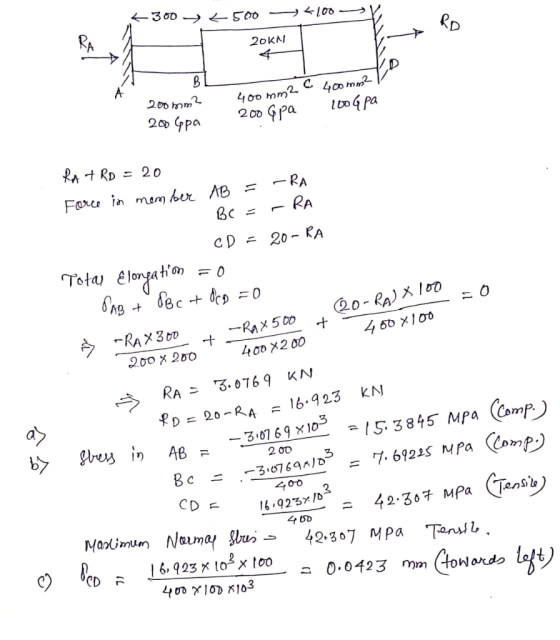
The fixed end bar ABCD is constructed of two different metals
as shown in the figure....
= 2.4-8 The fixed-end bar ABCD consists of three prismatic segments, as shown in the figure....
 = 2.4-8 The fixed-end bar ABCD consists of three prismatic segments, as shown in the figure. The end segments have cross-sectional area A = 840 mm? and length L = 200 mm. The middle segment has cross-sectional area A2 = 1260 mm- and length L2 = 250 mm. Loads Pp and Pc are equal to 25.5 kN and 17.0 kN, respectively. (a) Determine the reactions R, and R, at the fixed supports (b) Determine the compressive axial force Fbc in...
Question #1: A two-section bar is shown in following figure. Left end is fixed. The deflection...
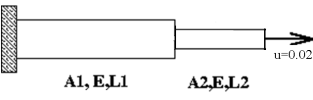 Question #1: A two-section bar is shown in following figure.
Left end is fixed. The deflection at the right end is 0.02 mm. The
information for this bar is:
E=210000 N/mm^2
L_1=100mm
L_2=50mm
EA_1/L_1=3000 N/mm
EA_2/L_2=1000 N/mm
Divide the bar into two1D elements with total 3 nodes. Use the FEM method to calculate strain,
stress and reaction forces.
u-0.02 A2,E.L2
Question #1: A two-section bar is shown in following figure.
Left end is fixed. The deflection at the right end is 0.02 mm. The
information for this bar is:
E=210000 N/mm^2
L_1=100mm
L_2=50mm
EA_1/L_1=3000 N/mm
EA_2/L_2=1000 N/mm
Divide the bar into two1D elements with total 3 nodes. Use the FEM method to calculate strain,
stress and reaction forces.
u-0.02 A2,E.L2
A two-section bar is shown in following figure. Left end is fixed. The deflection at the...
 A two-section bar is shown in following figure. Left end is
fixed. The deflection at the right end is 0.02 mm. The information
for this bar is:
Divide the bar into two1D elements with total 3 nodes. Use the
FEM method to calculate strain, stress and reaction forces. Follow
the discussions in the lecture 2 and lab 3 and show the process in
details.
A two-section bar is shown in following figure. Left end is
fixed. The deflection at the right end is 0.02 mm. The information
for this bar is:
Divide the bar into two1D elements with total 3 nodes. Use the
FEM method to calculate strain, stress and reaction forces. Follow
the discussions in the lecture 2 and lab 3 and show the process in
details.
The pin-connected structure shown in Fig. 5 consists of a rigid bar ABCD and two 1,500-mm-long...
 The pin-connected structure shown in Fig. 5 consists of a rigid bar ABCD and two 1,500-mm-long bars. Bar (1) is steel [E=200 GPa] with a cross-sectional area of A1 = 510 mm2. Bar (2) is an aluminium alloy [E-70 GPa] with a cross-sectional area of A2 1,300 mm2. All bars are unstressed before the load P is applied. If a concentrated load of P 200 kN acts on the structure at D determine: (a) the normal stresses in both bars...
3- (SKMMIH3/SME2113) from plastic having modulus of elasticity, E-4.0GPa a) Bar ABCD shown in Figure Q3a is made The bar consists of three segments, AB, BC, and CD. Segment AB is hollow and segm...
 3- (SKMMIH3/SME2113) from plastic having modulus of elasticity, E-4.0GPa a) Bar ABCD shown in Figure Q3a is made The bar consists of three segments, AB, BC, and CD. Segment AB is hollow and segments BC and CD are solids If the shortening (contraction) of bar ABCD is limited to 4.0 mm, determine the maximum allowable force P to be applied at C. (8 marks) 90 mm ΟΙ 00 mm 1080 min PL 500 mm 250 mm 250 mm Figure Q3a...
Q.3)Two forces P and Qx are applied at point C of a steel bar as shown in figure below. The strai...
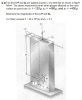 Q.3)Two forces P and Qx are applied at point C of a steel bar as shown in figure below. The strains measured by three strain gauges attached on the outer surface at point A are: ει--120μ. ε,-+480μ. and E3 = +400μ Determine the magnitudes of forces P and Qx. For Steel, assume E 29 x 106 psi and v 0.3 1.5" 24" 40 5"
Q.3)Two forces P and Qx are applied at point C of a steel bar as shown...
Q.3)Two forces P and Qx are applied at point C of a steel bar as shown in figure below. The strains measured by three strain gauges attached on the outer surface at point A are: ει--120μ. ε,-+480μ. and E3 = +400μ Determine the magnitudes of forces P and Qx. For Steel, assume E 29 x 106 psi and v 0.3 1.5" 24" 40 5"
Q.3)Two forces P and Qx are applied at point C of a steel bar as shown...
no need for ms solids 3 Statically indeterminate end-to-end bars. Given: The two-bar structure is fixed...
 no need for ms solids
3 Statically indeterminate end-to-end bars. Given: The two-bar structure is fixed at both ends and a 0.01 in. gap exists between the two bars, as shown in Figure 3. Bar l is made of Aluminum 2014-T6, the elastic modulus isEal umum. 6 ksi, the linear coefficient of thermal expansions is αalun in 12.8(10 6) F, and cross-section area of Bar l is Al-05 in. Bars 2 is made of Steel-A36 Structural with Estss 29000 ksi,...
no need for ms solids
3 Statically indeterminate end-to-end bars. Given: The two-bar structure is fixed at both ends and a 0.01 in. gap exists between the two bars, as shown in Figure 3. Bar l is made of Aluminum 2014-T6, the elastic modulus isEal umum. 6 ksi, the linear coefficient of thermal expansions is αalun in 12.8(10 6) F, and cross-section area of Bar l is Al-05 in. Bars 2 is made of Steel-A36 Structural with Estss 29000 ksi,...
At a given instant the top end A of the bar has the velocity and acceleration shown in the figure
 At a given instant the top end A of the bar has the velocity and acceleration shown in the figure. At the instant shown, determine: The velocity of point B. vB_______ cm/s (A. -5.00 B. 7.00 C. 8.66 D. 5.00 E. None) The angular velocity of the bar, OAB_______ rad/s (A.-1.0 B. 1.0 C.5.0 D.3.2 E. None) The acceleration of point B. aB_______ cm/s2 (A. -7.88 B. 7.88 C.-8.66 D8.66 E. None) The angular acceleration of the bar, αAB=_______ rad/s2 (A. 0.33 B. 3.30...
Consider the bar shown below which is made of two different materials with different cross sectional...
 Consider the bar shown below which is made of two different materials with different cross sectional areas. An axial force P 200x103 N is applied at the intersection point. Both ends of the bar are fixed 300 mm> 400 mm Aluminum A 2400 mm2 E 70 x 10 N/2 E2-200 x 109 N/m2 Steel A,-600 mm2 1. 2. 3. Find the axial displacements at X, -140 mm and X2 -440 mm Find the stress at X' = 140 mm and...
(30 pts) The bar ACB having two different cross-sectional areas Ai and Az js held between...
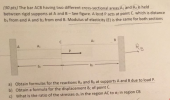 (30 pts) The bar ACB having two different cross-sectional areas Ai and Az js held between rigid supports at A and B-See figure. A load P acts at point C. which is distance b, from end A and b2 from end B. Modulus of elasticity (E) is the same for both sections Az A: 8 b: b2 a) Obtain formulas for the reactions Ra and Re at supports A and B due to load P b) Obtain a formula for...
 = 2.4-8 The fixed-end bar ABCD consists of three prismatic segments, as shown in the figure. The end segments have cross-sectional area A = 840 mm? and length L = 200 mm. The middle segment has cross-sectional area A2 = 1260 mm- and length L2 = 250 mm. Loads Pp and Pc are equal to 25.5 kN and 17.0 kN, respectively. (a) Determine the reactions R, and R, at the fixed supports (b) Determine the compressive axial force Fbc in...
 Question #1: A two-section bar is shown in following figure.
Left end is fixed. The deflection at the right end is 0.02 mm. The
information for this bar is:
E=210000 N/mm^2
L_1=100mm
L_2=50mm
EA_1/L_1=3000 N/mm
EA_2/L_2=1000 N/mm
Divide the bar into two1D elements with total 3 nodes. Use the FEM method to calculate strain,
stress and reaction forces.
u-0.02 A2,E.L2
Question #1: A two-section bar is shown in following figure.
Left end is fixed. The deflection at the right end is 0.02 mm. The
information for this bar is:
E=210000 N/mm^2
L_1=100mm
L_2=50mm
EA_1/L_1=3000 N/mm
EA_2/L_2=1000 N/mm
Divide the bar into two1D elements with total 3 nodes. Use the FEM method to calculate strain,
stress and reaction forces.
u-0.02 A2,E.L2
 A two-section bar is shown in following figure. Left end is
fixed. The deflection at the right end is 0.02 mm. The information
for this bar is:
Divide the bar into two1D elements with total 3 nodes. Use the
FEM method to calculate strain, stress and reaction forces. Follow
the discussions in the lecture 2 and lab 3 and show the process in
details.
A two-section bar is shown in following figure. Left end is
fixed. The deflection at the right end is 0.02 mm. The information
for this bar is:
Divide the bar into two1D elements with total 3 nodes. Use the
FEM method to calculate strain, stress and reaction forces. Follow
the discussions in the lecture 2 and lab 3 and show the process in
details.
 The pin-connected structure shown in Fig. 5 consists of a rigid bar ABCD and two 1,500-mm-long bars. Bar (1) is steel [E=200 GPa] with a cross-sectional area of A1 = 510 mm2. Bar (2) is an aluminium alloy [E-70 GPa] with a cross-sectional area of A2 1,300 mm2. All bars are unstressed before the load P is applied. If a concentrated load of P 200 kN acts on the structure at D determine: (a) the normal stresses in both bars...
 3- (SKMMIH3/SME2113) from plastic having modulus of elasticity, E-4.0GPa a) Bar ABCD shown in Figure Q3a is made The bar consists of three segments, AB, BC, and CD. Segment AB is hollow and segments BC and CD are solids If the shortening (contraction) of bar ABCD is limited to 4.0 mm, determine the maximum allowable force P to be applied at C. (8 marks) 90 mm ΟΙ 00 mm 1080 min PL 500 mm 250 mm 250 mm Figure Q3a...
 Q.3)Two forces P and Qx are applied at point C of a steel bar as shown in figure below. The strains measured by three strain gauges attached on the outer surface at point A are: ει--120μ. ε,-+480μ. and E3 = +400μ Determine the magnitudes of forces P and Qx. For Steel, assume E 29 x 106 psi and v 0.3 1.5" 24" 40 5"
Q.3)Two forces P and Qx are applied at point C of a steel bar as shown...
Q.3)Two forces P and Qx are applied at point C of a steel bar as shown in figure below. The strains measured by three strain gauges attached on the outer surface at point A are: ει--120μ. ε,-+480μ. and E3 = +400μ Determine the magnitudes of forces P and Qx. For Steel, assume E 29 x 106 psi and v 0.3 1.5" 24" 40 5"
Q.3)Two forces P and Qx are applied at point C of a steel bar as shown...
 no need for ms solids
3 Statically indeterminate end-to-end bars. Given: The two-bar structure is fixed at both ends and a 0.01 in. gap exists between the two bars, as shown in Figure 3. Bar l is made of Aluminum 2014-T6, the elastic modulus isEal umum. 6 ksi, the linear coefficient of thermal expansions is αalun in 12.8(10 6) F, and cross-section area of Bar l is Al-05 in. Bars 2 is made of Steel-A36 Structural with Estss 29000 ksi,...
no need for ms solids
3 Statically indeterminate end-to-end bars. Given: The two-bar structure is fixed at both ends and a 0.01 in. gap exists between the two bars, as shown in Figure 3. Bar l is made of Aluminum 2014-T6, the elastic modulus isEal umum. 6 ksi, the linear coefficient of thermal expansions is αalun in 12.8(10 6) F, and cross-section area of Bar l is Al-05 in. Bars 2 is made of Steel-A36 Structural with Estss 29000 ksi,...
 Consider the bar shown below which is made of two different materials with different cross sectional areas. An axial force P 200x103 N is applied at the intersection point. Both ends of the bar are fixed 300 mm> 400 mm Aluminum A 2400 mm2 E 70 x 10 N/2 E2-200 x 109 N/m2 Steel A,-600 mm2 1. 2. 3. Find the axial displacements at X, -140 mm and X2 -440 mm Find the stress at X' = 140 mm and...
 (30 pts) The bar ACB having two different cross-sectional areas Ai and Az js held between rigid supports at A and B-See figure. A load P acts at point C. which is distance b, from end A and b2 from end B. Modulus of elasticity (E) is the same for both sections Az A: 8 b: b2 a) Obtain formulas for the reactions Ra and Re at supports A and B due to load P b) Obtain a formula for...
Most questions answered within 3 hours.
-
Where is the error in this code sequence?
String s1 = "Hello";
String s2 = "ello";...
asked 10 months ago -
Financial data for Joel de Paris, Inc., for last year
follow:
Joel de Paris, Inc.
Balance...
asked 10 months ago -
Consider this reaction:
Al2(SO4)3 (aq)+ BaCl3
(aq) Al2Cl6 (aq)- +
3BaSO4(s) . What is the...
asked 10 months ago -
Suppose that Savneet is considering increasing her
recent random sample from 20 car rentals to 40...
asked 10 months ago -
Trucks arrive at an unloading terminal at an average rate of 120
per hour.
Trucks arrive...
asked 10 months ago -
Why are methanol and ethanol completely soluble in water while
octanol is not very little soluble....
asked 10 months ago -
A facilities manager at a university reads in a research report
that the mean amount of...
asked 10 months ago -
When the CuSO4 is rehydrated by adding water to the anhydrous
compound, is this an endothermic...
asked 10 months ago -
A ray of sunlight is passing from diamond into crown glass; the
angle of incidence is...
asked 10 months ago -
A block of mass 0.249 kg is placed on top of a light, vertical
spring of...
asked 10 months ago -
how do the kidneys compensate in the presences of acidosis
a) trigger hyperventilate
b) reserve acid...
asked 10 months ago -
Question 501 pts
The rental rate of capital to the firm increases. Which of the
following...
asked 10 months ago