
Homework Answers
Add Answer to:
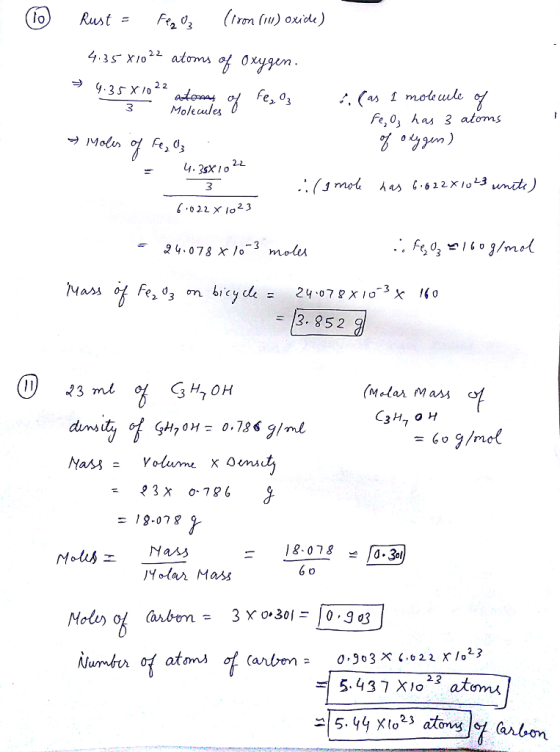
Station 10 The name of rust is iron(III) oxide. If there are 4.35 × 10²² atoms...
< Question 17 of 35 > The rust that appears on steel surfaces is iron(III) oxide....
 < Question 17 of 35 > The rust that appears on steel surfaces is iron(III) oxide. If the rust found spread over the surfaces of a steel swingset frame contains a total of 2.421 x 10oxygen atoms, how many grams of rust are present on the swingset frame? mass of iron(III) oxide: < Question 16 0135 > How many Fatoms are there in 4.52 x 10² molecules of trifluoroacetic acid, C, HF,0,? number of Fatoms:
Under certain conditions, the substances iron and oxygen combine to form iron(III) oxide. If 30.9 grams...
Under certain conditions, the substances iron and oxygen combine to form iron(III) oxide. If 30.9 grams of iron and 13.3 grams of oxygen combine to form iron(III) oxide, how many grams of iron(III) oxide must form? Under certain conditions, the substance mercury(II) oxide can be broken down to form mercury and oxygen. If 30.7 grams of mercury(II) oxide react to form 28.4 grams of mercury, how many grams of oxygen must simultaneously be formed?
One of the main components of rust is a hydrated iron (III) oxide – Fe2O3•nH2O. This...
One of the main components of rust is a hydrated iron (III) oxide – Fe2O3•nH2O. This compound can react with acids such as hydrochloric acid. The unbalanced reaction is shown below: Fe2O3•nH2O(s) + HCl(aq) FeCl3(aq) + H2O(l) If it takes 103 mL of 1.25 M HCl to completely react with 5.00 grams of Fe2O3•nH2O then what is the value of n? You must show all of your work to receive any credit. Round your value of n to the...
It is desired to produce 5.34 grams of iron(III)oxide by the following reaction. If the percent...
 It is desired to produce 5.34 grams of iron(III)oxide by the following reaction. If the percent yield of iron(III)oxide is 85.4%, how many grams of iron would need to be reacted? grams iron iron(s) + oxygen(g) - iron(III) oxide(s) Submit Answer Retry Entire Group 2 more group attempts remaining The equation for this reaction is: 4 Fe(s) + 3 02(9) - Fe2O3(s)
How many total atoms are in a 1.04 mol sample of Iron (III) Oxide (Fe2O3)?
How many total atoms are in a 1.04 mol sample of Iron (III) Oxide (Fe2O3)?
A mixture of 10.325 g of iron (III) oxide and 5.734 g of aluminum metal is...
 A mixture of 10.325 g of iron (III) oxide and 5.734 g of aluminum metal is placed in a crucible and heated in a high-temperature oven, where iron and aluminum oxide is formed. How many atoms of iron is formed during this reaction? (2 pts) How much aluminum, in grams, is left over after the chemical reaction has occurred? (2 pt) a.
Iron(III) oxide reacts with carbon to give iron and carbon monoxide. Fe2O3(s)+3C(s)→2Fe(s)+3CO(g) How many grams of...
Iron(III) oxide reacts with carbon to give iron and carbon monoxide. Fe2O3(s)+3C(s)→2Fe(s)+3CO(g) How many grams of C are required to react with 33.5 g of Fe2O3? How many grams of CO are produced when 41.0 g of C reacts?
Iron(III) oxide reacts with carbon to give iron and carbon monoxide. Fe2O3(s)+3C(s)→2Fe(s)+3CO(g) How many grams of...
Iron(III) oxide reacts with carbon to give iron and carbon monoxide. Fe2O3(s)+3C(s)→2Fe(s)+3CO(g) How many grams of C are required to react with 29.0 g of Fe2O3? How many grams of CO are produced when 41.0 g of C reacts? How many grams of Fe can be produced when 6.20 g of Fe2O3 reacts?
Iron(III) oxide reacts with carbon to give iron and carbon monoxide. Fe2O3(s)+3C(s)→2Fe(s)+3CO(g) How many grams of...
Iron(III) oxide reacts with carbon to give iron and carbon monoxide. Fe2O3(s)+3C(s)→2Fe(s)+3CO(g) How many grams of C are required to react with 18.1 g of Fe2O3?
In one experiment you reacted 45.7 g of Aluminum with 182.8 g of Iron (III) oxide...
 In one experiment you reacted 45.7 g of Aluminum with 182.8 g of Iron (III) oxide to produce Aluminum Oxide and Elemental iron (not diatomic). (10 pts each) a) Write and balance the chemical formula, What type of reaction was it? b) Identify the chemical that is being reduced? c) How many mols of Iron(lll) oxide do you have? d) which is the limiting reagent? e) How many grams of Aluminum Oxide did you produced? f) What would be your...
 < Question 17 of 35 > The rust that appears on steel surfaces is iron(III) oxide. If the rust found spread over the surfaces of a steel swingset frame contains a total of 2.421 x 10oxygen atoms, how many grams of rust are present on the swingset frame? mass of iron(III) oxide: < Question 16 0135 > How many Fatoms are there in 4.52 x 10² molecules of trifluoroacetic acid, C, HF,0,? number of Fatoms:
 It is desired to produce 5.34 grams of iron(III)oxide by the following reaction. If the percent yield of iron(III)oxide is 85.4%, how many grams of iron would need to be reacted? grams iron iron(s) + oxygen(g) - iron(III) oxide(s) Submit Answer Retry Entire Group 2 more group attempts remaining The equation for this reaction is: 4 Fe(s) + 3 02(9) - Fe2O3(s)
 A mixture of 10.325 g of iron (III) oxide and 5.734 g of aluminum metal is placed in a crucible and heated in a high-temperature oven, where iron and aluminum oxide is formed. How many atoms of iron is formed during this reaction? (2 pts) How much aluminum, in grams, is left over after the chemical reaction has occurred? (2 pt) a.
 In one experiment you reacted 45.7 g of Aluminum with 182.8 g of Iron (III) oxide to produce Aluminum Oxide and Elemental iron (not diatomic). (10 pts each) a) Write and balance the chemical formula, What type of reaction was it? b) Identify the chemical that is being reduced? c) How many mols of Iron(lll) oxide do you have? d) which is the limiting reagent? e) How many grams of Aluminum Oxide did you produced? f) What would be your...
Most questions answered within 3 hours.
-
Where is the error in this code sequence?
String s1 = "Hello";
String s2 = "ello";...
asked 11 months ago -
Financial data for Joel de Paris, Inc., for last year
follow:
Joel de Paris, Inc.
Balance...
asked 11 months ago -
Consider this reaction:
Al2(SO4)3 (aq)+ BaCl3
(aq) Al2Cl6 (aq)- +
3BaSO4(s) . What is the...
asked 11 months ago -
Suppose that Savneet is considering increasing her
recent random sample from 20 car rentals to 40...
asked 11 months ago -
Trucks arrive at an unloading terminal at an average rate of 120
per hour.
Trucks arrive...
asked 11 months ago -
Why are methanol and ethanol completely soluble in water while
octanol is not very little soluble....
asked 11 months ago -
A facilities manager at a university reads in a research report
that the mean amount of...
asked 11 months ago -
When the CuSO4 is rehydrated by adding water to the anhydrous
compound, is this an endothermic...
asked 11 months ago -
A ray of sunlight is passing from diamond into crown glass; the
angle of incidence is...
asked 11 months ago -
A block of mass 0.249 kg is placed on top of a light, vertical
spring of...
asked 11 months ago -
how do the kidneys compensate in the presences of acidosis
a) trigger hyperventilate
b) reserve acid...
asked 11 months ago -
Question 501 pts
The rental rate of capital to the firm increases. Which of the
following...
asked 11 months ago