Which fluid requires more energy to maintain flow ? a. Non viscous fluids b. High viscosity...
Which fluid requires more energy to maintain flow ?
a. Non viscous fluids b. High viscosity fluids
Homework Answers
b) High Viscosity fluids
as in viscous fluids energy gets dissipated as heat durin the motion so more energy is requred
Add Answer to:
Which fluid requires more energy to maintain flow ?
a. Non viscous fluids b.
High viscosity...
Which of the following is NOT a mechanism to maintain the body's internal temperature? A. Fluid...
Which of the following is NOT a mechanism to maintain the body's internal temperature? A. Fluid has a high capacity for heat, so it requires a great deal of energy to raise its temperature. B. Fluid is evaporated as sweat from the skin's surface, thus cooling the body. C. Warmed fluids from the body's surface return to the body's core, thus heating the body. D. Fluid acts as a coolant by increasing the blood flow from the warm body core...
What does Δp = QR mean in words? Pushing a viscous fluid through a pipe requires...
What does Δp = QR mean in words? Pushing a viscous fluid through a pipe requires a drop in pressure along the direction in which the fluid is flowing through the pipe. If there is no pressure difference across a pipe, the flow is 1/R. If you increase the flow of a viscous fluid, you increase the pressure at the end of the pipe toward which the fluid if flowing. A viscous fluid will always move more and more quickly...
12) As shown in fig. an open-tube manometer containing water (p.-10 kg/m') and mercury (p-1.36x 10...
 12) As shown in fig. an open-tube manometer containing water (p.-10 kg/m') and mercury (p-1.36x 10 kg/m). The height of water in the left column above the interface A is h' - 30 cm, while the height of mercury in the right column above B is h - 20 cm. The right column is open to the atmosphere Patm - 1.01 10 Pa. The pressure P in the container is: a) P-1.25x10 Pa a) P=0.56*10Pa b) P-4.29x10⁹ Pa d) P-2.46x10*...
10. Immiscible fluids Two immiscible incompressible Newtonian fluids flow together through in thedirection two lates separated...
 10. Immiscible fluids Two immiscible incompressible Newtonian fluids flow together through in thedirection two lates separated by a distance H in the y-direction. Let us make thé top plate /move with ection while fixing the bottom plate. At steady state, however, there be a little slip velocity of the more dense fluid only at the lower boundary The flow constant vetocity V in the x-dir is ynidirectional and faminar. For convenience, we take that x is the flow direction and...
Assuming both non-circular cylinders are experiencing the same external fluid flow (identical density, viscosity, fluid velocity),...
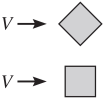 Assuming both non-circular cylinders are experiencing the same
external fluid flow (identical density, viscosity, fluid velocity),
which orientation would experience a higher convective heat
transfer coefficient? What is the ratio of Nusselt numbers for the
flat cross-section over the angled cross-section? Please show work,
and explain conceptually if possible. Thank you!
V- V —
Assuming both non-circular cylinders are experiencing the same
external fluid flow (identical density, viscosity, fluid velocity),
which orientation would experience a higher convective heat
transfer coefficient? What is the ratio of Nusselt numbers for the
flat cross-section over the angled cross-section? Please show work,
and explain conceptually if possible. Thank you!
V- V —
6.4 (B) Prove that a Newtonian fluid with constant viscosity in an incompressible flow obeys the...
 6.4 (B) Prove that a Newtonian fluid with constant viscosity in an incompressible flow obeys the relation V T-uVv.
According to Bernoulli's principle, all other things being equal, for a non-viscous incompressible fluid undergoing streamline...
According to Bernoulli's principle, all other things being equal, for a non-viscous incompressible fluid undergoing streamline flow: b) The greater the density of a fluid, the greater the buoyant force on any object submerged in the fluid. C) The pressure in a fluid is lower where the fluid is moving faster D) Air moves faster over an airplane wing than it does under. E) The deeper the position in an incompressible fluid, the greater the density of the fluid.
Any object moving in a fluid experiences a drag or viscous force opposing its motion. Assume...
Any object moving in a fluid experiences a drag or viscous force opposing its motion. Assume the object is spherical and the flow around it is laminar. For an object of radius 0.25m moving in honey at 70F (viscosity 20 Pa.s), what is the drag force at a speed of 0.1 m/s? If the object is moving horizontally and at the same constant speed of 0.1 m/s, a force must be exerted on it to maintain that motion. That means...
2) (35 points) It is a common practice when examining a fluid's viscous behavior to plot the shear strain rate (velocity gradient) dv dy on the abscissa versus shear stress (t) on the ordinate. W...
 2) (35 points) It is a common practice when examining a fluid's viscous behavior to plot the shear strain rate (velocity gradient) dv dy on the abscissa versus shear stress (t) on the ordinate. When a fluid has a straight-line behavior between these two variables it is called a Newtonian fluid, and the resulting relationship is where u is the fluid viscosity. Many common fluids follow this behavior such as water, milk, and oil. Fluids that do not behave in...
Fluid 7-The surface tension is phenomenon due to (a) Cohesion (b) Viscous force (c) Adhesion between...
 Fluid
7-The surface tension is phenomenon due to (a) Cohesion (b) Viscous force (c) Adhesion between liquid and solid molecules (d) Difference between the forces of adhesion and cohesion 8-The discharge 100 ft/min is equal to (a) 41.23 LUs (b) 45.23 L/s (c) 47.23 Ls (d) 49.23 L/s 9-Specific gravity is the relation between (a) the density of the fluid of specific material to the density of water at 4 °C (b) the density of the fluid of specific material...
Fluid
7-The surface tension is phenomenon due to (a) Cohesion (b) Viscous force (c) Adhesion between liquid and solid molecules (d) Difference between the forces of adhesion and cohesion 8-The discharge 100 ft/min is equal to (a) 41.23 LUs (b) 45.23 L/s (c) 47.23 Ls (d) 49.23 L/s 9-Specific gravity is the relation between (a) the density of the fluid of specific material to the density of water at 4 °C (b) the density of the fluid of specific material...
 12) As shown in fig. an open-tube manometer containing water (p.-10 kg/m') and mercury (p-1.36x 10 kg/m). The height of water in the left column above the interface A is h' - 30 cm, while the height of mercury in the right column above B is h - 20 cm. The right column is open to the atmosphere Patm - 1.01 10 Pa. The pressure P in the container is: a) P-1.25x10 Pa a) P=0.56*10Pa b) P-4.29x10⁹ Pa d) P-2.46x10*...
 10. Immiscible fluids Two immiscible incompressible Newtonian fluids flow together through in thedirection two lates separated by a distance H in the y-direction. Let us make thé top plate /move with ection while fixing the bottom plate. At steady state, however, there be a little slip velocity of the more dense fluid only at the lower boundary The flow constant vetocity V in the x-dir is ynidirectional and faminar. For convenience, we take that x is the flow direction and...
 Assuming both non-circular cylinders are experiencing the same
external fluid flow (identical density, viscosity, fluid velocity),
which orientation would experience a higher convective heat
transfer coefficient? What is the ratio of Nusselt numbers for the
flat cross-section over the angled cross-section? Please show work,
and explain conceptually if possible. Thank you!
V- V —
Assuming both non-circular cylinders are experiencing the same
external fluid flow (identical density, viscosity, fluid velocity),
which orientation would experience a higher convective heat
transfer coefficient? What is the ratio of Nusselt numbers for the
flat cross-section over the angled cross-section? Please show work,
and explain conceptually if possible. Thank you!
V- V —
 6.4 (B) Prove that a Newtonian fluid with constant viscosity in an incompressible flow obeys the relation V T-uVv.
 2) (35 points) It is a common practice when examining a fluid's viscous behavior to plot the shear strain rate (velocity gradient) dv dy on the abscissa versus shear stress (t) on the ordinate. When a fluid has a straight-line behavior between these two variables it is called a Newtonian fluid, and the resulting relationship is where u is the fluid viscosity. Many common fluids follow this behavior such as water, milk, and oil. Fluids that do not behave in...
 Fluid
7-The surface tension is phenomenon due to (a) Cohesion (b) Viscous force (c) Adhesion between liquid and solid molecules (d) Difference between the forces of adhesion and cohesion 8-The discharge 100 ft/min is equal to (a) 41.23 LUs (b) 45.23 L/s (c) 47.23 Ls (d) 49.23 L/s 9-Specific gravity is the relation between (a) the density of the fluid of specific material to the density of water at 4 °C (b) the density of the fluid of specific material...
Fluid
7-The surface tension is phenomenon due to (a) Cohesion (b) Viscous force (c) Adhesion between liquid and solid molecules (d) Difference between the forces of adhesion and cohesion 8-The discharge 100 ft/min is equal to (a) 41.23 LUs (b) 45.23 L/s (c) 47.23 Ls (d) 49.23 L/s 9-Specific gravity is the relation between (a) the density of the fluid of specific material to the density of water at 4 °C (b) the density of the fluid of specific material...
Most questions answered within 3 hours.
-
Where is the error in this code sequence?
String s1 = "Hello";
String s2 = "ello";...
asked 10 months ago -
Financial data for Joel de Paris, Inc., for last year
follow:
Joel de Paris, Inc.
Balance...
asked 10 months ago -
Consider this reaction:
Al2(SO4)3 (aq)+ BaCl3
(aq) Al2Cl6 (aq)- +
3BaSO4(s) . What is the...
asked 10 months ago -
Suppose that Savneet is considering increasing her
recent random sample from 20 car rentals to 40...
asked 10 months ago -
Trucks arrive at an unloading terminal at an average rate of 120
per hour.
Trucks arrive...
asked 10 months ago -
Why are methanol and ethanol completely soluble in water while
octanol is not very little soluble....
asked 10 months ago -
A facilities manager at a university reads in a research report
that the mean amount of...
asked 10 months ago -
When the CuSO4 is rehydrated by adding water to the anhydrous
compound, is this an endothermic...
asked 10 months ago -
A ray of sunlight is passing from diamond into crown glass; the
angle of incidence is...
asked 10 months ago -
A block of mass 0.249 kg is placed on top of a light, vertical
spring of...
asked 10 months ago -
how do the kidneys compensate in the presences of acidosis
a) trigger hyperventilate
b) reserve acid...
asked 10 months ago -
Question 501 pts
The rental rate of capital to the firm increases. Which of the
following...
asked 10 months ago