Please just look over my work to see if I have been doing the problems right. Also help me solve the table for the combined circuits. Please show your work and explain. Also help me fill in column L.
Error Analysis not needed. Assume the equivalent voltage is 14V and every light bulb is a 1 ohm resistor.
Label the brightness of the single bulb circuit (problem 1) as L=10. This light bulb will serve as a baseline for the experiment. If a bulb in another circuit is less bright than this bulb, label it with a brightness of less than 10. If a bulb is brighter label it with brightness greater than 10.
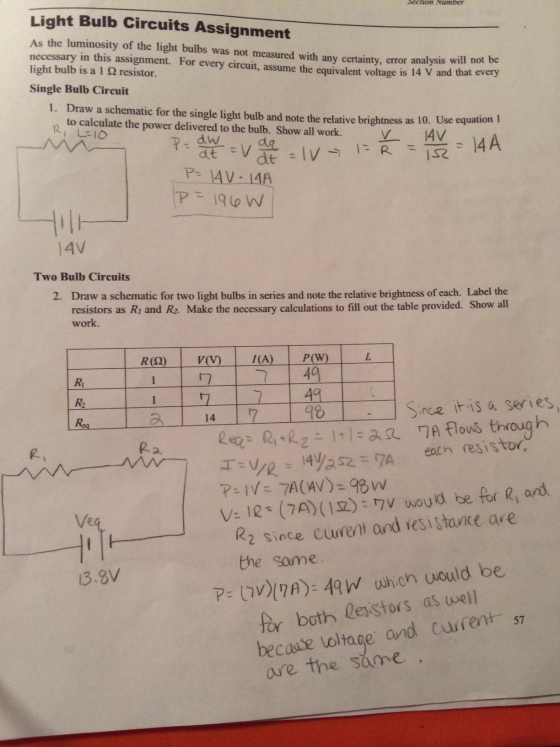
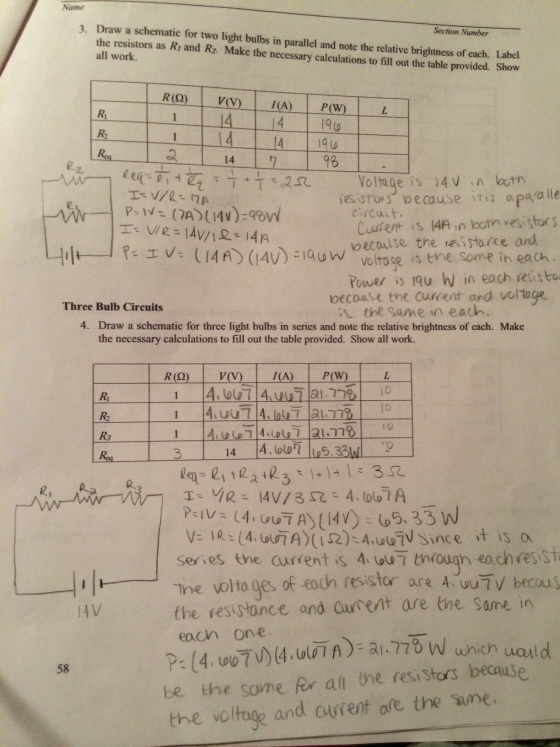
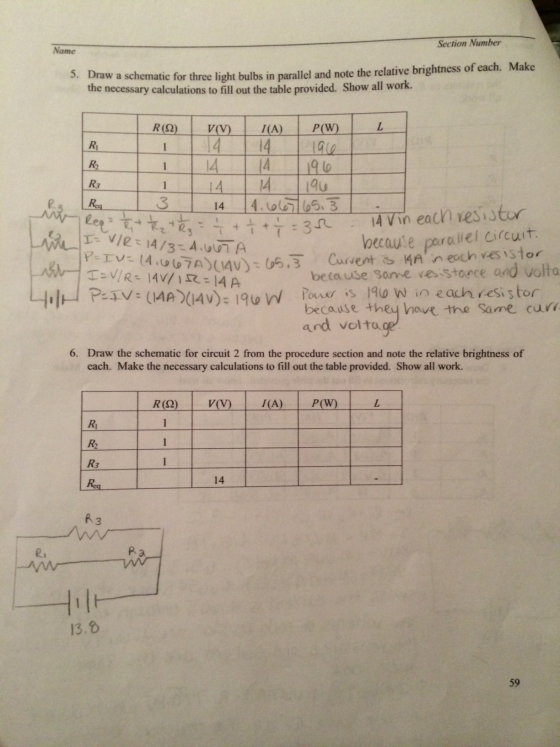
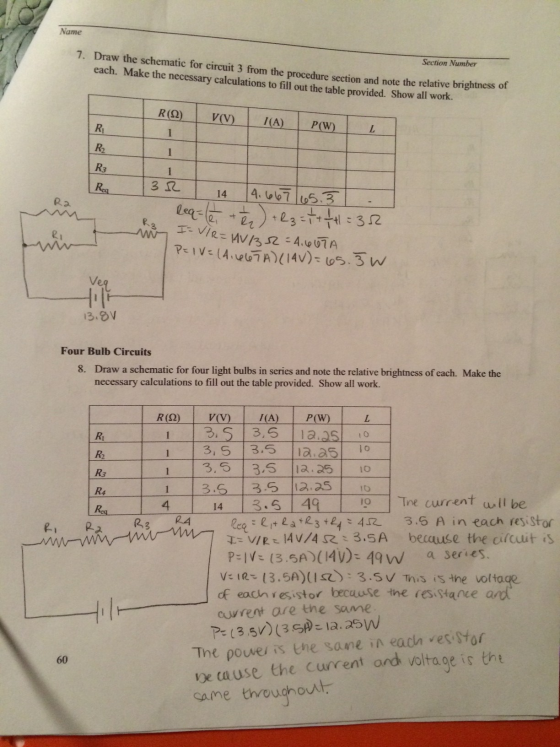
Homework Answers
1) P = V^2 /R = 14^2 / 1 = 196 W
2) we have V = I * ( R1 + R2)
14= I * 2
I = 7 A
so, V in R1 = I * R = 7 V
P in R1 = I^2 * R1 = 49 W
so, L for R1 = 10 * 49/ (196) = 2.5
I in R2 = 7 A
V in R2 = I * R2 = 7 V
P in R2 = I^2 * R2 = 49 W
L for R2 = (10 * 49) / 196 = 2.5
Req = ( R1 + R2) = 2
we have I for Req = V/ Req = 14/2 = 7 A
V in Req = I * req = 7 * 2 = 14 V
P in Req = I^2 * Req = (7^2) * 2 = 98 W
L for Req = ( 10 * 98) / 196 = 5
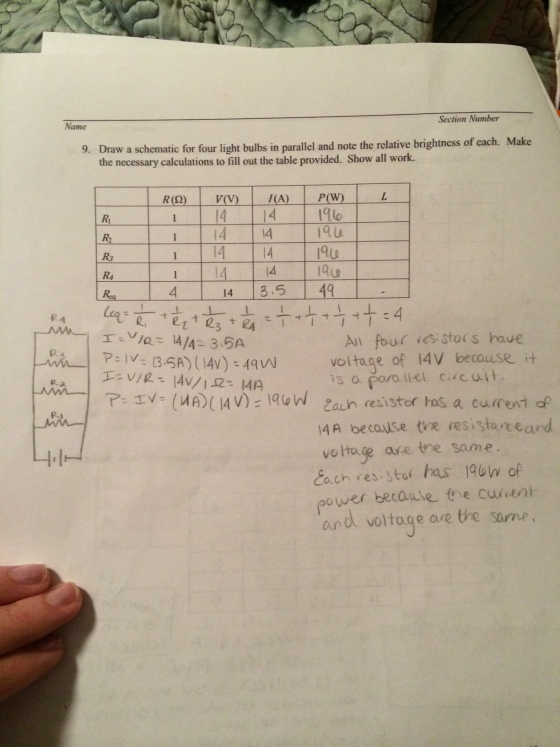
3)
Voltage across R1 = 14 V
Current across R1 = 14/R1 = 14 A
Power , P in R1 = V^2 / R1 =14^2 = 196 W
L in R1 = (196 * 10)/196 = 10
Voltage across R2 = 14 V
Current across R2 = 14/R2 = 14 A
Power , P in R2 = V^2 / R2 =14^2 = 196 W
L in R2 = (196 * 10)/196 = 10
Req = 1/(( 1/R1) + (1/R2)) = 1/ ((1/1) + (1/1)) = 0.5 ohms
Voltage across Req = 14 V
Current across Req = 14/Req = 14/0.5 = 28 A
Power , P in Req = V^2 / Req =14^2/0.5 = 392 W
L in Req = (392 * 10)/196 = 20
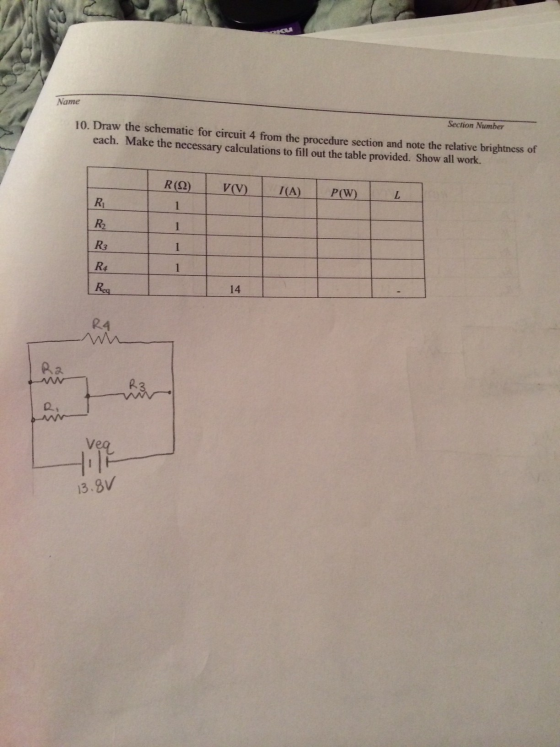
4)
Current across R1 = 14/(R1 + R2 + R3) = 14/3 = 4.667 A
Voltage across R1 = I * R1 = 4.667 * 1 = 4.667 V
Power , P in R1 = V^2 / R1 =4.667^2 = 21.780889 W
L in R1 = (21.780889* 10)/196 = 1.111
Current across R2 = 14/(R1 + R2 + R3) = 14/3 = 4.667 A
Voltage across R2 = I * R2 = 4.667 * 1 = 4.667 V
Power , P in R2 = V^2 / R2 =4.667^2 = 21.780889 W
L in R2 = (21.780889* 10)/196 = 1.111
Current across R3 = 14/(R1 + R2 + R3) = 14/3 = 4.667 A
Voltage across R3 = I * R3 = 4.667 * 1 = 4.667 V
Power , P in R3 = V^2 / R3 =4.667^2 = 21.780889 W
L in R3 = (21.780889* 10)/196 = 1.111
Req = R1 + R2+ R3 = 3 ohms
Current across Req = 14/(R1 + R2 + R3) = 14/3 = 4.667 A
Voltage across Req = I * Req = 4.667 * 3 = 14 V
Power , P in Req = V^2 / Req =14^2/3 = 65.333 W
L in Req = (65.333* 10)/196 = 3.333
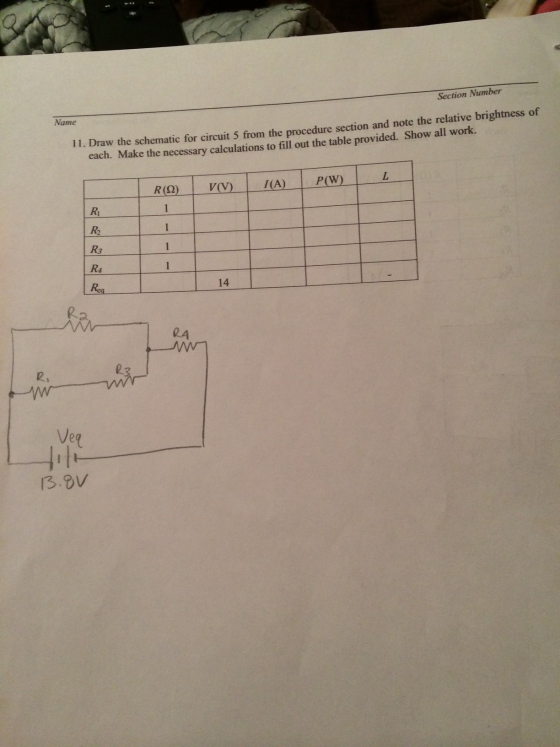
5)
Voltage across R1 = 14 V
Current across R1 = 14/R1 = 14 A
Power , P in R1 = V^2 / R1 =14^2 = 196 W
L in R1 = (196 * 10)/196 = 10
Voltage across R2 = 14 V
Current across R2 = 14/R2 = 14 A
Power , P in R2 = V^2 / R2 =14^2 = 196 W
L in R2 = (196 * 10)/196 = 10
Voltage across R3 = 14 V
Current across R3 = 14/R3 = 14 A
Power , P in R3 = V^2 / R3 =14^2 = 196 W
L in R3 = (196 * 10)/196 = 10
Req = 1/(( 1/R1) + (1/R2) + (1/R3)) = 1/ ((1/1) + (1/1) + (1/1)) =
0.333 ohms
Voltage across Req = 14 V
Current across Req = 14/Req = 14/0.333 = 42 A
Power , P in Req = V^2 / Req =14^2/0.333 = 588 W
L in Req = (588 * 10)/196 = 30
6)
Add Answer to:
Please just look over my work to see if I have been
doing the problems right....
How do I determine this I have only 3 tries left and I can’t reason my...
 How do I determine this I have only 3 tries left and I can’t
reason my answers anymore. Please help rank these from brightest to
dimmest. Also some may be the same brightness level so please help
me TT
Part A Consider a circuit containing five identical light bulbs and an ideal battery. Assume that the resistance of each light bulb remains constant. Rank the bulbs (A through E) based on their brightness. Rank from brightest to dimmest. To rank...
How do I determine this I have only 3 tries left and I can’t
reason my answers anymore. Please help rank these from brightest to
dimmest. Also some may be the same brightness level so please help
me TT
Part A Consider a circuit containing five identical light bulbs and an ideal battery. Assume that the resistance of each light bulb remains constant. Rank the bulbs (A through E) based on their brightness. Rank from brightest to dimmest. To rank...
I need aome help with this part of my lab. thank you! Kirchoff's Laws 4. Now...
 I need aome help with this part of my lab. thank you!
Kirchoff's Laws 4. Now click on this link, which is another circuit I modified and created for this lab: http://tinyurl.com/y8toda84 A. Do not Click run/Stop. This is a circuit that has elements that are neither series nor parallel, as well as multiple voltage sources. The best way for us to analyze this circuit is to use Kirchoff's laws. From the text here are Kirchoff's laws: 1) The sum...
I need aome help with this part of my lab. thank you!
Kirchoff's Laws 4. Now click on this link, which is another circuit I modified and created for this lab: http://tinyurl.com/y8toda84 A. Do not Click run/Stop. This is a circuit that has elements that are neither series nor parallel, as well as multiple voltage sources. The best way for us to analyze this circuit is to use Kirchoff's laws. From the text here are Kirchoff's laws: 1) The sum...
Can someone please help me with this problem? In this problem I also need to: Make...
 Can someone please help me with this problem? In this problem
I also need to:
Make assumptions, draw a model and assess my answer to justify
it. Please and thank you so much to whoever can do this :)
Problem 2 (12 points) Five resistors are connected as shown to an ideal power source with emf E. The resistances are labelled as multiples of R. 6R. Points 1 and 2 are labelled points in the wires. Assumptions: the power source...
Can someone please help me with this problem? In this problem
I also need to:
Make assumptions, draw a model and assess my answer to justify
it. Please and thank you so much to whoever can do this :)
Problem 2 (12 points) Five resistors are connected as shown to an ideal power source with emf E. The resistances are labelled as multiples of R. 6R. Points 1 and 2 are labelled points in the wires. Assumptions: the power source...
I am working on my Physics lab report where it was all about Direct Current Measurement...
I am working on my Physics lab report where it was all about Direct Current Measurement and Ohm’s Law. We had 5 different resistors and had to construct different circuits using a power supply, volt-ohm-milliammeter (VOM) and a digital multimeter to get measurements of resistance, voltage, and current. Nominal values of resistance and tolerance Resistor Nominal Resistance (Ohms) Tolerance (Ohms) R1 680 +/- 68 R2 1000 +/- 50 R3 1500 +/- 75 R4 4700 +/- 470 R5 10,000 +/- 500...
I am currently trying to figure out the experiment below. Please complete Table 1 with an...
 I am currently trying to figure out the experiment below. Please
complete Table 1 with an explanation, I appreciate it thank
you! Promise to give thumbs up!
Introduction The phase differences between the output voltage, the voltage across the inductor, the voltage across the capacitor, and the voltage across the resistor will be examined at resonant frequency. The voltage and phase relationship will also be examined for frequencies above and below resonance. Theory An inductor, a capacitor, and a resistor are...
I am currently trying to figure out the experiment below. Please
complete Table 1 with an explanation, I appreciate it thank
you! Promise to give thumbs up!
Introduction The phase differences between the output voltage, the voltage across the inductor, the voltage across the capacitor, and the voltage across the resistor will be examined at resonant frequency. The voltage and phase relationship will also be examined for frequencies above and below resonance. Theory An inductor, a capacitor, and a resistor are...
I only need help with the discussion there are many info that you do not need put I put just in ...
 I only need help with the discussion
there are many info that you do not need put I put just in
case as well as my data table.
please do it as soon as u can
Meauements ODeit1 Check2 Meaurements Checi3 Ced Check5 Check6 Measurements Check7 heck8 4058 33 536 1502 1035 979 119478 041 1.0319|0.554972| 64261| 153|15542033681 995781 5266566 1578807 298h 1631 119 1209430016 079096812 0.418135246 0,00032665 011890:004668155728441 0293237 1.291809502 1.22833 1.28 1952 -1116 4281 140616885511984206317 3346 8162 0.78...
I only need help with the discussion
there are many info that you do not need put I put just in
case as well as my data table.
please do it as soon as u can
Meauements ODeit1 Check2 Meaurements Checi3 Ced Check5 Check6 Measurements Check7 heck8 4058 33 536 1502 1035 979 119478 041 1.0319|0.554972| 64261| 153|15542033681 995781 5266566 1578807 298h 1631 119 1209430016 079096812 0.418135246 0,00032665 011890:004668155728441 0293237 1.291809502 1.22833 1.28 1952 -1116 4281 140616885511984206317 3346 8162 0.78...
I need help figuring out the flowchart and if I have the right answers for the...
 I need help figuring out the flowchart and if I have the right
answers for the prelab please and thank you!
Group I, the Chloride Group BACKGROUND The precipitating reagent for the chloride group is chloride ion in an acidic solution. Only three of the 18 metal ions form a precipitate with this reagent: silver ion (Ag'), mercury(I)ion (Hg). and lead ion (Pb). Since lead chloride is somewhat soluble, it is not completely precipitated here, and a low concentration of...
I need help figuring out the flowchart and if I have the right
answers for the prelab please and thank you!
Group I, the Chloride Group BACKGROUND The precipitating reagent for the chloride group is chloride ion in an acidic solution. Only three of the 18 metal ions form a precipitate with this reagent: silver ion (Ag'), mercury(I)ion (Hg). and lead ion (Pb). Since lead chloride is somewhat soluble, it is not completely precipitated here, and a low concentration of...
Please help with my car traffic simulator! Code that I already have below, I do not know how to...
 Please help with my car traffic simulator!
Code that I already have below, I do not know how to start it
off!
public class IntersectionSimulation
{
private final static int EAST_WEST_GREEN_TIME = 30 ;
private final static int[] NORTH_SOUTH_GREEN_TIMES = { 20, 24, 30, 42 } ;
private final static int[] CAR_INTERSECTION_RATES = { 3, 5, 10 } ;
private final static int[] CAR_QUEUEING_RATES = { 5, 10, 30 } ;
private final static int[] EXPERIMENT_DURATIONS = { 3*60, 5*60,...
Please help with my car traffic simulator!
Code that I already have below, I do not know how to start it
off!
public class IntersectionSimulation
{
private final static int EAST_WEST_GREEN_TIME = 30 ;
private final static int[] NORTH_SOUTH_GREEN_TIMES = { 20, 24, 30, 42 } ;
private final static int[] CAR_INTERSECTION_RATES = { 3, 5, 10 } ;
private final static int[] CAR_QUEUEING_RATES = { 5, 10, 30 } ;
private final static int[] EXPERIMENT_DURATIONS = { 3*60, 5*60,...
My homework is due tomorrow and I have work! Please help me and answer these questions!...
 My homework is due tomorrow and I have work! Please help me and
answer these questions! I'll give a thumbs up!
Electronic Structure of Atoms 1.20 Write the ground-state electron configuration for each atom. After each atom is its atomic number in parentheses. (a) Sodium (11) (b) Magnesium (12) (c) Oxygen (8) (d) Nitrogen (7) 1.21 Identify the atom that has each ground-state electron configuration. (a) 1s 2s 2p 3:23p (b) 1:2 2:22 1.23 How many electrons are in the...
My homework is due tomorrow and I have work! Please help me and
answer these questions! I'll give a thumbs up!
Electronic Structure of Atoms 1.20 Write the ground-state electron configuration for each atom. After each atom is its atomic number in parentheses. (a) Sodium (11) (b) Magnesium (12) (c) Oxygen (8) (d) Nitrogen (7) 1.21 Identify the atom that has each ground-state electron configuration. (a) 1s 2s 2p 3:23p (b) 1:2 2:22 1.23 How many electrons are in the...
Hi! I’m wondering if anyone can help with these physics problems from my exam krackers book?...
 Hi! I’m wondering if anyone can help with these physics
problems from my exam krackers book? I am studying for the mcat and
the explanations in the book and student doctor are not helping me.
Thanks so much!!
A. 2A B. 3 A C. 6A D. 12 A after the circuit has been on a long time? 12 V 2Ω 2Ω A. 1.2 x 10s C B. 2.5 x 10⁶ C C. 6.0 x 10 C D. 1.7×10⁻⁷ C ERhal...
Hi! I’m wondering if anyone can help with these physics
problems from my exam krackers book? I am studying for the mcat and
the explanations in the book and student doctor are not helping me.
Thanks so much!!
A. 2A B. 3 A C. 6A D. 12 A after the circuit has been on a long time? 12 V 2Ω 2Ω A. 1.2 x 10s C B. 2.5 x 10⁶ C C. 6.0 x 10 C D. 1.7×10⁻⁷ C ERhal...
 How do I determine this I have only 3 tries left and I can’t
reason my answers anymore. Please help rank these from brightest to
dimmest. Also some may be the same brightness level so please help
me TT
Part A Consider a circuit containing five identical light bulbs and an ideal battery. Assume that the resistance of each light bulb remains constant. Rank the bulbs (A through E) based on their brightness. Rank from brightest to dimmest. To rank...
How do I determine this I have only 3 tries left and I can’t
reason my answers anymore. Please help rank these from brightest to
dimmest. Also some may be the same brightness level so please help
me TT
Part A Consider a circuit containing five identical light bulbs and an ideal battery. Assume that the resistance of each light bulb remains constant. Rank the bulbs (A through E) based on their brightness. Rank from brightest to dimmest. To rank...
 I need aome help with this part of my lab. thank you!
Kirchoff's Laws 4. Now click on this link, which is another circuit I modified and created for this lab: http://tinyurl.com/y8toda84 A. Do not Click run/Stop. This is a circuit that has elements that are neither series nor parallel, as well as multiple voltage sources. The best way for us to analyze this circuit is to use Kirchoff's laws. From the text here are Kirchoff's laws: 1) The sum...
I need aome help with this part of my lab. thank you!
Kirchoff's Laws 4. Now click on this link, which is another circuit I modified and created for this lab: http://tinyurl.com/y8toda84 A. Do not Click run/Stop. This is a circuit that has elements that are neither series nor parallel, as well as multiple voltage sources. The best way for us to analyze this circuit is to use Kirchoff's laws. From the text here are Kirchoff's laws: 1) The sum...
 Can someone please help me with this problem? In this problem
I also need to:
Make assumptions, draw a model and assess my answer to justify
it. Please and thank you so much to whoever can do this :)
Problem 2 (12 points) Five resistors are connected as shown to an ideal power source with emf E. The resistances are labelled as multiples of R. 6R. Points 1 and 2 are labelled points in the wires. Assumptions: the power source...
Can someone please help me with this problem? In this problem
I also need to:
Make assumptions, draw a model and assess my answer to justify
it. Please and thank you so much to whoever can do this :)
Problem 2 (12 points) Five resistors are connected as shown to an ideal power source with emf E. The resistances are labelled as multiples of R. 6R. Points 1 and 2 are labelled points in the wires. Assumptions: the power source...
 I am currently trying to figure out the experiment below. Please
complete Table 1 with an explanation, I appreciate it thank
you! Promise to give thumbs up!
Introduction The phase differences between the output voltage, the voltage across the inductor, the voltage across the capacitor, and the voltage across the resistor will be examined at resonant frequency. The voltage and phase relationship will also be examined for frequencies above and below resonance. Theory An inductor, a capacitor, and a resistor are...
I am currently trying to figure out the experiment below. Please
complete Table 1 with an explanation, I appreciate it thank
you! Promise to give thumbs up!
Introduction The phase differences between the output voltage, the voltage across the inductor, the voltage across the capacitor, and the voltage across the resistor will be examined at resonant frequency. The voltage and phase relationship will also be examined for frequencies above and below resonance. Theory An inductor, a capacitor, and a resistor are...
 I only need help with the discussion
there are many info that you do not need put I put just in
case as well as my data table.
please do it as soon as u can
Meauements ODeit1 Check2 Meaurements Checi3 Ced Check5 Check6 Measurements Check7 heck8 4058 33 536 1502 1035 979 119478 041 1.0319|0.554972| 64261| 153|15542033681 995781 5266566 1578807 298h 1631 119 1209430016 079096812 0.418135246 0,00032665 011890:004668155728441 0293237 1.291809502 1.22833 1.28 1952 -1116 4281 140616885511984206317 3346 8162 0.78...
I only need help with the discussion
there are many info that you do not need put I put just in
case as well as my data table.
please do it as soon as u can
Meauements ODeit1 Check2 Meaurements Checi3 Ced Check5 Check6 Measurements Check7 heck8 4058 33 536 1502 1035 979 119478 041 1.0319|0.554972| 64261| 153|15542033681 995781 5266566 1578807 298h 1631 119 1209430016 079096812 0.418135246 0,00032665 011890:004668155728441 0293237 1.291809502 1.22833 1.28 1952 -1116 4281 140616885511984206317 3346 8162 0.78...
 I need help figuring out the flowchart and if I have the right
answers for the prelab please and thank you!
Group I, the Chloride Group BACKGROUND The precipitating reagent for the chloride group is chloride ion in an acidic solution. Only three of the 18 metal ions form a precipitate with this reagent: silver ion (Ag'), mercury(I)ion (Hg). and lead ion (Pb). Since lead chloride is somewhat soluble, it is not completely precipitated here, and a low concentration of...
I need help figuring out the flowchart and if I have the right
answers for the prelab please and thank you!
Group I, the Chloride Group BACKGROUND The precipitating reagent for the chloride group is chloride ion in an acidic solution. Only three of the 18 metal ions form a precipitate with this reagent: silver ion (Ag'), mercury(I)ion (Hg). and lead ion (Pb). Since lead chloride is somewhat soluble, it is not completely precipitated here, and a low concentration of...
 Please help with my car traffic simulator!
Code that I already have below, I do not know how to start it
off!
public class IntersectionSimulation
{
private final static int EAST_WEST_GREEN_TIME = 30 ;
private final static int[] NORTH_SOUTH_GREEN_TIMES = { 20, 24, 30, 42 } ;
private final static int[] CAR_INTERSECTION_RATES = { 3, 5, 10 } ;
private final static int[] CAR_QUEUEING_RATES = { 5, 10, 30 } ;
private final static int[] EXPERIMENT_DURATIONS = { 3*60, 5*60,...
Please help with my car traffic simulator!
Code that I already have below, I do not know how to start it
off!
public class IntersectionSimulation
{
private final static int EAST_WEST_GREEN_TIME = 30 ;
private final static int[] NORTH_SOUTH_GREEN_TIMES = { 20, 24, 30, 42 } ;
private final static int[] CAR_INTERSECTION_RATES = { 3, 5, 10 } ;
private final static int[] CAR_QUEUEING_RATES = { 5, 10, 30 } ;
private final static int[] EXPERIMENT_DURATIONS = { 3*60, 5*60,...
 My homework is due tomorrow and I have work! Please help me and
answer these questions! I'll give a thumbs up!
Electronic Structure of Atoms 1.20 Write the ground-state electron configuration for each atom. After each atom is its atomic number in parentheses. (a) Sodium (11) (b) Magnesium (12) (c) Oxygen (8) (d) Nitrogen (7) 1.21 Identify the atom that has each ground-state electron configuration. (a) 1s 2s 2p 3:23p (b) 1:2 2:22 1.23 How many electrons are in the...
My homework is due tomorrow and I have work! Please help me and
answer these questions! I'll give a thumbs up!
Electronic Structure of Atoms 1.20 Write the ground-state electron configuration for each atom. After each atom is its atomic number in parentheses. (a) Sodium (11) (b) Magnesium (12) (c) Oxygen (8) (d) Nitrogen (7) 1.21 Identify the atom that has each ground-state electron configuration. (a) 1s 2s 2p 3:23p (b) 1:2 2:22 1.23 How many electrons are in the...
 Hi! I’m wondering if anyone can help with these physics
problems from my exam krackers book? I am studying for the mcat and
the explanations in the book and student doctor are not helping me.
Thanks so much!!
A. 2A B. 3 A C. 6A D. 12 A after the circuit has been on a long time? 12 V 2Ω 2Ω A. 1.2 x 10s C B. 2.5 x 10⁶ C C. 6.0 x 10 C D. 1.7×10⁻⁷ C ERhal...
Hi! I’m wondering if anyone can help with these physics
problems from my exam krackers book? I am studying for the mcat and
the explanations in the book and student doctor are not helping me.
Thanks so much!!
A. 2A B. 3 A C. 6A D. 12 A after the circuit has been on a long time? 12 V 2Ω 2Ω A. 1.2 x 10s C B. 2.5 x 10⁶ C C. 6.0 x 10 C D. 1.7×10⁻⁷ C ERhal...
Most questions answered within 3 hours.
-
Where is the error in this code sequence?
String s1 = "Hello";
String s2 = "ello";...
asked 11 months ago -
Financial data for Joel de Paris, Inc., for last year
follow:
Joel de Paris, Inc.
Balance...
asked 11 months ago -
Consider this reaction:
Al2(SO4)3 (aq)+ BaCl3
(aq) Al2Cl6 (aq)- +
3BaSO4(s) . What is the...
asked 11 months ago -
Suppose that Savneet is considering increasing her
recent random sample from 20 car rentals to 40...
asked 11 months ago -
Trucks arrive at an unloading terminal at an average rate of 120
per hour.
Trucks arrive...
asked 11 months ago -
Why are methanol and ethanol completely soluble in water while
octanol is not very little soluble....
asked 11 months ago -
A facilities manager at a university reads in a research report
that the mean amount of...
asked 11 months ago -
When the CuSO4 is rehydrated by adding water to the anhydrous
compound, is this an endothermic...
asked 11 months ago -
A ray of sunlight is passing from diamond into crown glass; the
angle of incidence is...
asked 11 months ago -
A block of mass 0.249 kg is placed on top of a light, vertical
spring of...
asked 11 months ago -
how do the kidneys compensate in the presences of acidosis
a) trigger hyperventilate
b) reserve acid...
asked 11 months ago -
Question 501 pts
The rental rate of capital to the firm increases. Which of the
following...
asked 11 months ago