
Homework Answers
Add Answer to:
5 6 Liquid X is known to have a lower surface tension and lower viscosity than...
Liquid A is known to have a lower viscosity and lower vapor pressure than Liquid B....
 Liquid A is known to have a lower viscosity and lower vapor pressure than Liquid B. Use these facts to predict the result of each experiment in the table below, if you can. experiment Two 10 L glass flasks are evacuated and sealed. 25.0 mL of Liquid A are injected through the seal into one flask, and 25.0 mL of Liquid B are injected into the other flask. After 30 minutes, the pressures PA and PB inside the flasks are...
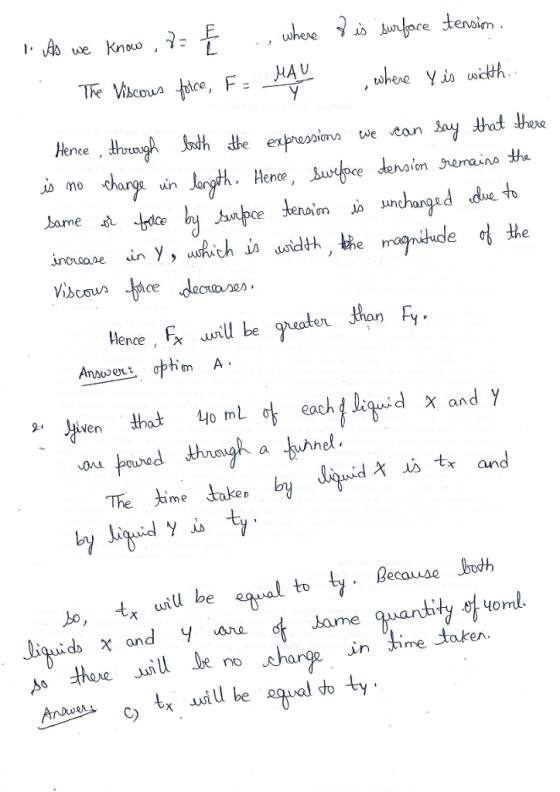
Liquid own to have a higher vapor pressure and higher viscosity than Liquid Y. Use these...
 Liquid own to have a higher vapor pressure and higher viscosity than Liquid Y. Use these facts to predict the result of each experiment in the table below, if you can. experiment predicted outcome Ox will be greater than ty Olx will be less than ty 25.0 mL each of Liquid X and Liquid Y are poured through a funnel, and the times tx and ty needed to pour each liquid through the funnel are measured. otx will be equal...
Liquid A is known to have a lower viscosity and lower vapor pressure than Liquid B....
 Liquid A is known to have a lower viscosity and lower vapor pressure than Liquid B. Use these facts to predict the result of each experiment in the table below, if you can. experiment predicted outcome F will be greater than FB 40.0 mL of Liquid A are poured into a beaker, and 40.0 mL of Liquid B are poured F will be less than FB into an identical beaker. Stirrers in each beaker are connected to motors, and the...
O GASES, LIQUIDS AND SOLIDS Understanding consequences of importa... Liquid A is known to have a...
 O GASES, LIQUIDS AND SOLIDS Understanding consequences of importa... Liquid A is known to have a lower viscosity and lower vapor pressure than Liquid B. Use these facts to predict the result of each experiment in the table below, if you can. experiment predicted outcome Ov will be greater than VB VA will be less than VB 10.0 mL of Liquid A are poured into a beaker. 10.0 mL of Liquid B are poured into another beaker. After 90 minutes...
O GASES, LIQUIDS AND SOLIDS Understanding consequences of important physical properties of... Liquid A is known...
 O GASES, LIQUIDS AND SOLIDS Understanding consequences of important physical properties of... Liquid A is known to have a higher surface tension and higher viscosity than Liquid B. Use these facts to predict the result of each experiment in the table below, if you can. experiment predicted outcome O PA will be greater than PB Pwill be less than PB Liquid A and Liquid B are each pumped through tubes with an inside diameter of 24.0 mm, and the pressures...
5. Suppose X has the Rayleigh density otherwise 0, a. Find the probability density function for Y...
 5. Suppose X has the Rayleigh density otherwise 0, a. Find the probability density function for Y-X using Theorem 8.1.1. b. Use the result in part (a) to find E() and V(). c. Write an expression to calculate E(Y) from the Rayleigh density using LOTUS. Would this be easier or harder to use than the above approach? of variables in one dimension). Let X be s Y(X), where g is differentiable and strictly incr 1 len the PDF of Y...
5. What was the purpose of the NaNO3 solution in this experiment? 6. Could a solution...
 5. What was the purpose of the NaNO3 solution in this experiment? 6. Could a solution of NaCl be used instead of NaNO3? 7. What was the purpose of FeSO4 solution in this experiment? 8. Could a solution of FeCl, be used instead of FeSO4? 9. Could a solution of NaSO4 be used instead of FeSO4? 10. Calculate the standard cell potential for the spontaneous redox reaction between a Pb(s)/Pb(NO3)2(aq) half-cell and a Ag(s)/AgNO3(aq) half-cell. Which metal would be oxidized?...
A. Identify the test statistic=_____ (Round to two decimal places) The P-value is=_____ (Round to three...
 A.
Identify the test statistic=_____ (Round to two decimal
places)
The P-value is=_____ (Round to three decimal
places)
What is the concluion for this hypothesis
test?
A. Fail to reject Upper H0. There is sufficient evidence to
warrant rejection of the claim that the variation of maximal skull
breadths in 4000 B.C. is the same as the variation in A.D. 150.
B. Reject Upper H 0. There is insufficient evidence to warrant
rejection of the claim that the variation of...
A.
Identify the test statistic=_____ (Round to two decimal
places)
The P-value is=_____ (Round to three decimal
places)
What is the concluion for this hypothesis
test?
A. Fail to reject Upper H0. There is sufficient evidence to
warrant rejection of the claim that the variation of maximal skull
breadths in 4000 B.C. is the same as the variation in A.D. 150.
B. Reject Upper H 0. There is insufficient evidence to warrant
rejection of the claim that the variation of...
PREPARATION OF PHARMACEUTICALS - Fischer Esterification Reactions Q: Calculate the expected mass of both methyl salicylate and aspirin assuming 100% yield. EXPERIMENT7 PREPARATION OF PHARMACEUTICALS...
 PREPARATION OF PHARMACEUTICALS - Fischer Esterification
Reactions
Q: Calculate the expected mass of both methyl salicylate and
aspirin assuming 100% yield.
EXPERIMENT7 PREPARATION OF PHARMACEUTICALS Fischer Esterification Reactions Almost 2500 years ago, physicians such as Hippocrates recommended that patients chew on the bark of the willow to alleviate pain. The active ingredient in willow bark was found to be salicin, a compound made of a molecule of salicyl alcohol bonded to a p-D-glucose molecule. In the stomach, the bond between...
PREPARATION OF PHARMACEUTICALS - Fischer Esterification
Reactions
Q: Calculate the expected mass of both methyl salicylate and
aspirin assuming 100% yield.
EXPERIMENT7 PREPARATION OF PHARMACEUTICALS Fischer Esterification Reactions Almost 2500 years ago, physicians such as Hippocrates recommended that patients chew on the bark of the willow to alleviate pain. The active ingredient in willow bark was found to be salicin, a compound made of a molecule of salicyl alcohol bonded to a p-D-glucose molecule. In the stomach, the bond between...
It's a weak acid strong base titration Experiment 4: Identification of an unknown acid by titration...
 It's a weak acid strong base titration
Experiment 4: Identification of an unknown acid by titration Page 2 of 15 Background In this experiment, you will use both qualitative and quantitative properties to determine an unknown acid's identity and concentration. To do this analysis, you will perform a titration of your unknown acid sample-specifically a potentiometric titration where you use a pH meter and record pH values during the titration, combined with a visual titration using a color indi- cator...
It's a weak acid strong base titration
Experiment 4: Identification of an unknown acid by titration Page 2 of 15 Background In this experiment, you will use both qualitative and quantitative properties to determine an unknown acid's identity and concentration. To do this analysis, you will perform a titration of your unknown acid sample-specifically a potentiometric titration where you use a pH meter and record pH values during the titration, combined with a visual titration using a color indi- cator...
 Liquid A is known to have a lower viscosity and lower vapor pressure than Liquid B. Use these facts to predict the result of each experiment in the table below, if you can. experiment Two 10 L glass flasks are evacuated and sealed. 25.0 mL of Liquid A are injected through the seal into one flask, and 25.0 mL of Liquid B are injected into the other flask. After 30 minutes, the pressures PA and PB inside the flasks are...
 Liquid own to have a higher vapor pressure and higher viscosity than Liquid Y. Use these facts to predict the result of each experiment in the table below, if you can. experiment predicted outcome Ox will be greater than ty Olx will be less than ty 25.0 mL each of Liquid X and Liquid Y are poured through a funnel, and the times tx and ty needed to pour each liquid through the funnel are measured. otx will be equal...
 Liquid A is known to have a lower viscosity and lower vapor pressure than Liquid B. Use these facts to predict the result of each experiment in the table below, if you can. experiment predicted outcome F will be greater than FB 40.0 mL of Liquid A are poured into a beaker, and 40.0 mL of Liquid B are poured F will be less than FB into an identical beaker. Stirrers in each beaker are connected to motors, and the...
 O GASES, LIQUIDS AND SOLIDS Understanding consequences of importa... Liquid A is known to have a lower viscosity and lower vapor pressure than Liquid B. Use these facts to predict the result of each experiment in the table below, if you can. experiment predicted outcome Ov will be greater than VB VA will be less than VB 10.0 mL of Liquid A are poured into a beaker. 10.0 mL of Liquid B are poured into another beaker. After 90 minutes...
 O GASES, LIQUIDS AND SOLIDS Understanding consequences of important physical properties of... Liquid A is known to have a higher surface tension and higher viscosity than Liquid B. Use these facts to predict the result of each experiment in the table below, if you can. experiment predicted outcome O PA will be greater than PB Pwill be less than PB Liquid A and Liquid B are each pumped through tubes with an inside diameter of 24.0 mm, and the pressures...
 5. Suppose X has the Rayleigh density otherwise 0, a. Find the probability density function for Y-X using Theorem 8.1.1. b. Use the result in part (a) to find E() and V(). c. Write an expression to calculate E(Y) from the Rayleigh density using LOTUS. Would this be easier or harder to use than the above approach? of variables in one dimension). Let X be s Y(X), where g is differentiable and strictly incr 1 len the PDF of Y...
 5. What was the purpose of the NaNO3 solution in this experiment? 6. Could a solution of NaCl be used instead of NaNO3? 7. What was the purpose of FeSO4 solution in this experiment? 8. Could a solution of FeCl, be used instead of FeSO4? 9. Could a solution of NaSO4 be used instead of FeSO4? 10. Calculate the standard cell potential for the spontaneous redox reaction between a Pb(s)/Pb(NO3)2(aq) half-cell and a Ag(s)/AgNO3(aq) half-cell. Which metal would be oxidized?...
 A.
Identify the test statistic=_____ (Round to two decimal
places)
The P-value is=_____ (Round to three decimal
places)
What is the concluion for this hypothesis
test?
A. Fail to reject Upper H0. There is sufficient evidence to
warrant rejection of the claim that the variation of maximal skull
breadths in 4000 B.C. is the same as the variation in A.D. 150.
B. Reject Upper H 0. There is insufficient evidence to warrant
rejection of the claim that the variation of...
A.
Identify the test statistic=_____ (Round to two decimal
places)
The P-value is=_____ (Round to three decimal
places)
What is the concluion for this hypothesis
test?
A. Fail to reject Upper H0. There is sufficient evidence to
warrant rejection of the claim that the variation of maximal skull
breadths in 4000 B.C. is the same as the variation in A.D. 150.
B. Reject Upper H 0. There is insufficient evidence to warrant
rejection of the claim that the variation of...
 PREPARATION OF PHARMACEUTICALS - Fischer Esterification
Reactions
Q: Calculate the expected mass of both methyl salicylate and
aspirin assuming 100% yield.
EXPERIMENT7 PREPARATION OF PHARMACEUTICALS Fischer Esterification Reactions Almost 2500 years ago, physicians such as Hippocrates recommended that patients chew on the bark of the willow to alleviate pain. The active ingredient in willow bark was found to be salicin, a compound made of a molecule of salicyl alcohol bonded to a p-D-glucose molecule. In the stomach, the bond between...
PREPARATION OF PHARMACEUTICALS - Fischer Esterification
Reactions
Q: Calculate the expected mass of both methyl salicylate and
aspirin assuming 100% yield.
EXPERIMENT7 PREPARATION OF PHARMACEUTICALS Fischer Esterification Reactions Almost 2500 years ago, physicians such as Hippocrates recommended that patients chew on the bark of the willow to alleviate pain. The active ingredient in willow bark was found to be salicin, a compound made of a molecule of salicyl alcohol bonded to a p-D-glucose molecule. In the stomach, the bond between...
 It's a weak acid strong base titration
Experiment 4: Identification of an unknown acid by titration Page 2 of 15 Background In this experiment, you will use both qualitative and quantitative properties to determine an unknown acid's identity and concentration. To do this analysis, you will perform a titration of your unknown acid sample-specifically a potentiometric titration where you use a pH meter and record pH values during the titration, combined with a visual titration using a color indi- cator...
It's a weak acid strong base titration
Experiment 4: Identification of an unknown acid by titration Page 2 of 15 Background In this experiment, you will use both qualitative and quantitative properties to determine an unknown acid's identity and concentration. To do this analysis, you will perform a titration of your unknown acid sample-specifically a potentiometric titration where you use a pH meter and record pH values during the titration, combined with a visual titration using a color indi- cator...
Most questions answered within 3 hours.
-
Where is the error in this code sequence?
String s1 = "Hello";
String s2 = "ello";...
asked 10 months ago -
Financial data for Joel de Paris, Inc., for last year
follow:
Joel de Paris, Inc.
Balance...
asked 10 months ago -
Consider this reaction:
Al2(SO4)3 (aq)+ BaCl3
(aq) Al2Cl6 (aq)- +
3BaSO4(s) . What is the...
asked 10 months ago -
Suppose that Savneet is considering increasing her
recent random sample from 20 car rentals to 40...
asked 10 months ago -
Trucks arrive at an unloading terminal at an average rate of 120
per hour.
Trucks arrive...
asked 10 months ago -
Why are methanol and ethanol completely soluble in water while
octanol is not very little soluble....
asked 10 months ago -
A facilities manager at a university reads in a research report
that the mean amount of...
asked 10 months ago -
When the CuSO4 is rehydrated by adding water to the anhydrous
compound, is this an endothermic...
asked 10 months ago -
A ray of sunlight is passing from diamond into crown glass; the
angle of incidence is...
asked 10 months ago -
A block of mass 0.249 kg is placed on top of a light, vertical
spring of...
asked 10 months ago -
how do the kidneys compensate in the presences of acidosis
a) trigger hyperventilate
b) reserve acid...
asked 10 months ago -
Question 501 pts
The rental rate of capital to the firm increases. Which of the
following...
asked 10 months ago