The following model represents the real goods sector of an economy: c = 4+.8(Y-T)-.1r I =...
The following model represents the real goods sector of an economy:
c = 4+.8(Y-T)-.1r I = 3-.3r g=5 T=5 NX =2-.1r
1. Find the IS curve.
2. if the MP curve is: r= 2 + pi, Find the Aggregate Demand curve.
Homework Answers

Add Answer to:
The following model represents the real goods sector of an
economy:
c = 4+.8(Y-T)-.1r I =...
Consider the Mundel-Fleming small open economy model: Y=C(Y-T)+1(1) + G Y = F(K,L) (M/P) L(r+z® Y)...
 Consider the Mundel-Fleming small open economy model: Y=C(Y-T)+1(1) + G Y = F(K,L) (M/P) L(r+z® Y) Goods Money C = 50+0.8(Y- T) M 3000 I = 200-20r r*=5 NX = 200-508 P = 3 G=T= 150 L(Y, r) Y - 30r 1- find the IS* equation (hint : y as a function of e) 2- find the LM* equation (hint, also relates y and maybe e) 3-draw the IS-LM curve I y 4- find the equilibrium interest rate (trick question!)...
4. An economy can be described by the following equations: C = 5+.8(Y-T) I = 2-r...
 4. An economy can be described by the following equations: C = 5+.8(Y-T) I = 2-r G = 2 T = 2 L(r,Y) = 4 + 4y -.5r M = 2 P=1 Solve algebraically for an equation for the IS curve (with 'r' on the left-hand side). Do the same for the LM curve. Finally, solve for the equilibrium values of 'r' and 'Y' in the ISLM model:
4. Points = 18. Consider IS-LM Model: Real Sector: Y=C+I+G C = a +b (1-t) Y...
 4. Points = 18. Consider IS-LM Model: Real Sector: Y=C+I+G C = a +b (1-t) Y I=d-ei G=Go t-income tax rate i-rate of interest Money Market: Ma=M Ma= kY-li Mg = Mo Mo - exogenous stock of money 1) Setup the system of solutions in general form, with variables vector in the following order: Y, C, I, i; (6 points) 2) Now, suppose we have the following values of parameters: a = 10; b = 0.7; t = 0.2; d...
2) Consider the following model of an economy. Note we introduce the external sector as a...
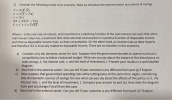 2) Consider the following model of an economy. Note we introduce the external sector as a source of savings. Y = F(R,N) C = C(Y-TA I = I(r) NX = NX(Y-TA) Y = C +I+G+NX Wherer is the real rate of interest, and investment is a declining function of the real interest rate such that when real interest rates rise, investment falls. Note also that consumption is a positive function of disposable income such that as disposable income rises, so...
1. Consider the following economy of Syldavia (a small open economy) Y=C+I+G+NX , NX = S-I...
1. Consider the following economy of Syldavia (a small open economy) Y=C+I+G+NX , NX = S-I Y=8000 G=750 T=750 C=1000+0.75(Y-T) I=1000-100r NX=500-500e r=r*=5 d. [ 5 points] Suppose the world interest rate drop from r=5 to 2percent (assume government G=750). Find the national saving, investment, trade balance, capital outflow and equilibrium exchange rate.
Recall the IS-LM model. In particular, the goods-market equilibrium condition was Y = C (Y −...
Recall the IS-LM model. In particular, the goods-market equilibrium condition was Y = C (Y − T ) + I (r) + G, and the money-market equilibrium condition was m = L (r, Y ). Here, the exogenous variables are G (government spending), T (taxes), and m (real money supply). The endogenous variables are Y (output, or income) and r (real interest rate). C (·) is the consumption function, which is increasing in disposable income Y − T , but...
Consider IS- LM Model Real Sector: Y C+IG C ab (1-t) Y I d-e t-income tax...
 Consider IS- LM Model Real Sector: Y C+IG C ab (1-t) Y I d-e t-income tax rate i-rate of interest G Go Money Market: Md Ms Md kY - Ms Mo Mo - exogenous stock of money 1) Setup the system of solutions in general form, with variables vector in the following order: Y, C, I, i; (6 points) 2) Now, suppose we have the following values of parameters: a 10; b 0.7;t= 0.2; d 25; k 0.25;1 0.04; e...
An economy is described by the following equations: C = 1,600 + 0.6(Y – T) –...
An economy is described by the following equations: C = 1,600 + 0.6(Y – T) – 2,000r IP = 2,500 – 1,000r G = 2,000 NX = 50 T = 2,000 The Bank of Lotusland, the central bank, has announced that it will set the real interest rate according to the policy reaction function found in the table below: Inflation rate, π Real interest rate, r 0.00 0.02 0.01 0.03 0.02 0.04 0.03 0.05 0.04 0.06 a. Find an equation...
Consider IS-LM Model: Real Sector: Y=C+I+G C=a+b (1-t) Y I=d-ei G=GO t-income tax rate i- rate...
 Consider IS-LM Model: Real Sector: Y=C+I+G C=a+b (1-t) Y I=d-ei G=GO t-income tax rate i- rate of interest Money Market: Ma=M Ma=ky-li M = Mo Mo - exogenous stock of money 1) Setup the system of solutions in general form, with variables vector in the following order: Y, C, I, i; (6 points) 2) Now, suppose we have the following values of parameters: a= 10; b = 0.7; t = 0.2; d = 25; k = 0.25; 1 = 0.04;...
Suppose that the following equations govern planned spending in the US: C = 500 + 0.75(Y-T) T = 0.2Y – 800 I = 3000 – 64000r G = 3200 NX = 1000 – 10e (e =“trade weighted” real ex. rate. As always, inc...
Suppose that the following equations govern planned spending in the US: C = 500 + 0.75(Y-T) T = 0.2Y – 800 I = 3000 – 64000r G = 3200 NX = 1000 – 10e (e =“trade weighted” real ex. rate. As always, increase in e = $ appreciation) NFO = 500 – 60000(r – r FOR) r FOR = 3% a) Explain how NFO responds to an increase in the Home interest rate, and an increase r FOR, based on...
 Consider the Mundel-Fleming small open economy model: Y=C(Y-T)+1(1) + G Y = F(K,L) (M/P) L(r+z® Y) Goods Money C = 50+0.8(Y- T) M 3000 I = 200-20r r*=5 NX = 200-508 P = 3 G=T= 150 L(Y, r) Y - 30r 1- find the IS* equation (hint : y as a function of e) 2- find the LM* equation (hint, also relates y and maybe e) 3-draw the IS-LM curve I y 4- find the equilibrium interest rate (trick question!)...
 4. An economy can be described by the following equations: C = 5+.8(Y-T) I = 2-r G = 2 T = 2 L(r,Y) = 4 + 4y -.5r M = 2 P=1 Solve algebraically for an equation for the IS curve (with 'r' on the left-hand side). Do the same for the LM curve. Finally, solve for the equilibrium values of 'r' and 'Y' in the ISLM model:
 4. Points = 18. Consider IS-LM Model: Real Sector: Y=C+I+G C = a +b (1-t) Y I=d-ei G=Go t-income tax rate i-rate of interest Money Market: Ma=M Ma= kY-li Mg = Mo Mo - exogenous stock of money 1) Setup the system of solutions in general form, with variables vector in the following order: Y, C, I, i; (6 points) 2) Now, suppose we have the following values of parameters: a = 10; b = 0.7; t = 0.2; d...
 2) Consider the following model of an economy. Note we introduce the external sector as a source of savings. Y = F(R,N) C = C(Y-TA I = I(r) NX = NX(Y-TA) Y = C +I+G+NX Wherer is the real rate of interest, and investment is a declining function of the real interest rate such that when real interest rates rise, investment falls. Note also that consumption is a positive function of disposable income such that as disposable income rises, so...
 Consider IS- LM Model Real Sector: Y C+IG C ab (1-t) Y I d-e t-income tax rate i-rate of interest G Go Money Market: Md Ms Md kY - Ms Mo Mo - exogenous stock of money 1) Setup the system of solutions in general form, with variables vector in the following order: Y, C, I, i; (6 points) 2) Now, suppose we have the following values of parameters: a 10; b 0.7;t= 0.2; d 25; k 0.25;1 0.04; e...
 Consider IS-LM Model: Real Sector: Y=C+I+G C=a+b (1-t) Y I=d-ei G=GO t-income tax rate i- rate of interest Money Market: Ma=M Ma=ky-li M = Mo Mo - exogenous stock of money 1) Setup the system of solutions in general form, with variables vector in the following order: Y, C, I, i; (6 points) 2) Now, suppose we have the following values of parameters: a= 10; b = 0.7; t = 0.2; d = 25; k = 0.25; 1 = 0.04;...
Most questions answered within 3 hours.
-
Where is the error in this code sequence?
String s1 = "Hello";
String s2 = "ello";...
asked 10 months ago -
Financial data for Joel de Paris, Inc., for last year
follow:
Joel de Paris, Inc.
Balance...
asked 10 months ago -
Consider this reaction:
Al2(SO4)3 (aq)+ BaCl3
(aq) Al2Cl6 (aq)- +
3BaSO4(s) . What is the...
asked 10 months ago -
Suppose that Savneet is considering increasing her
recent random sample from 20 car rentals to 40...
asked 10 months ago -
Trucks arrive at an unloading terminal at an average rate of 120
per hour.
Trucks arrive...
asked 10 months ago -
Why are methanol and ethanol completely soluble in water while
octanol is not very little soluble....
asked 10 months ago -
A facilities manager at a university reads in a research report
that the mean amount of...
asked 10 months ago -
When the CuSO4 is rehydrated by adding water to the anhydrous
compound, is this an endothermic...
asked 10 months ago -
A ray of sunlight is passing from diamond into crown glass; the
angle of incidence is...
asked 10 months ago -
A block of mass 0.249 kg is placed on top of a light, vertical
spring of...
asked 10 months ago -
how do the kidneys compensate in the presences of acidosis
a) trigger hyperventilate
b) reserve acid...
asked 10 months ago -
Question 501 pts
The rental rate of capital to the firm increases. Which of the
following...
asked 10 months ago