What happens to the [ADP] / [ATP] and [NAD+] / [NADH] ratios in red blood cells...
What happens to the [ADP] / [ATP] and [NAD+] / [NADH] ratios in red blood cells with a pyruvate kinase deficiency?
Homework Answers
The pyruvate kinase reaction
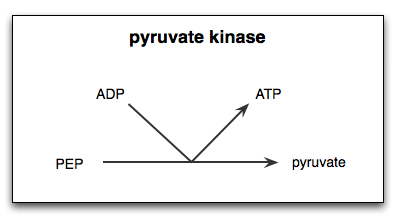
RegulationThis reaction has a large negative free energy change, one of three in glycolysis. All three such steps regulate the overall activity of the pathway, and are, in general, irreversible under wild-type conditions.
Pyruvate kinase activity is regulated by
- Its own substrate PEP and fructose 1,6-bisphosphate, an intermediate in glycolysis, both of which enhance enzymatic activity. Thus, glycolysis is driven to operate faster when more substrate is present.
- ATP is a negative allosteric inhibitor. This accounts for parallel regulation with PFK 1.
- It is not known whether citrate plays a role in negative allosteric inhibition, however it is believed that acetyl-CoA does.
- Alanine, a negative allosteric modulator
This protein may use the morpheein model of allosteric regulation. [1]
Like PFK, pyruvate kinase is regulated both by allosteric effectors and by covalent modification (phosphorylation). Pyruvate kinase is activated by F-1,6-BP in the liver, a second example of feedforward stimulation. ATP and alanine (a biosynthetic product of pyruvate) act as allosteric inhibitors of pyruvate kinase.
Liver pyruvate kinase is also regulated indirectly by epinephrine and glucagon, through protein kinase A. This protein kinase phosphorylates liver pyruvate kinase to deactivate it. Muscle pyruvate kinase is not inhibited by epinephrine activation of protein kinase A. Glucagon signals fasting (no glucose available). Thus, glycolysis is inhibited in the liver but unaffected in muscle when fasting. An increase in blood sugar leads to secretion of insulin, which activates phosphoprotein phosphatase I, leading to dephosphorylation and activation of pyruvate kinase. These controls prevent pyruvate kinase from being active at the same time as the enzymes that catalyze the reverse reaction (pyruvate carboxylase and phosphoenolpyruvate carboxykinase), preventing a futile cycle.
In fact, to say that the forward reaction and reverse reaction are not both active simultaneously may not be entirely accurate. Futile cycles, also known as substrate cycles, are known to fine-tune flux through metabolic pathways.
Add Answer to:
What happens to the [ADP] / [ATP] and [NAD+] / [NADH] ratios in
red blood cells...
A D FADH, FAD 2 H + %02 H2O NADH NAD ADP + P ATP A...
 A D FADH, FAD 2 H + %02 H2O NADH NAD ADP + P ATP A What is the name of the process involving ATP synthase? Active transport of ATP Cotransport Electron transport Chemiosmosis Substrate-level phosphorylation
Add coefficients to the reaction summary to show the net results of glycolysis. glucose+? ADP+? Pi+? NAD+⟶? pyruvate+? A...
Add coefficients to the reaction summary to show the net results of glycolysis. glucose+? ADP+? Pi+? NAD+⟶? pyruvate+? ATP+? NADHglucose+a ADP+b Pi+c NAD+⟶x pyruvate+y ATP+z NADH You do not need to add the water and hydrogen ions necessary to balance the overall reaction. Then, Draw the structure of pyruvate at pH 7.4.
NADH --> NAD+ + 2e- + H+ Question options: demonstrates that NADH can reduce to other...
NADH --> NAD+ + 2e- + H+ Question options: demonstrates that NADH can reduce to other molecules is the equation for the reduction of NADH is the equation for the oxidation of NADH demonstrates that NADH can donate e- to other molecules Glycolysis results in Question options: the synthesis of ATP via substrate-level phosphorylation the complete oxidation of glucose the reduction of electron carriers the sythesis of ATP via oxidative phosphorylation Pyruvate oxidation (which happens twice for every molecule of...
1. Which one of the following shows the correct sequence of energy transitions during chemiosmosis? A. NADH → electron acceptors → proton gradient → ATP synthase → ATP B. NADH → NAD+ → FADH2 → electro...
1. Which one of the following shows the correct sequence of energy transitions during chemiosmosis? A. NADH → electron acceptors → proton gradient → ATP synthase → ATP B. NADH → NAD+ → FADH2 → electron acceptors → ATP C. carbohydrates → acetyl CoA → CO2 → proton gradient → ATP D. NAD+ → NADH → protons → ADP → ATP E. glucose → pyruvate → acetyl CoA → NADH → ATP 2. Facultative anaerobes: A. prefer carbon dioxide. B....
Question 3 1 pts How many of the molecules below are products of glycolysis? ATP ADP...
 Question 3 1 pts How many of the molecules below are products of glycolysis? ATP ADP NADH Pyruvate Acetyl-CoA CO2 FADH2 Water Oxygen Glucose FADH NAD
Calculate what the net ATP yield (i.e., taking into consideration both consumption and production) of glycolysis...
Calculate what the net ATP yield (i.e., taking into consideration both consumption and production) of glycolysis would be in the complete absence of pyruvate kinase (PK) A deficiency in the glycolytic enzyme PK, is one of the most common enzymatic defects of the red blood cell, with a frequency of about 51 cases per million individuals. This deficiency arises from a mutation in the PK gene that causes a less efficient (but still active) PK to be produced. There are...
ve the overall reaction ATP + glucose→glucose-6-phosphate + ADP + H. lf the &G" of ATP...
 ve the overall reaction ATP + glucose→glucose-6-phosphate + ADP + H. lf the &G" of ATP hydrolysis is /mol, what is AG for the coupled reaction? A. 46 kJ/mo B-18.4 kJ/mol C. -32.2 kJ/mol D. 18.4kJ/mol 26. Which of the following is true about oxidation-reduction reactions? A. B. C. D. During oxidation a compound gains electrons. Every oxidation must be accompanied by a reduction Dehydrogenases typically remove two electrons and two hydrides (H). There are four commonly accessed oxidation states...
At what ratios of ATP/ADP will the inhibition of PFK-1 be most diminished and why? =...
At what ratios of ATP/ADP will the inhibition of PFK-1 be most diminished and why? = High ratios because the high amount of ATP encourages the body to transport ATP elsewhere leading to lower inhibition = High ratios because ADP inhibits PFK = Low ratios because the adenosine nucleotides are disappearing = Low ratios because the nucleotide pool is constant so a low ratio indicates a high amount of ADP
1. What is the importance of NAD+/NADH to cellular respiration? 2. Be able to write out...
1. What is the importance of NAD+/NADH to cellular respiration? 2. Be able to write out the biochemical equations for glucose respiration and photosynthesis AND label the oxidizing and reducing agents in each reaction. 3. What are the three stages of cellular respiration and where does each occur in the cell? 4. During cellular respiration, what is the role of each of these molecules: glucose, pyruvate, ATP, NAD+, FAD, NADH, FADH2, acetyl CoA, CO2, H2O, and O2? 5. For each...
This is a biochemistry question i need answers to 6-12 What is the purpose of fermentation...
 This is a biochemistry question i need answers to 6-12
What is the purpose of fermentation of pyruvate to lactate or ethanol? to produce additional ATP to provide a precursor for lactose synthesis to regenerate NAD* for glycolysis to prevent pyruvate from entering the TCA cycle none of the above Pyruvate kinase catalyzes what reaction? conversion of phosphoenol-pyruvate to pyruvate phosphorylation of pyruvate to 3-phosphoglycerate conversion of pyruvate to acetaldehyde and CO_2 conversion of pyruvate to lactate conversion of pyruvate...
This is a biochemistry question i need answers to 6-12
What is the purpose of fermentation of pyruvate to lactate or ethanol? to produce additional ATP to provide a precursor for lactose synthesis to regenerate NAD* for glycolysis to prevent pyruvate from entering the TCA cycle none of the above Pyruvate kinase catalyzes what reaction? conversion of phosphoenol-pyruvate to pyruvate phosphorylation of pyruvate to 3-phosphoglycerate conversion of pyruvate to acetaldehyde and CO_2 conversion of pyruvate to lactate conversion of pyruvate...
 A D FADH, FAD 2 H + %02 H2O NADH NAD ADP + P ATP A What is the name of the process involving ATP synthase? Active transport of ATP Cotransport Electron transport Chemiosmosis Substrate-level phosphorylation
 Question 3 1 pts How many of the molecules below are products of glycolysis? ATP ADP NADH Pyruvate Acetyl-CoA CO2 FADH2 Water Oxygen Glucose FADH NAD
 ve the overall reaction ATP + glucose→glucose-6-phosphate + ADP + H. lf the &G" of ATP hydrolysis is /mol, what is AG for the coupled reaction? A. 46 kJ/mo B-18.4 kJ/mol C. -32.2 kJ/mol D. 18.4kJ/mol 26. Which of the following is true about oxidation-reduction reactions? A. B. C. D. During oxidation a compound gains electrons. Every oxidation must be accompanied by a reduction Dehydrogenases typically remove two electrons and two hydrides (H). There are four commonly accessed oxidation states...
 This is a biochemistry question i need answers to 6-12
What is the purpose of fermentation of pyruvate to lactate or ethanol? to produce additional ATP to provide a precursor for lactose synthesis to regenerate NAD* for glycolysis to prevent pyruvate from entering the TCA cycle none of the above Pyruvate kinase catalyzes what reaction? conversion of phosphoenol-pyruvate to pyruvate phosphorylation of pyruvate to 3-phosphoglycerate conversion of pyruvate to acetaldehyde and CO_2 conversion of pyruvate to lactate conversion of pyruvate...
This is a biochemistry question i need answers to 6-12
What is the purpose of fermentation of pyruvate to lactate or ethanol? to produce additional ATP to provide a precursor for lactose synthesis to regenerate NAD* for glycolysis to prevent pyruvate from entering the TCA cycle none of the above Pyruvate kinase catalyzes what reaction? conversion of phosphoenol-pyruvate to pyruvate phosphorylation of pyruvate to 3-phosphoglycerate conversion of pyruvate to acetaldehyde and CO_2 conversion of pyruvate to lactate conversion of pyruvate...
Most questions answered within 3 hours.
-
Where is the error in this code sequence?
String s1 = "Hello";
String s2 = "ello";...
asked 11 months ago -
Financial data for Joel de Paris, Inc., for last year
follow:
Joel de Paris, Inc.
Balance...
asked 11 months ago -
Consider this reaction:
Al2(SO4)3 (aq)+ BaCl3
(aq) Al2Cl6 (aq)- +
3BaSO4(s) . What is the...
asked 11 months ago -
Suppose that Savneet is considering increasing her
recent random sample from 20 car rentals to 40...
asked 11 months ago -
Trucks arrive at an unloading terminal at an average rate of 120
per hour.
Trucks arrive...
asked 11 months ago -
Why are methanol and ethanol completely soluble in water while
octanol is not very little soluble....
asked 11 months ago -
A facilities manager at a university reads in a research report
that the mean amount of...
asked 11 months ago -
When the CuSO4 is rehydrated by adding water to the anhydrous
compound, is this an endothermic...
asked 11 months ago -
A ray of sunlight is passing from diamond into crown glass; the
angle of incidence is...
asked 11 months ago -
A block of mass 0.249 kg is placed on top of a light, vertical
spring of...
asked 11 months ago -
how do the kidneys compensate in the presences of acidosis
a) trigger hyperventilate
b) reserve acid...
asked 11 months ago -
Question 501 pts
The rental rate of capital to the firm increases. Which of the
following...
asked 11 months ago