
Homework Answers
Ans: Second law of thermodynamics means second equation in thermodynamics and it is expressed in terms of entropy(it means a thermodynamic quantity of a system's thermal energy for conversion into mechanical work).Second law of thermodynamics states that heat cannot suddenly flow from a cold object to a hot object in a closed system as it may violate the equation.It also states that the change in entropy in the whole universe can never be negative.
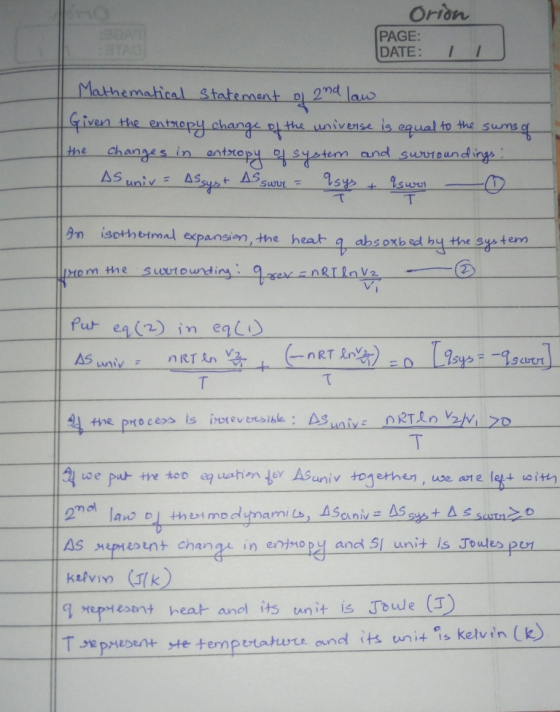
Mathematical representation of second law of thermodynamics:
I have sent the image of mathematical representation, I have explained each and every term and also the untis in SI form.
Add Answer to:
S 5 Write what express the Second law of thermodynamics. Write the mathematical formulation and describe...
A) First explain what is the first-law of thermodynamics; Give a common mathematical equation we use...
A) First explain what is the first-law of thermodynamics; Give a common mathematical equation we use for the first-law of thermodynamics (be sure to explain all variables in your equation) Give one example of spontaneous process; and one example of non-spontaneous process State second-law of thermodynamics in terms of entropy change What is the units of Entropy? What does entropy measure? If a gas is heated up, what happens to its entropy? If a gas is allowed to expand, what...
Can you describe what's QH and QL in the second law of thermodynamics?
Can you describe what's QH and QL in the second law of thermodynamics?
5. According to the second law of thermodynamics, what happens when a process takes place in...
5. According to the second law of thermodynamics, what happens when a process takes place in an isolated system? a.Entropy is a function of the absolute temperature. b.Entropy decreases. c.Entropy remains the same. d.Entropy increases. e.Entropy is a function of the work done.
Second Law of Thermodynamics Learning Goal: To understand the implications of the second law of thermodynamics...
Second Law of Thermodynamics Learning Goal: To understand the implications of the second law of thermodynamics. The second law of thermodynamics explains the direction in which the thermodynamic processes tend to go. That is, it limits the types of final states of the system that naturally evolve from a given initial state. The second law has many practical applications. For example it explains the limits of efficiency for heat engines and refrigerators. To develop a better understanding of this law,...
ECE Concepts hw help? 1a Explain Ohm's law in words. Express Ohm's law in a mathematical...
ECE Concepts hw help? 1a Explain Ohm's law in words. Express Ohm's law in a mathematical rela- tion. b. What are the units of voltage, current, resistance? c. Make a V-I (voltage vs. current) plot that characterizes a resistor. Mark the units for all quantities involved. d. What is a DC source? An AC source? What are the symbols for DC and AC sources in a circuit?
explain the relationship between the Law of Diffusion and the 2nd Law of Thermodynamics. What process(s)...
explain the relationship between the Law of Diffusion and the 2nd Law of Thermodynamics. What process(s) are available to cells to reverse the effects of the 2nd Law of Thermodynamics when it comes to molecules entering and exiting cells? Explain.
5. The total entropy of a system and its surroundings always increases for a spontaneous process is a statement bt a) the third law of thermodynamics. b) the second law of thermodynamics c) the l...
 5. The total entropy of a system and its surroundings always increases for a spontaneous process is a statement bt a) the third law of thermodynamics. b) the second law of thermodynamics c) the law of constant composition d) the law of conservation of matter e) the first law of thermodynamics 6. Which of the following is a redox reaction? 7. A certain electrochemical cell has for its cell reaction Zn Hgo occurring at the anode? Zno Hg Which is...
According to the second law of thermodynamics, the quality of energy changes over time. What sort...
According to the second law of thermodynamics, the quality of energy changes over time. What sort of significance does this hold for living organisms?
The second law of thermodynamics states that the entropy of a closed system always increases. Cellular...
The second law of thermodynamics states that the entropy of a closed system always increases. Cellular systems take disordered substrates to construct highly ordered molecules and organelles. How can photosynthesis be used to make glucose without violating this law? Note: glucose is more a ordered molecule then the CO2 used to construct it.
Question B3 (25 Marks Write down a mathematical expression for the First Law of Thermodynamics as applied to steady state, steady flow process, explaining clearly the notation and sign conventions us...
 Question B3 (25 Marks Write down a mathematical expression for the First Law of Thermodynamics as applied to steady state, steady flow process, explaining clearly the notation and sign conventions used. (5 marks) Consider steady state, steady flow of steam through a turbine used for electricity generation. You may assume that the process is adiabatic. The steam inlet and exit conditions are; Inlet Exit 15.0 0.01 Pressure (MPa) TemperatureC Velocity (m/s 500 40 80 Fraction 0.92 P, 15.0 MPa T,-500C...
 5. The total entropy of a system and its surroundings always increases for a spontaneous process is a statement bt a) the third law of thermodynamics. b) the second law of thermodynamics c) the law of constant composition d) the law of conservation of matter e) the first law of thermodynamics 6. Which of the following is a redox reaction? 7. A certain electrochemical cell has for its cell reaction Zn Hgo occurring at the anode? Zno Hg Which is...
 Question B3 (25 Marks Write down a mathematical expression for the First Law of Thermodynamics as applied to steady state, steady flow process, explaining clearly the notation and sign conventions used. (5 marks) Consider steady state, steady flow of steam through a turbine used for electricity generation. You may assume that the process is adiabatic. The steam inlet and exit conditions are; Inlet Exit 15.0 0.01 Pressure (MPa) TemperatureC Velocity (m/s 500 40 80 Fraction 0.92 P, 15.0 MPa T,-500C...
Most questions answered within 3 hours.
-
Where is the error in this code sequence?
String s1 = "Hello";
String s2 = "ello";...
asked 10 months ago -
Financial data for Joel de Paris, Inc., for last year
follow:
Joel de Paris, Inc.
Balance...
asked 10 months ago -
Consider this reaction:
Al2(SO4)3 (aq)+ BaCl3
(aq) Al2Cl6 (aq)- +
3BaSO4(s) . What is the...
asked 10 months ago -
Suppose that Savneet is considering increasing her
recent random sample from 20 car rentals to 40...
asked 10 months ago -
Trucks arrive at an unloading terminal at an average rate of 120
per hour.
Trucks arrive...
asked 10 months ago -
Why are methanol and ethanol completely soluble in water while
octanol is not very little soluble....
asked 10 months ago -
A facilities manager at a university reads in a research report
that the mean amount of...
asked 10 months ago -
When the CuSO4 is rehydrated by adding water to the anhydrous
compound, is this an endothermic...
asked 10 months ago -
A ray of sunlight is passing from diamond into crown glass; the
angle of incidence is...
asked 10 months ago -
A block of mass 0.249 kg is placed on top of a light, vertical
spring of...
asked 10 months ago -
how do the kidneys compensate in the presences of acidosis
a) trigger hyperventilate
b) reserve acid...
asked 10 months ago -
Question 501 pts
The rental rate of capital to the firm increases. Which of the
following...
asked 10 months ago