CHEM how does the time independent schrodinger equation (Hpsi=E*psi) give us total energy and what exactly...
Homework Answers
The time-independent Schrodinger equation :
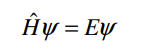
where E is a constant equal to the energy level of the system.and also called eigenvalue of the hamiltonian operator.
 -
Eigenfunction. of the hamiltonian operator.
-
Eigenfunction. of the hamiltonian operator.
In classical mechanics, the total energy (sum of kinetic and potential energy) is called the Hamiltonian.
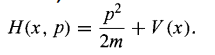
The corresponding Hamiltonian operator can be written as :
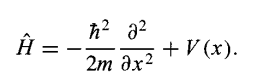
For a single particle in the non-relativistic limit:

P is the momentum eigenvector.
As the hamiltonian operator represents the sum of kinetic and potential energy, therefore the time-independent Schrodinger equation gives us the total energy.
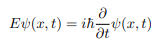
The product of energy times the wave function Eψ(x,
t) is equal to the first derivative of the wave function
with respect to time multiplied by 
Add Answer to:
CHEM
how does the time independent schrodinger equation
(Hpsi=E*psi) give us total energy and what exactly...
The Schrodinger equation for a particle in a ring can be expressed as H cap psi(phi)...
 The Schrodinger equation for a particle in a ring can be expressed as H cap psi(phi) = E psi(phi), where H cap = -h^2 partial^2/21 partial phi^2; psi(phi) = 1/squareroot 2 pi e^-ik phi, k is an integer What is the potential energy? What is the kinetic energy? Write the Schrodinger equation Derive the eigenvalue Show that psi(phi) = psi(phi + 2 pi) Derive an expression for the probability density for a particle in a ring?
b. The 1-D time-independent Schrodinger equation for the stationary states of a harmonic oscillator is given...
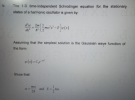 b. The 1-D time-independent Schrodinger equation for the stationary states of a harmonic oscillator is given by: Assuming that the simplest solution is the Gaussian wave function of the form: 4(x) = Copa Show that: a mo and E no
2. Schrodinger equation In quantum mechanics, physical quantities cor- respond to Hermitian operators. In particular, the...
 2. Schrodinger equation In quantum mechanics, physical quantities cor- respond to Hermitian operators. In particular, the total energy of the system corresponds to the Hamiltonian operator H, which is a hermitian operator The 'state of the system' is a time dependent vector in an inner product space, l(t)). The state of the system obeys the Schrodinger equation We assume that there are no time-varying external forces on the system, so that the Hamiltonian operator H is not itself time-dependent a)...
The time-independent Schroedinger equation is given by: − Wave functions that satisfy this equation are called...
 The time-independent Schroedinger equation is given by:
− Wave functions that satisfy this equation are called energy
eigenstates. a) If U=0 for all positions, this represents a free
particle. For a wave function with definite momentum ℏ,, compute E.
b) Is the relationship derived from a) consistent with what we know
from classical mechanics for a free particle? Explain how or how
not. c) Consider the wave function ((^b[j + ^bâj), with A some
number and c, d not equal...
The time-independent Schroedinger equation is given by:
− Wave functions that satisfy this equation are called energy
eigenstates. a) If U=0 for all positions, this represents a free
particle. For a wave function with definite momentum ℏ,, compute E.
b) Is the relationship derived from a) consistent with what we know
from classical mechanics for a free particle? Explain how or how
not. c) Consider the wave function ((^b[j + ^bâj), with A some
number and c, d not equal...
1. Which statement is true about the H-atom and explain why. a. The energy state does...
 1. Which statement is true about the H-atom and explain why. a. The energy state does not depend on the azimuthal quantum number, 1 b. Energy levels become more widely separated as the principle quantum rumber, n, increases c. The total number of nodes in a wave function is equal to twice the quantum number, n d. The 3dxy orbital has 1 angular node and 1 radial node 2. There are many mathematical acceptable solutions to the Schrodinger equation for...
Potential energy function, V(x) = (1/2)mw2x2 Assuming the time-independent Schrödinger equation, show that the following wave...
 Potential energy function,
V(x) = (1/2)mw2x2
Assuming the time-independent Schrödinger equation, show that the following wave functions are solutions describing the one-dimensional harmonic behaviour of a particle of mass m, where ?2-h/v/mK, and where co and ci are constants. Calculate the energies of the particle when it is in wave-functions ?0(x) and V1 (z) What is the general expression for the allowed energies En, corresponding to wave- functions Un(x), of this one-dimensional quantum oscillator? 6 the states corresponding to the...
Potential energy function,
V(x) = (1/2)mw2x2
Assuming the time-independent Schrödinger equation, show that the following wave functions are solutions describing the one-dimensional harmonic behaviour of a particle of mass m, where ?2-h/v/mK, and where co and ci are constants. Calculate the energies of the particle when it is in wave-functions ?0(x) and V1 (z) What is the general expression for the allowed energies En, corresponding to wave- functions Un(x), of this one-dimensional quantum oscillator? 6 the states corresponding to the...
2. The hydrogen atom [8 marks] The time-independent Schrödinger equation for the hydrogen atom in...
 2. The hydrogen atom [8 marks] The time-independent Schrödinger equation for the hydrogen atom in the spherical coordinate representation is where ao-top- 0.5298 10-10rn is the Bohr radius, and μ is the electon-proton reduced mass. Here, the square of the angular momentum operator L2 in the spherical coordinate representation is given by: 2 (2.2) sin θー sin θ 00 The form of the Schrödinger equation means that all energy eigenstates separate into radial and angular motion, and we can write...
4. Consider the time-independent Schrödinger equation for an "atom" in which the attractive force...
 4. Consider the time-independent Schrödinger equation for an "atom" in which the attractive force between the electron and the proton is modeled as a spring. Then V(r)- (1/2)mu22, where m is the mass of the electron and w is the natural frequency of oscillation You're goal is to determine the eigenenergies of the electron and the corresponding wave functions, as outlined below Let's again start with the radial equation associated with the Schrodinge equation 4.37 in Griffiths [where u(r) R(r)...
i) Write the time-independent Scrödinger wave equation for helium (He) and H + 2 atoms. ii)...
i) Write the time-independent Scrödinger wave equation for helium (He) and H + 2 atoms. ii) If interactions between electrons are ignored in these equations, find the energy of the system in terms of electronvolt (eV). iii) Write the spin wave function of a system consisting of two electrons. iv) Specify how the angular momentum of an electron is defined according to classical mechanics, bohr atomic theory, and quantum mechanics, and the values it will take. note: Please show all...
how does the fatigue testing machine work ? what does it give us ? and what...
how does the fatigue testing machine work ? what does it give us ? and what can we conclude based on its results ? and what are the steps used in this experiment?
 The Schrodinger equation for a particle in a ring can be expressed as H cap psi(phi) = E psi(phi), where H cap = -h^2 partial^2/21 partial phi^2; psi(phi) = 1/squareroot 2 pi e^-ik phi, k is an integer What is the potential energy? What is the kinetic energy? Write the Schrodinger equation Derive the eigenvalue Show that psi(phi) = psi(phi + 2 pi) Derive an expression for the probability density for a particle in a ring?
 b. The 1-D time-independent Schrodinger equation for the stationary states of a harmonic oscillator is given by: Assuming that the simplest solution is the Gaussian wave function of the form: 4(x) = Copa Show that: a mo and E no
 2. Schrodinger equation In quantum mechanics, physical quantities cor- respond to Hermitian operators. In particular, the total energy of the system corresponds to the Hamiltonian operator H, which is a hermitian operator The 'state of the system' is a time dependent vector in an inner product space, l(t)). The state of the system obeys the Schrodinger equation We assume that there are no time-varying external forces on the system, so that the Hamiltonian operator H is not itself time-dependent a)...
 The time-independent Schroedinger equation is given by:
− Wave functions that satisfy this equation are called energy
eigenstates. a) If U=0 for all positions, this represents a free
particle. For a wave function with definite momentum ℏ,, compute E.
b) Is the relationship derived from a) consistent with what we know
from classical mechanics for a free particle? Explain how or how
not. c) Consider the wave function ((^b[j + ^bâj), with A some
number and c, d not equal...
The time-independent Schroedinger equation is given by:
− Wave functions that satisfy this equation are called energy
eigenstates. a) If U=0 for all positions, this represents a free
particle. For a wave function with definite momentum ℏ,, compute E.
b) Is the relationship derived from a) consistent with what we know
from classical mechanics for a free particle? Explain how or how
not. c) Consider the wave function ((^b[j + ^bâj), with A some
number and c, d not equal...
 1. Which statement is true about the H-atom and explain why. a. The energy state does not depend on the azimuthal quantum number, 1 b. Energy levels become more widely separated as the principle quantum rumber, n, increases c. The total number of nodes in a wave function is equal to twice the quantum number, n d. The 3dxy orbital has 1 angular node and 1 radial node 2. There are many mathematical acceptable solutions to the Schrodinger equation for...
 Potential energy function,
V(x) = (1/2)mw2x2
Assuming the time-independent Schrödinger equation, show that the following wave functions are solutions describing the one-dimensional harmonic behaviour of a particle of mass m, where ?2-h/v/mK, and where co and ci are constants. Calculate the energies of the particle when it is in wave-functions ?0(x) and V1 (z) What is the general expression for the allowed energies En, corresponding to wave- functions Un(x), of this one-dimensional quantum oscillator? 6 the states corresponding to the...
Potential energy function,
V(x) = (1/2)mw2x2
Assuming the time-independent Schrödinger equation, show that the following wave functions are solutions describing the one-dimensional harmonic behaviour of a particle of mass m, where ?2-h/v/mK, and where co and ci are constants. Calculate the energies of the particle when it is in wave-functions ?0(x) and V1 (z) What is the general expression for the allowed energies En, corresponding to wave- functions Un(x), of this one-dimensional quantum oscillator? 6 the states corresponding to the...
 2. The hydrogen atom [8 marks] The time-independent Schrödinger equation for the hydrogen atom in the spherical coordinate representation is where ao-top- 0.5298 10-10rn is the Bohr radius, and μ is the electon-proton reduced mass. Here, the square of the angular momentum operator L2 in the spherical coordinate representation is given by: 2 (2.2) sin θー sin θ 00 The form of the Schrödinger equation means that all energy eigenstates separate into radial and angular motion, and we can write...
 4. Consider the time-independent Schrödinger equation for an "atom" in which the attractive force between the electron and the proton is modeled as a spring. Then V(r)- (1/2)mu22, where m is the mass of the electron and w is the natural frequency of oscillation You're goal is to determine the eigenenergies of the electron and the corresponding wave functions, as outlined below Let's again start with the radial equation associated with the Schrodinge equation 4.37 in Griffiths [where u(r) R(r)...
Most questions answered within 3 hours.
-
Where is the error in this code sequence?
String s1 = "Hello";
String s2 = "ello";...
asked 11 months ago -
Financial data for Joel de Paris, Inc., for last year
follow:
Joel de Paris, Inc.
Balance...
asked 11 months ago -
Consider this reaction:
Al2(SO4)3 (aq)+ BaCl3
(aq) Al2Cl6 (aq)- +
3BaSO4(s) . What is the...
asked 11 months ago -
Suppose that Savneet is considering increasing her
recent random sample from 20 car rentals to 40...
asked 11 months ago -
Trucks arrive at an unloading terminal at an average rate of 120
per hour.
Trucks arrive...
asked 11 months ago -
Why are methanol and ethanol completely soluble in water while
octanol is not very little soluble....
asked 11 months ago -
A facilities manager at a university reads in a research report
that the mean amount of...
asked 11 months ago -
When the CuSO4 is rehydrated by adding water to the anhydrous
compound, is this an endothermic...
asked 11 months ago -
A ray of sunlight is passing from diamond into crown glass; the
angle of incidence is...
asked 11 months ago -
A block of mass 0.249 kg is placed on top of a light, vertical
spring of...
asked 11 months ago -
how do the kidneys compensate in the presences of acidosis
a) trigger hyperventilate
b) reserve acid...
asked 11 months ago -
Question 501 pts
The rental rate of capital to the firm increases. Which of the
following...
asked 11 months ago