

Homework Answers
There no change pH at equivalence point. pH only depends on only concetraconce of H+ only. If you add more water there no change in H+ ions. Therefore they no pH change with dilution.
Add Answer to:
If the weak acid titration was repeated with the same weak acid used in this experiment...
Would you expect the pH at the equivalence point to be higher, lower or the same?...
 Would you expect the pH at the equivalence point to be higher,
lower or the same? Explain.
3. If the weak acid titration was repeated with the same weak acid used in this experiment but 150 ml of distilled water was added to the beaker instead of 80 ml, would you expect the pH at the equivalence point to be higher, lower, or the same? Explain.
Would you expect the pH at the equivalence point to be higher,
lower or the same? Explain.
3. If the weak acid titration was repeated with the same weak acid used in this experiment but 150 ml of distilled water was added to the beaker instead of 80 ml, would you expect the pH at the equivalence point to be higher, lower, or the same? Explain.
It's a weak acid strong base titration Experiment 4: Identification of an unknown acid by titration...
 It's a weak acid strong base titration
Experiment 4: Identification of an unknown acid by titration Page 2 of 15 Background In this experiment, you will use both qualitative and quantitative properties to determine an unknown acid's identity and concentration. To do this analysis, you will perform a titration of your unknown acid sample-specifically a potentiometric titration where you use a pH meter and record pH values during the titration, combined with a visual titration using a color indi- cator...
It's a weak acid strong base titration
Experiment 4: Identification of an unknown acid by titration Page 2 of 15 Background In this experiment, you will use both qualitative and quantitative properties to determine an unknown acid's identity and concentration. To do this analysis, you will perform a titration of your unknown acid sample-specifically a potentiometric titration where you use a pH meter and record pH values during the titration, combined with a visual titration using a color indi- cator...
Focus on Step A5 of the procedure, where one partner prepared their sample for visual titration...
 Focus on Step A5 of the procedure, where one
partner prepared their sample for visual titration by adding
approximately 100mL of water to the to
sample in the plastic cup or beaker before beginning the
titration.
Note that this step was also repeated in the potentiometric
(pH-meter) titration in Part 2 (Step A7).
In both cases, the addition of more water was an experimental
necessity, to allow the solution to be stirred easily and to ensure
that the pH probe...
Focus on Step A5 of the procedure, where one
partner prepared their sample for visual titration by adding
approximately 100mL of water to the to
sample in the plastic cup or beaker before beginning the
titration.
Note that this step was also repeated in the potentiometric
(pH-meter) titration in Part 2 (Step A7).
In both cases, the addition of more water was an experimental
necessity, to allow the solution to be stirred easily and to ensure
that the pH probe...
If the pH at the equivalence point for titration of a monoprotic weak acid with NaOH...
If the pH at the equivalence point for titration of a monoprotic weak acid with NaOH is 9.00, and 10 mL of base is required to reach the equivalence point, how would you determine the pKa of the acid? the pKa is 9.00 determine the pH after 5 mL of base is added; this is the pKa determine the pH when 20 mL of base is added; this is the pKa the pKa is -log(9)
Question: In the figure below, titration curves for strong acid with strong base and weak acid...
 Question: In the figure below, titration curves for strong acid
with strong base and weak acid with strong base are shown. Compare
the shapes of these curves early in the titration for three
different cases: titration of a strong acid, titration of a weak
acid with a lower pKa, and titration of a weak acid with a higher
pKa. Discuss with the class why the titration curve for weak acids
increase more rapidly early in the titration than do stronger...
Question: In the figure below, titration curves for strong acid
with strong base and weak acid with strong base are shown. Compare
the shapes of these curves early in the titration for three
different cases: titration of a strong acid, titration of a weak
acid with a lower pKa, and titration of a weak acid with a higher
pKa. Discuss with the class why the titration curve for weak acids
increase more rapidly early in the titration than do stronger...
1. What is the definition of an 'equivalence point' in an acid/base titration? (1 point) 2....
 1. What is the definition of an 'equivalence point' in an acid/base titration? (1 point) 2. In part one of the experiment, you will prepare the acid solutions being titrated from a stock solution. Describe how you will accurately prepare 10.00 mL of 0.100 M HCl solution using a 1.00 M HCl stock solution. In your response to this question, be very specific about the quantities of stock solution and deionized water to be used in the dilution and the...
In this experiment, you will titrate an unknown acid with a base. It will be important...
In this experiment, you will titrate an unknown acid with a base. It will be important for you to understand certain things about this titration in order to identify successfully your unknown. For all of the following questions, assume you are titrating an unknown monoprotic acid, HA, with NaOH solution. 0.146 g of HA is added to a beaker and made into a solution with ~100 mL of distilled water. As the titration proceeds, you keep track of the pH...
A student was conducting a titration experiment and was asked to calculate the theoretical pH of...
A student was conducting a titration experiment and was asked to calculate the theoretical pH of the solution at various points in the titration curve. In this experiment, the student added 47.812 ml of a 2.765M solution of acetic acid to a 200ml beaker. The student then added 92.1 ml of deionized water and began to stir. Calculate the theoretical pH at the following. Initial pH before addition of any NaOH? Be sure to consider the change in volume due...
can someone help me answer these 5 questions and figire this graph out please? Acid-Base Titration...
 can
someone help me answer these 5 questions and figire this graph out
please?
Acid-Base Titration of a Weak Acid with a Strong Base: Determination of K. Introduction: You will be titrating a solution of a weak acid with 0.100 M NaOH, while monitoring the reaction using a pH meter. Weak acids have characteristic acid-ionization constants, K. The purpose of this lab is to use the titration to determine the value of this constant for the weak acid called “benzoic...
can
someone help me answer these 5 questions and figire this graph out
please?
Acid-Base Titration of a Weak Acid with a Strong Base: Determination of K. Introduction: You will be titrating a solution of a weak acid with 0.100 M NaOH, while monitoring the reaction using a pH meter. Weak acids have characteristic acid-ionization constants, K. The purpose of this lab is to use the titration to determine the value of this constant for the weak acid called “benzoic...
16. In the titration of a wealk base with hydrochlori acid,a pH meter was used tofllow...
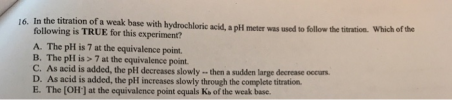 16. In the titration of a wealk base with hydrochlori acid,a pH meter was used tofllow the titration. Which of titration. Which of the following is TRUE for this experiment? A. The pH is 7 at the equivalence point. B. The pH is > 7 at the equivalence point. C. As acid is added, the pH decrease D. As acid is added, the pH increases slowly through the complete titration. E. The [OH] at the equivalence point equals Kb of...
 Would you expect the pH at the equivalence point to be higher,
lower or the same? Explain.
3. If the weak acid titration was repeated with the same weak acid used in this experiment but 150 ml of distilled water was added to the beaker instead of 80 ml, would you expect the pH at the equivalence point to be higher, lower, or the same? Explain.
Would you expect the pH at the equivalence point to be higher,
lower or the same? Explain.
3. If the weak acid titration was repeated with the same weak acid used in this experiment but 150 ml of distilled water was added to the beaker instead of 80 ml, would you expect the pH at the equivalence point to be higher, lower, or the same? Explain.
 It's a weak acid strong base titration
Experiment 4: Identification of an unknown acid by titration Page 2 of 15 Background In this experiment, you will use both qualitative and quantitative properties to determine an unknown acid's identity and concentration. To do this analysis, you will perform a titration of your unknown acid sample-specifically a potentiometric titration where you use a pH meter and record pH values during the titration, combined with a visual titration using a color indi- cator...
It's a weak acid strong base titration
Experiment 4: Identification of an unknown acid by titration Page 2 of 15 Background In this experiment, you will use both qualitative and quantitative properties to determine an unknown acid's identity and concentration. To do this analysis, you will perform a titration of your unknown acid sample-specifically a potentiometric titration where you use a pH meter and record pH values during the titration, combined with a visual titration using a color indi- cator...
 Focus on Step A5 of the procedure, where one
partner prepared their sample for visual titration by adding
approximately 100mL of water to the to
sample in the plastic cup or beaker before beginning the
titration.
Note that this step was also repeated in the potentiometric
(pH-meter) titration in Part 2 (Step A7).
In both cases, the addition of more water was an experimental
necessity, to allow the solution to be stirred easily and to ensure
that the pH probe...
Focus on Step A5 of the procedure, where one
partner prepared their sample for visual titration by adding
approximately 100mL of water to the to
sample in the plastic cup or beaker before beginning the
titration.
Note that this step was also repeated in the potentiometric
(pH-meter) titration in Part 2 (Step A7).
In both cases, the addition of more water was an experimental
necessity, to allow the solution to be stirred easily and to ensure
that the pH probe...
 Question: In the figure below, titration curves for strong acid
with strong base and weak acid with strong base are shown. Compare
the shapes of these curves early in the titration for three
different cases: titration of a strong acid, titration of a weak
acid with a lower pKa, and titration of a weak acid with a higher
pKa. Discuss with the class why the titration curve for weak acids
increase more rapidly early in the titration than do stronger...
Question: In the figure below, titration curves for strong acid
with strong base and weak acid with strong base are shown. Compare
the shapes of these curves early in the titration for three
different cases: titration of a strong acid, titration of a weak
acid with a lower pKa, and titration of a weak acid with a higher
pKa. Discuss with the class why the titration curve for weak acids
increase more rapidly early in the titration than do stronger...
 1. What is the definition of an 'equivalence point' in an acid/base titration? (1 point) 2. In part one of the experiment, you will prepare the acid solutions being titrated from a stock solution. Describe how you will accurately prepare 10.00 mL of 0.100 M HCl solution using a 1.00 M HCl stock solution. In your response to this question, be very specific about the quantities of stock solution and deionized water to be used in the dilution and the...
 can
someone help me answer these 5 questions and figire this graph out
please?
Acid-Base Titration of a Weak Acid with a Strong Base: Determination of K. Introduction: You will be titrating a solution of a weak acid with 0.100 M NaOH, while monitoring the reaction using a pH meter. Weak acids have characteristic acid-ionization constants, K. The purpose of this lab is to use the titration to determine the value of this constant for the weak acid called “benzoic...
can
someone help me answer these 5 questions and figire this graph out
please?
Acid-Base Titration of a Weak Acid with a Strong Base: Determination of K. Introduction: You will be titrating a solution of a weak acid with 0.100 M NaOH, while monitoring the reaction using a pH meter. Weak acids have characteristic acid-ionization constants, K. The purpose of this lab is to use the titration to determine the value of this constant for the weak acid called “benzoic...
 16. In the titration of a wealk base with hydrochlori acid,a pH meter was used tofllow the titration. Which of titration. Which of the following is TRUE for this experiment? A. The pH is 7 at the equivalence point. B. The pH is > 7 at the equivalence point. C. As acid is added, the pH decrease D. As acid is added, the pH increases slowly through the complete titration. E. The [OH] at the equivalence point equals Kb of...
Most questions answered within 3 hours.
-
Where is the error in this code sequence?
String s1 = "Hello";
String s2 = "ello";...
asked 10 months ago -
Financial data for Joel de Paris, Inc., for last year
follow:
Joel de Paris, Inc.
Balance...
asked 10 months ago -
Consider this reaction:
Al2(SO4)3 (aq)+ BaCl3
(aq) Al2Cl6 (aq)- +
3BaSO4(s) . What is the...
asked 10 months ago -
Suppose that Savneet is considering increasing her
recent random sample from 20 car rentals to 40...
asked 10 months ago -
Trucks arrive at an unloading terminal at an average rate of 120
per hour.
Trucks arrive...
asked 10 months ago -
Why are methanol and ethanol completely soluble in water while
octanol is not very little soluble....
asked 10 months ago -
A facilities manager at a university reads in a research report
that the mean amount of...
asked 10 months ago -
When the CuSO4 is rehydrated by adding water to the anhydrous
compound, is this an endothermic...
asked 10 months ago -
A ray of sunlight is passing from diamond into crown glass; the
angle of incidence is...
asked 10 months ago -
A block of mass 0.249 kg is placed on top of a light, vertical
spring of...
asked 10 months ago -
how do the kidneys compensate in the presences of acidosis
a) trigger hyperventilate
b) reserve acid...
asked 10 months ago -
Question 501 pts
The rental rate of capital to the firm increases. Which of the
following...
asked 10 months ago