
Homework Answers
From the DSO image,
Number of peak to peak division are 4 full and one is one fifth of ome division.
So total 4.2 division and volt/ division scale is at 5 m volt/ div.
So voltage will be # Of division * volt/ div
4.2* 5= 21 m V ( millivolt)
Similarly, the wave repeats after approximately 2.6 division ( on Y axis~ time axis)
And time per division scale is at 0.1 m second.
So time = 0.1 *2.6= 0.26 ms( milliseconds)
And frequency is 1/Time period
f= 1/.26 ms= 1000/ .26= 3846.15 Hz.
Add Answer to:
Compute the voltage, Period, and the frequency from the images of the waveform, voltage scale and...
Using images 6.6 – 6.8, determine the amplitude of the calibration waveform. Be sure to include...
 Using images 6.6 – 6.8, determine the amplitude of the
calibration waveform. Be sure to include proper units:
[Image 6.6 – Calibration Waveform Display]
[Image 6.7 – Calibration Waveform Vertical (VOLT/DIV)
Setting]
[Image 6.8 – Calibration Waveform Horizontal (TIME/DIV)
Setting]
# of vertical divisions
VOLT/DIV
Amplitude
Determine the period and calculate the frequency:
# of horizontal divisions
TIME/DIV
Period
Frequency
The calibration waveform has a specified amplitude of 2.0
VPP at a frequency of 1.0 Khz. How accurate is the...
Using images 6.6 – 6.8, determine the amplitude of the
calibration waveform. Be sure to include proper units:
[Image 6.6 – Calibration Waveform Display]
[Image 6.7 – Calibration Waveform Vertical (VOLT/DIV)
Setting]
[Image 6.8 – Calibration Waveform Horizontal (TIME/DIV)
Setting]
# of vertical divisions
VOLT/DIV
Amplitude
Determine the period and calculate the frequency:
# of horizontal divisions
TIME/DIV
Period
Frequency
The calibration waveform has a specified amplitude of 2.0
VPP at a frequency of 1.0 Khz. How accurate is the...
Calculate the amplitude, period and frequency of the voltage waveform shown in the graph.
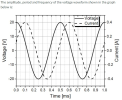 The amplitude, period and frequency of the voltage waveform shown in the graph below is:
Sine wave measurement: Images 6.9 – 6.12 show a sine wave. Note that Image 6.9 is...
 Sine wave measurement:
Images 6.9 – 6.12 show a sine wave. Note that Image 6.9 is a
close up of the function generator’s frequency display.
Using images 6.10 – 6.12, determine the amplitude of the sine
wave. Be sure to include proper units:
# of vertical divisions
VOLT/DIV
Amplitude
Determine the period and calculate the frequency:
# of horizontal divisions
TIME/DIV
Period
Frequency
Assuming that the frequency displayed in Image 6.9 is more
accurate than the oscilloscope, what is the...
Sine wave measurement:
Images 6.9 – 6.12 show a sine wave. Note that Image 6.9 is a
close up of the function generator’s frequency display.
Using images 6.10 – 6.12, determine the amplitude of the sine
wave. Be sure to include proper units:
# of vertical divisions
VOLT/DIV
Amplitude
Determine the period and calculate the frequency:
# of horizontal divisions
TIME/DIV
Period
Frequency
Assuming that the frequency displayed in Image 6.9 is more
accurate than the oscilloscope, what is the...
Q1:a) For the output waveform as shown below from oscilloscope determine the output voltages for inductive...
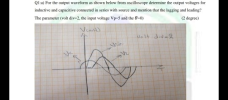 Q1:a) For the output waveform as shown below from oscilloscope determine the output voltages for inductive and capacitive connected in series with source and mention that the lagging and leading? The parameter (volt div=2, the input voltage Vp=5 and the 0=0) (2 degree) www.it Volt div-2 VL 4
If the period of a waveform is doubled, what happens to the frequency of that waveform?...
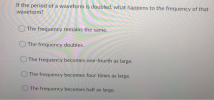 If the period of a waveform is doubled, what happens to the frequency of that waveform? The frequency remains the same. The frequency doubles. The frequency becomes one-fourth as large. The frequency becomes four times as large. The frequency becomes half as large.
QUESTION 1 Consider a sinusoidal waveform that has a frequency of 1 MHz. What is the...
 QUESTION 1 Consider a sinusoidal waveform that has a frequency of 1 MHz. What is the period of this waveform? If the TIME/DIV knob on the scope is set at 0.2 microseconds and the scope screen is divided into 10 major gridlines on the time axis, how many complete periods can be displayed on the oscilloscope screen?
From the following waveform, find the following: 30 Sine wave 20 10 Voltage 20ws 40W GOs...
 From the following waveform, find the following: 30 Sine wave 20 10 Voltage 20ws 40W GOs 80s -10 -20 Time -30 A- The period T (2.5 Points) B- The frequency f (2.5 Points) C- The Angular frequency (2.5 Points) D- The voltage expression Vit) (7.5 points)
How to find RMS Voltage of this waveform? Periodic waveform has period of 14ms. The cycle...
How to find RMS Voltage of this waveform? Periodic waveform has period of 14ms. The cycle starts at t=0 with voltage: V=1.6 x (10^6)(t^2.3) volts
Help fill in table The CH2 waveform vr(t) is shown in red. 3. Now, double the...
 Help fill in table
The CH2 waveform vr(t) is shown in red. 3. Now, double the function generator frequency (to f=1250Hz about 1250Hz) to display exactly two complete cycles in 8 horizontal divisions. Do not change the amplitude of e(t). Again, both waveforms should be centered vertically on the scope grid. Adjust the vertical POSITION knobs if necessary. Carefully sketch and label both waveforms on the grid. Use the same settings (VOLTS/DIV AND SEC/DIV from part A4.) as with the...
Help fill in table
The CH2 waveform vr(t) is shown in red. 3. Now, double the function generator frequency (to f=1250Hz about 1250Hz) to display exactly two complete cycles in 8 horizontal divisions. Do not change the amplitude of e(t). Again, both waveforms should be centered vertically on the scope grid. Adjust the vertical POSITION knobs if necessary. Carefully sketch and label both waveforms on the grid. Use the same settings (VOLTS/DIV AND SEC/DIV from part A4.) as with the...
2. Given the voltage waveform in Figure. a). What is the frequency of the signal? b).What...
 2. Given the voltage waveform in Figure. a). What is the frequency of the signal? b).What is the phase shift of the waveform? c) What is the maximum amplitude of the AC signal? d). What is the sine function that describes the waveform? e). What is the cosine function that describes the waveform? * Plot of a sinusoidal signal Magnitude -15 --20 -25 0.00 0.02 0.04 0.06 0.08 0.10 0.12 0.14 Time (ms) Figure P4.1 AC Signal to be Analyzed...
 Using images 6.6 – 6.8, determine the amplitude of the
calibration waveform. Be sure to include proper units:
[Image 6.6 – Calibration Waveform Display]
[Image 6.7 – Calibration Waveform Vertical (VOLT/DIV)
Setting]
[Image 6.8 – Calibration Waveform Horizontal (TIME/DIV)
Setting]
# of vertical divisions
VOLT/DIV
Amplitude
Determine the period and calculate the frequency:
# of horizontal divisions
TIME/DIV
Period
Frequency
The calibration waveform has a specified amplitude of 2.0
VPP at a frequency of 1.0 Khz. How accurate is the...
Using images 6.6 – 6.8, determine the amplitude of the
calibration waveform. Be sure to include proper units:
[Image 6.6 – Calibration Waveform Display]
[Image 6.7 – Calibration Waveform Vertical (VOLT/DIV)
Setting]
[Image 6.8 – Calibration Waveform Horizontal (TIME/DIV)
Setting]
# of vertical divisions
VOLT/DIV
Amplitude
Determine the period and calculate the frequency:
# of horizontal divisions
TIME/DIV
Period
Frequency
The calibration waveform has a specified amplitude of 2.0
VPP at a frequency of 1.0 Khz. How accurate is the...
 Sine wave measurement:
Images 6.9 – 6.12 show a sine wave. Note that Image 6.9 is a
close up of the function generator’s frequency display.
Using images 6.10 – 6.12, determine the amplitude of the sine
wave. Be sure to include proper units:
# of vertical divisions
VOLT/DIV
Amplitude
Determine the period and calculate the frequency:
# of horizontal divisions
TIME/DIV
Period
Frequency
Assuming that the frequency displayed in Image 6.9 is more
accurate than the oscilloscope, what is the...
Sine wave measurement:
Images 6.9 – 6.12 show a sine wave. Note that Image 6.9 is a
close up of the function generator’s frequency display.
Using images 6.10 – 6.12, determine the amplitude of the sine
wave. Be sure to include proper units:
# of vertical divisions
VOLT/DIV
Amplitude
Determine the period and calculate the frequency:
# of horizontal divisions
TIME/DIV
Period
Frequency
Assuming that the frequency displayed in Image 6.9 is more
accurate than the oscilloscope, what is the...
 Q1:a) For the output waveform as shown below from oscilloscope determine the output voltages for inductive and capacitive connected in series with source and mention that the lagging and leading? The parameter (volt div=2, the input voltage Vp=5 and the 0=0) (2 degree) www.it Volt div-2 VL 4
 If the period of a waveform is doubled, what happens to the frequency of that waveform? The frequency remains the same. The frequency doubles. The frequency becomes one-fourth as large. The frequency becomes four times as large. The frequency becomes half as large.
 QUESTION 1 Consider a sinusoidal waveform that has a frequency of 1 MHz. What is the period of this waveform? If the TIME/DIV knob on the scope is set at 0.2 microseconds and the scope screen is divided into 10 major gridlines on the time axis, how many complete periods can be displayed on the oscilloscope screen?
 From the following waveform, find the following: 30 Sine wave 20 10 Voltage 20ws 40W GOs 80s -10 -20 Time -30 A- The period T (2.5 Points) B- The frequency f (2.5 Points) C- The Angular frequency (2.5 Points) D- The voltage expression Vit) (7.5 points)
 Help fill in table
The CH2 waveform vr(t) is shown in red. 3. Now, double the function generator frequency (to f=1250Hz about 1250Hz) to display exactly two complete cycles in 8 horizontal divisions. Do not change the amplitude of e(t). Again, both waveforms should be centered vertically on the scope grid. Adjust the vertical POSITION knobs if necessary. Carefully sketch and label both waveforms on the grid. Use the same settings (VOLTS/DIV AND SEC/DIV from part A4.) as with the...
Help fill in table
The CH2 waveform vr(t) is shown in red. 3. Now, double the function generator frequency (to f=1250Hz about 1250Hz) to display exactly two complete cycles in 8 horizontal divisions. Do not change the amplitude of e(t). Again, both waveforms should be centered vertically on the scope grid. Adjust the vertical POSITION knobs if necessary. Carefully sketch and label both waveforms on the grid. Use the same settings (VOLTS/DIV AND SEC/DIV from part A4.) as with the...
 2. Given the voltage waveform in Figure. a). What is the frequency of the signal? b).What is the phase shift of the waveform? c) What is the maximum amplitude of the AC signal? d). What is the sine function that describes the waveform? e). What is the cosine function that describes the waveform? * Plot of a sinusoidal signal Magnitude -15 --20 -25 0.00 0.02 0.04 0.06 0.08 0.10 0.12 0.14 Time (ms) Figure P4.1 AC Signal to be Analyzed...
Most questions answered within 3 hours.
-
Where is the error in this code sequence?
String s1 = "Hello";
String s2 = "ello";...
asked 11 months ago -
Financial data for Joel de Paris, Inc., for last year
follow:
Joel de Paris, Inc.
Balance...
asked 11 months ago -
Consider this reaction:
Al2(SO4)3 (aq)+ BaCl3
(aq) Al2Cl6 (aq)- +
3BaSO4(s) . What is the...
asked 11 months ago -
Suppose that Savneet is considering increasing her
recent random sample from 20 car rentals to 40...
asked 11 months ago -
Trucks arrive at an unloading terminal at an average rate of 120
per hour.
Trucks arrive...
asked 11 months ago -
Why are methanol and ethanol completely soluble in water while
octanol is not very little soluble....
asked 11 months ago -
A facilities manager at a university reads in a research report
that the mean amount of...
asked 11 months ago -
When the CuSO4 is rehydrated by adding water to the anhydrous
compound, is this an endothermic...
asked 11 months ago -
A ray of sunlight is passing from diamond into crown glass; the
angle of incidence is...
asked 11 months ago -
A block of mass 0.249 kg is placed on top of a light, vertical
spring of...
asked 11 months ago -
how do the kidneys compensate in the presences of acidosis
a) trigger hyperventilate
b) reserve acid...
asked 11 months ago -
Question 501 pts
The rental rate of capital to the firm increases. Which of the
following...
asked 11 months ago