
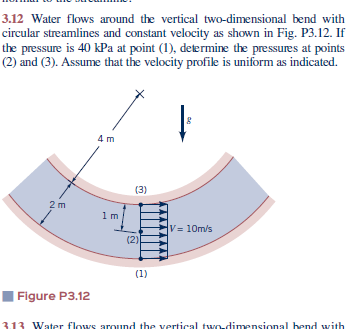
Not sure what the professor is asking by stating to "CONSIDER FLOW TO BE IN THE HORIZONTAL PLANE". The only thing I know is that gravity can be neglected in the horizontal direction? Please help with a detailed solution including formulas and assumptions used (:
Below is the link to the textbook solution of the original problem which can possibly provide help for formulas to use:
https://www.chegg.com/homework-help/Munson-Young-and-Okiishi-s-Fundamentals-of-Fluid-Mechanics-8th-edition-chapter-3-problem-12P-solution-9781119159599
Thank you!
Homework Answers


Add Answer to:
Not sure what the professor is asking by stating to "CONSIDER
FLOW TO BE IN THE...
please help...add sketch Water flows steadily through a curved duct that turns the flow through angle...
 please help...add sketch
Water flows steadily through a curved duct that turns the flow through angle = 1359, as shown in Fig. 3. The cross-sectional area of the duct changes from A1 = 0.025 m’ at the inlet to Az = 0.05 m² at the outlet. The average velocity at the duct inlet is V1 = 6 m/s. The momentum flux correction factor may be taken as B - 1.01 at the duct inlet and B = 1.03 at the...
please help...add sketch
Water flows steadily through a curved duct that turns the flow through angle = 1359, as shown in Fig. 3. The cross-sectional area of the duct changes from A1 = 0.025 m’ at the inlet to Az = 0.05 m² at the outlet. The average velocity at the duct inlet is V1 = 6 m/s. The momentum flux correction factor may be taken as B - 1.01 at the duct inlet and B = 1.03 at the...
Water flows steadily through a curved duct that turns the flow through angle @= 135º, as...
 Water flows steadily through a curved duct that turns the flow through angle @= 135º, as shown in Fig. 3. The cross-sectional area of the duct changes from A1 = 0.025 m² at the inlet to A2 = 0.05 m’ at the outlet. The average velocity at the duct inlet is V1 = 6 m/s. The momentum flux correction factor may be taken as B1 = 1.01 at the duct inlet and B2 = 1.03 at the its outlet. The...
asap please, will rate! 3. Water flows steadily through a curved duct that turns the flow...
 asap please, will rate!
3. Water flows steadily through a curved duct that turns the flow through angle 0= 135º, as shown in Fig. 3. The cross-sectional area of the duct changes from Aj 0.025 m² at the inlet to A2 = 0.05 m² at the outlet. The average velocity at the duct inlet is V1 = 6 m/s. The momentum flux correction factor may be taken as Bi= 1.01 at the duct inlet and B2 = 1.03 at the...
asap please, will rate!
3. Water flows steadily through a curved duct that turns the flow through angle 0= 135º, as shown in Fig. 3. The cross-sectional area of the duct changes from Aj 0.025 m² at the inlet to A2 = 0.05 m² at the outlet. The average velocity at the duct inlet is V1 = 6 m/s. The momentum flux correction factor may be taken as Bi= 1.01 at the duct inlet and B2 = 1.03 at the...
Consider the steady, incompressible flow of depth h of a liquid of known density ρ and...
 Consider the steady, incompressible flow of depth h of a liquid
of known density ρ and unknown viscosity µ down a flat plate as
shown in Figure 1. Air is the fluid above the liquid layer. The
force of gravity is in the vertical direction with acceleration g,
and the plate is at an angle θ with respect to the horizontal.
Assuming the coordinate system as shown, with x aligned with the
flow direction, and y normal to the plate,...
Consider the steady, incompressible flow of depth h of a liquid
of known density ρ and unknown viscosity µ down a flat plate as
shown in Figure 1. Air is the fluid above the liquid layer. The
force of gravity is in the vertical direction with acceleration g,
and the plate is at an angle θ with respect to the horizontal.
Assuming the coordinate system as shown, with x aligned with the
flow direction, and y normal to the plate,...
 please help...add sketch
Water flows steadily through a curved duct that turns the flow through angle = 1359, as shown in Fig. 3. The cross-sectional area of the duct changes from A1 = 0.025 m’ at the inlet to Az = 0.05 m² at the outlet. The average velocity at the duct inlet is V1 = 6 m/s. The momentum flux correction factor may be taken as B - 1.01 at the duct inlet and B = 1.03 at the...
please help...add sketch
Water flows steadily through a curved duct that turns the flow through angle = 1359, as shown in Fig. 3. The cross-sectional area of the duct changes from A1 = 0.025 m’ at the inlet to Az = 0.05 m² at the outlet. The average velocity at the duct inlet is V1 = 6 m/s. The momentum flux correction factor may be taken as B - 1.01 at the duct inlet and B = 1.03 at the...
 Water flows steadily through a curved duct that turns the flow through angle @= 135º, as shown in Fig. 3. The cross-sectional area of the duct changes from A1 = 0.025 m² at the inlet to A2 = 0.05 m’ at the outlet. The average velocity at the duct inlet is V1 = 6 m/s. The momentum flux correction factor may be taken as B1 = 1.01 at the duct inlet and B2 = 1.03 at the its outlet. The...
 asap please, will rate!
3. Water flows steadily through a curved duct that turns the flow through angle 0= 135º, as shown in Fig. 3. The cross-sectional area of the duct changes from Aj 0.025 m² at the inlet to A2 = 0.05 m² at the outlet. The average velocity at the duct inlet is V1 = 6 m/s. The momentum flux correction factor may be taken as Bi= 1.01 at the duct inlet and B2 = 1.03 at the...
asap please, will rate!
3. Water flows steadily through a curved duct that turns the flow through angle 0= 135º, as shown in Fig. 3. The cross-sectional area of the duct changes from Aj 0.025 m² at the inlet to A2 = 0.05 m² at the outlet. The average velocity at the duct inlet is V1 = 6 m/s. The momentum flux correction factor may be taken as Bi= 1.01 at the duct inlet and B2 = 1.03 at the...
 Consider the steady, incompressible flow of depth h of a liquid
of known density ρ and unknown viscosity µ down a flat plate as
shown in Figure 1. Air is the fluid above the liquid layer. The
force of gravity is in the vertical direction with acceleration g,
and the plate is at an angle θ with respect to the horizontal.
Assuming the coordinate system as shown, with x aligned with the
flow direction, and y normal to the plate,...
Consider the steady, incompressible flow of depth h of a liquid
of known density ρ and unknown viscosity µ down a flat plate as
shown in Figure 1. Air is the fluid above the liquid layer. The
force of gravity is in the vertical direction with acceleration g,
and the plate is at an angle θ with respect to the horizontal.
Assuming the coordinate system as shown, with x aligned with the
flow direction, and y normal to the plate,...
Most questions answered within 3 hours.
-
Where is the error in this code sequence?
String s1 = "Hello";
String s2 = "ello";...
asked 10 months ago -
Financial data for Joel de Paris, Inc., for last year
follow:
Joel de Paris, Inc.
Balance...
asked 10 months ago -
Consider this reaction:
Al2(SO4)3 (aq)+ BaCl3
(aq) Al2Cl6 (aq)- +
3BaSO4(s) . What is the...
asked 10 months ago -
Suppose that Savneet is considering increasing her
recent random sample from 20 car rentals to 40...
asked 10 months ago -
Trucks arrive at an unloading terminal at an average rate of 120
per hour.
Trucks arrive...
asked 10 months ago -
Why are methanol and ethanol completely soluble in water while
octanol is not very little soluble....
asked 10 months ago -
A facilities manager at a university reads in a research report
that the mean amount of...
asked 10 months ago -
When the CuSO4 is rehydrated by adding water to the anhydrous
compound, is this an endothermic...
asked 10 months ago -
A ray of sunlight is passing from diamond into crown glass; the
angle of incidence is...
asked 10 months ago -
A block of mass 0.249 kg is placed on top of a light, vertical
spring of...
asked 10 months ago -
how do the kidneys compensate in the presences of acidosis
a) trigger hyperventilate
b) reserve acid...
asked 10 months ago -
Question 501 pts
The rental rate of capital to the firm increases. Which of the
following...
asked 10 months ago