![BC:6.1 For the following signals, use the defini- tion to calculate the z-transform and find the region of convergence for each signal below. Does it matter whether you use the 1-sided or 2-sided definition for these signals? If this matters, calculate it using each definition c.) zefn] = (0.5)-7uln-3] un +5](http://img.homeworklib.com/questions/f52b0ca0-b8e8-11ec-9f1c-85c4c359d60c.png?x-oss-process=image/resize,w_560)
Homework Answers
Request Answer!
We need at least 10 more requests to produce the answer.
0 / 10 have requested this problem solution
The more requests, the faster the answer.
Add Answer to:
BC:6.1 For the following signals, use the defini- tion to calculate the z-transform and find the...
(40pts) Find the z transform of the following discrete-time signals. Please remember to include the "region...
 (40pts) Find the z transform of the following discrete-time signals. Please remember to include the "region of convergence" for each signal: (a) x(n)=3e * (n) +2 (4) (-1-1) +5d(n) (b) x(n)=nu(n-1) x(n) = 4 cos(ant)u(n) x(n) = 2 cos[0.27(n-1)Ju(n) (e) x(n)=(n-1) cos[@nju(n-1)
4. Find the z-transform (if it exists) and the corresponding region of convergence for each of...
 4. Find the z-transform (if it exists) and the corresponding region of convergence for each of the following signals. To the extent possible, use the properties of the z-transform to enable the re-use of standard results and reduce calculations. Simplify your expressions. (Recall that for real-valued signals, the transform should only have real-valued coefficients.) (a) z[n] = (1)(n-1) sin(竽幔)u[n-2] (b) x[n-2"u[n] + 0.5"u[n-2] (d)-[n] = n(j)nuln-3]
5. (22+2=4") Topic: The z-transform, z-transform properties Use the z-transform properties to determine the z-transform the...
 5. (22+2=4") Topic: The z-transform, z-transform properties Use the z-transform properties to determine the z-transform the following signal and specify the region of convergence. x[n]=(1)"u[n]*2":[-n-1]+)?[n-2]
Following the example in Section 3.10-1, numerically calculate the Fourier transform of the following signals and...
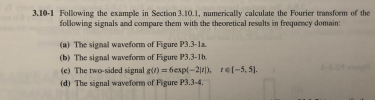 Following the example in Section 3.10-1, numerically calculate
the Fourier transform of the following signals and compare them
with the theoretical results in frequency domain:
(a) The signal waveform of Figure P3.3-1a
(b) The signal waveform of Figure P3.3-1b
(d) The signal waveform of Figure P3.3-4
3.10-1 Following the example in Section 3.10.1, numerically calculate the Fourier transform of the following signals and compare them with the theoretical results in frequency domain: (a) The signal waveform of Figure P3.3-la (b)...
Following the example in Section 3.10-1, numerically calculate
the Fourier transform of the following signals and compare them
with the theoretical results in frequency domain:
(a) The signal waveform of Figure P3.3-1a
(b) The signal waveform of Figure P3.3-1b
(d) The signal waveform of Figure P3.3-4
3.10-1 Following the example in Section 3.10.1, numerically calculate the Fourier transform of the following signals and compare them with the theoretical results in frequency domain: (a) The signal waveform of Figure P3.3-la (b)...
3. For each of the following discrete-time sequences: (i) Find the Z-transform (ZT), if it exists,...
 3. For each of the following discrete-time sequences: (i) Find the Z-transform (ZT), if it exists, and plot the region of convergence (ROC) in the Z-plane (ii) Find the poles and zeros and plot them in the 2-plane (iii) Determine whether the DTFT of the sequence exists (a) x[n] = 8[n – 1] + 28[n – 3] (b) [n] = (0.9e-j*)" u[n + 2] – 2-ul-n - 1] (c) x[n] = 2-" un + 1]
For each signal x(n) in Problems #(1)-(5), use Z Transform Tables to do the following: (a) Write ...
 For each signal x(n) in Problems #(1)-(5), use Z Transform Tables to do the following: (a) Write the formulas for its Z Transform, X(e), and Region of Convergence, RoCr (b) List the values of all poles and all zeros. (c) Sketch the pole zero diagram. Label both axes. Give key values along both axes. sin ( (-n))u-n]. (Hints: cos(π/3) (5) x1n] , 1/2, sin(π/3)-V3/2) ,"
For each signal x(n) in Problems #(1)-(5), use Z Transform Tables to do the following:...
For each signal x(n) in Problems #(1)-(5), use Z Transform Tables to do the following: (a) Write the formulas for its Z Transform, X(e), and Region of Convergence, RoCr (b) List the values of all poles and all zeros. (c) Sketch the pole zero diagram. Label both axes. Give key values along both axes. sin ( (-n))u-n]. (Hints: cos(π/3) (5) x1n] , 1/2, sin(π/3)-V3/2) ,"
For each signal x(n) in Problems #(1)-(5), use Z Transform Tables to do the following:...
Signals and systems .all T-Mobile 5:32 PM イ* 74% (TCO 4) Determine the z-transform of the...
 Signals and systems
.all T-Mobile 5:32 PM イ* 74% (TCO 4) Determine the z-transform of the signal, x(n). shown below using the basic definition of z-transform X(z)x(n)z-". Allvalues not shown can be assumed to be zero. an arbtrary sequence, all values not shown are zero C6 우 ' .3 sample number or n Top Oz- z2 - 2z3 - 2z4 01-z1- 2z2 + 2z*
Signals and systems
.all T-Mobile 5:32 PM イ* 74% (TCO 4) Determine the z-transform of the signal, x(n). shown below using the basic definition of z-transform X(z)x(n)z-". Allvalues not shown can be assumed to be zero. an arbtrary sequence, all values not shown are zero C6 우 ' .3 sample number or n Top Oz- z2 - 2z3 - 2z4 01-z1- 2z2 + 2z*
4. Laplace Transform. (15 pts) Find the Laplace Transform of the following signals and sketch the...
 4. Laplace Transform. (15 pts) Find the Laplace Transform of the following signals and sketch the corresponding pole-zero plot for each signal. In the plot, indicate the regions of convergence (ROC). Write X(s) as a single fraction in the form of DO (a) (5 pts)-(t-e*ta(t) + e-8tu(t). Show that X(s) =は,,늚. with ROC of Re(s) >-6. (b) (5 pts)-(t) = M(-t) +Au(-t). (c) (5 pts)-(t) 6(t)-a(-t). (s+6) (s+8)
1) (Fourier Transforms each of the following signals (a - c), sketch the signal x(t), and find its Fourier Transform X(f) using the defining integral (rather than "known" transforms and prope...
 1) (Fourier Transforms each of the following signals (a - c), sketch the signal x(t), and find its Fourier Transform X(f) using the defining integral (rather than "known" transforms and properties) (a)x(t) rectt 0.5) from Definition)- For (c) r(t) = te-2, 11(1) (b) x(t)-2t rect(t)
1) (Fourier Transforms each of the following signals (a - c), sketch the signal x(t), and find its Fourier Transform X(f) using the defining integral (rather than "known" transforms and properties) (a)x(t) rectt 0.5) from...
1) (Fourier Transforms each of the following signals (a - c), sketch the signal x(t), and find its Fourier Transform X(f) using the defining integral (rather than "known" transforms and properties) (a)x(t) rectt 0.5) from Definition)- For (c) r(t) = te-2, 11(1) (b) x(t)-2t rect(t)
1) (Fourier Transforms each of the following signals (a - c), sketch the signal x(t), and find its Fourier Transform X(f) using the defining integral (rather than "known" transforms and properties) (a)x(t) rectt 0.5) from...
Name 2. (10 points) a) Find an expression for the Fourier Transform of the signal use...
 Name 2. (10 points) a) Find an expression for the Fourier Transform of the signal use the tables provided. illutrated below- you may 1.5p 0.5 05 2 1.5 1 0.5 0 0.51 1.5 2 b) Using your result from part (a), find an expression for the Fourier Transform of the signal c) Using your result from part (a), find an expression for the Fourier Transform of the signal d) Note that the signal p(o) illustrated below can be expressed as...
 (40pts) Find the z transform of the following discrete-time signals. Please remember to include the "region of convergence" for each signal: (a) x(n)=3e * (n) +2 (4) (-1-1) +5d(n) (b) x(n)=nu(n-1) x(n) = 4 cos(ant)u(n) x(n) = 2 cos[0.27(n-1)Ju(n) (e) x(n)=(n-1) cos[@nju(n-1)
 4. Find the z-transform (if it exists) and the corresponding region of convergence for each of the following signals. To the extent possible, use the properties of the z-transform to enable the re-use of standard results and reduce calculations. Simplify your expressions. (Recall that for real-valued signals, the transform should only have real-valued coefficients.) (a) z[n] = (1)(n-1) sin(竽幔)u[n-2] (b) x[n-2"u[n] + 0.5"u[n-2] (d)-[n] = n(j)nuln-3]
 5. (22+2=4") Topic: The z-transform, z-transform properties Use the z-transform properties to determine the z-transform the following signal and specify the region of convergence. x[n]=(1)"u[n]*2":[-n-1]+)?[n-2]
 Following the example in Section 3.10-1, numerically calculate
the Fourier transform of the following signals and compare them
with the theoretical results in frequency domain:
(a) The signal waveform of Figure P3.3-1a
(b) The signal waveform of Figure P3.3-1b
(d) The signal waveform of Figure P3.3-4
3.10-1 Following the example in Section 3.10.1, numerically calculate the Fourier transform of the following signals and compare them with the theoretical results in frequency domain: (a) The signal waveform of Figure P3.3-la (b)...
Following the example in Section 3.10-1, numerically calculate
the Fourier transform of the following signals and compare them
with the theoretical results in frequency domain:
(a) The signal waveform of Figure P3.3-1a
(b) The signal waveform of Figure P3.3-1b
(d) The signal waveform of Figure P3.3-4
3.10-1 Following the example in Section 3.10.1, numerically calculate the Fourier transform of the following signals and compare them with the theoretical results in frequency domain: (a) The signal waveform of Figure P3.3-la (b)...
 3. For each of the following discrete-time sequences: (i) Find the Z-transform (ZT), if it exists, and plot the region of convergence (ROC) in the Z-plane (ii) Find the poles and zeros and plot them in the 2-plane (iii) Determine whether the DTFT of the sequence exists (a) x[n] = 8[n – 1] + 28[n – 3] (b) [n] = (0.9e-j*)" u[n + 2] – 2-ul-n - 1] (c) x[n] = 2-" un + 1]
 For each signal x(n) in Problems #(1)-(5), use Z Transform Tables to do the following: (a) Write the formulas for its Z Transform, X(e), and Region of Convergence, RoCr (b) List the values of all poles and all zeros. (c) Sketch the pole zero diagram. Label both axes. Give key values along both axes. sin ( (-n))u-n]. (Hints: cos(π/3) (5) x1n] , 1/2, sin(π/3)-V3/2) ,"
For each signal x(n) in Problems #(1)-(5), use Z Transform Tables to do the following:...
For each signal x(n) in Problems #(1)-(5), use Z Transform Tables to do the following: (a) Write the formulas for its Z Transform, X(e), and Region of Convergence, RoCr (b) List the values of all poles and all zeros. (c) Sketch the pole zero diagram. Label both axes. Give key values along both axes. sin ( (-n))u-n]. (Hints: cos(π/3) (5) x1n] , 1/2, sin(π/3)-V3/2) ,"
For each signal x(n) in Problems #(1)-(5), use Z Transform Tables to do the following:...
 Signals and systems
.all T-Mobile 5:32 PM イ* 74% (TCO 4) Determine the z-transform of the signal, x(n). shown below using the basic definition of z-transform X(z)x(n)z-". Allvalues not shown can be assumed to be zero. an arbtrary sequence, all values not shown are zero C6 우 ' .3 sample number or n Top Oz- z2 - 2z3 - 2z4 01-z1- 2z2 + 2z*
Signals and systems
.all T-Mobile 5:32 PM イ* 74% (TCO 4) Determine the z-transform of the signal, x(n). shown below using the basic definition of z-transform X(z)x(n)z-". Allvalues not shown can be assumed to be zero. an arbtrary sequence, all values not shown are zero C6 우 ' .3 sample number or n Top Oz- z2 - 2z3 - 2z4 01-z1- 2z2 + 2z*
 4. Laplace Transform. (15 pts) Find the Laplace Transform of the following signals and sketch the corresponding pole-zero plot for each signal. In the plot, indicate the regions of convergence (ROC). Write X(s) as a single fraction in the form of DO (a) (5 pts)-(t-e*ta(t) + e-8tu(t). Show that X(s) =は,,늚. with ROC of Re(s) >-6. (b) (5 pts)-(t) = M(-t) +Au(-t). (c) (5 pts)-(t) 6(t)-a(-t). (s+6) (s+8)
 1) (Fourier Transforms each of the following signals (a - c), sketch the signal x(t), and find its Fourier Transform X(f) using the defining integral (rather than "known" transforms and properties) (a)x(t) rectt 0.5) from Definition)- For (c) r(t) = te-2, 11(1) (b) x(t)-2t rect(t)
1) (Fourier Transforms each of the following signals (a - c), sketch the signal x(t), and find its Fourier Transform X(f) using the defining integral (rather than "known" transforms and properties) (a)x(t) rectt 0.5) from...
1) (Fourier Transforms each of the following signals (a - c), sketch the signal x(t), and find its Fourier Transform X(f) using the defining integral (rather than "known" transforms and properties) (a)x(t) rectt 0.5) from Definition)- For (c) r(t) = te-2, 11(1) (b) x(t)-2t rect(t)
1) (Fourier Transforms each of the following signals (a - c), sketch the signal x(t), and find its Fourier Transform X(f) using the defining integral (rather than "known" transforms and properties) (a)x(t) rectt 0.5) from...
 Name 2. (10 points) a) Find an expression for the Fourier Transform of the signal use the tables provided. illutrated below- you may 1.5p 0.5 05 2 1.5 1 0.5 0 0.51 1.5 2 b) Using your result from part (a), find an expression for the Fourier Transform of the signal c) Using your result from part (a), find an expression for the Fourier Transform of the signal d) Note that the signal p(o) illustrated below can be expressed as...
Most questions answered within 3 hours.
-
Where is the error in this code sequence?
String s1 = "Hello";
String s2 = "ello";...
asked 10 months ago -
Financial data for Joel de Paris, Inc., for last year
follow:
Joel de Paris, Inc.
Balance...
asked 10 months ago -
Consider this reaction:
Al2(SO4)3 (aq)+ BaCl3
(aq) Al2Cl6 (aq)- +
3BaSO4(s) . What is the...
asked 10 months ago -
Suppose that Savneet is considering increasing her
recent random sample from 20 car rentals to 40...
asked 10 months ago -
Trucks arrive at an unloading terminal at an average rate of 120
per hour.
Trucks arrive...
asked 10 months ago -
Why are methanol and ethanol completely soluble in water while
octanol is not very little soluble....
asked 10 months ago -
A facilities manager at a university reads in a research report
that the mean amount of...
asked 10 months ago -
When the CuSO4 is rehydrated by adding water to the anhydrous
compound, is this an endothermic...
asked 10 months ago -
A ray of sunlight is passing from diamond into crown glass; the
angle of incidence is...
asked 10 months ago -
A block of mass 0.249 kg is placed on top of a light, vertical
spring of...
asked 10 months ago -
how do the kidneys compensate in the presences of acidosis
a) trigger hyperventilate
b) reserve acid...
asked 10 months ago -
Question 501 pts
The rental rate of capital to the firm increases. Which of the
following...
asked 10 months ago