
Homework Answers
Answer - ALT
enzyme (EC 2.6.1.2) means alanine transaminase enzyme that
transfers an amino group (-NH2) from L-alanine to  -ketoglutarate. The ALT enzyme catalyzes the reaction and the
products are pyruvate and L-glutamate. The amino acid alanine is
converted to pyruvate that is utilized in cellular energy
production as it enters TCA cycle and then the electrones are
transferred to terminal electrone acceptor that is oxygen via
electron transport chain and generates ATP.
-ketoglutarate. The ALT enzyme catalyzes the reaction and the
products are pyruvate and L-glutamate. The amino acid alanine is
converted to pyruvate that is utilized in cellular energy
production as it enters TCA cycle and then the electrones are
transferred to terminal electrone acceptor that is oxygen via
electron transport chain and generates ATP.
Complete enzymatic reactions -
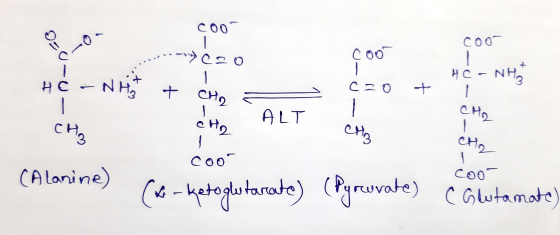
Alanine transaminase catalyzes a reversible transamination reaction -
i) It transfers an amino group from
alanine to
-ketoglutarate and forms glutamate and pyruvate.
ii) Reversibly, it can transfer
amino group from glutamate (an amino acid) to pyruvate and can form
alanine and
-ketoglutarate.
ALT enzyme requires a cofactor pyridoxal-5-phosphate (P5P), that accepts amino group from an amino acid and transfers it to the carbonyl compound. P5P is an active form of vitamine B6.
Part A - Overview of enzyme structure and enzymatic reactions Enzymes are large globular proteins. Much...
 Part A - Overview of enzyme structure and enzymatic reactions Enzymes are large globular proteins. Much of their three dimensional shape is the result of interactions between the R (variable) groups of their amino acids. The active site is the portion of the enzyme that will interact with the substrate the molecule that the enzyme acts upon. The nature and arrangement of amino acids in the active site make each enzyme specific to a substrate and to the reaction it...
List and describe the factors that can affect enzymatic reactions. a. Substrate Concentration b. Enzyme Concentration...
List and describe the factors that can affect enzymatic reactions. a. Substrate Concentration b. Enzyme Concentration c. pH d. Temperature e. Cofactors f. Inhibitors (I have them listed but do not understand their affects)
What is an enzyme? What is activation energy? How are those terms related? Define enzymatic activity
 What is an enzyme? What is activation energy? How are those terms related? Define enzymatic activity
Which enzyme(s) (or enzymatic steps) is(are) likely to be regulatory? O A. those with mass action...
 Which enzyme(s) (or enzymatic steps) is(are) likely to be regulatory? O A. those with mass action ratios much less than Keq, OB. the first enzyme in metabolic pathway, OC. the first enzyme unique to a branch in a pathway, OD.those with disequilibrium ratios much less than 1, O E. all of the above, OF. none of the above.
Give three examples of enzymatic reactions regulated by phosphorylation-dephosphorylation.
Give three examples of enzymatic reactions regulated by phosphorylation-dephosphorylation.
Correctly identify what might be occurring at the enzymatic level at each point in this growth...
 Correctly identify what might be occurring at the enzymatic level at each point in this growth rate versus time plot. Drag the appropriate labels to their respective targets. Reset Enzymatic reactions occurring at maximal rate possible Optimum Protein denaturation: collapse of cytoplasmic membrane, thermallysis Growth rate Membrane gelling: transport processes so slow that growth cannot occur Minimum Maximum Enzyme reactions occur at increasing rapid rales Temperature
11) What is the specificity constant (or enzymatic efficiency) of the 56 kDa enzyme, fumarase? It...
11) What is the specificity constant (or enzymatic efficiency) of the 56 kDa enzyme, fumarase? It has a Kcat of 9x10³ (s-1), a Km of 3x10⁻⁷ (M), and you plan to use it at a concentration of 200 nM. A) 1.6x10⁸ (M-1 S-1) B) 3x10¹⁰(M-1 S-1) This is the correct answer, why? C) 1.5x10⁻² (M-1 S-1) D) 0.0018 (M-1 S-1) E) 3.3x10⁻¹¹ (M-1 S-1)
Please answer all of those questions 7. Which of the followings is correct about the mechanisms of enzymatic reactions? General acid-base mechanism b. Metal elements mediated mechanism a. Covalent bo...
 Please answer all of those questions
7. Which of the followings is correct about the mechanisms of enzymatic reactions? General acid-base mechanism b. Metal elements mediated mechanism a. Covalent bonding mediated mechanism d. All above c. e. None a bove Which of the followings is correct about the meaning of the constant (Km) of Michaelis-Menten equation of enzyme catalyzed reactions? a. The constant and Michaelis-Menten equation is applicable only to the stage of reaction immediately after mixing of substrate(s) with...
Please answer all of those questions
7. Which of the followings is correct about the mechanisms of enzymatic reactions? General acid-base mechanism b. Metal elements mediated mechanism a. Covalent bonding mediated mechanism d. All above c. e. None a bove Which of the followings is correct about the meaning of the constant (Km) of Michaelis-Menten equation of enzyme catalyzed reactions? a. The constant and Michaelis-Menten equation is applicable only to the stage of reaction immediately after mixing of substrate(s) with...
Explain the following, “Maltose results from the enzymatic hydrolysis of amylose, a homopolysaccharide , by the...
Explain the following, “Maltose results from the enzymatic hydrolysis of amylose, a homopolysaccharide , by the enzyme amylase. Maltose is converted to two molecules of glucose by the enzyme maltase, which hydrolyzes the glycosidic bond.” especially explain the ezyme Maltase and the enzymatic hydrolysis of amylose. thank you!
Physical Origins of Enzyme Catalysis 2. Draw a reaction coordinate diagram for a one step reaction...
 Physical Origins of Enzyme Catalysis 2. Draw a reaction coordinate diagram for a one step reaction occurring the the absence and present of an enzyme catalyst. Label the x and y axis and indicate which potential energy curve is the enzymatic reaction and which is the non-enzymatic one 3. The following shows the transition state for an enzymatic reaction. Indicate which non- covalent force is contributing to transition state stabilization PHE
 Part A - Overview of enzyme structure and enzymatic reactions Enzymes are large globular proteins. Much of their three dimensional shape is the result of interactions between the R (variable) groups of their amino acids. The active site is the portion of the enzyme that will interact with the substrate the molecule that the enzyme acts upon. The nature and arrangement of amino acids in the active site make each enzyme specific to a substrate and to the reaction it...
 What is an enzyme? What is activation energy? How are those terms related? Define enzymatic activity
 Which enzyme(s) (or enzymatic steps) is(are) likely to be regulatory? O A. those with mass action ratios much less than Keq, OB. the first enzyme in metabolic pathway, OC. the first enzyme unique to a branch in a pathway, OD.those with disequilibrium ratios much less than 1, O E. all of the above, OF. none of the above.
 Correctly identify what might be occurring at the enzymatic level at each point in this growth rate versus time plot. Drag the appropriate labels to their respective targets. Reset Enzymatic reactions occurring at maximal rate possible Optimum Protein denaturation: collapse of cytoplasmic membrane, thermallysis Growth rate Membrane gelling: transport processes so slow that growth cannot occur Minimum Maximum Enzyme reactions occur at increasing rapid rales Temperature
 Please answer all of those questions
7. Which of the followings is correct about the mechanisms of enzymatic reactions? General acid-base mechanism b. Metal elements mediated mechanism a. Covalent bonding mediated mechanism d. All above c. e. None a bove Which of the followings is correct about the meaning of the constant (Km) of Michaelis-Menten equation of enzyme catalyzed reactions? a. The constant and Michaelis-Menten equation is applicable only to the stage of reaction immediately after mixing of substrate(s) with...
Please answer all of those questions
7. Which of the followings is correct about the mechanisms of enzymatic reactions? General acid-base mechanism b. Metal elements mediated mechanism a. Covalent bonding mediated mechanism d. All above c. e. None a bove Which of the followings is correct about the meaning of the constant (Km) of Michaelis-Menten equation of enzyme catalyzed reactions? a. The constant and Michaelis-Menten equation is applicable only to the stage of reaction immediately after mixing of substrate(s) with...
 Physical Origins of Enzyme Catalysis 2. Draw a reaction coordinate diagram for a one step reaction occurring the the absence and present of an enzyme catalyst. Label the x and y axis and indicate which potential energy curve is the enzymatic reaction and which is the non-enzymatic one 3. The following shows the transition state for an enzymatic reaction. Indicate which non- covalent force is contributing to transition state stabilization PHE
Most questions answered within 3 hours.
-
Where is the error in this code sequence?
String s1 = "Hello";
String s2 = "ello";...
asked 10 months ago -
Financial data for Joel de Paris, Inc., for last year
follow:
Joel de Paris, Inc.
Balance...
asked 10 months ago -
Consider this reaction:
Al2(SO4)3 (aq)+ BaCl3
(aq) Al2Cl6 (aq)- +
3BaSO4(s) . What is the...
asked 10 months ago -
Suppose that Savneet is considering increasing her
recent random sample from 20 car rentals to 40...
asked 10 months ago -
Trucks arrive at an unloading terminal at an average rate of 120
per hour.
Trucks arrive...
asked 10 months ago -
Why are methanol and ethanol completely soluble in water while
octanol is not very little soluble....
asked 10 months ago -
A facilities manager at a university reads in a research report
that the mean amount of...
asked 10 months ago -
When the CuSO4 is rehydrated by adding water to the anhydrous
compound, is this an endothermic...
asked 10 months ago -
A ray of sunlight is passing from diamond into crown glass; the
angle of incidence is...
asked 10 months ago -
A block of mass 0.249 kg is placed on top of a light, vertical
spring of...
asked 10 months ago -
how do the kidneys compensate in the presences of acidosis
a) trigger hyperventilate
b) reserve acid...
asked 10 months ago -
Question 501 pts
The rental rate of capital to the firm increases. Which of the
following...
asked 10 months ago