Explain the path conjugate pairs of B cells and T cells follow from the initial pairing...
Explain the path conjugate pairs of B cells and T cells follow from the initial pairing at the B
cell/T cell border to the ultimate production of high affinity, isotype switched antibodies
Homework Answers
Antigen presenting B cell will present MHCII proceesed antigen to T helper cell and it will stimulate T helper cell to start secreting cytokine IL-4 and IL-6 which provides signal to B-cell ,IL-4 for activation of B-cell and IL-6 for proliferation and differentiation of B-cell into plasma B-cell and memory B-cell. Somatic hypermutation and VDJ recombination takes place for gene arrangement for heavy and light chain to produce high affinity antibody against specific antigen. Then plasma B-cell start will produce IgM class antibody initially 10 days then class switching takes place to produce IgG class antibody against same antigen. Formation of IgG class antibody from IgM class antibody is termed as class switching.
Add Answer to:
Explain the path conjugate pairs of B cells and T cells follow
from the initial pairing...
Question 13 0.25 Immunity is the type of host defense mediated by secreted for protection against...
 Question 13 0.25 Immunity is the type of host defense mediated by secreted for protection against extracellular microbes and their toxins bodies this Humoral Cell-mediated Complement Cytokine Question 14 0.25 pts This type of antibody response is described as _ when a follicular B cell antibody binds with a protein antigen, which then results in isotype switching, production of high affinity antibodies, and long-lived plasma cells. T-independent T-dependent B-independent B-dependent
Question 14 0.25 pts This type of antibody response is described as when a follicular B...
 Question 14 0.25 pts This type of antibody response is described as when a follicular B cell antibody binds with a protein antigen, which then results in isotype switching, production of high affinity antibodies, and long-lived plasma cells. T-independent OT-dependent B-independent B-dependent Question 8 0.25 pts Public health practitioners were successful in eradicating smallpox because: smallpox only infected humans and no other natural animal reservoir to "hide" the disease. O only one serotype of the virus (with no mutations). O...
No explanation needed. 1. T cells with high affinity for self antigens are eliminated during T...
No explanation needed. 1. T cells with high affinity for self antigens are eliminated during T cell selection because A. These cells have limited lifespan B. These cells do not recycle C. These cells can bind to self antigen on body cells leading to body cell destruction D. These cells have no memory 2. HIGM results from a mutation in _______. A. CD40 B. CD40L C. CD28 D. CD80/86 3. CSR results in chromosomal rearrangement of IgM to produce A....
Name: 43. Antigens can be found on... (a) flagella (b) cell walls (c) human cells (d)...
 Name: 43. Antigens can be found on... (a) flagella (b) cell walls (c) human cells (d) all of the above 40. What is the site where stem cells develop and mature into T lymphocytes in humans? (a) spice (b) thymus (c) blood (d) bone marrow 47. Antigen presentation with MHC I molecules sensitizes which type of T cell? (a) cytotoxic T cells (b) helper T cells (c) plasma cells (d) all of the above 48. How does the Tc cell...
45. Antigens can be found on... (a) flagella (b ell walls (c) human cells (@a 46....
 45. Antigens can be found on... (a) flagella (b ell walls (c) human cells (@a 46. What is the site where stem cells develop and mature into T lymphocytes in humans (b) thymus (c) blood (d) bone marrow b) cell walls (c) human cells (d) all of the above develop and mature into T lymphocytes in humans? (a) spleen 41. Antigen presentation with MHC I molecules sensities which type of T cell? (a) cytotox C (b) helper T cells (c)...
QUESTION 1 3 po HIV predominantly infects T-helper cells, cells that are responsible for coordinating B-...
 QUESTION 1 3 po HIV predominantly infects T-helper cells, cells that are responsible for coordinating B- and T-cell activity. Based on this information, explain why HIV-infected individuals are at a very high risk for developing microbial infections. List the causative agent (virus) and discuss its properties. Name and briefly discuss 3 diseases that AIDS patients are more likely to contract. (Terminology to use: opportunistic pathogens, T and B cell purposes, CD4 cells, retrovirus, reverse transcription) TTT Arial 3 (12pt) -...
ANSWER ALL QUESTIONS FULLY AND CORRECTLY 5-1 T cells recognize antigen when the antigen a. forms...
 ANSWER ALL QUESTIONS FULLY AND CORRECTLY
5-1 T cells recognize antigen when the antigen a. forms a complex with membrane-bound MHC molecules on another host-derived cell b. is internalized by T cells via phagocytosis and subsequently binds to T-cell receptors in the endoplasmic reticulum c. is presented on the surface of a B cell on membrane-bound immunoglobulins d. forms a complex with membrane-bound MHC molecules on the T cell e. bears epitopes derived from proteins, carbohydrates, and lipids. 5-2 a....
ANSWER ALL QUESTIONS FULLY AND CORRECTLY
5-1 T cells recognize antigen when the antigen a. forms a complex with membrane-bound MHC molecules on another host-derived cell b. is internalized by T cells via phagocytosis and subsequently binds to T-cell receptors in the endoplasmic reticulum c. is presented on the surface of a B cell on membrane-bound immunoglobulins d. forms a complex with membrane-bound MHC molecules on the T cell e. bears epitopes derived from proteins, carbohydrates, and lipids. 5-2 a....
How does activation by T-independent antigens differ from this figure? Extracellular antigens B cell receptors Antigen...
 How does activation by T-independent antigens differ
from this figure?
Extracellular antigens B cell receptors Antigen fragments MHC class II with antigen displayed on surface **Cytokines Plasma cell Antibodies T cell B cell B cell 1 APC receptors 2 Antigen is 3 Antigen fragments are T helper cell recognize and phagocytized and displayed on the B cell secretes cytokines, attach to antigen. digested (see surface, attracting a activating a B cell. Figure 17.12). matching T helper cell. Figure 17.5 Activation...
How does activation by T-independent antigens differ
from this figure?
Extracellular antigens B cell receptors Antigen fragments MHC class II with antigen displayed on surface **Cytokines Plasma cell Antibodies T cell B cell B cell 1 APC receptors 2 Antigen is 3 Antigen fragments are T helper cell recognize and phagocytized and displayed on the B cell secretes cytokines, attach to antigen. digested (see surface, attracting a activating a B cell. Figure 17.12). matching T helper cell. Figure 17.5 Activation...
please answer all 4 questions Question 11 3 pts A B-cell may be activated by: O...
 please answer all 4 questions
Question 11 3 pts A B-cell may be activated by: O A TEH cell O Another B-cell O A cytotoxic T-cell O A natural killer T-cell Question 12 3 pts What happens to centrocytes that have high-affinity (tightly-binding) antigen receptors after somatic hypermutation? They receive survival signals from TFH cells o They cannot process antigen or present it to TFH cells o They undergo phagocytosis by dendritic cells in the "light zone" o They die...
please answer all 4 questions
Question 11 3 pts A B-cell may be activated by: O A TEH cell O Another B-cell O A cytotoxic T-cell O A natural killer T-cell Question 12 3 pts What happens to centrocytes that have high-affinity (tightly-binding) antigen receptors after somatic hypermutation? They receive survival signals from TFH cells o They cannot process antigen or present it to TFH cells o They undergo phagocytosis by dendritic cells in the "light zone" o They die...
Intracellular electrophysiological recordings were made from 2 separate cell pairs (A) and (B) below. The names of the c...
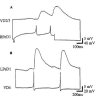 Intracellular electrophysiological recordings were made
from 2 separate cell pairs (A) and (B) below. The names of the
cells are indicated on the left hand side of the traces (eg.
RPeD1).
a. label on each diagram (A and B) which is the
pre-synaptic cell and which is the post-synaptic cell.
b. which of the recordings shows temporal summation of
the synaptic responses? Explain your answer .
RPeD1 5 mV 40 mV 100ms LPeD1 5 mV 20 mV VD4 200ms
Intracellular electrophysiological recordings were made
from 2 separate cell pairs (A) and (B) below. The names of the
cells are indicated on the left hand side of the traces (eg.
RPeD1).
a. label on each diagram (A and B) which is the
pre-synaptic cell and which is the post-synaptic cell.
b. which of the recordings shows temporal summation of
the synaptic responses? Explain your answer .
RPeD1 5 mV 40 mV 100ms LPeD1 5 mV 20 mV VD4 200ms
 Question 13 0.25 Immunity is the type of host defense mediated by secreted for protection against extracellular microbes and their toxins bodies this Humoral Cell-mediated Complement Cytokine Question 14 0.25 pts This type of antibody response is described as _ when a follicular B cell antibody binds with a protein antigen, which then results in isotype switching, production of high affinity antibodies, and long-lived plasma cells. T-independent T-dependent B-independent B-dependent
 Question 14 0.25 pts This type of antibody response is described as when a follicular B cell antibody binds with a protein antigen, which then results in isotype switching, production of high affinity antibodies, and long-lived plasma cells. T-independent OT-dependent B-independent B-dependent Question 8 0.25 pts Public health practitioners were successful in eradicating smallpox because: smallpox only infected humans and no other natural animal reservoir to "hide" the disease. O only one serotype of the virus (with no mutations). O...
 Name: 43. Antigens can be found on... (a) flagella (b) cell walls (c) human cells (d) all of the above 40. What is the site where stem cells develop and mature into T lymphocytes in humans? (a) spice (b) thymus (c) blood (d) bone marrow 47. Antigen presentation with MHC I molecules sensitizes which type of T cell? (a) cytotoxic T cells (b) helper T cells (c) plasma cells (d) all of the above 48. How does the Tc cell...
 45. Antigens can be found on... (a) flagella (b ell walls (c) human cells (@a 46. What is the site where stem cells develop and mature into T lymphocytes in humans (b) thymus (c) blood (d) bone marrow b) cell walls (c) human cells (d) all of the above develop and mature into T lymphocytes in humans? (a) spleen 41. Antigen presentation with MHC I molecules sensities which type of T cell? (a) cytotox C (b) helper T cells (c)...
 QUESTION 1 3 po HIV predominantly infects T-helper cells, cells that are responsible for coordinating B- and T-cell activity. Based on this information, explain why HIV-infected individuals are at a very high risk for developing microbial infections. List the causative agent (virus) and discuss its properties. Name and briefly discuss 3 diseases that AIDS patients are more likely to contract. (Terminology to use: opportunistic pathogens, T and B cell purposes, CD4 cells, retrovirus, reverse transcription) TTT Arial 3 (12pt) -...
 ANSWER ALL QUESTIONS FULLY AND CORRECTLY
5-1 T cells recognize antigen when the antigen a. forms a complex with membrane-bound MHC molecules on another host-derived cell b. is internalized by T cells via phagocytosis and subsequently binds to T-cell receptors in the endoplasmic reticulum c. is presented on the surface of a B cell on membrane-bound immunoglobulins d. forms a complex with membrane-bound MHC molecules on the T cell e. bears epitopes derived from proteins, carbohydrates, and lipids. 5-2 a....
ANSWER ALL QUESTIONS FULLY AND CORRECTLY
5-1 T cells recognize antigen when the antigen a. forms a complex with membrane-bound MHC molecules on another host-derived cell b. is internalized by T cells via phagocytosis and subsequently binds to T-cell receptors in the endoplasmic reticulum c. is presented on the surface of a B cell on membrane-bound immunoglobulins d. forms a complex with membrane-bound MHC molecules on the T cell e. bears epitopes derived from proteins, carbohydrates, and lipids. 5-2 a....
 How does activation by T-independent antigens differ
from this figure?
Extracellular antigens B cell receptors Antigen fragments MHC class II with antigen displayed on surface **Cytokines Plasma cell Antibodies T cell B cell B cell 1 APC receptors 2 Antigen is 3 Antigen fragments are T helper cell recognize and phagocytized and displayed on the B cell secretes cytokines, attach to antigen. digested (see surface, attracting a activating a B cell. Figure 17.12). matching T helper cell. Figure 17.5 Activation...
How does activation by T-independent antigens differ
from this figure?
Extracellular antigens B cell receptors Antigen fragments MHC class II with antigen displayed on surface **Cytokines Plasma cell Antibodies T cell B cell B cell 1 APC receptors 2 Antigen is 3 Antigen fragments are T helper cell recognize and phagocytized and displayed on the B cell secretes cytokines, attach to antigen. digested (see surface, attracting a activating a B cell. Figure 17.12). matching T helper cell. Figure 17.5 Activation...
 please answer all 4 questions
Question 11 3 pts A B-cell may be activated by: O A TEH cell O Another B-cell O A cytotoxic T-cell O A natural killer T-cell Question 12 3 pts What happens to centrocytes that have high-affinity (tightly-binding) antigen receptors after somatic hypermutation? They receive survival signals from TFH cells o They cannot process antigen or present it to TFH cells o They undergo phagocytosis by dendritic cells in the "light zone" o They die...
please answer all 4 questions
Question 11 3 pts A B-cell may be activated by: O A TEH cell O Another B-cell O A cytotoxic T-cell O A natural killer T-cell Question 12 3 pts What happens to centrocytes that have high-affinity (tightly-binding) antigen receptors after somatic hypermutation? They receive survival signals from TFH cells o They cannot process antigen or present it to TFH cells o They undergo phagocytosis by dendritic cells in the "light zone" o They die...
 Intracellular electrophysiological recordings were made
from 2 separate cell pairs (A) and (B) below. The names of the
cells are indicated on the left hand side of the traces (eg.
RPeD1).
a. label on each diagram (A and B) which is the
pre-synaptic cell and which is the post-synaptic cell.
b. which of the recordings shows temporal summation of
the synaptic responses? Explain your answer .
RPeD1 5 mV 40 mV 100ms LPeD1 5 mV 20 mV VD4 200ms
Intracellular electrophysiological recordings were made
from 2 separate cell pairs (A) and (B) below. The names of the
cells are indicated on the left hand side of the traces (eg.
RPeD1).
a. label on each diagram (A and B) which is the
pre-synaptic cell and which is the post-synaptic cell.
b. which of the recordings shows temporal summation of
the synaptic responses? Explain your answer .
RPeD1 5 mV 40 mV 100ms LPeD1 5 mV 20 mV VD4 200ms
Most questions answered within 3 hours.
-
Where is the error in this code sequence?
String s1 = "Hello";
String s2 = "ello";...
asked 11 months ago -
Financial data for Joel de Paris, Inc., for last year
follow:
Joel de Paris, Inc.
Balance...
asked 11 months ago -
Consider this reaction:
Al2(SO4)3 (aq)+ BaCl3
(aq) Al2Cl6 (aq)- +
3BaSO4(s) . What is the...
asked 11 months ago -
Suppose that Savneet is considering increasing her
recent random sample from 20 car rentals to 40...
asked 11 months ago -
Trucks arrive at an unloading terminal at an average rate of 120
per hour.
Trucks arrive...
asked 11 months ago -
Why are methanol and ethanol completely soluble in water while
octanol is not very little soluble....
asked 11 months ago -
A facilities manager at a university reads in a research report
that the mean amount of...
asked 11 months ago -
When the CuSO4 is rehydrated by adding water to the anhydrous
compound, is this an endothermic...
asked 11 months ago -
A ray of sunlight is passing from diamond into crown glass; the
angle of incidence is...
asked 11 months ago -
A block of mass 0.249 kg is placed on top of a light, vertical
spring of...
asked 11 months ago -
how do the kidneys compensate in the presences of acidosis
a) trigger hyperventilate
b) reserve acid...
asked 11 months ago -
Question 501 pts
The rental rate of capital to the firm increases. Which of the
following...
asked 11 months ago