
Homework Answers
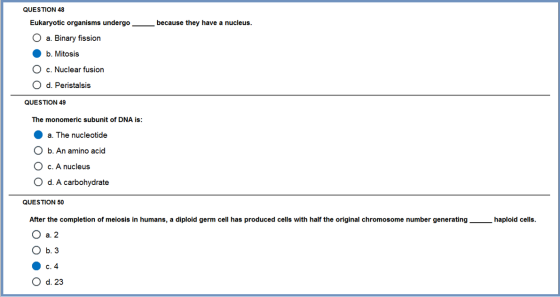
Question 48: Eukaryotic organisms undergo _ because they have a nucleus.
a. Binary fission b. Mitosis c. Nuclear fusion d. Peristalsis
Answer: b. Mitosis
Mitosis is a cell division process in which chromosomes undergo replication and get separated into two new nuclei, thus produces identical copies of cells.
Question 49: The monomeric subunit of DNA is:
a. The nucleotide b. An amino acid c. A nucleus d. A carbohydrate
Answer: a. The nucleotide
Nucleotides are the monomeric subunits of DNA. They are the basic building blocks of nucleic acids (DNA and RNA). The four nucleotide bases are adenine, cytosine, guanine and thymine. Each nucleotide base consists of a phosphate group, a deoxyribose sugar and a nitrogen-containing base.
Question 50: After the completion of meiosis in humans, a diploid germ cell has produced cells with half the original chromosome number generating _ haploid cells.
a. 2 b. 3 c. 4 o d. 23
Answer: c. 4
Meiosis is also called reductional division, and it produces four daughter cells with haploid (n) number of chromosomes. After the successive meiotic divisions, the number of original chromosomes in daughter cells get reduced from diploid to haploid number, and gives rise to four haploid cells. In human, each haploid parent cell contains 23 chromosomes. Fusion of haploid gametes produces zygote with diploid number of chromosomes. Zygote thus formed contains 46 number of chromosomes. After the completion of meiosis in humans, a diploid germ cell has produced cells with half the original chromosome number generating four haploid cells.
Add Answer to:
QUESTION 48 Eukaryotic organisms undergo, OBinary fsion because they have a nucleus Ob Mtoss OCNuclear fusion...
Question 22 (0136) . value: 0.27 points Sexual life cycle Complete the sentences below about sexually...
 Question 22 (0136) . value: 0.27 points Sexual life cycle Complete the sentences below about sexually reproducing organisms using some of the provided words. germ Sexually reproducing organisms produce gametes when cells undergo meiosis. diploid Fusion of gametes produces a from zygote that carries genetic information Diploid cells called the body's diploid cells somatic cells do not undergo meiosis and make up most of haploid larva spore one parent Reset
For the next group of questions consider a diploid cell from a eukaryotic organism with a...
 For the next group of questions consider a diploid cell from a eukaryotic organism with a total of ten chromosomes. After one round of the cell cycle is complete you observe a total of four daughter cells. During this cell division occurred and the resulting daughter cells are. mitosis; haploid with ten total chromosomes each mitosis; diploid with five total chromosomes each meiosis; diploid with ten total chromosomes each meiosis; haploid with five total chromosomes each Before the cell divided,...
Quession 14 Which statement about mitosis is true? Select one a. DNA replication is completed in...
 Quession 14 Which statement about mitosis is true? Select one a. DNA replication is completed in prophase. b. The chromosome number in the resulting cells is halved c. Two genetically identical daughter cells are formed. d Crossing over occurs during prophase e. It consists of two nuclear divisions. Quession 15 How does a nucleus in G2 difler from a nucleus in G17 Select one a. DNA synthesis occurs only in G1 phase. b Inactive cells are arrested only in G2...
25. Mendel's factors undergo segregation and independent assortment. How is this illustrated in the chromosomes during...
 25. Mendel's factors undergo segregation and independent assortment. How is this illustrated in the chromosomes during Meiosis I? 26. Explain how these inheritance patterns are considered non-Mendelian. Incomplete Dominance . Multiple Alleles • Codominance X-linked Linkage . Pedigrees - Genetic Disorders 27. What is non-disjunction and how does it affect the chromosome distribution during meiosis? 28. What is a karyotype and what does it allow you to do? 29. Fill in the circles and squares to illustrate the following inheritance...
please help and thank you Materials Needed per class: 1 box of 24 microscope slides of...
 please help and thank you
Materials Needed per class: 1 box of 24 microscope slides of meiosis 1 1 box of 24 microscope slides of meiosis 2 red and yellow popbead chromosome kits Objectives To become familiar with the process of meiosis and to be able to identify the principal phases of meiosis To understand how the process of meiosis is similar to mitosis and how it differs from mitosis Introduction The genetic information of a cell is encoded in...
please help and thank you
Materials Needed per class: 1 box of 24 microscope slides of meiosis 1 1 box of 24 microscope slides of meiosis 2 red and yellow popbead chromosome kits Objectives To become familiar with the process of meiosis and to be able to identify the principal phases of meiosis To understand how the process of meiosis is similar to mitosis and how it differs from mitosis Introduction The genetic information of a cell is encoded in...
strand(s) and the RNA molecule is made up of strand(s). The DNA molecule is made up...
 strand(s) and the RNA molecule is made up of strand(s). The DNA molecule is made up of O a. 4; 2 Ob. 1; 1 O c. 2; 1 O d. 1; 2 O e. 2; 4 QUESTION 45 The formation of large molecules from small subunits is known as what kind of reaction? O a reduction O b.condensation Oc decarboxylation d. hydrolysis O e. oxidation What is formed when an atom loses or gains an electron? O a. ion b....
In what way is artificial selection different from natural selection? Question 1 options: A. There is no...
In what way is artificial selection different from natural selection? Question 1 options: A. There is no difference; both have caused evolution throughout the history of life on earth B. Artificial selection applies to changes in domestic animals only, while natural selection applies to all other species C. In artificial selection, human preference is the selecting force; in natural selection, environmental conditions are the selecting force. D. Artificial selection causes one species to change to another, while natural selection only modifies existing species. E. Artificial...
1. Which of the following are the sites within the human body where carbon dioxide and...
1. Which of the following are the sites within the human body where carbon dioxide and oxygen are exchanged? A. Alveoli B. Arteries C. Synapses D. Venules 2. Which of the following describes the most important reason for repeating an experimental investigation? A. To verify the validity of the original findings B. To expand upon the original investigation C. To manipulate the independent variable D. To attempt to disprove the hypothesis 3. Lithium has an atomic number of 3 and...
 Question 22 (0136) . value: 0.27 points Sexual life cycle Complete the sentences below about sexually reproducing organisms using some of the provided words. germ Sexually reproducing organisms produce gametes when cells undergo meiosis. diploid Fusion of gametes produces a from zygote that carries genetic information Diploid cells called the body's diploid cells somatic cells do not undergo meiosis and make up most of haploid larva spore one parent Reset
 For the next group of questions consider a diploid cell from a eukaryotic organism with a total of ten chromosomes. After one round of the cell cycle is complete you observe a total of four daughter cells. During this cell division occurred and the resulting daughter cells are. mitosis; haploid with ten total chromosomes each mitosis; diploid with five total chromosomes each meiosis; diploid with ten total chromosomes each meiosis; haploid with five total chromosomes each Before the cell divided,...
 Quession 14 Which statement about mitosis is true? Select one a. DNA replication is completed in prophase. b. The chromosome number in the resulting cells is halved c. Two genetically identical daughter cells are formed. d Crossing over occurs during prophase e. It consists of two nuclear divisions. Quession 15 How does a nucleus in G2 difler from a nucleus in G17 Select one a. DNA synthesis occurs only in G1 phase. b Inactive cells are arrested only in G2...
 25. Mendel's factors undergo segregation and independent assortment. How is this illustrated in the chromosomes during Meiosis I? 26. Explain how these inheritance patterns are considered non-Mendelian. Incomplete Dominance . Multiple Alleles • Codominance X-linked Linkage . Pedigrees - Genetic Disorders 27. What is non-disjunction and how does it affect the chromosome distribution during meiosis? 28. What is a karyotype and what does it allow you to do? 29. Fill in the circles and squares to illustrate the following inheritance...
 please help and thank you
Materials Needed per class: 1 box of 24 microscope slides of meiosis 1 1 box of 24 microscope slides of meiosis 2 red and yellow popbead chromosome kits Objectives To become familiar with the process of meiosis and to be able to identify the principal phases of meiosis To understand how the process of meiosis is similar to mitosis and how it differs from mitosis Introduction The genetic information of a cell is encoded in...
please help and thank you
Materials Needed per class: 1 box of 24 microscope slides of meiosis 1 1 box of 24 microscope slides of meiosis 2 red and yellow popbead chromosome kits Objectives To become familiar with the process of meiosis and to be able to identify the principal phases of meiosis To understand how the process of meiosis is similar to mitosis and how it differs from mitosis Introduction The genetic information of a cell is encoded in...
 strand(s) and the RNA molecule is made up of strand(s). The DNA molecule is made up of O a. 4; 2 Ob. 1; 1 O c. 2; 1 O d. 1; 2 O e. 2; 4 QUESTION 45 The formation of large molecules from small subunits is known as what kind of reaction? O a reduction O b.condensation Oc decarboxylation d. hydrolysis O e. oxidation What is formed when an atom loses or gains an electron? O a. ion b....
Most questions answered within 3 hours.
-
Where is the error in this code sequence?
String s1 = "Hello";
String s2 = "ello";...
asked 11 months ago -
Financial data for Joel de Paris, Inc., for last year
follow:
Joel de Paris, Inc.
Balance...
asked 11 months ago -
Consider this reaction:
Al2(SO4)3 (aq)+ BaCl3
(aq) Al2Cl6 (aq)- +
3BaSO4(s) . What is the...
asked 11 months ago -
Suppose that Savneet is considering increasing her
recent random sample from 20 car rentals to 40...
asked 11 months ago -
Trucks arrive at an unloading terminal at an average rate of 120
per hour.
Trucks arrive...
asked 11 months ago -
Why are methanol and ethanol completely soluble in water while
octanol is not very little soluble....
asked 11 months ago -
A facilities manager at a university reads in a research report
that the mean amount of...
asked 11 months ago -
When the CuSO4 is rehydrated by adding water to the anhydrous
compound, is this an endothermic...
asked 11 months ago -
A ray of sunlight is passing from diamond into crown glass; the
angle of incidence is...
asked 11 months ago -
A block of mass 0.249 kg is placed on top of a light, vertical
spring of...
asked 11 months ago -
how do the kidneys compensate in the presences of acidosis
a) trigger hyperventilate
b) reserve acid...
asked 11 months ago -
Question 501 pts
The rental rate of capital to the firm increases. Which of the
following...
asked 11 months ago