Show that a signal and its Hilbert transform are orthogonal.
Show that a signal and its Hilbert transform are orthogonal.
Homework Answers
Request Answer!
We need at least 10 more requests to produce the answer.
0 / 10 have requested this problem solution
The more requests, the faster the answer.
Show that the energy content of a signal is equal to the energy content of its...
Show that the energy content of a signal is equal to the energy content of its Hilbert transform.
Can you help me solve this question step by step please? Check that the Hilbert transform...
Can you help me solve this question step by step please? Check that the Hilbert transform of an even s (t) signal turns out to be an odd signal.
First -- use an 8 kHz sampled speech signal (or higher), the Discrete Hilbert Transform, filters,...
First -- use an 8 kHz sampled speech signal (or higher), the Discrete Hilbert Transform, filters, etc., and implement the algorithm we outlined in class (and in the handout). Start with a scrambler using a fixed foldover frequency and finish with a Fancy Scrambler that uses a set of random foldover frequencies. Recovery is achieved using the same type of scrambler to undo the frequency inversion. Second -- implement a voice scrambler of your own devising. Any type of scrambling...
Let H be a separable Hilbert space with basis {en}neN and define P2 as the orthogonal...
 Let H be a separable Hilbert space with basis {en}neN and define P2 as the orthogonal projection onto spanfe1,., e,}. Show that, for any T E B (H), the sequence PTP converges strongly to T HINT: A sequence of operators Tn E B (H) converges strongly to T if ||Th - Tnh|| converges to 0 Vh E H.
Let H be a separable Hilbert space with basis {en}neN and define P2 as the orthogonal projection onto spanfe1,., e,}. Show that,...
Let H be a separable Hilbert space with basis {en}neN and define P2 as the orthogonal projection onto spanfe1,., e,}. Show that, for any T E B (H), the sequence PTP converges strongly to T HINT: A sequence of operators Tn E B (H) converges strongly to T if ||Th - Tnh|| converges to 0 Vh E H.
Let H be a separable Hilbert space with basis {en}neN and define P2 as the orthogonal projection onto spanfe1,., e,}. Show that,...
Drow the magnitud and Digital Differntaler and phare characterstic of Hilbert transform
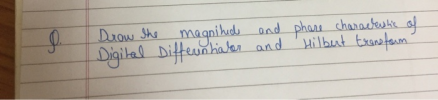 Drow the magnitud and Digital Differntaler and phare characterstic of Hilbert transform
Let H be a separable Hilbert space with basis en]nen and define P as the orthogonal projection onto span(e,... ,en)...
 Let H be a separable Hilbert space with basis en]nen and define P as the orthogonal projection onto span(e,... ,en) (a) A sequence of operators T, E B(H) is said to converge strongly to T if |Th-Tnhl converges to 0 for all h EH (note that strong convergence is actually weaker than operator norm convergence-think of this as the difference between pointwise and uniform convergence). Show that, for any T E B(H), the sequence P,T Pn converges strongly to T....
Please be neat and show all work. Thank you. 1. Determine the z-transform of the signal...
 Please be neat and show all work. Thank you.
1. Determine the z-transform of the signal x(n)s {100 elsewhere 1} x(n)=( 0; elsewhere
Please be neat and show all work. Thank you.
1. Determine the z-transform of the signal x(n)s {100 elsewhere 1} x(n)=( 0; elsewhere
Let H be a real Hilbert space of infinite sequences (o1, 2,.. such that the sum...
 Let H be a real Hilbert space of infinite sequences (o1, 2,.. such that the sum 0) converges. Let the dot product be (u, u) = Σ u,ui Consider a linear 3D subspace generated by (non-orthogonal) basis fa, b,c) Find an orthogonal basis of this space.
2. Orthogonal frequency division multiplexing (OFDM), where the signal is built in the frequency ...
 2. Orthogonal frequency division multiplexing (OFDM), where the signal is built in the frequency do- main and then a fast Fourier transform (FFT is taken to get samples of the time domain signal for transmission, is used in a large range of wireless communication standards such as 4G cellular. One drawback of OFDM is that the time domain samples can exhibit large peaks, hence making efficient amplification difficult. Motivated by the Central Limit Theorem (which we will learn later), the...
show that 9- a) A is orthogonal if and only if A' is orthogonal b) A is orthogonal if and only if A is orthogonal c) A& B are orthogonal then AB is orthogonal d) A is orthogonal then det(A)=1...
 show that
9- a) A is orthogonal if and only if A' is orthogonal b) A is orthogonal if and only if A is orthogonal c) A& B are orthogonal then AB is orthogonal d) A is orthogonal then det(A)=1 or det(A)=-1
9- a) A is orthogonal if and only if A' is orthogonal b) A is orthogonal if and only if A is orthogonal c) A& B are orthogonal then AB is orthogonal d) A is orthogonal then det(A)=1...
show that
9- a) A is orthogonal if and only if A' is orthogonal b) A is orthogonal if and only if A is orthogonal c) A& B are orthogonal then AB is orthogonal d) A is orthogonal then det(A)=1 or det(A)=-1
9- a) A is orthogonal if and only if A' is orthogonal b) A is orthogonal if and only if A is orthogonal c) A& B are orthogonal then AB is orthogonal d) A is orthogonal then det(A)=1...
 Let H be a separable Hilbert space with basis {en}neN and define P2 as the orthogonal projection onto spanfe1,., e,}. Show that, for any T E B (H), the sequence PTP converges strongly to T HINT: A sequence of operators Tn E B (H) converges strongly to T if ||Th - Tnh|| converges to 0 Vh E H.
Let H be a separable Hilbert space with basis {en}neN and define P2 as the orthogonal projection onto spanfe1,., e,}. Show that,...
Let H be a separable Hilbert space with basis {en}neN and define P2 as the orthogonal projection onto spanfe1,., e,}. Show that, for any T E B (H), the sequence PTP converges strongly to T HINT: A sequence of operators Tn E B (H) converges strongly to T if ||Th - Tnh|| converges to 0 Vh E H.
Let H be a separable Hilbert space with basis {en}neN and define P2 as the orthogonal projection onto spanfe1,., e,}. Show that,...
 Drow the magnitud and Digital Differntaler and phare characterstic of Hilbert transform
 Let H be a separable Hilbert space with basis en]nen and define P as the orthogonal projection onto span(e,... ,en) (a) A sequence of operators T, E B(H) is said to converge strongly to T if |Th-Tnhl converges to 0 for all h EH (note that strong convergence is actually weaker than operator norm convergence-think of this as the difference between pointwise and uniform convergence). Show that, for any T E B(H), the sequence P,T Pn converges strongly to T....
 Please be neat and show all work. Thank you.
1. Determine the z-transform of the signal x(n)s {100 elsewhere 1} x(n)=( 0; elsewhere
Please be neat and show all work. Thank you.
1. Determine the z-transform of the signal x(n)s {100 elsewhere 1} x(n)=( 0; elsewhere
 Let H be a real Hilbert space of infinite sequences (o1, 2,.. such that the sum 0) converges. Let the dot product be (u, u) = Σ u,ui Consider a linear 3D subspace generated by (non-orthogonal) basis fa, b,c) Find an orthogonal basis of this space.
 2. Orthogonal frequency division multiplexing (OFDM), where the signal is built in the frequency do- main and then a fast Fourier transform (FFT is taken to get samples of the time domain signal for transmission, is used in a large range of wireless communication standards such as 4G cellular. One drawback of OFDM is that the time domain samples can exhibit large peaks, hence making efficient amplification difficult. Motivated by the Central Limit Theorem (which we will learn later), the...
 show that
9- a) A is orthogonal if and only if A' is orthogonal b) A is orthogonal if and only if A is orthogonal c) A& B are orthogonal then AB is orthogonal d) A is orthogonal then det(A)=1 or det(A)=-1
9- a) A is orthogonal if and only if A' is orthogonal b) A is orthogonal if and only if A is orthogonal c) A& B are orthogonal then AB is orthogonal d) A is orthogonal then det(A)=1...
show that
9- a) A is orthogonal if and only if A' is orthogonal b) A is orthogonal if and only if A is orthogonal c) A& B are orthogonal then AB is orthogonal d) A is orthogonal then det(A)=1 or det(A)=-1
9- a) A is orthogonal if and only if A' is orthogonal b) A is orthogonal if and only if A is orthogonal c) A& B are orthogonal then AB is orthogonal d) A is orthogonal then det(A)=1...
Most questions answered within 3 hours.
-
Where is the error in this code sequence?
String s1 = "Hello";
String s2 = "ello";...
asked 10 months ago -
Financial data for Joel de Paris, Inc., for last year
follow:
Joel de Paris, Inc.
Balance...
asked 10 months ago -
Consider this reaction:
Al2(SO4)3 (aq)+ BaCl3
(aq) Al2Cl6 (aq)- +
3BaSO4(s) . What is the...
asked 10 months ago -
Suppose that Savneet is considering increasing her
recent random sample from 20 car rentals to 40...
asked 10 months ago -
Trucks arrive at an unloading terminal at an average rate of 120
per hour.
Trucks arrive...
asked 10 months ago -
Why are methanol and ethanol completely soluble in water while
octanol is not very little soluble....
asked 10 months ago -
A facilities manager at a university reads in a research report
that the mean amount of...
asked 10 months ago -
When the CuSO4 is rehydrated by adding water to the anhydrous
compound, is this an endothermic...
asked 10 months ago -
A ray of sunlight is passing from diamond into crown glass; the
angle of incidence is...
asked 10 months ago -
A block of mass 0.249 kg is placed on top of a light, vertical
spring of...
asked 10 months ago -
how do the kidneys compensate in the presences of acidosis
a) trigger hyperventilate
b) reserve acid...
asked 10 months ago -
Question 501 pts
The rental rate of capital to the firm increases. Which of the
following...
asked 10 months ago