First -- use an 8 kHz sampled speech signal (or higher), the Discrete Hilbert Transform, filters,...
First -- use an 8 kHz sampled speech signal (or higher), the Discrete Hilbert Transform, filters, etc., and implement the algorithm we outlined in class (and in the handout). Start with a scrambler using a fixed foldover frequency and finish with a Fancy Scrambler that uses a set of random foldover frequencies. Recovery is achieved using the same type of scrambler to undo the frequency inversion.
Second -- implement a voice scrambler of your own devising. Any type of scrambling is okay, however, you must write the code to scramble and unscramble the speech and the unscrambled speech should be clearly intelligible.
Homework Answers
Voice Scrambler has been implemented. The approach uses a fixed foldover frequency and ultimately develops algorithms using filtering and modulation. With voice as input, the output is the scrambled voice. Here, the wider input signal bandwidth is achieved using an up-sampling scheme. This scrambling method is often referred to as frequency inversion.
The input voice 'folds' into a carrier signal. The frequency inversion causes a shift in the frequency spectrum with upper and lower sidebands.
Here is the code:
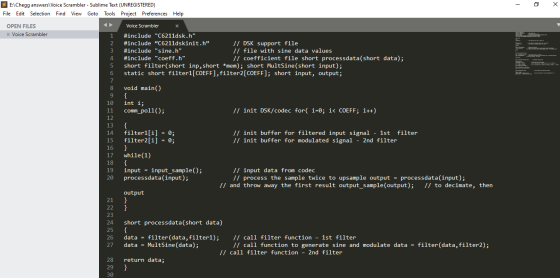
Here is the code text:
#include "C6211dsk.h"
#include “C6211dskinit.h” // DSK
support file
#include "sine.h"
// file with sine data values
#include "coeff.h"
// coefficient file short
processdata(short data);
short filter(short inp,short *mem); short MultSine(short
input);
static short filter1[COEFF],filter2[COEFF]; short input,
output;
void main()
{
int i;
comm_poll();
// init DSK/codec for( i=0;
i< COEFF; i++)
{
filter1[i] = 0;
// init buffer for filtered
input signal - 1st filter
filter2[i] = 0;
// init buffer for modulated
signal - 2nd filter
}
while(1)
{
input = input_sample();
// input data from codec
processdata(input);
// process the sample twice
to upsample output = processdata(input);
// and
throw away the first result output_sample(output); //
to decimate, then output
}
}
short processdata(short data)
{
data = filter(data,filter1); // call filter function –
1st filter
data = MultSine(data);
// call function to generate sine and modulate
data = filter(data,filter2);
// call filter function – 2nd filter
return data;
}
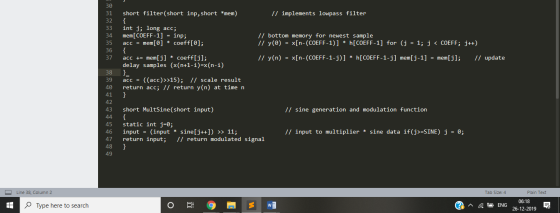
short filter(short inp,short *mem)
// implements lowpass filter
{
int j; long acc;
mem[COEFF-1] = inp;
// bottom memory for newest sample
acc = mem[0] * coeff[0];
// y(0) = x[n-(COEFF-1)] *
h[COEFF-1] for (j = 1; j < COEFF; j++)
{
acc += mem[j] * coeff[j];
// y(n) = x[n-(COEFF-1-j)] *
h[COEFF-1-j] mem[j-1] = mem[j]; // update delay samples
(x(n+1-i)=x(n-i)
}
acc = ((acc)>>15); // scale result
return acc; // return y(n) at time n
}
short MultSine(short input)
// sine generation and modulation function
{
static int j=0;
input = (input * sine[j++]) >> 11;
// input
to multiplier * sine data if(j>=SINE) j = 0;
return input; // return modulated signal
}
Add Answer to:
First -- use an 8 kHz sampled speech signal (or higher), the
Discrete Hilbert Transform, filters,...
Most questions answered within 3 hours.
-
Where is the error in this code sequence?
String s1 = "Hello";
String s2 = "ello";...
asked 10 months ago -
Financial data for Joel de Paris, Inc., for last year
follow:
Joel de Paris, Inc.
Balance...
asked 10 months ago -
Consider this reaction:
Al2(SO4)3 (aq)+ BaCl3
(aq) Al2Cl6 (aq)- +
3BaSO4(s) . What is the...
asked 10 months ago -
Suppose that Savneet is considering increasing her
recent random sample from 20 car rentals to 40...
asked 10 months ago -
Trucks arrive at an unloading terminal at an average rate of 120
per hour.
Trucks arrive...
asked 10 months ago -
Why are methanol and ethanol completely soluble in water while
octanol is not very little soluble....
asked 10 months ago -
A facilities manager at a university reads in a research report
that the mean amount of...
asked 10 months ago -
When the CuSO4 is rehydrated by adding water to the anhydrous
compound, is this an endothermic...
asked 10 months ago -
A ray of sunlight is passing from diamond into crown glass; the
angle of incidence is...
asked 10 months ago -
A block of mass 0.249 kg is placed on top of a light, vertical
spring of...
asked 10 months ago -
how do the kidneys compensate in the presences of acidosis
a) trigger hyperventilate
b) reserve acid...
asked 10 months ago -
Question 501 pts
The rental rate of capital to the firm increases. Which of the
following...
asked 10 months ago