As an ice skater begins a spin, his angular speed is 3.37 rad/s. After pulling in...
As an ice skater begins a spin, his angular speed is 3.37 rad/s. After pulling in his arms, his angular speed increases to 5.74 rad/s.
A)Find the ratio of the skater's final moment of inertia to his initial moment of inertia.
Homework Answers

Add Answer to:
As an ice skater begins a spin, his angular speed is 3.37 rad/s.
After pulling in...
A 60.0-kg skater begins a spin with an angular speed of 6.0 rad/s and of moment...
A 60.0-kg skater begins a spin with an angular speed of 6.0 rad/s and of moment of inertia 3.0 kg.m2. By changing the position of her arms, the skater decreases her moment of inertia to one-half its initial value. What is the skater's initial kinetic energy?
(a) Calculate the angular momentum of an ice skater spinning at 6.00 rev/s given his moment...
(a) Calculate the angular momentum of an ice skater spinning at 6.00 rev/s given his moment of inertia is 0.300 kg · m2. _____kg · m2/s (b) He reduces his rate of spin (his angular velocity) by extending his arms and increasing his moment of inertia. Find the value of his moment of inertia if his angular velocity drops to 1.75 rev/s. ______kg · m2 (c) Suppose instead he keeps his arms in and allows friction with the ice to...
An ice skater spinning with outstretched arms has an angular speed of 5.0rad/s . She tucks...
An ice skater spinning with outstretched arms has an angular speed of 5.0rad/s . She tucks in her arms, decreasing her moment of inertia by 29% . What is the resulting angular speed? rad/s By what factor does the skater's kinetic energy change? (Neglect any frictional effects.) where does the extra kinetic energy come from?
Calculate the angular momentum, in kg · m2/s, of an ice skater spinning at 6.00 rev/s...
 Calculate the angular momentum, in kg · m2/s, of an ice skater
spinning at 6.00 rev/s given his moment of inertia is 0.330 kg ·
m2.
(a) Calculate the angular momentum, in kg . m/s, of an ice skater spinning at 6.00 rev/s given his moment of inertia is 0.330 kg . m2. kg. m/s (b) He reduces his rate of spin (his angular velocity) by extending his arms and increasing his moment of inertia. Find the value of his...
Calculate the angular momentum, in kg · m2/s, of an ice skater
spinning at 6.00 rev/s given his moment of inertia is 0.330 kg ·
m2.
(a) Calculate the angular momentum, in kg . m/s, of an ice skater spinning at 6.00 rev/s given his moment of inertia is 0.330 kg . m2. kg. m/s (b) He reduces his rate of spin (his angular velocity) by extending his arms and increasing his moment of inertia. Find the value of his...
(a) Calculate the angular momentum of an ice skater spinning at 6.00 rev/s given his moment...
(a) Calculate the angular momentum of an ice skater spinning at 6.00 rev/s given his moment of inertia is 0.400kg⋅m20.400kg⋅m2 (b) He reduces his rate of spin (his angular velocity) by extending his arms and increasing his moment of inertia. Find the value of his moment of inertia if his angular velocity decreases to 1.25 rev/s. (c) Suppose instead he keeps his arms in and allows friction of the ice to slow him to 3.00 rev/s. What average torque was exerted...
6. Teeny, the 3,750 kg ice skating elephant, begins a spin with an angular speed of...
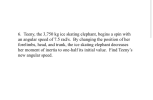 6. Teeny, the 3,750 kg ice skating elephant, begins a spin with an angular speed of 7.5 rad/s. By changing the position of her forelimbs, head, and trunk, the ice skating elephant decreases her moment of inertia to one-half its initial value. Find Teeny's new angular speed.
3. An ice skater can increase their angular velocity during a spin by pulling their arms...
3. An ice skater can increase their angular velocity during a spin by pulling their arms inward, lowering their moment of inertia. The only external torques are small forces at small radii (in particular, friction in the tip of their skate), and can be ignored. Suppose they begin with their arms fully extended and bring them fully in, reducing their moment of inertia by half. (a) By what factor will their angular velocity ω change? Explain. (b) By what factor...
(a) Calculate the angular momentum (in kg.m"/s) of an ice skater spinning at 6.00 rev/s given...
 (a) Calculate the angular momentum (in kg.m"/s) of an ice skater spinning at 6.00 rev/s given his moment of inertia is 0.470 kg-m kg-m /s (b) He reduces his rate of spin (his angular velocity) by extending his arms and increasing his moment of inertia. Find the value of his moment of inertia (in kg-m2) if his angular velocity drops to 1.35 rev/s. (c) Suppose instead he keeps his arms in and allows friction with the ice to slow him...
(a) Calculate the angular momentum (in kg·m2/s) of an ice skater spinning at 6.00 rev/s given...
(a) Calculate the angular momentum (in kg·m2/s) of an ice skater spinning at 6.00 rev/s given his moment of inertia is 0.410 kg·m2. kg·m2/s (b) He reduces his rate of spin (his angular velocity) by extending his arms and increasing his moment of inertia. Find the value of his moment of inertia (in kg·m2) if his angular velocity drops to 1.00 rev/s. kg·m2 (c) Suppose instead he keeps his arms in and allows friction with the ice to slow him...
(a) Calculate the angular momentum (in kg.m2/s) of an ice skater spinning at 6.00 rev/s given...
 (a) Calculate the angular momentum (in kg.m2/s) of an ice skater spinning at 6.00 rev/s given his moment of inertia is 0.470 kg.m2 kg-m2/s (b) He reduces his rate of spin (his angular velocity) by extending his arms and increasing his moment of inertia. Find the value of his moment of inertia (in kg m-) if his angular velocity drops to 1.00 rev/s. kg-m2 (c) suppose instead he keeps his arms in and allows friction with the ice to slow...
 Calculate the angular momentum, in kg · m2/s, of an ice skater
spinning at 6.00 rev/s given his moment of inertia is 0.330 kg ·
m2.
(a) Calculate the angular momentum, in kg . m/s, of an ice skater spinning at 6.00 rev/s given his moment of inertia is 0.330 kg . m2. kg. m/s (b) He reduces his rate of spin (his angular velocity) by extending his arms and increasing his moment of inertia. Find the value of his...
Calculate the angular momentum, in kg · m2/s, of an ice skater
spinning at 6.00 rev/s given his moment of inertia is 0.330 kg ·
m2.
(a) Calculate the angular momentum, in kg . m/s, of an ice skater spinning at 6.00 rev/s given his moment of inertia is 0.330 kg . m2. kg. m/s (b) He reduces his rate of spin (his angular velocity) by extending his arms and increasing his moment of inertia. Find the value of his...
 6. Teeny, the 3,750 kg ice skating elephant, begins a spin with an angular speed of 7.5 rad/s. By changing the position of her forelimbs, head, and trunk, the ice skating elephant decreases her moment of inertia to one-half its initial value. Find Teeny's new angular speed.
 (a) Calculate the angular momentum (in kg.m"/s) of an ice skater spinning at 6.00 rev/s given his moment of inertia is 0.470 kg-m kg-m /s (b) He reduces his rate of spin (his angular velocity) by extending his arms and increasing his moment of inertia. Find the value of his moment of inertia (in kg-m2) if his angular velocity drops to 1.35 rev/s. (c) Suppose instead he keeps his arms in and allows friction with the ice to slow him...
 (a) Calculate the angular momentum (in kg.m2/s) of an ice skater spinning at 6.00 rev/s given his moment of inertia is 0.470 kg.m2 kg-m2/s (b) He reduces his rate of spin (his angular velocity) by extending his arms and increasing his moment of inertia. Find the value of his moment of inertia (in kg m-) if his angular velocity drops to 1.00 rev/s. kg-m2 (c) suppose instead he keeps his arms in and allows friction with the ice to slow...
Most questions answered within 3 hours.
-
Where is the error in this code sequence?
String s1 = "Hello";
String s2 = "ello";...
asked 10 months ago -
Financial data for Joel de Paris, Inc., for last year
follow:
Joel de Paris, Inc.
Balance...
asked 10 months ago -
Consider this reaction:
Al2(SO4)3 (aq)+ BaCl3
(aq) Al2Cl6 (aq)- +
3BaSO4(s) . What is the...
asked 10 months ago -
Suppose that Savneet is considering increasing her
recent random sample from 20 car rentals to 40...
asked 10 months ago -
Trucks arrive at an unloading terminal at an average rate of 120
per hour.
Trucks arrive...
asked 10 months ago -
Why are methanol and ethanol completely soluble in water while
octanol is not very little soluble....
asked 10 months ago -
A facilities manager at a university reads in a research report
that the mean amount of...
asked 10 months ago -
When the CuSO4 is rehydrated by adding water to the anhydrous
compound, is this an endothermic...
asked 10 months ago -
A ray of sunlight is passing from diamond into crown glass; the
angle of incidence is...
asked 10 months ago -
A block of mass 0.249 kg is placed on top of a light, vertical
spring of...
asked 10 months ago -
how do the kidneys compensate in the presences of acidosis
a) trigger hyperventilate
b) reserve acid...
asked 10 months ago -
Question 501 pts
The rental rate of capital to the firm increases. Which of the
following...
asked 10 months ago