PLEASE HELP: Combine the two following standard reduction potentials, and write the balanced reaction.Which compound will...
PLEASE HELP:
Combine the two following standard reduction potentials, and write the balanced reaction.Which compound will be oxidized, and which will be reduced? Which compound is considered the electron acceptor?
(each is given as oxidized + e-> reduced)
Acetaldehyde + 2H++ 2e-> Ethanol
S + 2H++2e-> H2S
Homework Answers
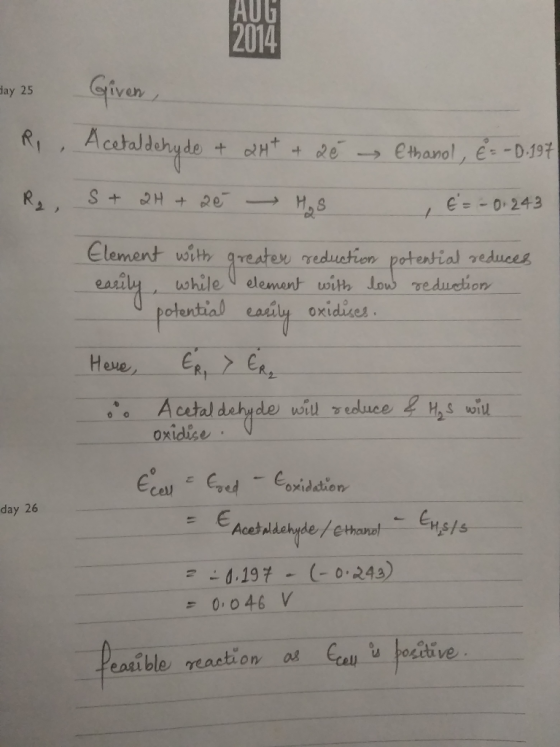
*Combined reaction :
Acetaldehyde + H2S --> Ethanol + S (reaction is balanced)
*An electron acceptor, accepts electrons transferred to it from another compound. It is an oxidizing agent because it accept electrons and is itself reduced in the process. Therefore, acetaldehyde is electron acceptor here.
Add Answer to:
PLEASE HELP:
Combine the two following standard reduction potentials, and
write the balanced reaction.Which compound will...
Question 2 (1 point) Given the following half reactions with their corresponding standard reduction potentials, which...
 Question 2 (1 point) Given the following half reactions with their corresponding standard reduction potentials, which of the following is/are true for the overall reaction happening under standard conditions? S+ 2H+ + 2e + H2S E' = -0.243 V Fe3+ + e + Fe2+ E'' - 0.771 V (CHECK THE ONE(S) THAT IS/ARE CORRECT) 1) Fe3+ has a greater affinity for electrons than S. 2) AE'O = 1.014 V for the spontaneous reaction. 3) Fe2+ is the reducing agent. 4)...
The body can break down alcohol through the following reaction: ethanol + NAD +→ acetadehyde +...
 The body can break down alcohol through the following reaction:
ethanol + NAD +→ acetadehyde + NADH + H+ Calculate Delta G* for
this reaction at 25C.
The standard reduction potentials are:
ethanol →acetaldehyde + 2H+ + 2e- E = -0.197V
NAD+ + H+ + 2e- → NADH E= -0.320V
1. The body can break down alcohol through the following reaction: ethanol + NAD* acetadehyde + NADH+H* Calculate AGº for this reaction at 25°C. The standard reduction potentials are: ethanol...
The body can break down alcohol through the following reaction:
ethanol + NAD +→ acetadehyde + NADH + H+ Calculate Delta G* for
this reaction at 25C.
The standard reduction potentials are:
ethanol →acetaldehyde + 2H+ + 2e- E = -0.197V
NAD+ + H+ + 2e- → NADH E= -0.320V
1. The body can break down alcohol through the following reaction: ethanol + NAD* acetadehyde + NADH+H* Calculate AGº for this reaction at 25°C. The standard reduction potentials are: ethanol...
12. Using two half reactions that have NEGATIVE standard reduction potentials results results in a battery...
 12. Using two half reactions that have NEGATIVE standard reduction potentials results results in a battery that... Reduction Half-Reaction F2(g) + 2e →2F(aq) S2082 (aq) + 2e- → 25042 (aq) O2(g) + 4H+ (aq) + 4e → 2H2O(1) Br2(1) + 2e + 2Br (aq) Agt(aq) + e → Ag(s) Fe3+ (aq) + e- → Fe2+ (aq) 126) + 2e → 21 (aq) Cu2+ (aq) + 2e → Cu(s) Sn4+ (aq) + 2e → Sn2+ (aq) S(s) + 2H+ (aq) +...
please help with these, the standard reduction potentials are given in the last two pictures A...
 please help with these, the standard reduction potentials are
given in the last two pictures
A standard galvanic cell is constructed in which a Cu2+ Cu half cell acts as the cathode. Which of the following statements are correct? Hint: Refer to a table of standard reduction potentials. (Choose all that apply.) The cathode reaction is Cu -> Cu2+ + 2e Fe2+Fe could be the other standard half cell. Hg2+Hg could be the other standard half cell. In the external...
please help with these, the standard reduction potentials are
given in the last two pictures
A standard galvanic cell is constructed in which a Cu2+ Cu half cell acts as the cathode. Which of the following statements are correct? Hint: Refer to a table of standard reduction potentials. (Choose all that apply.) The cathode reaction is Cu -> Cu2+ + 2e Fe2+Fe could be the other standard half cell. Hg2+Hg could be the other standard half cell. In the external...
Name Standard Reduction Potentials of Some Biologically Important Half-Reactions TABLE 13-7 Amino...
 Name Standard Reduction Potentials of Some Biologically Important Half-Reactions TABLE 13-7 Amino acids pki k2 pkR Half-reaction 2.34 9.60 2.34 9.69 1.99 10.96 2.32 9.62 2.36 9.60 2.36 9.68 Ubiquinone + 2H+ + 2e-→ ubiquinol + H: 0.045 Fumarate:-+ 2H. + 2e-→ succinate"- 2H+ + 2e-→ H2 (at standard conditions, pH 0) 0.000 Crotonyl-CoA+2H +2butyryl-CoA0.015 Oxaloacetate:-+ 2H+ + 2e-→ malate"--0.166 Pyruvate +2H2elactate Acetaldehyde + 2H+ + 2e-→ ethanol FAD +2HFADH2 Glutathione + 2H+ + 2e- Alanine Proline 0.031 228 921...
Please help with the following standard reduction potentials to determine the Ksp for Hg2Cl2(s) at 25...
 Please help with the following standard reduction potentials to
determine the Ksp for Hg2Cl2(s) at 25 degree celsius.
17. Given the following standard reduction potentials, E = +0.789 V Hg22 (aq) 2 Hg(%) + 2 e E = +0.271 V 2 Hg(A) 2 Cl (aq) 2 e Hg2Cl2(s) + determine Ksp for Hg2Cl2(s) at 25 °C
17. Given the following standard reduction potentials, E = +0.789 V Hg22 (aq) 2 Hg(%) + 2 e E = +0.271 V 2 Hg(A)...
Please help with the following standard reduction potentials to
determine the Ksp for Hg2Cl2(s) at 25 degree celsius.
17. Given the following standard reduction potentials, E = +0.789 V Hg22 (aq) 2 Hg(%) + 2 e E = +0.271 V 2 Hg(A) 2 Cl (aq) 2 e Hg2Cl2(s) + determine Ksp for Hg2Cl2(s) at 25 °C
17. Given the following standard reduction potentials, E = +0.789 V Hg22 (aq) 2 Hg(%) + 2 e E = +0.271 V 2 Hg(A)...
1. Write balanced net ionic equations for the following oxidation-reduction reac- tions: a. Hydrogen sulfide is...
 1. Write balanced net ionic equations for the following oxidation-reduction reac- tions: a. Hydrogen sulfide is added to a solution of Fe(NO3)3. b. Hydrogen peroxide is added to an acidic solution of an iron(II) salt c. The Mn2+ ion is oxidized to MnO2 by KCIO3 in acidic solution (assuming reduction of ClOs to CI-), e Cr20,2 complex ion is reduced to Cr3+ by H2S in acidic solution. e. The compound Co(OH)2 is oxidized to Co(OH)s upon standing in contact with...
Please help with the following standard reduction potentials to determine the Ksp for Hg2Cl2(s) at 25...
 Please help with the following standard reduction potentials to
determine the Ksp for Hg2Cl2(s) at 25 degree celsius.
17. Given the following standard reduction potentials, E = +0.789 V Hg22 (aq) 2 Hg(%) + 2 e E = +0.271 V 2 Hg(A) 2 Cl (aq) 2 e Hg2Cl2(s) + determine Ksp for Hg2Cl2(s) at 25 °C
Please help with the following standard reduction potentials to
determine the Ksp for Hg2Cl2(s) at 25 degree celsius.
17. Given the following standard reduction potentials, E = +0.789 V Hg22 (aq) 2 Hg(%) + 2 e E = +0.271 V 2 Hg(A) 2 Cl (aq) 2 e Hg2Cl2(s) + determine Ksp for Hg2Cl2(s) at 25 °C
May or may not use Standard Reduction Potentials to answer the question. Standard Reduction Potentials at...
 May or may not use Standard Reduction Potentials to
answer the question.
Standard Reduction Potentials at 298 K E° (V) 2.08 v 1.776 v 1.33 v 0.800 v 0.520 v 0.337 v 0.159 v 0.000 v -0.227 v 0.42 v 0.90 v 2.36 v 2.84 v 2.92 v Half-reaction O3 +2 H+1 22 H20+02 H202 + 2 H +2 e -2 H20 Cr207 + 14 H+6e-->2 Cr+7 H20 Cu +e Cu Cut2 +2e Cu 2H+1+2e -H2 Co2 +2e --Co Cr2+2e-Cr...
May or may not use Standard Reduction Potentials to
answer the question.
Standard Reduction Potentials at 298 K E° (V) 2.08 v 1.776 v 1.33 v 0.800 v 0.520 v 0.337 v 0.159 v 0.000 v -0.227 v 0.42 v 0.90 v 2.36 v 2.84 v 2.92 v Half-reaction O3 +2 H+1 22 H20+02 H202 + 2 H +2 e -2 H20 Cr207 + 14 H+6e-->2 Cr+7 H20 Cu +e Cu Cut2 +2e Cu 2H+1+2e -H2 Co2 +2e --Co Cr2+2e-Cr...
i dont understand this i need help please. Table 2. Standard Reduction Potentials for Some Metal...
 i dont understand this i need help please.
Table 2. Standard Reduction Potentials for Some Metal Cations, in volts 1.50 Au" (aq) + 3e → Au(s) Pt* (aq) + 2e → Pt(s) 1.2 0.885 0.799 0.521 0.337 0.000 Hg2+ (aq) + 2e → Hg(e) Ag+ (aq) + e → Ag(s) Cu (aq) + e + Cu(s) Cu?* (aq) + 2e → Cu(s) 2H+ (aq) + 2e → Ha@ Pb2+ (aq) + 2e Pb(s) Sn(aq) + 2e → Sn() Ni?" (aq)...
i dont understand this i need help please.
Table 2. Standard Reduction Potentials for Some Metal Cations, in volts 1.50 Au" (aq) + 3e → Au(s) Pt* (aq) + 2e → Pt(s) 1.2 0.885 0.799 0.521 0.337 0.000 Hg2+ (aq) + 2e → Hg(e) Ag+ (aq) + e → Ag(s) Cu (aq) + e + Cu(s) Cu?* (aq) + 2e → Cu(s) 2H+ (aq) + 2e → Ha@ Pb2+ (aq) + 2e Pb(s) Sn(aq) + 2e → Sn() Ni?" (aq)...
 Question 2 (1 point) Given the following half reactions with their corresponding standard reduction potentials, which of the following is/are true for the overall reaction happening under standard conditions? S+ 2H+ + 2e + H2S E' = -0.243 V Fe3+ + e + Fe2+ E'' - 0.771 V (CHECK THE ONE(S) THAT IS/ARE CORRECT) 1) Fe3+ has a greater affinity for electrons than S. 2) AE'O = 1.014 V for the spontaneous reaction. 3) Fe2+ is the reducing agent. 4)...
 The body can break down alcohol through the following reaction:
ethanol + NAD +→ acetadehyde + NADH + H+ Calculate Delta G* for
this reaction at 25C.
The standard reduction potentials are:
ethanol →acetaldehyde + 2H+ + 2e- E = -0.197V
NAD+ + H+ + 2e- → NADH E= -0.320V
1. The body can break down alcohol through the following reaction: ethanol + NAD* acetadehyde + NADH+H* Calculate AGº for this reaction at 25°C. The standard reduction potentials are: ethanol...
The body can break down alcohol through the following reaction:
ethanol + NAD +→ acetadehyde + NADH + H+ Calculate Delta G* for
this reaction at 25C.
The standard reduction potentials are:
ethanol →acetaldehyde + 2H+ + 2e- E = -0.197V
NAD+ + H+ + 2e- → NADH E= -0.320V
1. The body can break down alcohol through the following reaction: ethanol + NAD* acetadehyde + NADH+H* Calculate AGº for this reaction at 25°C. The standard reduction potentials are: ethanol...
 12. Using two half reactions that have NEGATIVE standard reduction potentials results results in a battery that... Reduction Half-Reaction F2(g) + 2e →2F(aq) S2082 (aq) + 2e- → 25042 (aq) O2(g) + 4H+ (aq) + 4e → 2H2O(1) Br2(1) + 2e + 2Br (aq) Agt(aq) + e → Ag(s) Fe3+ (aq) + e- → Fe2+ (aq) 126) + 2e → 21 (aq) Cu2+ (aq) + 2e → Cu(s) Sn4+ (aq) + 2e → Sn2+ (aq) S(s) + 2H+ (aq) +...
 please help with these, the standard reduction potentials are
given in the last two pictures
A standard galvanic cell is constructed in which a Cu2+ Cu half cell acts as the cathode. Which of the following statements are correct? Hint: Refer to a table of standard reduction potentials. (Choose all that apply.) The cathode reaction is Cu -> Cu2+ + 2e Fe2+Fe could be the other standard half cell. Hg2+Hg could be the other standard half cell. In the external...
please help with these, the standard reduction potentials are
given in the last two pictures
A standard galvanic cell is constructed in which a Cu2+ Cu half cell acts as the cathode. Which of the following statements are correct? Hint: Refer to a table of standard reduction potentials. (Choose all that apply.) The cathode reaction is Cu -> Cu2+ + 2e Fe2+Fe could be the other standard half cell. Hg2+Hg could be the other standard half cell. In the external...
 Name Standard Reduction Potentials of Some Biologically Important Half-Reactions TABLE 13-7 Amino acids pki k2 pkR Half-reaction 2.34 9.60 2.34 9.69 1.99 10.96 2.32 9.62 2.36 9.60 2.36 9.68 Ubiquinone + 2H+ + 2e-→ ubiquinol + H: 0.045 Fumarate:-+ 2H. + 2e-→ succinate"- 2H+ + 2e-→ H2 (at standard conditions, pH 0) 0.000 Crotonyl-CoA+2H +2butyryl-CoA0.015 Oxaloacetate:-+ 2H+ + 2e-→ malate"--0.166 Pyruvate +2H2elactate Acetaldehyde + 2H+ + 2e-→ ethanol FAD +2HFADH2 Glutathione + 2H+ + 2e- Alanine Proline 0.031 228 921...
 Please help with the following standard reduction potentials to
determine the Ksp for Hg2Cl2(s) at 25 degree celsius.
17. Given the following standard reduction potentials, E = +0.789 V Hg22 (aq) 2 Hg(%) + 2 e E = +0.271 V 2 Hg(A) 2 Cl (aq) 2 e Hg2Cl2(s) + determine Ksp for Hg2Cl2(s) at 25 °C
17. Given the following standard reduction potentials, E = +0.789 V Hg22 (aq) 2 Hg(%) + 2 e E = +0.271 V 2 Hg(A)...
Please help with the following standard reduction potentials to
determine the Ksp for Hg2Cl2(s) at 25 degree celsius.
17. Given the following standard reduction potentials, E = +0.789 V Hg22 (aq) 2 Hg(%) + 2 e E = +0.271 V 2 Hg(A) 2 Cl (aq) 2 e Hg2Cl2(s) + determine Ksp for Hg2Cl2(s) at 25 °C
17. Given the following standard reduction potentials, E = +0.789 V Hg22 (aq) 2 Hg(%) + 2 e E = +0.271 V 2 Hg(A)...
 1. Write balanced net ionic equations for the following oxidation-reduction reac- tions: a. Hydrogen sulfide is added to a solution of Fe(NO3)3. b. Hydrogen peroxide is added to an acidic solution of an iron(II) salt c. The Mn2+ ion is oxidized to MnO2 by KCIO3 in acidic solution (assuming reduction of ClOs to CI-), e Cr20,2 complex ion is reduced to Cr3+ by H2S in acidic solution. e. The compound Co(OH)2 is oxidized to Co(OH)s upon standing in contact with...
 Please help with the following standard reduction potentials to
determine the Ksp for Hg2Cl2(s) at 25 degree celsius.
17. Given the following standard reduction potentials, E = +0.789 V Hg22 (aq) 2 Hg(%) + 2 e E = +0.271 V 2 Hg(A) 2 Cl (aq) 2 e Hg2Cl2(s) + determine Ksp for Hg2Cl2(s) at 25 °C
Please help with the following standard reduction potentials to
determine the Ksp for Hg2Cl2(s) at 25 degree celsius.
17. Given the following standard reduction potentials, E = +0.789 V Hg22 (aq) 2 Hg(%) + 2 e E = +0.271 V 2 Hg(A) 2 Cl (aq) 2 e Hg2Cl2(s) + determine Ksp for Hg2Cl2(s) at 25 °C
 May or may not use Standard Reduction Potentials to
answer the question.
Standard Reduction Potentials at 298 K E° (V) 2.08 v 1.776 v 1.33 v 0.800 v 0.520 v 0.337 v 0.159 v 0.000 v -0.227 v 0.42 v 0.90 v 2.36 v 2.84 v 2.92 v Half-reaction O3 +2 H+1 22 H20+02 H202 + 2 H +2 e -2 H20 Cr207 + 14 H+6e-->2 Cr+7 H20 Cu +e Cu Cut2 +2e Cu 2H+1+2e -H2 Co2 +2e --Co Cr2+2e-Cr...
May or may not use Standard Reduction Potentials to
answer the question.
Standard Reduction Potentials at 298 K E° (V) 2.08 v 1.776 v 1.33 v 0.800 v 0.520 v 0.337 v 0.159 v 0.000 v -0.227 v 0.42 v 0.90 v 2.36 v 2.84 v 2.92 v Half-reaction O3 +2 H+1 22 H20+02 H202 + 2 H +2 e -2 H20 Cr207 + 14 H+6e-->2 Cr+7 H20 Cu +e Cu Cut2 +2e Cu 2H+1+2e -H2 Co2 +2e --Co Cr2+2e-Cr...
 i dont understand this i need help please.
Table 2. Standard Reduction Potentials for Some Metal Cations, in volts 1.50 Au" (aq) + 3e → Au(s) Pt* (aq) + 2e → Pt(s) 1.2 0.885 0.799 0.521 0.337 0.000 Hg2+ (aq) + 2e → Hg(e) Ag+ (aq) + e → Ag(s) Cu (aq) + e + Cu(s) Cu?* (aq) + 2e → Cu(s) 2H+ (aq) + 2e → Ha@ Pb2+ (aq) + 2e Pb(s) Sn(aq) + 2e → Sn() Ni?" (aq)...
i dont understand this i need help please.
Table 2. Standard Reduction Potentials for Some Metal Cations, in volts 1.50 Au" (aq) + 3e → Au(s) Pt* (aq) + 2e → Pt(s) 1.2 0.885 0.799 0.521 0.337 0.000 Hg2+ (aq) + 2e → Hg(e) Ag+ (aq) + e → Ag(s) Cu (aq) + e + Cu(s) Cu?* (aq) + 2e → Cu(s) 2H+ (aq) + 2e → Ha@ Pb2+ (aq) + 2e Pb(s) Sn(aq) + 2e → Sn() Ni?" (aq)...
Most questions answered within 3 hours.
-
Where is the error in this code sequence?
String s1 = "Hello";
String s2 = "ello";...
asked 10 months ago -
Financial data for Joel de Paris, Inc., for last year
follow:
Joel de Paris, Inc.
Balance...
asked 10 months ago -
Consider this reaction:
Al2(SO4)3 (aq)+ BaCl3
(aq) Al2Cl6 (aq)- +
3BaSO4(s) . What is the...
asked 10 months ago -
Suppose that Savneet is considering increasing her
recent random sample from 20 car rentals to 40...
asked 10 months ago -
Trucks arrive at an unloading terminal at an average rate of 120
per hour.
Trucks arrive...
asked 10 months ago -
Why are methanol and ethanol completely soluble in water while
octanol is not very little soluble....
asked 10 months ago -
A facilities manager at a university reads in a research report
that the mean amount of...
asked 10 months ago -
When the CuSO4 is rehydrated by adding water to the anhydrous
compound, is this an endothermic...
asked 10 months ago -
A ray of sunlight is passing from diamond into crown glass; the
angle of incidence is...
asked 10 months ago -
A block of mass 0.249 kg is placed on top of a light, vertical
spring of...
asked 10 months ago -
how do the kidneys compensate in the presences of acidosis
a) trigger hyperventilate
b) reserve acid...
asked 10 months ago -
Question 501 pts
The rental rate of capital to the firm increases. Which of the
following...
asked 10 months ago