C++ ONLY a) Write a non-recursive implementation of Fibonacci function that uses stack (you can use...
C++ ONLY
a) Write a non-recursive implementation of Fibonacci function that uses stack (you can use STL stack).
b) Calculate the complexity of your algorithm.
Homework Answers
******************************************************************************************
Please Upvote the answer as it matters to me a lot :)
*****************************************************************************************
As per HomeworkLib expert answering guidelines,Experts are supposed to
answer only certain number of questions/sub-parts in a post.Please
raise the remaining as a new question as per HomeworkLib
guidelines.
******************************************************************************************
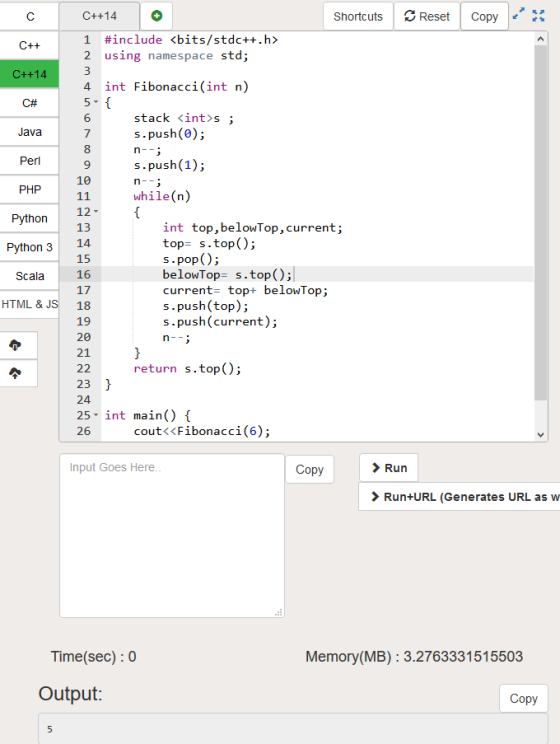
#include <bits/stdc++.h>
using namespace std;
int Fibonacci(int n)
{
stack <int>s ;
s.push(0);
n--;
s.push(1);
n--;
while(n)
{
int top,belowTop,current;
top= s.top();
s.pop();
belowTop= s.top();
current= top+ belowTop;
s.push(top);
s.push(current);
n--;
}
return s.top();
}
int main() {
cout<<Fibonacci(6);
return 0;
}
Add Answer to:
C++ ONLY
a) Write a non-recursive implementation of Fibonacci function
that uses stack (you can use...
Please use Java. Write a non-recursive method that uses a stack to check whether its string...
Please use Java. Write a non-recursive method that uses a stack to check whether its string parameter is a palindrome. Write a program to test and demo your method. Fibonacci Numbers Write a method that uses a stack to determine the desired Fibonacci number. Write a program to test and demo your method. Balancing Grouping Symbols Write a method that takes a string parameter and determines whether the string contains matching grouping symbols. Grouping symbols are parenthesis ( ), curly...
C++ Write an implementation of the ADT stack that uses a resizable array (vector class of...
C++ Write an implementation of the ADT stack that uses a resizable array (vector class of C++ STL) to represent the stack items. Anytime the stack becomes full, double the size of the array. Maintain the stack’s bottom entry at the beginning of the array the same way we did in array-based implementation.
I need help with this code. Im using C++ coding. Non Recursive (iterative) Fibonacci Write a...
I need help with this code. Im using C++ coding. Non Recursive (iterative) Fibonacci Write a program that uses a for loop to calculate a Fibonacci sequence (NOT RECURSIVE!!!) up to a given position, starting with position 0. This function defines a Fibonacci sequence: If the number is 0, the function returns a 0 If the number is 1, the function returns a 1 If the number is higher than 1, it returns the sum of the previous two numbers...
In Haskell: Write a recursive function fibonacci that computes the n-th Fibonacci number. fibonacci :: Int...
In Haskell: Write a recursive function fibonacci that computes the n-th Fibonacci number. fibonacci :: Int -> Int Write a recursive function myProduct that multiplies all the numbers in a list. myProduct :: [Integer] -> Integer Using the technique of List Comprehension write a function that would remove even numbers from a list of lists. For Example: given input: [[1,2,3,4], [6,3,45,8], [4,9,23,8]] expected output: [[1,3], [3,45],[9,23]]. Show how the library function replicate :: Int -> a-> [a] that produces a...
Extra Credit - Fibonacci Function (Lec. 5 topic: Recursive function and runtime stack. Use recursion to...
 Extra Credit - Fibonacci Function (Lec. 5 topic: Recursive function and runtime stack. Use recursion to calculate the Fibonacci Function 1.) Use a recursive function called fib() to calculate the Fibonacci Function for the following values for the variable n. int n = 10; int n = 20; int n = 30; int n = 40; int n = 45; int n = 46; 2.) In addition to calculating and displaying the results, use a "timer" to see how long...
The following Implementation of the Fibonacci function is a correct, but inefficient, def fibonacci(n): if n...
 The following
Implementation of the Fibonacci function is a
correct, but inefficient,
def fibonacci(n):
if n <= 2:
return 1
else:
return fib(n - 1) +
fib(n - 2)
In more details, the
code shown runs very slowly for even relatively small values of
n; it can take minutes or hours to compute even the 40th
or 50th Fibonacci number. The code is inefficient because it makes
too many recursive calls. It ends up recomputing each Fibonacci
number many times....
The following
Implementation of the Fibonacci function is a
correct, but inefficient,
def fibonacci(n):
if n <= 2:
return 1
else:
return fib(n - 1) +
fib(n - 2)
In more details, the
code shown runs very slowly for even relatively small values of
n; it can take minutes or hours to compute even the 40th
or 50th Fibonacci number. The code is inefficient because it makes
too many recursive calls. It ends up recomputing each Fibonacci
number many times....
(a) Write a program in Java to implement a recursive search function int terSearch(int A[], int...
(a) Write a program in Java to implement a recursive search function int terSearch(int A[], int l, int r, int x) that returns the location of x in a given sorted array of n integers A if x is present, otherwise -1. The terSearch search function, unlike the binary search, must consider two dividing points int d1 = l + (r - l)/3 int d2 = d1 + (r - l)/3 For the first call of your recursive search function...
The following is a correct implementation of a non-recursive method to find the nth Fibonacci number...
The following is a correct implementation of a non-recursive method to find the nth Fibonacci number in Java: public static long fib(int n){ long[ ] fibNums = new long[n + 1]; fibNums[0] = 0; finNums[1] = 1; for(int i = 2; i <= n; i++){ fibNums[i] = fibNums [i - 1] + finBums[i - 2]; } return fibNums[n]; } I am having trouble understanding the code. Why the creation of the long array make this...
Create an implementation for the Gale-Shapley algorithm, determine its time complexity. you will need to write...
Create an implementation for the Gale-Shapley algorithm, determine its time complexity. you will need to write up your implementation and discuss the data structures that you select and the time complexity of your algorithm. You can use pseudocode, but more concrete
Please code this in Java, thank you! (a) Implement a sublinear running time complexity recursive function...
 Please code this in Java, thank you!
(a) Implement a sublinear running time complexity recursive function in Java public static long long x, int n) to calculate X Note: In your function you can use only the basic arithmetic operators (+, -,, %, and /) (b) What is the running time complexity of your function? Justify (c) Give a number of multiplications used by your function to calculate x63.
Please code this in Java, thank you!
(a) Implement a sublinear running time complexity recursive function in Java public static long long x, int n) to calculate X Note: In your function you can use only the basic arithmetic operators (+, -,, %, and /) (b) What is the running time complexity of your function? Justify (c) Give a number of multiplications used by your function to calculate x63.
 Extra Credit - Fibonacci Function (Lec. 5 topic: Recursive function and runtime stack. Use recursion to calculate the Fibonacci Function 1.) Use a recursive function called fib() to calculate the Fibonacci Function for the following values for the variable n. int n = 10; int n = 20; int n = 30; int n = 40; int n = 45; int n = 46; 2.) In addition to calculating and displaying the results, use a "timer" to see how long...
 The following
Implementation of the Fibonacci function is a
correct, but inefficient,
def fibonacci(n):
if n <= 2:
return 1
else:
return fib(n - 1) +
fib(n - 2)
In more details, the
code shown runs very slowly for even relatively small values of
n; it can take minutes or hours to compute even the 40th
or 50th Fibonacci number. The code is inefficient because it makes
too many recursive calls. It ends up recomputing each Fibonacci
number many times....
The following
Implementation of the Fibonacci function is a
correct, but inefficient,
def fibonacci(n):
if n <= 2:
return 1
else:
return fib(n - 1) +
fib(n - 2)
In more details, the
code shown runs very slowly for even relatively small values of
n; it can take minutes or hours to compute even the 40th
or 50th Fibonacci number. The code is inefficient because it makes
too many recursive calls. It ends up recomputing each Fibonacci
number many times....
 Please code this in Java, thank you!
(a) Implement a sublinear running time complexity recursive function in Java public static long long x, int n) to calculate X Note: In your function you can use only the basic arithmetic operators (+, -,, %, and /) (b) What is the running time complexity of your function? Justify (c) Give a number of multiplications used by your function to calculate x63.
Please code this in Java, thank you!
(a) Implement a sublinear running time complexity recursive function in Java public static long long x, int n) to calculate X Note: In your function you can use only the basic arithmetic operators (+, -,, %, and /) (b) What is the running time complexity of your function? Justify (c) Give a number of multiplications used by your function to calculate x63.
Most questions answered within 3 hours.
-
Where is the error in this code sequence?
String s1 = "Hello";
String s2 = "ello";...
asked 10 months ago -
Financial data for Joel de Paris, Inc., for last year
follow:
Joel de Paris, Inc.
Balance...
asked 10 months ago -
Consider this reaction:
Al2(SO4)3 (aq)+ BaCl3
(aq) Al2Cl6 (aq)- +
3BaSO4(s) . What is the...
asked 10 months ago -
Suppose that Savneet is considering increasing her
recent random sample from 20 car rentals to 40...
asked 10 months ago -
Trucks arrive at an unloading terminal at an average rate of 120
per hour.
Trucks arrive...
asked 10 months ago -
Why are methanol and ethanol completely soluble in water while
octanol is not very little soluble....
asked 10 months ago -
A facilities manager at a university reads in a research report
that the mean amount of...
asked 10 months ago -
When the CuSO4 is rehydrated by adding water to the anhydrous
compound, is this an endothermic...
asked 10 months ago -
A ray of sunlight is passing from diamond into crown glass; the
angle of incidence is...
asked 10 months ago -
A block of mass 0.249 kg is placed on top of a light, vertical
spring of...
asked 10 months ago -
how do the kidneys compensate in the presences of acidosis
a) trigger hyperventilate
b) reserve acid...
asked 10 months ago -
Question 501 pts
The rental rate of capital to the firm increases. Which of the
following...
asked 10 months ago