Write a C program that determines the sum of the decimal digits that appear in the...
Write a C program that determines the sum of the decimal digits that appear in the command line arguments (excluding argv[0]) of the main function. The sum should be zero if there are no command line arguments following argv[0], or if the command line arguments following argv[0] do not include any decimal digits.
Example
If the command line arguments (following argv[0]) were
- 7M3 3DoorsDown Sum41 U2 The4Seasons Maroon5 TheB52s
then the sum would be
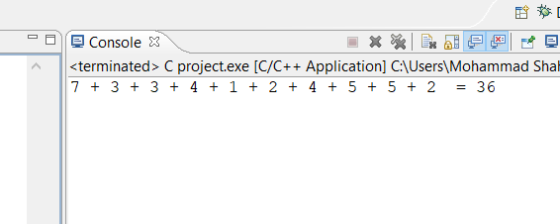
- 7 + 3 + 3 + 4 + 1 + 2 + 4 + 5 + 5 + 2 = 36
Homework Answers
Please find the answer below:
#include <stdio.h>
#include <string.h>
int main(int argc, char *argv[]){
int sum = 0;
int i=0;
int first = 1;
for(i=1;i<argc;i++){
int index = 0;
for(index=0;index<strlen(argv[i]);index++){
if(argv[i][index]>='0' && argv[i][index]<='9'){
sum+=argv[i][index]-'0';
if(first==1){
printf("%c
",argv[i][index]);
first = 0;
}else{
printf("+ %c
",argv[i][index]);
}
}
}
}
printf(" = %d",sum);
return 0;
}
output:
Add Answer to:
Write a C program that
determines the sum of the decimal digits that appear in the...
Write a C program such that … the program receives ( following argv[0] ) one or...
Write a C program such that … the program receives ( following argv[0] ) one or more integer values as command line arguments the program prints (to standard output) … the command line arguments, with each appearing on a separate line the sum of the integer values that follow argv[0] Hints http://www.cplusplus.com/reference/cstdlib/strtol THE CORRECT OUTPUT OF THE TEST CASE : The command line arguments are ... argv[0] ... "./a.out" argv[1] ... "2" argv[2] ... "9" argv[3] ... "-100" argv[4] ......
1) Write a C program that displays all the command line arguments that appear on the...
1) Write a C program that displays all the command line arguments that appear on the command line when the program is invoked. Use the file name cl.c for your c program. Test your program with cl hello goodbye and cl 1 2 3 4 5 6 7 8 and cl 2) Write a C program which displays the sum of the command line arguments. Hint: use sscanf to convert the decimal arguments (which are strings) to binary numbers that...
Objective: Use input/output files, strings, and command line arguments. Write a program that processes a text...
Objective: Use input/output files, strings, and command line arguments. Write a program that processes a text file by removing all blank lines (including lines that only contain white spaces), all spaces/tabs before the beginning of the line, and all spaces/tabs at the end of the line. The file must be saved under a different name with all the lines numbered and a single blank line added at the end of the file. For example, if the input file is given...
Problem: Write a program that behaves as described below.If the first command-line argument after the program...
Problem: Write a program that behaves as described below.If the first command-line argument after the program name (argv[1]) is “--help”, print the usage information for the program. If that argument is not “--help”, you are to expectargv[1]and subsequent arguments to be real numbers(C, integer, float, or double types)in formats acceptable to the sscanf()function of the C library or strings of ASCII chars that are not readable as real numbers. You are to read the numbers, count them and calculate the...
Program already solved, but I need to put function documentation headers for each and every function...
Program already solved, but I need to put function documentation headers for each and every function in your program (for the ones you write, and keep the function header I give you for the main() function). Also make sure you keep the file block header at the top of the file, and fill in the information correctly. Secondly this week you must get your indentation correct. All indentation must use 2 spaces, and you should not have embedded tabs in...
(Java Please) Sum of Digits Write a program that will sum the digits of a number...
(Java Please) Sum of Digits Write a program that will sum the digits of a number input by the user. For example, if the user enters the number 1234, the sum of the digits will be 10 (1 + 2 + 3 + 4 = 10). The user will enter a number with at least 4 digits (greater than 1000). That value will be sent to a method which will return the sum. Sample Output 1: SUM OF DIGITS -------------...
Command line input In C++ it is possible to accept command line arguments. Command-line arguments are...
Command line input In C++ it is possible to accept command line arguments. Command-line arguments are given after the name of a program in command-line operating systems like Linux and are passed in to the program from the operating system. To use command line arguments in the program, it must first understand the full declaration of the main function, which until now has accepted no arguments. In fact, main can accept two arguments: one argument is number of command line...
***Program must compile under Ubuntu! (35 pts) Write a C++ program A4p3.cpp with a class that...
***Program must compile under Ubuntu! (35 pts) Write a C++ program A4p3.cpp with a class that is a derived class of your class from problem 2. Add a private intmember variable var2 to this class. Initialize the member variables var and var2 with values between 1 and 50 using a constructor that takes two integer parameters. Add a public member function called getsp that should print out the sum and product of var and var2. In your main function, create...
1) Write a complete C or C++ program to print Hello World Greetings. 2) Using the...
1) Write a complete C or C++ program to print Hello World Greetings. 2) Using the command line, compile and generate the executable for the above program. Let’s call helloWorld the target executable. 3) Write a C program that does the following: a) forks a child to execute helloWorld b) waits for the child execution to end 4) Reuse the above program to try a different variant of exec family of system calls. OPTIONAL: 1) write a program main that...
[THIS SHOULD BE WRITTEN IN C++] The first argument, usually called argc, tells the program how...
[THIS SHOULD BE WRITTEN IN C++] The first argument, usually called argc, tells the program how many command line arguments were passed to the program on its invocation. The second argument, argv, is an array of strings containing the arguments themselves. Write a main which prints out the arguments passed to the program. For example, when I run my program like this: ./prog apples bananas oranges it outputs: Argument #0 is ./prog Argument #1 is apple Argument #2 is bananas...
Most questions answered within 3 hours.
-
Where is the error in this code sequence?
String s1 = "Hello";
String s2 = "ello";...
asked 10 months ago -
Financial data for Joel de Paris, Inc., for last year
follow:
Joel de Paris, Inc.
Balance...
asked 10 months ago -
Consider this reaction:
Al2(SO4)3 (aq)+ BaCl3
(aq) Al2Cl6 (aq)- +
3BaSO4(s) . What is the...
asked 10 months ago -
Suppose that Savneet is considering increasing her
recent random sample from 20 car rentals to 40...
asked 10 months ago -
Trucks arrive at an unloading terminal at an average rate of 120
per hour.
Trucks arrive...
asked 10 months ago -
Why are methanol and ethanol completely soluble in water while
octanol is not very little soluble....
asked 10 months ago -
A facilities manager at a university reads in a research report
that the mean amount of...
asked 10 months ago -
When the CuSO4 is rehydrated by adding water to the anhydrous
compound, is this an endothermic...
asked 10 months ago -
A ray of sunlight is passing from diamond into crown glass; the
angle of incidence is...
asked 10 months ago -
A block of mass 0.249 kg is placed on top of a light, vertical
spring of...
asked 10 months ago -
how do the kidneys compensate in the presences of acidosis
a) trigger hyperventilate
b) reserve acid...
asked 10 months ago -
Question 501 pts
The rental rate of capital to the firm increases. Which of the
following...
asked 10 months ago