Command line input In C++ it is possible to accept command line arguments. Command-line arguments are...
Command line input
In C++ it is possible to accept command line arguments. Command-line arguments are given after the name of a program in command-line operating systems like Linux and are passed in to the program from the operating system. To use command line arguments in the program, it must first understand the full declaration of the main function, which until now has accepted no arguments. In fact, main can accept two arguments: one argument is number of command line arguments, and the other argument is a full list of all of the command line arguments in an array of strings.
The full header of main looks like this:
int main(int argc, char *argv[])
The integer, argc is the argument Count (hence argc). It is the number of arguments passed into the program from the command line, including the name of the program.
The array of character pointers is the listing of all the arguments. argv[0] is the name of the program, or an empty string if the name is not available. After that, every element number less than argc is a command line argument. It can use each argv element just like a cstring or use argv as a twodimensional array.
How could this be used? Almost any program that wants its parameters to be set when it is executed would use this.
For example:
#include <iostream>
using namespace std;
int main(int argc, char *argv[]) {
// process command line arguments
cout << "The name of the program is " << argv[0] << endl;
if (argc == 1) {
cout << "Usage: Provide some command line arguments!\n";
} else {
cout << "The command line arguments are:\n";
for (int i = 1; i < argc; ++i) {
int value = std::atoi(argv[i]);
cout << argv[i];
if (value != 0) {
cout << " (value: " << value << ")\n";
}
cout << endl;
}
}
return 0;
}
This demonstration program is fairly simple. It first checks that the user added a second argument. The program checks to see if the argument is valid by trying to convert it using std::atoi.
The program gets the name of the file from the command line only. Do not interactively prompt the user for the file name.
• If no command line arguments are passed to the program, the program should display a usage message to the user and terminate.
• If more than 2 arguments are passed to the program, the program should display a usage message to the user and terminate.
A correct use would be:
./a.out file.txt
An incorrect use would be:
./a.out
Error: Specify the file name as a command line argument.
For example: ./a.out file1.txt
./a.out f1.txt f2.txt
Error: Specify the file name as a command line argument.
For example: ./a.out file1.txt
Homework Answers
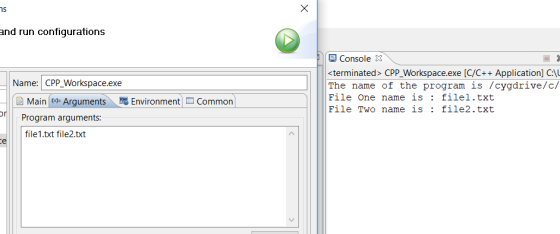
Please find the code below::::
#include <iostream>
using namespace std;
int main(int argc, char *argv[]) {
// process command line arguments
cout << "The name of the program is " <<
argv[0] << endl;
if (argc <3) {
cout << "Error: Specify the
file name as a command line argument.";
cout<<"\nFor example: ./a.out
file1.txt file2.txt";
}else if (argc > 3) {
cout << "Error: Too many
argument passed!!!,Specify the file name as a command line
argument.";
cout<<"\nFor example: ./a.out
file1.txt file2.txt";
}else {
cout<<"File One name is :
"<<argv[1]<<endl;
cout<<"File Two name is :
"<<argv[2]<<endl;
}
return 0;
}
command
Add Answer to:
Command line input
In C++ it is possible to accept command line arguments.
Command-line arguments are...
Objective: Use input/output files, strings, and command line arguments. Write a program that processes a text...
Objective: Use input/output files, strings, and command line arguments. Write a program that processes a text file by removing all blank lines (including lines that only contain white spaces), all spaces/tabs before the beginning of the line, and all spaces/tabs at the end of the line. The file must be saved under a different name with all the lines numbered and a single blank line added at the end of the file. For example, if the input file is given...
In C Programming Adding to your program in part A, go through the command line arguments...
In C Programming Adding to your program in part A, go through the command line arguments and find the largest and smallest arguments by alphabetical order. Note that you should not need to sort your arguments, but instead compare them and save the smallest and largest strings as you go through. For example, if called with ./reverse one two three: It would display the output for part A: Three two one And then it would display The smallest string was:...
I need only one C++ function . It's C++ don't write any other language. Hello I need...
 I need only one C++ function . It's C++ don't
write any other language.
Hello I need unzip function here is my zip function
below. So I need the opposite function unzip.
Instructions:
The next tools you will build come in a pair, because
one (zip) is a file compression tool, and
the other (unzip) is a file decompression
tool.
The type of compression used here is a simple form of
compression called run-length encoding (RLE). RLE is quite simple:
when...
I need only one C++ function . It's C++ don't
write any other language.
Hello I need unzip function here is my zip function
below. So I need the opposite function unzip.
Instructions:
The next tools you will build come in a pair, because
one (zip) is a file compression tool, and
the other (unzip) is a file decompression
tool.
The type of compression used here is a simple form of
compression called run-length encoding (RLE). RLE is quite simple:
when...
I am using xcode Use the following ideas to develop a nonrecursive, linear-time algorithm for the...
I am using xcode Use the following ideas to develop a nonrecursive, linear-time algorithm for the maximum-subarray problem. Start at the left end of the array, and progress toward the right, keeping track of the maximum subarray seen so far. Knowing a maximum subarray of A[1..j], extend the answer to find a maximum subarray ending at index j + 1 by using the following observation: a maximum subarray of A[1..j + 1] is either a maximum subarray of A[1..j] or...
1. In ANSII standard C++, there is no library function to convert an integer to a...
1. In ANSII standard C++, there is no library function to convert an integer to a string. Your program should develop such a function. In other words complete the following program using your itos function. (Use of other C functions is prohibitted) // this program will read in an integer and convert it to a string #include <iostream> #include <cstdlib> #include <string> using namespace std; string itos(int n) { } int main(int argc, char* argv[]){ int n = atoi(argv[1]); cout...
What is the output of the following code given the program was called using the command-line:...
What is the output of the following code given the program was called using the command-line: a.out input.txt output.txt int main(int argc, char* argv[]) { cout << argc; return 0; } Select one: a. 1 b. 2 c. 3 d. 6 which asnwer it is
Program already solved, but I need to put function documentation headers for each and every function...
Program already solved, but I need to put function documentation headers for each and every function in your program (for the ones you write, and keep the function header I give you for the main() function). Also make sure you keep the file block header at the top of the file, and fill in the information correctly. Secondly this week you must get your indentation correct. All indentation must use 2 spaces, and you should not have embedded tabs in...
C programming The program will require the following structure: struct _data { char *name; long number;...
C programming The program will require the following structure: struct _data { char *name; long number; }; The program will require command line arguments: int main(int argv, char **argc) { Where argv is the number of arguments and argc is an array holding the arguments (each is a string). Your program must catch any case where no command line arguement was provided and print a warning message (see below). You MUST include/use the following functions, defined as follows: int SCAN(FILE...
Write a C++ program In this assignment you will complete the definition of two functions that...
Write a C++ program In this assignment you will complete the definition of two functions that implement the repeated squaring algorithm described in the Stamp textbook on pages 98-99. Note that your implementation should not use the pow() function, the powl() functions, or any other built-in exponentiation functions. program4-driver.cpp - This file contains a completed main() function that serves as the driver to parse the command line, pass the values to the powerModN() function, and print the result. Make no...
Modify When executing on the command line having only this program name, the program will accept...
Modify When executing on the command line having only this program name, the program will accept keyboard input and display such until the user does control+break to exit the program. The new code should within only this case situation “if (argc == 1){ /* no args; copy standard input */” Replace line #20 “filecopy(stdin, stdout);” with your new code. Open read a text file “7NoInputFileResponse.txt” that contains a message “There were no arguments on the command line to be tested...
 I need only one C++ function . It's C++ don't
write any other language.
Hello I need unzip function here is my zip function
below. So I need the opposite function unzip.
Instructions:
The next tools you will build come in a pair, because
one (zip) is a file compression tool, and
the other (unzip) is a file decompression
tool.
The type of compression used here is a simple form of
compression called run-length encoding (RLE). RLE is quite simple:
when...
I need only one C++ function . It's C++ don't
write any other language.
Hello I need unzip function here is my zip function
below. So I need the opposite function unzip.
Instructions:
The next tools you will build come in a pair, because
one (zip) is a file compression tool, and
the other (unzip) is a file decompression
tool.
The type of compression used here is a simple form of
compression called run-length encoding (RLE). RLE is quite simple:
when...
Most questions answered within 3 hours.
-
Where is the error in this code sequence?
String s1 = "Hello";
String s2 = "ello";...
asked 10 months ago -
Financial data for Joel de Paris, Inc., for last year
follow:
Joel de Paris, Inc.
Balance...
asked 10 months ago -
Consider this reaction:
Al2(SO4)3 (aq)+ BaCl3
(aq) Al2Cl6 (aq)- +
3BaSO4(s) . What is the...
asked 10 months ago -
Suppose that Savneet is considering increasing her
recent random sample from 20 car rentals to 40...
asked 10 months ago -
Trucks arrive at an unloading terminal at an average rate of 120
per hour.
Trucks arrive...
asked 10 months ago -
Why are methanol and ethanol completely soluble in water while
octanol is not very little soluble....
asked 10 months ago -
A facilities manager at a university reads in a research report
that the mean amount of...
asked 10 months ago -
When the CuSO4 is rehydrated by adding water to the anhydrous
compound, is this an endothermic...
asked 10 months ago -
A ray of sunlight is passing from diamond into crown glass; the
angle of incidence is...
asked 10 months ago -
A block of mass 0.249 kg is placed on top of a light, vertical
spring of...
asked 10 months ago -
how do the kidneys compensate in the presences of acidosis
a) trigger hyperventilate
b) reserve acid...
asked 10 months ago -
Question 501 pts
The rental rate of capital to the firm increases. Which of the
following...
asked 10 months ago