A dish containing 145 g of water at 54.0 degrees Celsius is put in a refrigerator...
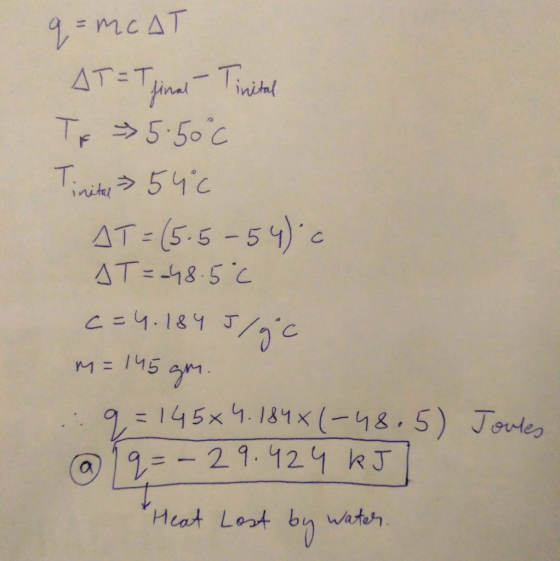
A dish containing 145 g of water at 54.0 degrees Celsius is put in a refrigerator to cool. It is removed when the temperature ofthe water is 5.50 degrees Celsius. (Specific heat H2O(l)=4.184 j/gC.
a) how much heat (in KJ) does the water lose?
b) Describe how the entropy of the system changes in this process?
Homework Answers
a). Heat Lost by Water= 29.424 kJ
b). Entropy of the system DECREASES. Because, Entropy is the measurement of randomness of a system and as temperature of water is reduced, the randomness of the system will reduce.Hence entropy reduces.
Add Answer to:
A dish containing 145 g of water at 54.0 degrees Celsius is put
in a refrigerator...
A lead block with a mass of 46.5 g at a temperature of 76.98 degrees celsius...
A lead block with a mass of 46.5 g at a temperature of 76.98 degrees celsius was placed into a calorimeter containing 100.0 mL of water at a temperature of 20.6 degrees celsius. What is the equilibrium temperature if the specific heat of water is 4.184 J/g and the specific heat of lead is 0.158 J/gdegreeC?
How much heat is needed to convert 200 grams of ice at 0 degrees Celsius to...
How much heat is needed to convert 200 grams of ice at 0 degrees Celsius to steam at 100 degrees Celsius?(Hf(0 C)=334 J/g, Specific heat of water = 4.184 J/gK, Hv(100 C) = 2260 J/g, Specific heat of ice = 2.108 J/gC) and how do i do it?
It takes 11.2 kj of energy to raise the temperature of 145 g of benzene from 25 degrees Celsius to 70 degrees Celsius....
It takes 11.2 kj of energy to raise the temperature of 145 g of benzene from 25 degrees Celsius to 70 degrees Celsius. What is the specific heat of benzene? Please show work I am trying to figure out how to work these problems. I will rate high. Thanks
It takes 11.2 kj of energy to raise the temperature of 145 g of benzene from 25 degrees Celsius to 70 degrees Celsius....
It takes 11.2 kj of energy to raise the temperature of 145 g of benzene from 25 degrees Celsius to 70 degrees Celsius. What is the specific heat of benzene? Please show work I am trying to figure out how to work these problems. I will rate high. Thanks
What is the final temperature when 100 g of iron at 90 degrees Celsius is placed...
What is the final temperature when 100 g of iron at 90 degrees Celsius is placed in 400 g of water at 25 degrees Celsius? The specific heat capacity of iron 0.45 J/g*K and the specific heat capacity of water is 4.184 J/g*K.
What is the final temperature when 100 g of iron at 90 degrees Celsius is placed...
What is the final temperature when 100 g of iron at 90 degrees Celsius is placed in 400 g of water at 25 degrees Celsius? The specific heat capacity of iron 0.45 J/g*K and the specific heat capacity of water is 4.184 J/g*K
A metal sample weighing 24.000 g is heated to 100.0 degrees celsius and then transferred into a calorimeter containing 3...
A metal sample weighing 24.000 g is heated to 100.0 degrees celsius and then transferred into a calorimeter containing 30.0 mL of water at a temperature of 22.8 degrees celsius. If the specific heat of the metal is 0.105 J/g*C, what is the final temperature of the metal sample plus water?
The temperature H in degrees Celsius of a bottle water t minutes after being put in...
 The temperature H in degrees Celsius of a bottle water t minutes after being put in a refrigerator is H (t) = 4 + 16e -0.02. How fast, in degrees/min, is the bottle of water cooling 10 minutes after being put into the refrigerator? Enter your answer as a decimal to 3 places.
A hot lump of 32.3g of Copper at an initial temperature of 96.5 degrees Celsius in...
 A
hot lump of 32.3g of Copper at an initial temperature of 96.5
degrees Celsius in 50mL H2O initially at 25.0 degrees Celsius and
allowed to reach thermal equilibrium. What is the final temperature
of the copper and water, given that the specific hear is 0.385J/g°C
and the specific heat of water is 4.184J/g°C?
4. A hot lump of 41.3 g of copper at an initial temperature of 94.8 °C is placed in 50.0 mL H2O initially at 25.0 °C...
A
hot lump of 32.3g of Copper at an initial temperature of 96.5
degrees Celsius in 50mL H2O initially at 25.0 degrees Celsius and
allowed to reach thermal equilibrium. What is the final temperature
of the copper and water, given that the specific hear is 0.385J/g°C
and the specific heat of water is 4.184J/g°C?
4. A hot lump of 41.3 g of copper at an initial temperature of 94.8 °C is placed in 50.0 mL H2O initially at 25.0 °C...
450.0 g of H 2O is at 54.0 oC. It loses ________ kJ of heat to...
450.0 g of H 2O is at 54.0 oC. It loses ________ kJ of heat to a cooler environment. The final temperature is 48.7 oC. The specific heat of water is 4.184 J/g·C. Watch units. How many kJ of heat did it lose? 8.02 kJ 11.5 kJ 9.98 kJ 14.0 kJ 25.2 kJ 12.60 milliliters of a 1.25 M KOH solution are required to titrate 20.0 milliliters of a H3PO4 solution. What is the molarity of the H3PO4 solution? 3KOH...
 The temperature H in degrees Celsius of a bottle water t minutes after being put in a refrigerator is H (t) = 4 + 16e -0.02. How fast, in degrees/min, is the bottle of water cooling 10 minutes after being put into the refrigerator? Enter your answer as a decimal to 3 places.
 A
hot lump of 32.3g of Copper at an initial temperature of 96.5
degrees Celsius in 50mL H2O initially at 25.0 degrees Celsius and
allowed to reach thermal equilibrium. What is the final temperature
of the copper and water, given that the specific hear is 0.385J/g°C
and the specific heat of water is 4.184J/g°C?
4. A hot lump of 41.3 g of copper at an initial temperature of 94.8 °C is placed in 50.0 mL H2O initially at 25.0 °C...
A
hot lump of 32.3g of Copper at an initial temperature of 96.5
degrees Celsius in 50mL H2O initially at 25.0 degrees Celsius and
allowed to reach thermal equilibrium. What is the final temperature
of the copper and water, given that the specific hear is 0.385J/g°C
and the specific heat of water is 4.184J/g°C?
4. A hot lump of 41.3 g of copper at an initial temperature of 94.8 °C is placed in 50.0 mL H2O initially at 25.0 °C...
Most questions answered within 3 hours.
-
Where is the error in this code sequence?
String s1 = "Hello";
String s2 = "ello";...
asked 11 months ago -
Financial data for Joel de Paris, Inc., for last year
follow:
Joel de Paris, Inc.
Balance...
asked 11 months ago -
Consider this reaction:
Al2(SO4)3 (aq)+ BaCl3
(aq) Al2Cl6 (aq)- +
3BaSO4(s) . What is the...
asked 11 months ago -
Suppose that Savneet is considering increasing her
recent random sample from 20 car rentals to 40...
asked 11 months ago -
Trucks arrive at an unloading terminal at an average rate of 120
per hour.
Trucks arrive...
asked 11 months ago -
Why are methanol and ethanol completely soluble in water while
octanol is not very little soluble....
asked 11 months ago -
A facilities manager at a university reads in a research report
that the mean amount of...
asked 11 months ago -
When the CuSO4 is rehydrated by adding water to the anhydrous
compound, is this an endothermic...
asked 11 months ago -
A ray of sunlight is passing from diamond into crown glass; the
angle of incidence is...
asked 11 months ago -
A block of mass 0.249 kg is placed on top of a light, vertical
spring of...
asked 11 months ago -
how do the kidneys compensate in the presences of acidosis
a) trigger hyperventilate
b) reserve acid...
asked 11 months ago -
Question 501 pts
The rental rate of capital to the firm increases. Which of the
following...
asked 11 months ago