Question 1: Consider the following LP model. max ? = 4?1 + 4?2 s.t. 3?1 −...
Question 1: Consider the following LP model.
max ? = 4?1 + 4?2
s.t. 3?1 − ?2 ≤ 9
?1 + ?2 ≤ 7
5?2 ≤ 25
?1 ≥ 0, ?2 ≥ 0
Part a) Find the optimal solution for the above model using simplex technique.
Part b) Find the shadow prices (optimal dual variables) for the model.
Part c) If you could buy an additional unit of the first resource for a cost of 5/2, would you do this? Why?
Homework Answers
(a)
Standard form:
max ? = 4?1 + 4?2 + 0s1 + 0s2 + 0s3
s.t. 3?1 − ?2 + 1s1 = 9
?1 + ?2 + 1s2 = 7
5?2 + 1s3 = 25
?1, ?2, s1, s2 ≥ 0
| Iteration-1 | Cj | 4 | 4 | 0 | 0 | 0 | ||
| B | CB | XB | x1 | x2 | S1 | S2 | S3 | Min Ratio XB / x1 |
| S1 | 0 | 9 | (3) | -1 | 1 | 0 | 0 | 9 / 3=3→ |
| S2 | 0 | 7 | 1 | 1 | 0 | 1 | 0 | 7 / 1=7 |
| S3 | 0 | 25 | 0 | 5 | 0 | 0 | 1 | --- |
| Z=0 | Zj | 0 | 0 | 0 | 0 | 0 | ||
| Zj-Cj | -4↑ | -4 | 0 | 0 | 0 |
Negative minimum Zj-Cj is -4
and its column index is 1. So, the entering variable is
x1.
The minimum ratio is 3 and its row index is 1. So, the leaving
basic variable is S1.
So, the pivot element is 3.
Entering =x1, Departing =S1, Key Element =3
Row operations:
- R1(new)=R1(old) / 3
- R2(new)=R2(old) - R1(new)
- R3(new)=R3(old)
| Iteration-2 | Cj | 4 | 4 | 0 | 0 | 0 | ||
| B | CB | XB | x1 | x2 | S1 | S2 | S3 | Min Ratio XB / x2 |
| x1 | 4 | 3 | 1 | -0.333 | 0.333 | 0 | 0 | --- |
| S2 | 0 | 4 | 0 | (1.333) | -0.333 | 1 | 0 | 4 / 1.333=3→ |
| S3 | 0 | 25 | 0 | 5 | 0 | 0 | 1 | 255=5 |
| Z=12 | Zj | 4 | -1.333 | 1.333 | 0 | 0 | ||
| Zj-Cj | 0 | -5.333↑ | 1.333 | 0 | 0 |
Negative minimum Zj-Cj is
-5.333 and its column index is 2. So, the entering variable is
x2.
The minimum ratio is 3 and its row index is 2. So, the leaving
basic variable is S2.
So, the pivot element is 1.333.
Entering =x2, Departing =S2, Key Element
=1.333
Row operations:
- R2(new)=R2(old) / 1.333
- R1(new)=R1(old) + 0.333 * R2(new)
- R3(new)=R3(old) - 5 * R2(new)
| Iteration-3 | Cj | 4 | 4 | 0 | 0 | 0 | |
| B | CB | XB | x1 | x2 | S1 | S2 | S3 |
| x1 | 4 | 4 | 1 | 0 | 0.25 | 0.25 | 0 |
| x2 | 4 | 3 | 0 | 1 | -0.25 | 0.75 | 0 |
| S3 | 0 | 10 | 0 | 0 | 1.25 | -3.75 | 1 |
| Z=28 | Zj | 4 | 4 | 0 | 4 | 0 | |
| Zj-Cj | 0 | 0 | 0 | 4 | 0 |
Since all Zj-Cj ≥ 0, we have reached the optimality condition and the optimal solution is as follows:
x1 = 4
x2 = 3
Max Z = 28
(b)
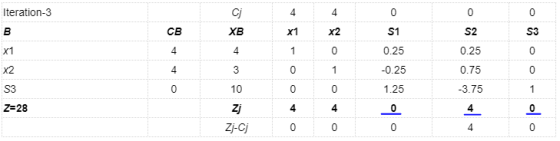
Note the Zj row entries corresponding to S1, S2, and S3. These are the shadow prices of Constraint-1, 2, and 3 respectively.
So,
the shadow prices are 0, 4, and 0 for Constraint-1, 2, and 3 respectively.
(c)
No. because the shadow price is zero meaning that already there exists slack capacity. Additional resources at any cost are unnecessary.
Add Answer to:
Question 1: Consider the following LP model.
max ? = 4?1 + 4?2
s.t. 3?1 −...
Consider the following LP max z=3x1+x2 s.t. −2x1 + x2 ≤ 3 x1 + 2x2 ≤...
Consider the following LP max z=3x1+x2 s.t. −2x1 + x2 ≤ 3 x1 + 2x2 ≤ 5 x1,x2 ≥0 (a) Find the dual (or shadow) prices of the binding constraints (b) Find the dual (or shadow) prices of the binding “dual” constraints.
ALGORITHM DESIGN Write the following LP in standard form. max x_1 + 3x_2 + 2x_3 s.t....
 ALGORITHM DESIGN
Write the following LP in standard form. max x_1 + 3x_2 + 2x_3 s.t. x_1 - x_2 + 2x_3 lessthanorequalto 5 2x_1 - x_2 lessthanorequalto 0 2x_2 + x_3 lessthanorequalto 5 x_1, x_2, x_3 greaterthanorequalto 0 (b) Write the Dual LP of the LP of part (a).[Use the usual dual format, that is, min{b^T y : A^T y greaterthanorequalto c, y greaterthanorequalto 0}.] (c) Run the simplex algorithm to obtain the optimal solution to the primal.
ALGORITHM DESIGN
Write the following LP in standard form. max x_1 + 3x_2 + 2x_3 s.t. x_1 - x_2 + 2x_3 lessthanorequalto 5 2x_1 - x_2 lessthanorequalto 0 2x_2 + x_3 lessthanorequalto 5 x_1, x_2, x_3 greaterthanorequalto 0 (b) Write the Dual LP of the LP of part (a).[Use the usual dual format, that is, min{b^T y : A^T y greaterthanorequalto c, y greaterthanorequalto 0}.] (c) Run the simplex algorithm to obtain the optimal solution to the primal.
Consider the following LP: Max x1 +x2 +x3 s.t. x1 +2x2 +2x3 ≤ 20 Solve this...
Consider the following LP: Max x1 +x2 +x3 s.t. x1 +2x2 +2x3 ≤ 20 Solve this problem without using the simplex algorithm, but using the fact that an optimal solution to LP exists at one of the basic feasible solutions.
Use the simplex algorithm to find all optimal solutions to the following LP. max z=2x1+x2 s.t....
Use the simplex algorithm to find all optimal solutions to the following LP. max z=2x1+x2 s.t. 4x1 + 2x2 ≤ 4 −2x1 + x2 ≤ 2 x1 ≥1 x1,x2 ≥0
3. Use the simplex algorithm to find an optimal solution to the following LP: s.t. 3x1...
 3. Use the simplex algorithm to find an optimal solution to the following LP: s.t. 3x1 +26 s.t.-xi + 2x2 S 0 レ
Consider the following LP problem max z = x1 +2x2 + x3 + x4 s.t. x1...
 Consider the following LP problem max z = x1 +2x2 + x3 + x4 s.t. x1 + 2x2 + x3 く2 +2x3 く! X1, x2, x3, x4 20 a) Obtain the dual formulation of the LP.
Consider the following linear program Max 3xl +2x2 S.t 1x1 + 1x2 〈 10 3x1 1x2...
 Consider the following linear program Max 3xl +2x2 S.t 1x1 + 1x2 〈 10 3x1 1x2 〈 24 1xl t 2x2< 16 And xl, x2> 0. a) Use Excel Solver to find the optimal solution to this problem. State the optimal values of xl, x2, and Z. b) Assume that the objective function coefficient for xl changes from 3 to 5. Does the optimal solution change? c) Assume that the objective function coefficient for x1 remains 3, but the objective...
Q3. (Dual Simplex Method) (2 marks) Use the dual Simplex method to solve the following LP model: max z= 2x1 +4x2 +9x3 x1 x2 x3 S 1 -x1+ X2 +2x3 S -4 x2+ X1,X2,X3 S 0 Q3. (Dual Simplex Method) (2...
 Q3. (Dual Simplex Method) (2 marks) Use the dual Simplex method to solve the following LP model: max z= 2x1 +4x2 +9x3 x1 x2 x3 S 1 -x1+ X2 +2x3 S -4 x2+ X1,X2,X3 S 0
Q3. (Dual Simplex Method) (2 marks) Use the dual Simplex method to solve the following LP model: max z= 2x1 +4x2 +9x3 x1 x2 x3 S 1 -x1+ X2 +2x3 S -4 x2+ X1,X2,X3 S 0
Q3. (Dual Simplex Method) (2 marks) Use the dual Simplex method to solve the following LP model: max z= 2x1 +4x2 +9x3 x1 x2 x3 S 1 -x1+ X2 +2x3 S -4 x2+ X1,X2,X3 S 0
Problem 3 Consider the LP problem Minimize -3r22 0s1+0s2 +0s3 0s Subject to 228 2r2 + $2 1,2,81,8...
 Problem 3 Consider the LP problem Minimize -3r22 0s1+0s2 +0s3 0s Subject to 228 2r2 + $2 1,2,81,82 8384 with optimal tableau as follows: sic r1 T2 s1 s2 s3 s4 Solution C 0 0 20 1 0 0 12 Optimum 0 30 0-103 4 0 021 2 Find the dual optimal solution and the corresponding objective function value using the information provided in the optimal simplex tableau.
Problem 3 Consider the LP problem Minimize -3r22 0s1+0s2 +0s3 0s Subject...
Problem 3 Consider the LP problem Minimize -3r22 0s1+0s2 +0s3 0s Subject to 228 2r2 + $2 1,2,81,82 8384 with optimal tableau as follows: sic r1 T2 s1 s2 s3 s4 Solution C 0 0 20 1 0 0 12 Optimum 0 30 0-103 4 0 021 2 Find the dual optimal solution and the corresponding objective function value using the information provided in the optimal simplex tableau.
Problem 3 Consider the LP problem Minimize -3r22 0s1+0s2 +0s3 0s Subject...
SOLVE STEP BY STEP! 4. Consider the following LP: Minimize z = x; +3x2 - X3...
 SOLVE STEP BY STEP!
4. Consider the following LP: Minimize z = x; +3x2 - X3 Subject to x + x2 + x2 > 3 -x + 2xz > 2 -x + 3x2 + x3 34 X1 X2,43 20 (a) Using the two-phase method, find the optimal solution to the primal problem above. (b) Write directly the dual of the primal problem, without using the method of transformation. (c) Determine the optimal values of the dual variables from the optimal...
SOLVE STEP BY STEP!
4. Consider the following LP: Minimize z = x; +3x2 - X3 Subject to x + x2 + x2 > 3 -x + 2xz > 2 -x + 3x2 + x3 34 X1 X2,43 20 (a) Using the two-phase method, find the optimal solution to the primal problem above. (b) Write directly the dual of the primal problem, without using the method of transformation. (c) Determine the optimal values of the dual variables from the optimal...
 ALGORITHM DESIGN
Write the following LP in standard form. max x_1 + 3x_2 + 2x_3 s.t. x_1 - x_2 + 2x_3 lessthanorequalto 5 2x_1 - x_2 lessthanorequalto 0 2x_2 + x_3 lessthanorequalto 5 x_1, x_2, x_3 greaterthanorequalto 0 (b) Write the Dual LP of the LP of part (a).[Use the usual dual format, that is, min{b^T y : A^T y greaterthanorequalto c, y greaterthanorequalto 0}.] (c) Run the simplex algorithm to obtain the optimal solution to the primal.
ALGORITHM DESIGN
Write the following LP in standard form. max x_1 + 3x_2 + 2x_3 s.t. x_1 - x_2 + 2x_3 lessthanorequalto 5 2x_1 - x_2 lessthanorequalto 0 2x_2 + x_3 lessthanorequalto 5 x_1, x_2, x_3 greaterthanorequalto 0 (b) Write the Dual LP of the LP of part (a).[Use the usual dual format, that is, min{b^T y : A^T y greaterthanorequalto c, y greaterthanorequalto 0}.] (c) Run the simplex algorithm to obtain the optimal solution to the primal.
 3. Use the simplex algorithm to find an optimal solution to the following LP: s.t. 3x1 +26 s.t.-xi + 2x2 S 0 レ
 Consider the following LP problem max z = x1 +2x2 + x3 + x4 s.t. x1 + 2x2 + x3 く2 +2x3 く! X1, x2, x3, x4 20 a) Obtain the dual formulation of the LP.
 Consider the following linear program Max 3xl +2x2 S.t 1x1 + 1x2 〈 10 3x1 1x2 〈 24 1xl t 2x2< 16 And xl, x2> 0. a) Use Excel Solver to find the optimal solution to this problem. State the optimal values of xl, x2, and Z. b) Assume that the objective function coefficient for xl changes from 3 to 5. Does the optimal solution change? c) Assume that the objective function coefficient for x1 remains 3, but the objective...
 Q3. (Dual Simplex Method) (2 marks) Use the dual Simplex method to solve the following LP model: max z= 2x1 +4x2 +9x3 x1 x2 x3 S 1 -x1+ X2 +2x3 S -4 x2+ X1,X2,X3 S 0
Q3. (Dual Simplex Method) (2 marks) Use the dual Simplex method to solve the following LP model: max z= 2x1 +4x2 +9x3 x1 x2 x3 S 1 -x1+ X2 +2x3 S -4 x2+ X1,X2,X3 S 0
Q3. (Dual Simplex Method) (2 marks) Use the dual Simplex method to solve the following LP model: max z= 2x1 +4x2 +9x3 x1 x2 x3 S 1 -x1+ X2 +2x3 S -4 x2+ X1,X2,X3 S 0
 Problem 3 Consider the LP problem Minimize -3r22 0s1+0s2 +0s3 0s Subject to 228 2r2 + $2 1,2,81,82 8384 with optimal tableau as follows: sic r1 T2 s1 s2 s3 s4 Solution C 0 0 20 1 0 0 12 Optimum 0 30 0-103 4 0 021 2 Find the dual optimal solution and the corresponding objective function value using the information provided in the optimal simplex tableau.
Problem 3 Consider the LP problem Minimize -3r22 0s1+0s2 +0s3 0s Subject...
Problem 3 Consider the LP problem Minimize -3r22 0s1+0s2 +0s3 0s Subject to 228 2r2 + $2 1,2,81,82 8384 with optimal tableau as follows: sic r1 T2 s1 s2 s3 s4 Solution C 0 0 20 1 0 0 12 Optimum 0 30 0-103 4 0 021 2 Find the dual optimal solution and the corresponding objective function value using the information provided in the optimal simplex tableau.
Problem 3 Consider the LP problem Minimize -3r22 0s1+0s2 +0s3 0s Subject...
 SOLVE STEP BY STEP!
4. Consider the following LP: Minimize z = x; +3x2 - X3 Subject to x + x2 + x2 > 3 -x + 2xz > 2 -x + 3x2 + x3 34 X1 X2,43 20 (a) Using the two-phase method, find the optimal solution to the primal problem above. (b) Write directly the dual of the primal problem, without using the method of transformation. (c) Determine the optimal values of the dual variables from the optimal...
SOLVE STEP BY STEP!
4. Consider the following LP: Minimize z = x; +3x2 - X3 Subject to x + x2 + x2 > 3 -x + 2xz > 2 -x + 3x2 + x3 34 X1 X2,43 20 (a) Using the two-phase method, find the optimal solution to the primal problem above. (b) Write directly the dual of the primal problem, without using the method of transformation. (c) Determine the optimal values of the dual variables from the optimal...
Most questions answered within 3 hours.
-
Where is the error in this code sequence?
String s1 = "Hello";
String s2 = "ello";...
asked 10 months ago -
Financial data for Joel de Paris, Inc., for last year
follow:
Joel de Paris, Inc.
Balance...
asked 10 months ago -
Consider this reaction:
Al2(SO4)3 (aq)+ BaCl3
(aq) Al2Cl6 (aq)- +
3BaSO4(s) . What is the...
asked 10 months ago -
Suppose that Savneet is considering increasing her
recent random sample from 20 car rentals to 40...
asked 10 months ago -
Trucks arrive at an unloading terminal at an average rate of 120
per hour.
Trucks arrive...
asked 10 months ago -
Why are methanol and ethanol completely soluble in water while
octanol is not very little soluble....
asked 10 months ago -
A facilities manager at a university reads in a research report
that the mean amount of...
asked 10 months ago -
When the CuSO4 is rehydrated by adding water to the anhydrous
compound, is this an endothermic...
asked 10 months ago -
A ray of sunlight is passing from diamond into crown glass; the
angle of incidence is...
asked 10 months ago -
A block of mass 0.249 kg is placed on top of a light, vertical
spring of...
asked 10 months ago -
how do the kidneys compensate in the presences of acidosis
a) trigger hyperventilate
b) reserve acid...
asked 10 months ago -
Question 501 pts
The rental rate of capital to the firm increases. Which of the
following...
asked 10 months ago