Draw a diagram of light Rays going from a source and through and converging (convex) lens....
Draw a diagram of light Rays going from a source and through and converging (convex) lens. Label the focal point and briefly describe what happens to light as IT goes through the lens?.
Homework Answers

Add Answer to:
Draw a diagram of light Rays going from a source and
through and converging (convex) lens....
I'm confused on how the image (the circle) can be behind the source (the dot) and the lens its going through? I'...
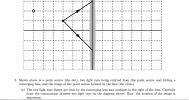 I'm confused on how the image (the circle) can be behind the
source (the dot) and the lens its going through? I'm also not sure
how to locate the focal point and how that relates to the image
postition
2. Shown above is a source (the dot), two light rays being emitted from this point source and hitting point a converging lens, and the image of the point source formed by the lens (the circle) (a) The two light rays...
I'm confused on how the image (the circle) can be behind the
source (the dot) and the lens its going through? I'm also not sure
how to locate the focal point and how that relates to the image
postition
2. Shown above is a source (the dot), two light rays being emitted from this point source and hitting point a converging lens, and the image of the point source formed by the lens (the circle) (a) The two light rays...
2. Explain why light rays converge when passing through a double convex lens by describing the...
2. Explain why light rays converge when passing through a double convex lens by describing the paths of three light rays; one along the optic axis and the other two parallel to the optic axis. 3. What happens to the image if half a converging lens is covered? Explain why this occurs. 4. What are the conditions necessary to form a virtual image using a converging lens? 5. What type of lens is used in a magnifying glass? Explain how...
A convex lens is a transparent instrument that uses refraction to bend and focus light from...
A convex lens is a transparent instrument that uses refraction to bend and focus light from an object, forming a sharp image. We'll first investigate how the lens produces an image from a point source of light (a lamp). Select Screen at upper right, which makes the object a lamp and gives a black screen that can be dragged around. Select Many rays at upper left to see how the lens bends some of the rays of light from the...
1.) Parallel light rays pass through a concave lens as illustrated in figure 1. Using the...
 1.)
Parallel light rays pass through a concave lens as illustrated in
figure 1. Using the diagram, indicate the focal point of this lens.
2.) A convex lens has a focal length of 100 mm. The lens
produces an image from an object placed 50 cm from the lens.
Determine the distance from the lens to the image in the
magnification of the image.
Figure 1: Concave lens
1.)
Parallel light rays pass through a concave lens as illustrated in
figure 1. Using the diagram, indicate the focal point of this lens.
2.) A convex lens has a focal length of 100 mm. The lens
produces an image from an object placed 50 cm from the lens.
Determine the distance from the lens to the image in the
magnification of the image.
Figure 1: Concave lens
Image Saeen Convex Light Source and Objact Figure 7.1- A sketch of the apparatus run the PhET s...
 7.2?7.3?7.4?
Image Saeen Convex Light Source and Objact Figure 7.1- A sketch of the apparatus run the PhET simulation "Geometric 7.1] Action-Item: Download and Optics". You should see a sketch of an object, a thin, convex lens, and an image, with two light rays passing from one particular point on the object through the lens, to one particular point on the image, and beyond. The horizontal line stretching across the screen is called the "principle axis". The small "x" marks...
7.2?7.3?7.4?
Image Saeen Convex Light Source and Objact Figure 7.1- A sketch of the apparatus run the PhET simulation "Geometric 7.1] Action-Item: Download and Optics". You should see a sketch of an object, a thin, convex lens, and an image, with two light rays passing from one particular point on the object through the lens, to one particular point on the image, and beyond. The horizontal line stretching across the screen is called the "principle axis". The small "x" marks...
A small bulb is placed in front of a convex lens Suppose that the bulb is...
 A small bulb is placed in front of a convex lens Suppose that the bulb is placed as shown. Using all three principal rays, draw an accurate ray diagram to determine the location of the image. Label the image location. Small bulb b. Repeat part a for the case shown at right, in which the bulb is farther from the lens. Small bulb bangladov Lens c. Suppose that in each case above you were to place a small paper screen...
An object (represented by the brown arrow) is placed near a concave lens Three sample rays of light are shown traveling from the tip of the object to the lens. On the diagram below, draw three arrows...
 An object (represented by the brown arrow) is placed near a concave lens Three sample rays of light are shown traveling from the tip of the object to the lens. On the diagram below, draw three arrows to show the subsequent paths of the three light rays given. Draw a fourth arrow to represent the image that is formed by the lens. The focal points of the lens are shown for reference Note: to locate the image, you will also...
1. The distance from the center of a lens to the location where parallel rays converge...
 1. The distance from the center of a lens to the location where parallel rays converge or appear to converge is called the length. convergence O meeting O focal O None of the above 2. When incoming rays are the focal point and the image point are the same. O parallel O from a nearby object O passing through the near side focal point O None of the above 3. A(n) image will not appear on a screen placed at...
1.You use a CONVEX lens of focal length f= 5 cm to concentrate the rays of...
 1.You use a CONVEX lens of focal length f= 5 cm to concentrate the rays of the sun to set fire to (an unfortunate) leaf a) Draw a picture of the rays through the lens b) Label the OBJECT DISTANCE (o), IMAGE DISTANCE (i), and determine their NUMERICAL VALUES (with UNITS of course). (HINT: use 1/o + 1/1-1/f.)
Cv A thin convex lens perpendicular to the rays. The imaginary line perpendicular to the lens...
 Cv A thin convex lens perpendicular to the rays. The imaginary line perpendicular to the lens and running exactly through the center is referred to as the optical axis or principal axis. Note that it is necessary to place the lens on the front half of the table to observe the intended phenomenon. Dim the class lights and observe the refracted rays 21 What is the focal length of the lens? Answer: 13 cm Use a thick block half lens....
 I'm confused on how the image (the circle) can be behind the
source (the dot) and the lens its going through? I'm also not sure
how to locate the focal point and how that relates to the image
postition
2. Shown above is a source (the dot), two light rays being emitted from this point source and hitting point a converging lens, and the image of the point source formed by the lens (the circle) (a) The two light rays...
I'm confused on how the image (the circle) can be behind the
source (the dot) and the lens its going through? I'm also not sure
how to locate the focal point and how that relates to the image
postition
2. Shown above is a source (the dot), two light rays being emitted from this point source and hitting point a converging lens, and the image of the point source formed by the lens (the circle) (a) The two light rays...
 1.)
Parallel light rays pass through a concave lens as illustrated in
figure 1. Using the diagram, indicate the focal point of this lens.
2.) A convex lens has a focal length of 100 mm. The lens
produces an image from an object placed 50 cm from the lens.
Determine the distance from the lens to the image in the
magnification of the image.
Figure 1: Concave lens
1.)
Parallel light rays pass through a concave lens as illustrated in
figure 1. Using the diagram, indicate the focal point of this lens.
2.) A convex lens has a focal length of 100 mm. The lens
produces an image from an object placed 50 cm from the lens.
Determine the distance from the lens to the image in the
magnification of the image.
Figure 1: Concave lens
 7.2?7.3?7.4?
Image Saeen Convex Light Source and Objact Figure 7.1- A sketch of the apparatus run the PhET simulation "Geometric 7.1] Action-Item: Download and Optics". You should see a sketch of an object, a thin, convex lens, and an image, with two light rays passing from one particular point on the object through the lens, to one particular point on the image, and beyond. The horizontal line stretching across the screen is called the "principle axis". The small "x" marks...
7.2?7.3?7.4?
Image Saeen Convex Light Source and Objact Figure 7.1- A sketch of the apparatus run the PhET simulation "Geometric 7.1] Action-Item: Download and Optics". You should see a sketch of an object, a thin, convex lens, and an image, with two light rays passing from one particular point on the object through the lens, to one particular point on the image, and beyond. The horizontal line stretching across the screen is called the "principle axis". The small "x" marks...
 A small bulb is placed in front of a convex lens Suppose that the bulb is placed as shown. Using all three principal rays, draw an accurate ray diagram to determine the location of the image. Label the image location. Small bulb b. Repeat part a for the case shown at right, in which the bulb is farther from the lens. Small bulb bangladov Lens c. Suppose that in each case above you were to place a small paper screen...
 An object (represented by the brown arrow) is placed near a concave lens Three sample rays of light are shown traveling from the tip of the object to the lens. On the diagram below, draw three arrows to show the subsequent paths of the three light rays given. Draw a fourth arrow to represent the image that is formed by the lens. The focal points of the lens are shown for reference Note: to locate the image, you will also...
 1. The distance from the center of a lens to the location where parallel rays converge or appear to converge is called the length. convergence O meeting O focal O None of the above 2. When incoming rays are the focal point and the image point are the same. O parallel O from a nearby object O passing through the near side focal point O None of the above 3. A(n) image will not appear on a screen placed at...
 1.You use a CONVEX lens of focal length f= 5 cm to concentrate the rays of the sun to set fire to (an unfortunate) leaf a) Draw a picture of the rays through the lens b) Label the OBJECT DISTANCE (o), IMAGE DISTANCE (i), and determine their NUMERICAL VALUES (with UNITS of course). (HINT: use 1/o + 1/1-1/f.)
 Cv A thin convex lens perpendicular to the rays. The imaginary line perpendicular to the lens and running exactly through the center is referred to as the optical axis or principal axis. Note that it is necessary to place the lens on the front half of the table to observe the intended phenomenon. Dim the class lights and observe the refracted rays 21 What is the focal length of the lens? Answer: 13 cm Use a thick block half lens....
Most questions answered within 3 hours.
-
Where is the error in this code sequence?
String s1 = "Hello";
String s2 = "ello";...
asked 10 months ago -
Financial data for Joel de Paris, Inc., for last year
follow:
Joel de Paris, Inc.
Balance...
asked 10 months ago -
Consider this reaction:
Al2(SO4)3 (aq)+ BaCl3
(aq) Al2Cl6 (aq)- +
3BaSO4(s) . What is the...
asked 10 months ago -
Suppose that Savneet is considering increasing her
recent random sample from 20 car rentals to 40...
asked 10 months ago -
Trucks arrive at an unloading terminal at an average rate of 120
per hour.
Trucks arrive...
asked 10 months ago -
Why are methanol and ethanol completely soluble in water while
octanol is not very little soluble....
asked 10 months ago -
A facilities manager at a university reads in a research report
that the mean amount of...
asked 10 months ago -
When the CuSO4 is rehydrated by adding water to the anhydrous
compound, is this an endothermic...
asked 10 months ago -
A ray of sunlight is passing from diamond into crown glass; the
angle of incidence is...
asked 10 months ago -
A block of mass 0.249 kg is placed on top of a light, vertical
spring of...
asked 10 months ago -
how do the kidneys compensate in the presences of acidosis
a) trigger hyperventilate
b) reserve acid...
asked 10 months ago -
Question 501 pts
The rental rate of capital to the firm increases. Which of the
following...
asked 10 months ago