what ion fragments are expected from the mass spectrum of ethane
Homework Answers

For spectrum #4, assign the fragments and parent radical ion at m/z ratios of 30, 73....
 For spectrum #4, assign the fragments and parent radical ion at
m/z ratios of 30, 73.
Unknown Mass Spectrum #4 C,H,N, 39 41 44 010 70740 50 53 56 st L
For spectrum #4, assign the fragments and parent radical ion at
m/z ratios of 30, 73.
Unknown Mass Spectrum #4 C,H,N, 39 41 44 010 70740 50 53 56 st L
In Lab H, you will be introduced to mass spectrometry as a new analytical technique for identifyi...
 In Lab H, you will be introduced to mass spectrometry as a new analytical technique for identifying molecules. A simplified mass spectrum for ethane is shown below. Use the dropdown menus to identify the base peak and molecular ion peak 14 16 18 20 22 24 26 28 30 32 (m/z) BASE PEAK: Select ] MOLECULAR ION PEAK: [ Select ] Given the mass of the base and molecular ion peaks, choose the two most common fragments of ethane: FRAGMENT...
Sketch an approximate mass spectrum of ethane (C2H6).
Sketch an approximate mass spectrum of ethane (C2H6).
can you interpret the mass spectrum and assign the mass fragments ( write the strcture )...
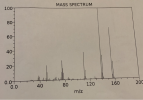 can you interpret the mass spectrum and assign the mass
fragments ( write the strcture ) the compund is 2-chloro benzoic
acid
MASS SPECTRUM 40 80 120 160 200 m/z
can you interpret the mass spectrum and assign the mass
fragments ( write the strcture ) the compund is 2-chloro benzoic
acid
MASS SPECTRUM 40 80 120 160 200 m/z
In this mass spectrum, which peak most likely represents the molecular ion? In this mass spectrum,...
 In this mass spectrum, which peak most likely represents the
molecular ion?
In this mass spectrum, which peak most likely represents the molecular ion?
In this mass spectrum, which peak most likely represents the
molecular ion?
In this mass spectrum, which peak most likely represents the molecular ion?
In a mass spectrum for ethyl cinnamate, identify the fragments responsible for the possible peaks and...
In a mass spectrum for ethyl cinnamate, identify the fragments responsible for the possible peaks and draw a mechanism to show how they would form.
In a mass spectrum for ethyl acetate, identify the fragments responsible for the possible peaks and...
In a mass spectrum for ethyl acetate, identify the fragments responsible for the possible peaks and draw a mechanism to show how they would form
(a) Draw the five major fragments of 3-chlorodecane that give rise to peaks in the 8 Mass Spectrum and provide their...
 (a) Draw the five major fragments of 3-chlorodecane that give rise to peaks in the 8 Mass Spectrum and provide their m/e values, showing the ratio of the peak values where applicable.
(a) Draw the five major fragments of 3-chlorodecane that give rise to peaks in the 8 Mass Spectrum and provide their m/e values, showing the ratio of the peak values where applicable.
(a) Draw the five major fragments of 3-chlorodecane that give rise to peaks in the 8 Mass Spectrum and provide their m/e values, showing the ratio of the peak values where applicable.
I need to come up with fragments that match with my mass spectrum. The molecule is cyclopentanol.
 i need to come up with fragments that match with my mass
spectrum. The molecule is cyclopentanol.
6pts 11) MASS SPECTRUM: Mass to charge Composition Assignment Structure of Assigne (m/z) Unk 16 60 20 10 20 30 40 50 60 70 80
6pts 11) MASS SPECTRUM: Mass to charge Composition Assignment Structure of Assigne (m/z)
Unk 16 60 20 10 20 30 40 50 60 70 80
i need to come up with fragments that match with my mass
spectrum. The molecule is cyclopentanol.
6pts 11) MASS SPECTRUM: Mass to charge Composition Assignment Structure of Assigne (m/z) Unk 16 60 20 10 20 30 40 50 60 70 80
6pts 11) MASS SPECTRUM: Mass to charge Composition Assignment Structure of Assigne (m/z)
Unk 16 60 20 10 20 30 40 50 60 70 80
In a mass spectrum for p-tert-butylacetophenone, identify the fragments responsible for the possible peaks and draw...
In a mass spectrum for p-tert-butylacetophenone, identify the fragments responsible for the possible peaks and draw a mechanism to show how they would form.
 For spectrum #4, assign the fragments and parent radical ion at
m/z ratios of 30, 73.
Unknown Mass Spectrum #4 C,H,N, 39 41 44 010 70740 50 53 56 st L
For spectrum #4, assign the fragments and parent radical ion at
m/z ratios of 30, 73.
Unknown Mass Spectrum #4 C,H,N, 39 41 44 010 70740 50 53 56 st L
 In Lab H, you will be introduced to mass spectrometry as a new analytical technique for identifying molecules. A simplified mass spectrum for ethane is shown below. Use the dropdown menus to identify the base peak and molecular ion peak 14 16 18 20 22 24 26 28 30 32 (m/z) BASE PEAK: Select ] MOLECULAR ION PEAK: [ Select ] Given the mass of the base and molecular ion peaks, choose the two most common fragments of ethane: FRAGMENT...
 can you interpret the mass spectrum and assign the mass
fragments ( write the strcture ) the compund is 2-chloro benzoic
acid
MASS SPECTRUM 40 80 120 160 200 m/z
can you interpret the mass spectrum and assign the mass
fragments ( write the strcture ) the compund is 2-chloro benzoic
acid
MASS SPECTRUM 40 80 120 160 200 m/z
 In this mass spectrum, which peak most likely represents the
molecular ion?
In this mass spectrum, which peak most likely represents the molecular ion?
In this mass spectrum, which peak most likely represents the
molecular ion?
In this mass spectrum, which peak most likely represents the molecular ion?
 (a) Draw the five major fragments of 3-chlorodecane that give rise to peaks in the 8 Mass Spectrum and provide their m/e values, showing the ratio of the peak values where applicable.
(a) Draw the five major fragments of 3-chlorodecane that give rise to peaks in the 8 Mass Spectrum and provide their m/e values, showing the ratio of the peak values where applicable.
(a) Draw the five major fragments of 3-chlorodecane that give rise to peaks in the 8 Mass Spectrum and provide their m/e values, showing the ratio of the peak values where applicable.
 i need to come up with fragments that match with my mass
spectrum. The molecule is cyclopentanol.
6pts 11) MASS SPECTRUM: Mass to charge Composition Assignment Structure of Assigne (m/z) Unk 16 60 20 10 20 30 40 50 60 70 80
6pts 11) MASS SPECTRUM: Mass to charge Composition Assignment Structure of Assigne (m/z)
Unk 16 60 20 10 20 30 40 50 60 70 80
i need to come up with fragments that match with my mass
spectrum. The molecule is cyclopentanol.
6pts 11) MASS SPECTRUM: Mass to charge Composition Assignment Structure of Assigne (m/z) Unk 16 60 20 10 20 30 40 50 60 70 80
6pts 11) MASS SPECTRUM: Mass to charge Composition Assignment Structure of Assigne (m/z)
Unk 16 60 20 10 20 30 40 50 60 70 80
Most questions answered within 3 hours.
-
Where is the error in this code sequence?
String s1 = "Hello";
String s2 = "ello";...
asked 11 months ago -
Financial data for Joel de Paris, Inc., for last year
follow:
Joel de Paris, Inc.
Balance...
asked 11 months ago -
Consider this reaction:
Al2(SO4)3 (aq)+ BaCl3
(aq) Al2Cl6 (aq)- +
3BaSO4(s) . What is the...
asked 11 months ago -
Suppose that Savneet is considering increasing her
recent random sample from 20 car rentals to 40...
asked 11 months ago -
Trucks arrive at an unloading terminal at an average rate of 120
per hour.
Trucks arrive...
asked 11 months ago -
Why are methanol and ethanol completely soluble in water while
octanol is not very little soluble....
asked 11 months ago -
A facilities manager at a university reads in a research report
that the mean amount of...
asked 11 months ago -
When the CuSO4 is rehydrated by adding water to the anhydrous
compound, is this an endothermic...
asked 11 months ago -
A ray of sunlight is passing from diamond into crown glass; the
angle of incidence is...
asked 11 months ago -
A block of mass 0.249 kg is placed on top of a light, vertical
spring of...
asked 11 months ago -
how do the kidneys compensate in the presences of acidosis
a) trigger hyperventilate
b) reserve acid...
asked 11 months ago -
Question 501 pts
The rental rate of capital to the firm increases. Which of the
following...
asked 11 months ago