In a mass spectrum for ethyl acetate, identify the fragments responsible for the possible peaks and...
In a mass spectrum for ethyl acetate, identify the fragments responsible for the possible peaks and draw a mechanism to show how they would form
Homework Answers
 Answer question
Add Answer to:
In a mass spectrum for ethyl acetate, identify the fragments
responsible for the possible peaks and...
In a mass spectrum for ethyl cinnamate, identify the fragments responsible for the possible peaks and...
In a mass spectrum for ethyl cinnamate, identify the fragments responsible for the possible peaks and draw a mechanism to show how they would form.
In a mass spectrum for p-tert-butylacetophenone, identify the fragments responsible for the possible peaks and draw...
In a mass spectrum for p-tert-butylacetophenone, identify the fragments responsible for the possible peaks and draw a mechanism to show how they would form.
(a) Draw the five major fragments of 3-chlorodecane that give rise to peaks in the 8 Mass Spectrum and provide their...
 (a) Draw the five major fragments of 3-chlorodecane that give rise to peaks in the 8 Mass Spectrum and provide their m/e values, showing the ratio of the peak values where applicable.
(a) Draw the five major fragments of 3-chlorodecane that give rise to peaks in the 8 Mass Spectrum and provide their m/e values, showing the ratio of the peak values where applicable.
(a) Draw the five major fragments of 3-chlorodecane that give rise to peaks in the 8 Mass Spectrum and provide their m/e values, showing the ratio of the peak values where applicable.
Please show all work and explanations if possible. Thank you so much! 4. (4pts) A mass spectrum shows significant pe...
 Please show all work and explanations if possible.
Thank you so much!
4. (4pts) A mass spectrum shows significant peaks at m/z 87, 115, and 143. Which of the following compounds is responsible for that mass spectrum: 4,7-dimethyl-1-octanol, 2,6-dimethyl-4-octanol, or 2,2,4-trimethyl-4-heptanol? Provide structures of the cationic fragments that support your choice and provide the mechanism for the formation of ONE of these fragments from the molecular ion. он он но
Please show all work and explanations if possible.
Thank you so much!
4. (4pts) A mass spectrum shows significant peaks at m/z 87, 115, and 143. Which of the following compounds is responsible for that mass spectrum: 4,7-dimethyl-1-octanol, 2,6-dimethyl-4-octanol, or 2,2,4-trimethyl-4-heptanol? Provide structures of the cationic fragments that support your choice and provide the mechanism for the formation of ONE of these fragments from the molecular ion. он он но
draw the structures that result from the fragments accorfing to the main peaks in the followomg...
 draw the structures that result from the fragments accorfing
to the main peaks in the followomg mass spectrum
sec-butyl acetate Mass Spectrum Relative Intensity 61 73 101 83 J 20 40 80 100 60 m/z
draw the structures that result from the fragments accorfing
to the main peaks in the followomg mass spectrum
sec-butyl acetate Mass Spectrum Relative Intensity 61 73 101 83 J 20 40 80 100 60 m/z
1) Predict and assign in the major peaks in the IR spectrum of a) n-propyl acetate,...
1) Predict and assign in the major peaks in the IR spectrum of a) n-propyl acetate, CH3COOCH2CH2CH3 and b) 2-methyl-1-propyl acetate, CH3COOCH2CH(CH3)2 2) Predict and assign in the major peaks in the 1H NMR spectrum of a) n-propyl acetate, CH3COOCH2CH2CH3 and b) 2-methyl-1-propyl acetate, CH3COOCH2CH(CH3)2 3) Predict the appearance of the 1H NMR spectrum of a) methyl acetate, CH3COOCH3 and b) ethyl propionate, CH3CH2COOCH2CH3 Thank you!
. Here is the NMR of the ethyl acetate. We combined all the fractions that the...
 . Here is the NMR of the ethyl acetate. We combined all the
fractions that the class distilled when doing Experiment 2 into one
sample and took the NMR of that one sample. a. Assign all the peaks
to the protons in ethyl acetate b. Based on this spectrum would you
say they sample is pure? Why or why not?
Chem 2400L - Experiment 8. Interpretation of NMR - Post Lab Questions 1. Here is the NMR of the ethyl...
. Here is the NMR of the ethyl acetate. We combined all the
fractions that the class distilled when doing Experiment 2 into one
sample and took the NMR of that one sample. a. Assign all the peaks
to the protons in ethyl acetate b. Based on this spectrum would you
say they sample is pure? Why or why not?
Chem 2400L - Experiment 8. Interpretation of NMR - Post Lab Questions 1. Here is the NMR of the ethyl...
In the stretching region of the spectrum, identify as many IR peaks as possible that are...
 In the stretching region of the spectrum, identify as many IR peaks as possible that are consistent with the molecular formula. List the wavenumber of each identifiable peak and the type of bond or structural grouping to which it corresponds. Draw the structures of all possible molecules that are consistent with both the molecular formula and the stretching frequencies present in the IR spectrum. On the basis of all frequencies, both stretching and bending, ) state which structure(s) can be...
Explain how the peaks in NMR spectrum correspond to the structure of isopentyl acetate.
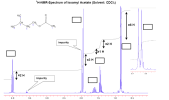 Explain how the peaks in NMR spectrum correspond to the
structure of isopentyl acetate.
Explain how the peaks in NMR spectrum correspond to the
structure of isopentyl acetate.
(a) Draw the five major fragments of 3-chlorodecane that give rise to peaks in the 8...
 (a) Draw the five major fragments of 3-chlorodecane that give rise to peaks in the 8 Mass Spectrum and provide their m/e values, showing the ratio of the peak values where applicable.
 (a) Draw the five major fragments of 3-chlorodecane that give rise to peaks in the 8 Mass Spectrum and provide their m/e values, showing the ratio of the peak values where applicable.
(a) Draw the five major fragments of 3-chlorodecane that give rise to peaks in the 8 Mass Spectrum and provide their m/e values, showing the ratio of the peak values where applicable.
(a) Draw the five major fragments of 3-chlorodecane that give rise to peaks in the 8 Mass Spectrum and provide their m/e values, showing the ratio of the peak values where applicable.
 Please show all work and explanations if possible.
Thank you so much!
4. (4pts) A mass spectrum shows significant peaks at m/z 87, 115, and 143. Which of the following compounds is responsible for that mass spectrum: 4,7-dimethyl-1-octanol, 2,6-dimethyl-4-octanol, or 2,2,4-trimethyl-4-heptanol? Provide structures of the cationic fragments that support your choice and provide the mechanism for the formation of ONE of these fragments from the molecular ion. он он но
Please show all work and explanations if possible.
Thank you so much!
4. (4pts) A mass spectrum shows significant peaks at m/z 87, 115, and 143. Which of the following compounds is responsible for that mass spectrum: 4,7-dimethyl-1-octanol, 2,6-dimethyl-4-octanol, or 2,2,4-trimethyl-4-heptanol? Provide structures of the cationic fragments that support your choice and provide the mechanism for the formation of ONE of these fragments from the molecular ion. он он но
 draw the structures that result from the fragments accorfing
to the main peaks in the followomg mass spectrum
sec-butyl acetate Mass Spectrum Relative Intensity 61 73 101 83 J 20 40 80 100 60 m/z
draw the structures that result from the fragments accorfing
to the main peaks in the followomg mass spectrum
sec-butyl acetate Mass Spectrum Relative Intensity 61 73 101 83 J 20 40 80 100 60 m/z
 . Here is the NMR of the ethyl acetate. We combined all the
fractions that the class distilled when doing Experiment 2 into one
sample and took the NMR of that one sample. a. Assign all the peaks
to the protons in ethyl acetate b. Based on this spectrum would you
say they sample is pure? Why or why not?
Chem 2400L - Experiment 8. Interpretation of NMR - Post Lab Questions 1. Here is the NMR of the ethyl...
. Here is the NMR of the ethyl acetate. We combined all the
fractions that the class distilled when doing Experiment 2 into one
sample and took the NMR of that one sample. a. Assign all the peaks
to the protons in ethyl acetate b. Based on this spectrum would you
say they sample is pure? Why or why not?
Chem 2400L - Experiment 8. Interpretation of NMR - Post Lab Questions 1. Here is the NMR of the ethyl...
 In the stretching region of the spectrum, identify as many IR peaks as possible that are consistent with the molecular formula. List the wavenumber of each identifiable peak and the type of bond or structural grouping to which it corresponds. Draw the structures of all possible molecules that are consistent with both the molecular formula and the stretching frequencies present in the IR spectrum. On the basis of all frequencies, both stretching and bending, ) state which structure(s) can be...
 Explain how the peaks in NMR spectrum correspond to the
structure of isopentyl acetate.
Explain how the peaks in NMR spectrum correspond to the
structure of isopentyl acetate.
 (a) Draw the five major fragments of 3-chlorodecane that give rise to peaks in the 8 Mass Spectrum and provide their m/e values, showing the ratio of the peak values where applicable.
Most questions answered within 3 hours.
-
Where is the error in this code sequence?
String s1 = "Hello";
String s2 = "ello";...
asked 10 months ago -
Financial data for Joel de Paris, Inc., for last year
follow:
Joel de Paris, Inc.
Balance...
asked 10 months ago -
Consider this reaction:
Al2(SO4)3 (aq)+ BaCl3
(aq) Al2Cl6 (aq)- +
3BaSO4(s) . What is the...
asked 10 months ago -
Suppose that Savneet is considering increasing her
recent random sample from 20 car rentals to 40...
asked 10 months ago -
Trucks arrive at an unloading terminal at an average rate of 120
per hour.
Trucks arrive...
asked 10 months ago -
Why are methanol and ethanol completely soluble in water while
octanol is not very little soluble....
asked 10 months ago -
A facilities manager at a university reads in a research report
that the mean amount of...
asked 10 months ago -
When the CuSO4 is rehydrated by adding water to the anhydrous
compound, is this an endothermic...
asked 10 months ago -
A ray of sunlight is passing from diamond into crown glass; the
angle of incidence is...
asked 10 months ago -
A block of mass 0.249 kg is placed on top of a light, vertical
spring of...
asked 10 months ago -
how do the kidneys compensate in the presences of acidosis
a) trigger hyperventilate
b) reserve acid...
asked 10 months ago -
Question 501 pts
The rental rate of capital to the firm increases. Which of the
following...
asked 10 months ago