Two charged rods extends from x = 0 to x = L, but one along the...
Two charged rods extends from x = 0 to x = L, but one along the x-axis (y = 0) and the other a distance L away (y = L). The first is positively charged and the second negatively charged, with charger per unit lengths of λ and -λ, respectively. Find the electric field, as a function of x and y, in this system.
Homework Answers
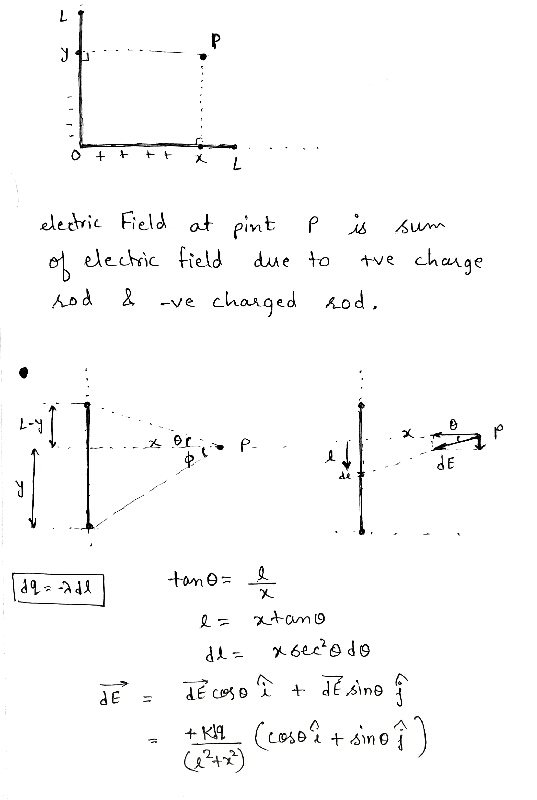
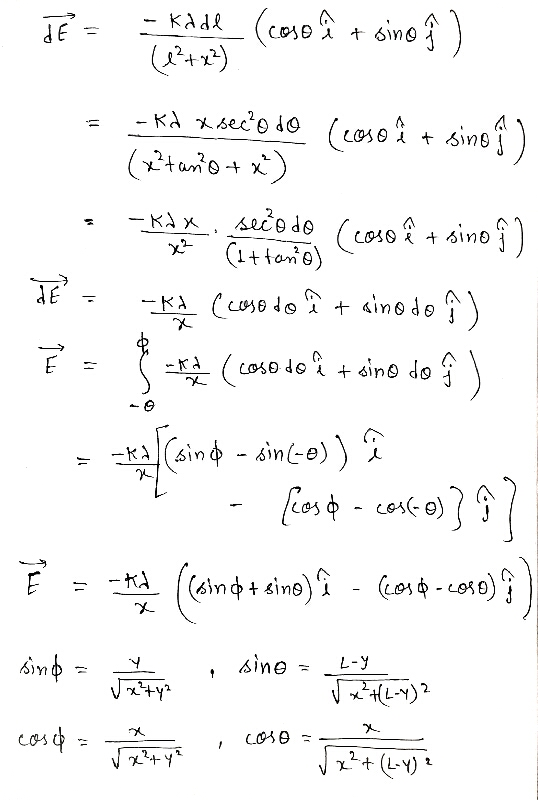
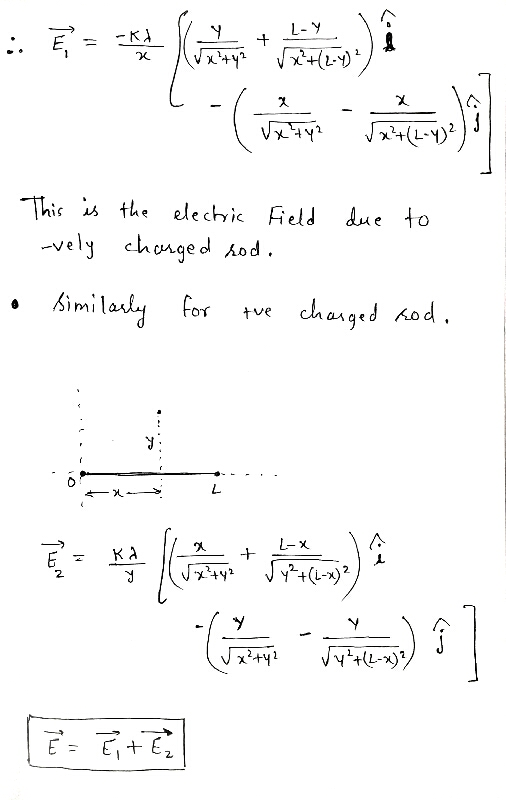
The expressions are little bit complicated. So I suggest you to solve it by yourself also using this solution.
For any query , let me know.
uniformly charged rod sits along the-x-axis. It has a total charge of-4 pC and extends from...
 uniformly charged rod sits along the-x-axis. It has a total charge of-4 pC and extends from the origin to x =-15 cm. a) What is the linear charge density? b) What is the magnitude and direction of the electric field atx 30 cm, y c) What is the electric potential at x = 30 cm, y-0 cm? 0 cm?
Three charged spheres are suspended by nonconducting light rods of length L = 0.656 m from...
 Three charged spheres are suspended by nonconducting light rods of length L = 0.656 m from the point O. The rods are fixed in position so that the middle rod is vertical and the rods on the left and right make an angle of theta = 30 degree with the vertical (see figure below). (Assume that the +x axis is to the right and the +y axis is up along the page. Express your answer in vector form.) (a) What...
Problem 1 (30 points) Two uniformly charged rods with charge Q and length L lie along...
 Problem 1 (30 points) Two uniformly charged rods with charge Q and length L lie along the z-axis as shown in the figure (rods have been fixed in their positions, so they cannot move). (a)(15pts.) Find the electric field created by the left rod at point I where = > L. (b)(15pts.) Find the electric force on the right rod that is applied by the left rod.
Consider two thin nonconducting rods of length L that are parallel to each other, and a...
 Consider two thin nonconducting rods of length L that are parallel to each other, and a distance L apart. One rod has a charge + and the other has a charge +2Q, each uniformly distributed along their lengths. Find the electric field midway between the two rods, as shown L/2 E=? t0 +20
A uniformly charged rod of length L and total charge Q lies along the x axis
 8. A uniformly charged rod of length L and total charge Q lies along the x axis as shown in in the figure below. Find the components of the electric field at the point P on the y axis a distance d from the origin. ANSWER:
Two thin rods of length L lie along the x-axis, one between x=a/2 and x=a/2+L and...
Two thin rods of length L lie along the x-axis, one between x=a/2 and x=a/2+L and the other between x=?a/2 and x=?a/2?L. Each rod has positive charge Q distributed uniformly along its length. Part A Calculate the electric field produced by the second rod at points along the positive x-axis. Express your answer in terms of the variables x, a, L, Q and appropriate constants. ANSWER: Ex = 2kQL(12x+a?12L+2x+a) Incorrect; Try Again; 5 attempts remaining Part B Find the magnitude...
On a thin rod of length L lying along the x-axis with one end at the...
On a thin rod of length L lying along the x-axis with one end at the origin (x = 0), there is distributed a charge per unit length given by λ = b x, where b is a constant. (a) Taking the electrostatic potential at infinity to be zero, find V at the point P on the y-axis. (b) Determine the vertical component, Ey, of the electric field intensity at P from the result of part (a). (c) What is...
A positively charged rod of length L = 0.220 m with linear charge density = 2.71...
 A positively charged rod of length L = 0.220 m with linear charge density = 2.71 mc/m lies along the x axis as in the figure. Find the electric field at the position Pa distance 0.335 m away from the origin (Express your answer in vector form.) N/C р Submit Answer
continuous object using integrals. Consider a thin, charged rod of length, L. It lies along the...
 continuous object using integrals. Consider a thin, charged
rod of length, L. It lies along the x-axis with one end at x = 0
and the other end at x = L. It has a non-uniform linear charge
density given by the function
λ(x) = −λ0 + Ax , where λ0 and A are both positive
constants.
(a) What are the units of λ0 and A? Explain.
(b) Suppose that λ0 and A are related such that A = 2λ0/L....
continuous object using integrals. Consider a thin, charged
rod of length, L. It lies along the x-axis with one end at x = 0
and the other end at x = L. It has a non-uniform linear charge
density given by the function
λ(x) = −λ0 + Ax , where λ0 and A are both positive
constants.
(a) What are the units of λ0 and A? Explain.
(b) Suppose that λ0 and A are related such that A = 2λ0/L....
 uniformly charged rod sits along the-x-axis. It has a total charge of-4 pC and extends from the origin to x =-15 cm. a) What is the linear charge density? b) What is the magnitude and direction of the electric field atx 30 cm, y c) What is the electric potential at x = 30 cm, y-0 cm? 0 cm?
 Three charged spheres are suspended by nonconducting light rods of length L = 0.656 m from the point O. The rods are fixed in position so that the middle rod is vertical and the rods on the left and right make an angle of theta = 30 degree with the vertical (see figure below). (Assume that the +x axis is to the right and the +y axis is up along the page. Express your answer in vector form.) (a) What...
 Problem 1 (30 points) Two uniformly charged rods with charge Q and length L lie along the z-axis as shown in the figure (rods have been fixed in their positions, so they cannot move). (a)(15pts.) Find the electric field created by the left rod at point I where = > L. (b)(15pts.) Find the electric force on the right rod that is applied by the left rod.
 Consider two thin nonconducting rods of length L that are parallel to each other, and a distance L apart. One rod has a charge + and the other has a charge +2Q, each uniformly distributed along their lengths. Find the electric field midway between the two rods, as shown L/2 E=? t0 +20
 A positively charged rod of length L = 0.220 m with linear charge density = 2.71 mc/m lies along the x axis as in the figure. Find the electric field at the position Pa distance 0.335 m away from the origin (Express your answer in vector form.) N/C р Submit Answer
 continuous object using integrals. Consider a thin, charged
rod of length, L. It lies along the x-axis with one end at x = 0
and the other end at x = L. It has a non-uniform linear charge
density given by the function
λ(x) = −λ0 + Ax , where λ0 and A are both positive
constants.
(a) What are the units of λ0 and A? Explain.
(b) Suppose that λ0 and A are related such that A = 2λ0/L....
continuous object using integrals. Consider a thin, charged
rod of length, L. It lies along the x-axis with one end at x = 0
and the other end at x = L. It has a non-uniform linear charge
density given by the function
λ(x) = −λ0 + Ax , where λ0 and A are both positive
constants.
(a) What are the units of λ0 and A? Explain.
(b) Suppose that λ0 and A are related such that A = 2λ0/L....
Most questions answered within 3 hours.
-
Where is the error in this code sequence?
String s1 = "Hello";
String s2 = "ello";...
asked 11 months ago -
Financial data for Joel de Paris, Inc., for last year
follow:
Joel de Paris, Inc.
Balance...
asked 11 months ago -
Consider this reaction:
Al2(SO4)3 (aq)+ BaCl3
(aq) Al2Cl6 (aq)- +
3BaSO4(s) . What is the...
asked 11 months ago -
Suppose that Savneet is considering increasing her
recent random sample from 20 car rentals to 40...
asked 11 months ago -
Trucks arrive at an unloading terminal at an average rate of 120
per hour.
Trucks arrive...
asked 11 months ago -
Why are methanol and ethanol completely soluble in water while
octanol is not very little soluble....
asked 11 months ago -
A facilities manager at a university reads in a research report
that the mean amount of...
asked 11 months ago -
When the CuSO4 is rehydrated by adding water to the anhydrous
compound, is this an endothermic...
asked 11 months ago -
A ray of sunlight is passing from diamond into crown glass; the
angle of incidence is...
asked 11 months ago -
A block of mass 0.249 kg is placed on top of a light, vertical
spring of...
asked 11 months ago -
how do the kidneys compensate in the presences of acidosis
a) trigger hyperventilate
b) reserve acid...
asked 11 months ago -
Question 501 pts
The rental rate of capital to the firm increases. Which of the
following...
asked 11 months ago