Based on the following data collected: Water and Table Salt= Strong Electrolyte Water and Baking Soda=...
Based on the following data collected:
Water and Table Salt= Strong Electrolyte
Water and Baking Soda= Strong Electrolyte
Water and Sugar= Nonelectrolyte
Water and Vinegar= Weak Electrolyte
Rubbing alcohol and Table Salt= Strong Electrolyte
Rubbing alcohol and Baking Soda= Strong Electrolyte
Rubbing alcohol and Sugar= Weak Electrolyte
Rubbing alcohol and Vinegar= Weak Electrolyte
Oil and Table Salt= Nonelectrolyte
Oil and Baking Soda= Nonelectrolyte
Oil and Sugar= Nonelectrolyte
Oil and Vinegar= Nonelectrolyte
For all solutions of electrolytes, write the equation that describes the dissolution process.
I have these two so far. are they correct? what else is left?
NaCl -------> Na+ + Cl-
NaHCO3 + H2O ----> H2CO3 + NaOH
Homework Answers
Sol:
Electrolytes are those which produces positive and negative
charges when dissolved in to a solvent..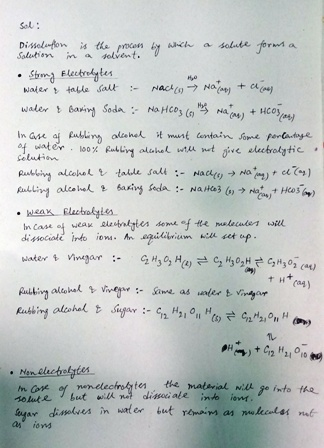
Add Answer to:
Based on the following data collected:
Water and Table Salt= Strong
Electrolyte
Water and Baking Soda=...
write the equation that describes the dissolution process for the solutions of electrolytes. salt and water,...
write the equation that describes the dissolution process for the solutions of electrolytes. salt and water, baking soda and water, sugar and water, vinegar and water, rubbing alcohol and salt, rubbing alc and baking soda, alc and sugar, alc and vinegar, oil and salt, oil and baking soda, oil and vinegar, oil and sugar. classify each mixture as strong, weak or non electrolyte.
Classify each compound as a strong electrolyte, weak electrolyte, or nonelectrolyte. Strong electrolyte Weak elec...
 Classify each compound as a strong electrolyte, weak electrolyte, or nonelectrolyte. Strong electrolyte Weak electrolyte Nonelectrolyte H.SO, H.CO (NH),S Answer Bank Classify the mixtures as colloids, suspensions, or true solutions. Colloids Suspensions True solutions milk of magnesia blod table salt in water dast free air mayonnaise Answer Bank Assuming 100% dissociation, calculate the freezing point and the boiling point of 0.820 mol Na, So, in 1.00 kg water. freezing point: 1.25 boiling point: -4.57
Classify each compound as a strong electrolyte, weak electrolyte, or nonelectrolyte. Strong electrolyte Weak electrolyte Nonelectrolyte...
 Classify each compound as a strong electrolyte, weak electrolyte, or nonelectrolyte. Strong electrolyte Weak electrolyte Nonelectrolyte Answer Bank H.CO, (NH4)2S H, SO Classify the mixtures as colloids, suspensions, or true solutions. Colloids Suspensions True solutions Answer Bank mayonnaise table salt in water tog milk or magnesta d use free ait Dood Assuming 100% dissociation, calculate the freezing point and the boiling point of 0.820 mol Na, So, in 1.00 kg water. freezing point: boiling point: Cell membranes are semipermeable, and...
Table Salt from Baking Soda Name: Date: Partner: DATA: Mass of beaker 95.85. Mass of beaker...
 Table Salt from Baking Soda Name: Date: Partner: DATA: Mass of beaker 95.85. Mass of beaker and sample (NaHCO3) 17.45. Mass of sample (NaHCO3) Mass of beaker and residue (NaCl) 1" Heating... :26 99, Mass of beaker and residue (NaCl) 2 Heating.. 26.85, Mass of beaker and residue (NaCl) 3* Heating... 26.959 Mass of beaker and residue (NaCl) best g Mass of residue (NaCl) 9 Volume of conc. HCI added ml CALCULATIONS: g/mol Molar mass of NaHCO3 Number of moles...
A tablespoon (about 15.0 mL) of sodium chloride, a common table salt, is dissolved in water....
A tablespoon (about 15.0 mL) of sodium chloride, a common table salt, is dissolved in water. What is the change in enthalpy (in kJ) of this dissolution process? Given: d NaCL (s) = 2.16 g cm^-3 NaCl(s) —> Na+(aq) + Cl-(aq) ΔH = 3.87 kJ mol^-1
9. Which of the following would behave as a strong electrolyte in water? a ethanol, C...
 9. Which of the following would behave as a strong electrolyte in water? a ethanol, C H OH d acetic acid, CHCOOH e table salt, NaCI b. formaldehyde, CH-0 c. table sugar, CiH:20 10. Which of the following should have the highest conductivity? a. 3.0 M NaC b. 2.1 MNa PO c. 24 MCaC e3.2 MNHNO 11. If the molar concentration of sodium sulfate (Na SO.) is 0.10 M, what is the concentration of sodium ion? a 0.10 M d...
please help me answer the questions with the provided data. Data Table for Part 4 s-soluble,...
 please help me answer the questions with the provided
data.
Data Table for Part 4 s-soluble, ss-slightly soluble, i-insoluble mass of beaker 205.354 mass of beaker + 10.0mL. NaCI 1A 56 Water Oil Type of particle(s) present (molecule, ion, both) Polarity of solute L NaCI 1a 563 g CuSO mass of beaker + dry NaCl mass of solution mass of solute (NaC1) sucrose ar vegetable oils 11.609 g vinegar 3-268 Part 2 S-strong electrolyte, W-weak electrolyte, N- non-clectrolyte 1. Calculate...
please help me answer the questions with the provided
data.
Data Table for Part 4 s-soluble, ss-slightly soluble, i-insoluble mass of beaker 205.354 mass of beaker + 10.0mL. NaCI 1A 56 Water Oil Type of particle(s) present (molecule, ion, both) Polarity of solute L NaCI 1a 563 g CuSO mass of beaker + dry NaCl mass of solution mass of solute (NaC1) sucrose ar vegetable oils 11.609 g vinegar 3-268 Part 2 S-strong electrolyte, W-weak electrolyte, N- non-clectrolyte 1. Calculate...
5. The temperature in an orchard is 0°C. If a farmer sprays 10.0 kg of water at 20°C around the fruit trees and the...
 5. The temperature in an orchard is 0°C. If a farmer sprays 10.0 kg of water at 20°C around the fruit trees and the water cools, then freezes at 0°C, how many kilojoules of energy are released? How does this energy affect the orchard temperature? 6. Classify each of the following as element, compound, homogeneous or heterogeneous mixture: Gasoline, bubbly champagne, coffee with lemon juice, cola drink, sulfur, helium, mercury. Isopropyl alcohol ("rubbing alcohol"), table sugar, common salt, "plaster cast,...
What would be the purpose of this lab based on the following information? Colligative Properties II...
What would be the purpose of this lab based on the following information? Colligative Properties II Colligative Property is a property of a solution that depends only on the number of solute molecule present. Osmotic pressure, freezing point depression, boiling point elevation, and vapor pressure lowering are all colligative properties. In today’s lab we will look at three of these properties. Electrolytes are substances that forms ions in solution that conduct electricity. Electrolytes can either be an acid, base or...
SOLUTIONS 22. Non-polar compounds are soluble in ionic compounds b) electrolytes c) polar solvents d) non-polar...
 SOLUTIONS 22. Non-polar compounds are soluble in ionic compounds b) electrolytes c) polar solvents d) non-polar solvents 23. Which of the following would increase the solubility of gaseous O2 in water? (there is more than correct answer, mark them all!) Decreasing the temperature of the solution Increasing the temperature of the solution Decreasing the pressure of the solution Increasing the pressure of the solution 24. Which of the following describes an unsaturated solution? A solution that has less than the...
 Classify each compound as a strong electrolyte, weak electrolyte, or nonelectrolyte. Strong electrolyte Weak electrolyte Nonelectrolyte H.SO, H.CO (NH),S Answer Bank Classify the mixtures as colloids, suspensions, or true solutions. Colloids Suspensions True solutions milk of magnesia blod table salt in water dast free air mayonnaise Answer Bank Assuming 100% dissociation, calculate the freezing point and the boiling point of 0.820 mol Na, So, in 1.00 kg water. freezing point: 1.25 boiling point: -4.57
 Classify each compound as a strong electrolyte, weak electrolyte, or nonelectrolyte. Strong electrolyte Weak electrolyte Nonelectrolyte Answer Bank H.CO, (NH4)2S H, SO Classify the mixtures as colloids, suspensions, or true solutions. Colloids Suspensions True solutions Answer Bank mayonnaise table salt in water tog milk or magnesta d use free ait Dood Assuming 100% dissociation, calculate the freezing point and the boiling point of 0.820 mol Na, So, in 1.00 kg water. freezing point: boiling point: Cell membranes are semipermeable, and...
 Table Salt from Baking Soda Name: Date: Partner: DATA: Mass of beaker 95.85. Mass of beaker and sample (NaHCO3) 17.45. Mass of sample (NaHCO3) Mass of beaker and residue (NaCl) 1" Heating... :26 99, Mass of beaker and residue (NaCl) 2 Heating.. 26.85, Mass of beaker and residue (NaCl) 3* Heating... 26.959 Mass of beaker and residue (NaCl) best g Mass of residue (NaCl) 9 Volume of conc. HCI added ml CALCULATIONS: g/mol Molar mass of NaHCO3 Number of moles...
 9. Which of the following would behave as a strong electrolyte in water? a ethanol, C H OH d acetic acid, CHCOOH e table salt, NaCI b. formaldehyde, CH-0 c. table sugar, CiH:20 10. Which of the following should have the highest conductivity? a. 3.0 M NaC b. 2.1 MNa PO c. 24 MCaC e3.2 MNHNO 11. If the molar concentration of sodium sulfate (Na SO.) is 0.10 M, what is the concentration of sodium ion? a 0.10 M d...
 please help me answer the questions with the provided
data.
Data Table for Part 4 s-soluble, ss-slightly soluble, i-insoluble mass of beaker 205.354 mass of beaker + 10.0mL. NaCI 1A 56 Water Oil Type of particle(s) present (molecule, ion, both) Polarity of solute L NaCI 1a 563 g CuSO mass of beaker + dry NaCl mass of solution mass of solute (NaC1) sucrose ar vegetable oils 11.609 g vinegar 3-268 Part 2 S-strong electrolyte, W-weak electrolyte, N- non-clectrolyte 1. Calculate...
please help me answer the questions with the provided
data.
Data Table for Part 4 s-soluble, ss-slightly soluble, i-insoluble mass of beaker 205.354 mass of beaker + 10.0mL. NaCI 1A 56 Water Oil Type of particle(s) present (molecule, ion, both) Polarity of solute L NaCI 1a 563 g CuSO mass of beaker + dry NaCl mass of solution mass of solute (NaC1) sucrose ar vegetable oils 11.609 g vinegar 3-268 Part 2 S-strong electrolyte, W-weak electrolyte, N- non-clectrolyte 1. Calculate...
 5. The temperature in an orchard is 0°C. If a farmer sprays 10.0 kg of water at 20°C around the fruit trees and the water cools, then freezes at 0°C, how many kilojoules of energy are released? How does this energy affect the orchard temperature? 6. Classify each of the following as element, compound, homogeneous or heterogeneous mixture: Gasoline, bubbly champagne, coffee with lemon juice, cola drink, sulfur, helium, mercury. Isopropyl alcohol ("rubbing alcohol"), table sugar, common salt, "plaster cast,...
 SOLUTIONS 22. Non-polar compounds are soluble in ionic compounds b) electrolytes c) polar solvents d) non-polar solvents 23. Which of the following would increase the solubility of gaseous O2 in water? (there is more than correct answer, mark them all!) Decreasing the temperature of the solution Increasing the temperature of the solution Decreasing the pressure of the solution Increasing the pressure of the solution 24. Which of the following describes an unsaturated solution? A solution that has less than the...
Most questions answered within 3 hours.
-
Where is the error in this code sequence?
String s1 = "Hello";
String s2 = "ello";...
asked 10 months ago -
Financial data for Joel de Paris, Inc., for last year
follow:
Joel de Paris, Inc.
Balance...
asked 10 months ago -
Consider this reaction:
Al2(SO4)3 (aq)+ BaCl3
(aq) Al2Cl6 (aq)- +
3BaSO4(s) . What is the...
asked 10 months ago -
Suppose that Savneet is considering increasing her
recent random sample from 20 car rentals to 40...
asked 10 months ago -
Trucks arrive at an unloading terminal at an average rate of 120
per hour.
Trucks arrive...
asked 10 months ago -
Why are methanol and ethanol completely soluble in water while
octanol is not very little soluble....
asked 10 months ago -
A facilities manager at a university reads in a research report
that the mean amount of...
asked 10 months ago -
When the CuSO4 is rehydrated by adding water to the anhydrous
compound, is this an endothermic...
asked 10 months ago -
A ray of sunlight is passing from diamond into crown glass; the
angle of incidence is...
asked 10 months ago -
A block of mass 0.249 kg is placed on top of a light, vertical
spring of...
asked 10 months ago -
how do the kidneys compensate in the presences of acidosis
a) trigger hyperventilate
b) reserve acid...
asked 10 months ago -
Question 501 pts
The rental rate of capital to the firm increases. Which of the
following...
asked 10 months ago