Calculate the change in internal energy (ΔrU) for the following reaction at 1.00 bar and 298...
Calculate the change in internal energy (ΔrU) for the following reaction at 1.00 bar and 298 K. Express your answer in kJ/mol. ?8?18(?)+17?2(?) → 8??2(?)+9?2?(?) ∆??=−5430??/??l
Homework Answers
Given  rH = -
5430 kJ/mol
rH = -
5430 kJ/mol
According to 1st law of thermodynamics:
rH =
rU +
P*V
Also P*V =
- n(g)*RT
For the given reaction,
n(g) = (moles of
gaseous products) - (moles of gaseous reactants)
=> n(g) = 8 - 17 = -
9 mol
Now P*V = - (- 9 mol *
8.314 J/mol.K * 298K) = 22298 J/mol * (1kJ / 1000 J) = 22.298
kJ/mol
=> rH =
rU +
P*V
=> rU =
rH -
P*V
=> rU =
−5430 kJ/mol - 22.298 kJ/mol
=> rU = -
5452.3 kJ/mol (Answer)
Add Answer to:
Calculate the change in internal energy (ΔrU) for the following
reaction at 1.00 bar and 298...
calculate the Gibbs free-energy change for the following reaction at 298 k if the partial pressure of each is 0.10 atm a...
calculate the Gibbs free-energy change for the following reaction at 298 k if the partial pressure of each is 0.10 atm and the Gf of NO and NOBr are 86.55 KJ/mol and 82.4 KJ/mol respectively.
For a gaseous reaction, standard conditions are 298 K and a partial pressure of 1 bar for all species. For the reaction C2H6(g)+H2(g)↽−−⇀2CH4(g) the standard change in Gibbs free energy is Δ𝐺∘=−32.8 kJ/mol. What is Δ𝐺 for this reaction at 298
For a gaseous reaction, standard conditions are 298 K and a partial pressure of 1 bar for all speies. For the reactionC2H6(g)+H2(g)↽−−⇀2CH4(g)the standard change in Gibbs free energy is Δ𝐺∘=−32.8 kJ/mol.ΔG°=−32.8 kJ/mol. What is ΔG for this reaction at 298 K when the partial pressures are 𝑃C2H6=0.400 bar,𝑃H2=0.150 bar, and 𝑃CH4=0.850 bar?𝑃CH4=0.850 bar? Δ𝐺=_____ kJ/molSk
21A. Calculate the standard free energy change, AGºat 298 K for the reaction 2COXg) + 2NO(g)...
 21A. Calculate the standard free energy change, AGºat 298 K for the reaction 2COXg) + 2NO(g) -2CO(g) + N:(g) The standard free energy of formation for CO is - 137 kJ, for NO it is 87.6 kJ/mol and for CO, it is -394 kJ/mol. B. Calculate the free energy change. AG. at 298 K. given that the partial pressure of CO is 5.0 atm, that of NO is 4.0 atm, that of CO, is 3.0 atm & that of N,...
correct answer? The change in Gibbs free energy, AGⓇ for the following reaction at 298 K...
 correct answer?
The change in Gibbs free energy, AGⓇ for the following reaction at 298 K is 70.6 kJ/mol. 2NO,(9) — 2NO(g) + O2(9) What is Keq for this reaction? O 4.30 O 0.971 2.00 1.03 O 0.936
correct answer?
The change in Gibbs free energy, AGⓇ for the following reaction at 298 K is 70.6 kJ/mol. 2NO,(9) — 2NO(g) + O2(9) What is Keq for this reaction? O 4.30 O 0.971 2.00 1.03 O 0.936
For a gaseous reaction, standard conditions are 298 K and a partial pressure of 1 bar...
 For a gaseous reaction, standard conditions are 298 K and a partial pressure of 1 bar for all species. For the reaction N2(g) + 3 H2(g) = 2 NH3(g) the standard change in Gibbs free energy is AGⓇ = -72.6 kJ/mol. What is AG for this reaction at 298 K when the partial pressures are PN, = 0.200 bar, Ph, = 0.150 bar, and PnHz = 0.800 bar. kJ AG = mol
Calculate the standard Gibbs energy change for the following generic reaction at 298 K, using the...
 Calculate the standard Gibbs energy change for the following generic reaction at 298 K, using the standard enthalpies of formation and standard entropies from the table below A+B-C AHI KJ SI JKT Substance mor1 mor1 148.0 299.0 0 76.2 -269.9 105.3 Select one: O a. 8.001e4 kJ/mol O b.-337.5 kJ/mol O C.-265.1 kJ/mol O d. 382.9 kJ/mol o e.-3.460e4 kJ/mol
Estimate the free energy change (AGrxn) for the following reaction at 298 K, if each gaseous...
 Estimate the free energy change (AGrxn) for the following reaction at 298 K, if each gaseous substance is present at p = 0.50 atm. C(s) + 2H2(g) = CH4(9) Enter your answer in kJ. Calculate the DeltaG of the reaction at 298 K and then plug into DeltaG=DeltaG_0+R*T*In(Q). Check your units on all data. Submit Answer Incorrect. Tries 1/99 Previous Tries
Calculate the internal energy change, ΔrU, for the combustion of 29.3 g of vitamin C (C6H8O6,...
Calculate the internal energy change, ΔrU, for the combustion of 29.3 g of vitamin C (C6H8O6, molar mass = 176.124 g mol-1) if the combustion inside a bomb calorimeter, Ccal= 8.31 kJ °C-1, causes a temperature change from 21.5 °C to 68.3 °C. -2.34 × 10³ kJ mol-1 -1.78 × 10³ kJ mol-1 -9.19 × 10² kJ mol-1 -6.03 × 10³ kJ mol-1 -1.67 × 10² kJ mol-1
Estimate the free energy change (ΔGrxn) for the following reaction at 298 K, if each gaseous...
Estimate the free energy change (ΔGrxn) for the following reaction at 298 K, if each gaseous substance is present at p = 0.30 atm. C2H5OH(l) + 3O2(g) ⇌ 2CO2(g) + 3H2O(l) Enter your answer in kJ.
Calculate the pressure in bar of 1130 mol krypton in a 170.0 L container at 298...
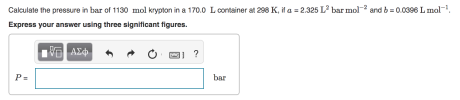 Calculate the pressure in bar of 1130 mol krypton in a 170.0 L container at 298 K, if a = 2.325 L2 bar mol-2 and b = 0.0396 L mol-1. Express your answer using three significant figures. TO AO o 2 ? bar
 21A. Calculate the standard free energy change, AGºat 298 K for the reaction 2COXg) + 2NO(g) -2CO(g) + N:(g) The standard free energy of formation for CO is - 137 kJ, for NO it is 87.6 kJ/mol and for CO, it is -394 kJ/mol. B. Calculate the free energy change. AG. at 298 K. given that the partial pressure of CO is 5.0 atm, that of NO is 4.0 atm, that of CO, is 3.0 atm & that of N,...
 correct answer?
The change in Gibbs free energy, AGⓇ for the following reaction at 298 K is 70.6 kJ/mol. 2NO,(9) — 2NO(g) + O2(9) What is Keq for this reaction? O 4.30 O 0.971 2.00 1.03 O 0.936
correct answer?
The change in Gibbs free energy, AGⓇ for the following reaction at 298 K is 70.6 kJ/mol. 2NO,(9) — 2NO(g) + O2(9) What is Keq for this reaction? O 4.30 O 0.971 2.00 1.03 O 0.936
 For a gaseous reaction, standard conditions are 298 K and a partial pressure of 1 bar for all species. For the reaction N2(g) + 3 H2(g) = 2 NH3(g) the standard change in Gibbs free energy is AGⓇ = -72.6 kJ/mol. What is AG for this reaction at 298 K when the partial pressures are PN, = 0.200 bar, Ph, = 0.150 bar, and PnHz = 0.800 bar. kJ AG = mol
 Calculate the standard Gibbs energy change for the following generic reaction at 298 K, using the standard enthalpies of formation and standard entropies from the table below A+B-C AHI KJ SI JKT Substance mor1 mor1 148.0 299.0 0 76.2 -269.9 105.3 Select one: O a. 8.001e4 kJ/mol O b.-337.5 kJ/mol O C.-265.1 kJ/mol O d. 382.9 kJ/mol o e.-3.460e4 kJ/mol
 Estimate the free energy change (AGrxn) for the following reaction at 298 K, if each gaseous substance is present at p = 0.50 atm. C(s) + 2H2(g) = CH4(9) Enter your answer in kJ. Calculate the DeltaG of the reaction at 298 K and then plug into DeltaG=DeltaG_0+R*T*In(Q). Check your units on all data. Submit Answer Incorrect. Tries 1/99 Previous Tries
 Calculate the pressure in bar of 1130 mol krypton in a 170.0 L container at 298 K, if a = 2.325 L2 bar mol-2 and b = 0.0396 L mol-1. Express your answer using three significant figures. TO AO o 2 ? bar
Most questions answered within 3 hours.
-
Where is the error in this code sequence?
String s1 = "Hello";
String s2 = "ello";...
asked 10 months ago -
Financial data for Joel de Paris, Inc., for last year
follow:
Joel de Paris, Inc.
Balance...
asked 10 months ago -
Consider this reaction:
Al2(SO4)3 (aq)+ BaCl3
(aq) Al2Cl6 (aq)- +
3BaSO4(s) . What is the...
asked 10 months ago -
Suppose that Savneet is considering increasing her
recent random sample from 20 car rentals to 40...
asked 10 months ago -
Trucks arrive at an unloading terminal at an average rate of 120
per hour.
Trucks arrive...
asked 10 months ago -
Why are methanol and ethanol completely soluble in water while
octanol is not very little soluble....
asked 10 months ago -
A facilities manager at a university reads in a research report
that the mean amount of...
asked 10 months ago -
When the CuSO4 is rehydrated by adding water to the anhydrous
compound, is this an endothermic...
asked 10 months ago -
A ray of sunlight is passing from diamond into crown glass; the
angle of incidence is...
asked 10 months ago -
A block of mass 0.249 kg is placed on top of a light, vertical
spring of...
asked 10 months ago -
how do the kidneys compensate in the presences of acidosis
a) trigger hyperventilate
b) reserve acid...
asked 10 months ago -
Question 501 pts
The rental rate of capital to the firm increases. Which of the
following...
asked 10 months ago