after taxes are imposed, would producer and consumer surplus rise or decline?
Homework Answers
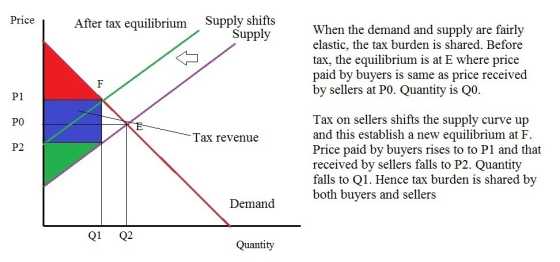
This depends on the price elasticity of demand and supply. For fairly elastic demand and supply curves, tax raises the price consumers pay reduces the price producers receive and finally reduces the quantity. In this manner, both consumer and producer surplus are reduced. This is shown below
In extreme cases when either of the demand or the supply curve is perfectly elastic or inelastic, consumer surplus can be unchanged while producer surplus is reduced or vice versa
Add Answer to:
after taxes are imposed, would producer and consumer surplus rise
or decline?
When prices rise above equilibrium: producer surplus falls and consumer surplus falls. consumer surplus falls and...
When prices rise above equilibrium: producer surplus falls and consumer surplus falls. consumer surplus falls and it is uncertain what happens to producer surplus. producer surplus falls and consumer surplus rises. producer surplus falls and it is uncertain what happens to consumer surplus.
Refer to figure and answer the following questions: Calculate the consumer surplus and producer surplus and...
Refer to figure and answer the following questions: Calculate the consumer surplus and producer surplus and total surplus at the equilibrium. If the government imposes a $6 tax per unit then what will be the new consumer surplus, new producer surplus and total surplus? Did the government gain something after the taxes are imposed? If yes, calculate the amount. Is there any deadweight loss after the taxes? If yes calculate the amount and explain why it occurred?
Questions 3 & 4 are more important. Explain consumer and producer surplus and provide an exa...
Questions 3 & 4 are more important. Explain consumer and producer surplus and provide an example of each. What happens to the consumer surplus and producer surplus when price increases or decreases? Explain the relationship between the tax size and deadweight loss. When tax causes deadweight loss then why it is imposed in the first place? Who gains in this situation? Also if tax has to be imposed how to determine what size of tax will generate optimum tax revenue...
Determine where producer is experiencing a producer surplus or consumer surplus, along with the amount of...
 Determine where producer is experiencing a producer surplus or
consumer surplus, along with the amount of the surplus.
For each scenario, decide whether it creates a producer or a consumer surplus. Then, calculate the ensuing surplus. Alice is willing to spend $30 on a pair of jeans, and has a coupon for $10 off which she found online. She selects and purchases a pair of jeans which cost $35 pre-discount. Alice experiences a Alice's surplus: $ Jeff finds some steaks...
Determine where producer is experiencing a producer surplus or
consumer surplus, along with the amount of the surplus.
For each scenario, decide whether it creates a producer or a consumer surplus. Then, calculate the ensuing surplus. Alice is willing to spend $30 on a pair of jeans, and has a coupon for $10 off which she found online. She selects and purchases a pair of jeans which cost $35 pre-discount. Alice experiences a Alice's surplus: $ Jeff finds some steaks...
Question 5 Welfare for a country is equal to consumer surplus consumer surplus minus producer surplus...
 Question 5 Welfare for a country is equal to consumer surplus consumer surplus minus producer surplus consumer surplus plus producer Surplus plus tariffrevenues consumer surplus plus producer Surplus minus tariff revenues Question 6 Use the graph below to answer this question: In autarky (before trade) consumer surplus is the area represented by the letter(s) (For this question and the following ones that use the same graph. Sis domestic supply. Dis domestic demand Pw is the world price is the tarif)
Consumer surplus (after-tax) E. Producer surplus (after-tax): h. Total surplus: i. Amount of tax ...
 Consumer surplus (after-tax) E. Producer surplus (after-tax): h. Total surplus: i. Amount of tax paid by buyer (tax incidence quantity sold): . Amount of tax paid by seller (tax incidence quantity sold): k. Total deadweight loss: Figure 2a. Figure 2b. Price t Prise pply Supply Denand 03 1 132 23 3 33 4435 051 13 33 3 354455 Dwant
Consumer surplus (after-tax) E. Producer surplus (after-tax): h. Total surplus: i. Amount of tax paid by buyer (tax incidence quantity sold):...
Consumer surplus (after-tax) E. Producer surplus (after-tax): h. Total surplus: i. Amount of tax paid by buyer (tax incidence quantity sold): . Amount of tax paid by seller (tax incidence quantity sold): k. Total deadweight loss: Figure 2a. Figure 2b. Price t Prise pply Supply Denand 03 1 132 23 3 33 4435 051 13 33 3 354455 Dwant
Consumer surplus (after-tax) E. Producer surplus (after-tax): h. Total surplus: i. Amount of tax paid by buyer (tax incidence quantity sold):...
Consumer & Producer Surplus If QP = 450 - P and Q* = 2P - 150:...
 Consumer & Producer Surplus If QP = 450 - P and Q* = 2P - 150: a. Solve for the market equilibrium price (P) and market equilibrium quantity (Q*). (4 points) b. Solve for consumer surplus, producer surplus and total surplus. (4 points) 2. Welfare Effects of a Per Unit Tax Given the same demand and supply equations as in question #1, suppose the government imposes a per unit tax of $15: 22 a. Solve for the new equilibrium quantity...
If the producer surplus is $1000 and the consumer surplus is $300, social surplus is ________....
If the producer surplus is $1000 and the consumer surplus is $300, social surplus is ________. $700 -$700 $1300
When the efficient quantity is produced O A. producer surplus exceeds consumer surplus by the greatest...
 When the efficient quantity is produced O A. producer surplus exceeds consumer surplus by the greatest possible amount O B. consumer surplus exceeds producer surplus by the greatest possible amount O C. total producer surplus is zero . O D. total consumer surplus is zero. O E. the sum of consumer surplus and producer surplus is maximized
3: P. P. 4 e 5: Which areas represent producer surplus after the tax is imposed...
 3: P. P. 4 e 5: Which areas represent producer surplus after the tax is imposed E+C ge 6: E+G E C+G ge 7: F+G E
 Determine where producer is experiencing a producer surplus or
consumer surplus, along with the amount of the surplus.
For each scenario, decide whether it creates a producer or a consumer surplus. Then, calculate the ensuing surplus. Alice is willing to spend $30 on a pair of jeans, and has a coupon for $10 off which she found online. She selects and purchases a pair of jeans which cost $35 pre-discount. Alice experiences a Alice's surplus: $ Jeff finds some steaks...
Determine where producer is experiencing a producer surplus or
consumer surplus, along with the amount of the surplus.
For each scenario, decide whether it creates a producer or a consumer surplus. Then, calculate the ensuing surplus. Alice is willing to spend $30 on a pair of jeans, and has a coupon for $10 off which she found online. She selects and purchases a pair of jeans which cost $35 pre-discount. Alice experiences a Alice's surplus: $ Jeff finds some steaks...
 Question 5 Welfare for a country is equal to consumer surplus consumer surplus minus producer surplus consumer surplus plus producer Surplus plus tariffrevenues consumer surplus plus producer Surplus minus tariff revenues Question 6 Use the graph below to answer this question: In autarky (before trade) consumer surplus is the area represented by the letter(s) (For this question and the following ones that use the same graph. Sis domestic supply. Dis domestic demand Pw is the world price is the tarif)
 Consumer surplus (after-tax) E. Producer surplus (after-tax): h. Total surplus: i. Amount of tax paid by buyer (tax incidence quantity sold): . Amount of tax paid by seller (tax incidence quantity sold): k. Total deadweight loss: Figure 2a. Figure 2b. Price t Prise pply Supply Denand 03 1 132 23 3 33 4435 051 13 33 3 354455 Dwant
Consumer surplus (after-tax) E. Producer surplus (after-tax): h. Total surplus: i. Amount of tax paid by buyer (tax incidence quantity sold):...
Consumer surplus (after-tax) E. Producer surplus (after-tax): h. Total surplus: i. Amount of tax paid by buyer (tax incidence quantity sold): . Amount of tax paid by seller (tax incidence quantity sold): k. Total deadweight loss: Figure 2a. Figure 2b. Price t Prise pply Supply Denand 03 1 132 23 3 33 4435 051 13 33 3 354455 Dwant
Consumer surplus (after-tax) E. Producer surplus (after-tax): h. Total surplus: i. Amount of tax paid by buyer (tax incidence quantity sold):...
 Consumer & Producer Surplus If QP = 450 - P and Q* = 2P - 150: a. Solve for the market equilibrium price (P) and market equilibrium quantity (Q*). (4 points) b. Solve for consumer surplus, producer surplus and total surplus. (4 points) 2. Welfare Effects of a Per Unit Tax Given the same demand and supply equations as in question #1, suppose the government imposes a per unit tax of $15: 22 a. Solve for the new equilibrium quantity...
 When the efficient quantity is produced O A. producer surplus exceeds consumer surplus by the greatest possible amount O B. consumer surplus exceeds producer surplus by the greatest possible amount O C. total producer surplus is zero . O D. total consumer surplus is zero. O E. the sum of consumer surplus and producer surplus is maximized
 3: P. P. 4 e 5: Which areas represent producer surplus after the tax is imposed E+C ge 6: E+G E C+G ge 7: F+G E
Most questions answered within 3 hours.
-
Where is the error in this code sequence?
String s1 = "Hello";
String s2 = "ello";...
asked 11 months ago -
Financial data for Joel de Paris, Inc., for last year
follow:
Joel de Paris, Inc.
Balance...
asked 11 months ago -
Consider this reaction:
Al2(SO4)3 (aq)+ BaCl3
(aq) Al2Cl6 (aq)- +
3BaSO4(s) . What is the...
asked 11 months ago -
Suppose that Savneet is considering increasing her
recent random sample from 20 car rentals to 40...
asked 11 months ago -
Trucks arrive at an unloading terminal at an average rate of 120
per hour.
Trucks arrive...
asked 11 months ago -
Why are methanol and ethanol completely soluble in water while
octanol is not very little soluble....
asked 11 months ago -
A facilities manager at a university reads in a research report
that the mean amount of...
asked 11 months ago -
When the CuSO4 is rehydrated by adding water to the anhydrous
compound, is this an endothermic...
asked 11 months ago -
A ray of sunlight is passing from diamond into crown glass; the
angle of incidence is...
asked 11 months ago -
A block of mass 0.249 kg is placed on top of a light, vertical
spring of...
asked 11 months ago -
how do the kidneys compensate in the presences of acidosis
a) trigger hyperventilate
b) reserve acid...
asked 11 months ago -
Question 501 pts
The rental rate of capital to the firm increases. Which of the
following...
asked 11 months ago