write reactions for each of the following behaving as an acid or a base in water....
write reactions for each of the following behaving as an acid or a base in water.
CH3NH2
C6H5COOH
(I do not know how to determine if these compounds are acidic or basic without being given the reaction?)
Homework Answers
CH3NH2(aq) + H2O(l) --------------> CH3NH3^+ (aq) + OH^- (aq)
The protons acceptor is called base. CH3NH2 is base.
C6H5COOH (aq) + H2O(l)------------> C6H5COO^- (aq) + H3O+(aq)
The proton donor is called acid. C6H5COOH is acid .
Add Answer to:
write reactions for each of the following behaving as an acid or
a base in water....
3. a. Show the product of the following Bronston-Lowry acid base reactions. If there is no...
 3. a. Show the product of the following Bronston-Lowry acid base reactions. If there is no reaction, write NR. (3 points) CHS CHICH2Cog H NaOtt + + H CI (ii) NHZ HC bility of basic and acidic
3. a. Show the product of the following Bronston-Lowry acid base reactions. If there is no reaction, write NR. (3 points) CHS CHICH2Cog H NaOtt + + H CI (ii) NHZ HC bility of basic and acidic
3. a. Show the product of the following Bronston-Lowry acid base reactions. If there is no reaction, write NR. (3 points) CHS CHICH2Cog H NaOtt + + H CI (ii) NHZ HC bility of basic and acidic
Write a balanced Bronsted Lowry acid base reaction with each of the following weak bases and...
 Write a balanced Bronsted Lowry acid base reaction with each of the following weak bases and water. Also, write a Kb expression for each weak base a. NH3 b. CH3NH2 c. C6H5N
The Separation of Three Organic Compounds by Acid, Base Reactions and Liquid, Liquid Extraction. Okay, so...
The Separation of Three Organic Compounds by Acid, Base Reactions and Liquid, Liquid Extraction. Okay, so we had solid benzoic acid, ethyl 4- aminobenzoate, and 9-fluorenone all dissolved in methyleene chloride. We separated the basic component by adding 3M HCl, we separated the acidic component by adding 3M NaOH. I don't understand what happens here. To isolate the acidic solution, we added 6 M NaOH and used the vacuum to recover the solid. To isolate the basic solution we added...
Writing polyprotic acid and base reactions: 1. Write all the dissociations for the three polyprotic acids:...
 Writing polyprotic acid and base reactions: 1. Write all the dissociations for the three polyprotic acids: H_2CO_3, H_3AsO_4, H_3PO_4. Match the appropriate Ka1, Ka2, Ka3 values to the dissociation reaction. 2. Identify all the species in each of the reactions as either an acid, a base, or amphoteric. Imagine putting NaH_2AsO_4 in solution. This is a salt. Describe, using chemical equation, exactly what happens? First write the dissociation reaction of the salt. Then identify the pH active species, and then...
The Separation of Three Organic Compounds by Acid, Base Reactions and Liquid, Liquid Extraction. Okay, so...
The Separation of Three Organic Compounds by Acid, Base Reactions and Liquid, Liquid Extraction. Okay, so we had solid benzoic acid, ethyl 4- aminobenzoate, and 9-fluorenone all dissolved in diethyl ether. We separated the basic component by adding 3M HCl, we separated the acidic component by adding 3M NaOH. I don't understand what happens here. To isolate the acidic solution, we added 6 M NaOH and used the vacuum to recover the solid. To isolate the basic solution we added...
Please do not copy from others! Write all acid-base hydrolysis reactions for Histidine - a polyprotic...
Please do not copy from others! Write all acid-base hydrolysis reactions for Histidine - a polyprotic acid. Clearly write the structure of the species and the charges. Identify all possible acidic and basic species.
how do I know if a compound is a base or an acid just by looking...
how do I know if a compound is a base or an acid just by looking at its formula? i know how to determine acid and bases based on the whole equation, but it is hard to know just by looking at the compound, for example, Hco3, is it a base or an acid and how do we know, are there steps I can use? please give me examples with the explanation when I look at the formula for Hco3,...
Write the structures for each of the following Acid-Base reactions. Used curved arrows to show of...
 Write the structures for each of the following Acid-Base reactions. Used curved arrows to show of electrons in each reaction. (a) the reaction between a Lewis acid and an amine (b) the reaction between a Lewis acid and an alcohol
For each salt complete a Bronsted-Lowry acid-base reaction with water, indicating all conjugate acid-base pairs. Then...
 For each salt complete a Bronsted-Lowry acid-base reaction with water, indicating all conjugate acid-base pairs. Then use the reaction to explain if the salt solution is acidic, basic, or neutral in each case. 1. NH_4^+ Cl^- + H_2) rightarrow 2. NaCl + H_2O rightarrow 3. NaC_2H_3O_2 + H_2O rightarrow 4. K_2PO_4 + 3H_2O rightarrow 5. (NH_4)_2SO_4 + 2H_2O rightarrow
25. Write the complete equation for the neutralization reactions that take place when the following water...
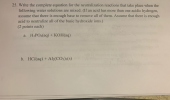 25. Write the complete equation for the neutralization reactions that take place when the following water solutions are mixed. (If an acid has more than one acidic hydrogen, assume that there is enough base to remove all of them. Assume that there is enough acid to neutralize all of the basic hydroxide ions.) (2 points each) A a. HаРО:(аq) + КОН(аq) b. HCl(aq) +Al2(CO3)s(s)
 3. a. Show the product of the following Bronston-Lowry acid base reactions. If there is no reaction, write NR. (3 points) CHS CHICH2Cog H NaOtt + + H CI (ii) NHZ HC bility of basic and acidic
3. a. Show the product of the following Bronston-Lowry acid base reactions. If there is no reaction, write NR. (3 points) CHS CHICH2Cog H NaOtt + + H CI (ii) NHZ HC bility of basic and acidic
3. a. Show the product of the following Bronston-Lowry acid base reactions. If there is no reaction, write NR. (3 points) CHS CHICH2Cog H NaOtt + + H CI (ii) NHZ HC bility of basic and acidic
 Write a balanced Bronsted Lowry acid base reaction with each of the following weak bases and water. Also, write a Kb expression for each weak base a. NH3 b. CH3NH2 c. C6H5N
 Writing polyprotic acid and base reactions: 1. Write all the dissociations for the three polyprotic acids: H_2CO_3, H_3AsO_4, H_3PO_4. Match the appropriate Ka1, Ka2, Ka3 values to the dissociation reaction. 2. Identify all the species in each of the reactions as either an acid, a base, or amphoteric. Imagine putting NaH_2AsO_4 in solution. This is a salt. Describe, using chemical equation, exactly what happens? First write the dissociation reaction of the salt. Then identify the pH active species, and then...
 Write the structures for each of the following Acid-Base reactions. Used curved arrows to show of electrons in each reaction. (a) the reaction between a Lewis acid and an amine (b) the reaction between a Lewis acid and an alcohol
 For each salt complete a Bronsted-Lowry acid-base reaction with water, indicating all conjugate acid-base pairs. Then use the reaction to explain if the salt solution is acidic, basic, or neutral in each case. 1. NH_4^+ Cl^- + H_2) rightarrow 2. NaCl + H_2O rightarrow 3. NaC_2H_3O_2 + H_2O rightarrow 4. K_2PO_4 + 3H_2O rightarrow 5. (NH_4)_2SO_4 + 2H_2O rightarrow
 25. Write the complete equation for the neutralization reactions that take place when the following water solutions are mixed. (If an acid has more than one acidic hydrogen, assume that there is enough base to remove all of them. Assume that there is enough acid to neutralize all of the basic hydroxide ions.) (2 points each) A a. HаРО:(аq) + КОН(аq) b. HCl(aq) +Al2(CO3)s(s)
Most questions answered within 3 hours.
-
Where is the error in this code sequence?
String s1 = "Hello";
String s2 = "ello";...
asked 10 months ago -
Financial data for Joel de Paris, Inc., for last year
follow:
Joel de Paris, Inc.
Balance...
asked 10 months ago -
Consider this reaction:
Al2(SO4)3 (aq)+ BaCl3
(aq) Al2Cl6 (aq)- +
3BaSO4(s) . What is the...
asked 10 months ago -
Suppose that Savneet is considering increasing her
recent random sample from 20 car rentals to 40...
asked 10 months ago -
Trucks arrive at an unloading terminal at an average rate of 120
per hour.
Trucks arrive...
asked 10 months ago -
Why are methanol and ethanol completely soluble in water while
octanol is not very little soluble....
asked 10 months ago -
A facilities manager at a university reads in a research report
that the mean amount of...
asked 10 months ago -
When the CuSO4 is rehydrated by adding water to the anhydrous
compound, is this an endothermic...
asked 10 months ago -
A ray of sunlight is passing from diamond into crown glass; the
angle of incidence is...
asked 10 months ago -
A block of mass 0.249 kg is placed on top of a light, vertical
spring of...
asked 10 months ago -
how do the kidneys compensate in the presences of acidosis
a) trigger hyperventilate
b) reserve acid...
asked 10 months ago -
Question 501 pts
The rental rate of capital to the firm increases. Which of the
following...
asked 10 months ago