Provide an explanation as to how the protonation/deprotonation of acetylsalicylic acid might allow it to act...
Provide an explanation as to how the protonation/deprotonation of acetylsalicylic acid might allow it to act as an uncoupling agent?
Homework Answers
Uncoupling agent is a molecule or agent that breaks or uncouples the electrochemical gradient in the mitochondria. Acetylsalicylic acid is an uncoupling agent. It has a aromatic benzene ring attached to a acetyl group on one end. It has free oxygen molecule that can bind to the other hydrogen ions in the medium. It binds to the proton present in the intermembrane space and as it moves inside the inner mitochondrial membrane it releases the bound hydrogen in the mitochondria. In this way the protonation and deprotonation helps in the breaking of the electrochemical gradient created by the electron transport chain and behaves as a uncoupling agent.
Add Answer to:
Provide an explanation as to how the protonation/deprotonation
of acetylsalicylic acid might allow it to act...
QUESTIONS 1. In the chromatogram of the analgesic tablet, the peaks for acetylsalicylic acid and caffeine...
 QUESTIONS 1. In the chromatogram of the analgesic tablet, the peaks for acetylsalicylic acid and caffeine have roughly the same area even though there is 10 to 15 times as much acetylsalicylic acid as caffeine in the tablet. Provide an explanation for this observation. 2. A typical aspirin tablet contains approximately 30 mg of caffeine. How does your answer compare to this value? What are some of the sources of error that could cause a difference between your answer and...
8) Th e substitution reaction below Time spent: does not work. Provide an explanation of what...
 8) Th e substitution reaction below Time spent: does not work. Provide an explanation of what might be the problem. BrH Br: HO: 9) What could be changed above to allow the reaction to proceed to the 1-bromopropane product? Recall from lab that alcohols can be dehydrated to form alkenes by heating with a strong acid. This reaction follows an E1 mechanism (P, H, and Eg). Dehydration of alcohols H2SO4 heat Alcohol Alkene 10) Why is acid required for the...
1) Draw the conjugate base of each acid by deprotonation of the most acidic proton (might not be shown). 2) Rank the fol...
 1) Draw the conjugate base of each acid by deprotonation of the
most acidic proton (might not be shown).
2) Rank the following acids from weakest to strongest (1=weakest
6=strongest)
ОН (А) ГОН "NH₂
1) Draw the conjugate base of each acid by deprotonation of the
most acidic proton (might not be shown).
2) Rank the following acids from weakest to strongest (1=weakest
6=strongest)
ОН (А) ГОН "NH₂
which functional group that exists in the acetylsalicylic acid that allows us to ise PH to...
which functional group that exists in the acetylsalicylic acid that allows us to ise PH to hepl us drop it out of solution ? how does lowering the PH drastically allow us to drop us to drop out of solution? what does the addition of a proton do to affect solubility of acetylsalicyclic acid in water?
Aspirin (acetylsalicylic acid) may be formed from salicylic acid and acetic acid as follows: 13a How...
Aspirin (acetylsalicylic acid) may be formed from salicylic acid and acetic acid as follows: 13a How many g of aspirin may be produced from 6.94 × 10² mol salicylic acid
Acid-Catalyzed Aldol Condensation OH он steps 1. Provide curved arrows for each step (just the part...
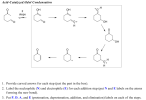 Acid-Catalyzed Aldol Condensation OH он steps 1. Provide curved arrows for each step (just the part in the box) 2. Label the nucleophile (N) and electrophile (E) for each addition step (put N and E labels on the atoms forming the new bond). 3. Put P, D, A, and E (protonation, deprotonation, addition, and elimination) labels on each of the steps.
Experiment 2: Synthesis of Aspirin (Acetylsalicylic Acid ) 1. How many moles of salicylic acid are...
Experiment 2: Synthesis of Aspirin (Acetylsalicylic Acid ) 1. How many moles of salicylic acid are there in 1.0 grams of salicylic acid? 2. How many moles of acetic anhydride are there in 3 mL of acetic anhydride? 3. When 1.0g of salicylic acid and 3 mL of acetic anhydride react, DETERMINE which one is the limiting reactant (you can go to General Chemistry if you need help about limiting reagent)? 4. What is phosphoric acid used for in the...
4) How many grams of oxygen are present in 9.51 g of acetylsalicylic acid (CsHaO4), better...
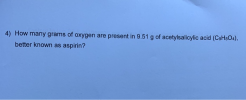 4) How many grams of oxygen are present in 9.51 g of acetylsalicylic acid (CsHaO4), better known as aspirin?
1.examine the list of ingredients for aspirin.list the active and inactive ingredients 2.how might the inactive...
1.examine the list of ingredients for aspirin.list the active and inactive ingredients 2.how might the inactive ingredients influence acetylsalicylic acid percenf yield
An explanation of how simulation might be used to improve performance in your health services organization...
An explanation of how simulation might be used to improve performance in your health services organization or one with which you are familiar. Be specific, and provide examples.
 QUESTIONS 1. In the chromatogram of the analgesic tablet, the peaks for acetylsalicylic acid and caffeine have roughly the same area even though there is 10 to 15 times as much acetylsalicylic acid as caffeine in the tablet. Provide an explanation for this observation. 2. A typical aspirin tablet contains approximately 30 mg of caffeine. How does your answer compare to this value? What are some of the sources of error that could cause a difference between your answer and...
 8) Th e substitution reaction below Time spent: does not work. Provide an explanation of what might be the problem. BrH Br: HO: 9) What could be changed above to allow the reaction to proceed to the 1-bromopropane product? Recall from lab that alcohols can be dehydrated to form alkenes by heating with a strong acid. This reaction follows an E1 mechanism (P, H, and Eg). Dehydration of alcohols H2SO4 heat Alcohol Alkene 10) Why is acid required for the...
 1) Draw the conjugate base of each acid by deprotonation of the
most acidic proton (might not be shown).
2) Rank the following acids from weakest to strongest (1=weakest
6=strongest)
ОН (А) ГОН "NH₂
1) Draw the conjugate base of each acid by deprotonation of the
most acidic proton (might not be shown).
2) Rank the following acids from weakest to strongest (1=weakest
6=strongest)
ОН (А) ГОН "NH₂
 Acid-Catalyzed Aldol Condensation OH он steps 1. Provide curved arrows for each step (just the part in the box) 2. Label the nucleophile (N) and electrophile (E) for each addition step (put N and E labels on the atoms forming the new bond). 3. Put P, D, A, and E (protonation, deprotonation, addition, and elimination) labels on each of the steps.
 4) How many grams of oxygen are present in 9.51 g of acetylsalicylic acid (CsHaO4), better known as aspirin?
Most questions answered within 3 hours.
-
Where is the error in this code sequence?
String s1 = "Hello";
String s2 = "ello";...
asked 10 months ago -
Financial data for Joel de Paris, Inc., for last year
follow:
Joel de Paris, Inc.
Balance...
asked 10 months ago -
Consider this reaction:
Al2(SO4)3 (aq)+ BaCl3
(aq) Al2Cl6 (aq)- +
3BaSO4(s) . What is the...
asked 10 months ago -
Suppose that Savneet is considering increasing her
recent random sample from 20 car rentals to 40...
asked 10 months ago -
Trucks arrive at an unloading terminal at an average rate of 120
per hour.
Trucks arrive...
asked 10 months ago -
Why are methanol and ethanol completely soluble in water while
octanol is not very little soluble....
asked 10 months ago -
A facilities manager at a university reads in a research report
that the mean amount of...
asked 10 months ago -
When the CuSO4 is rehydrated by adding water to the anhydrous
compound, is this an endothermic...
asked 10 months ago -
A ray of sunlight is passing from diamond into crown glass; the
angle of incidence is...
asked 10 months ago -
A block of mass 0.249 kg is placed on top of a light, vertical
spring of...
asked 10 months ago -
how do the kidneys compensate in the presences of acidosis
a) trigger hyperventilate
b) reserve acid...
asked 10 months ago -
Question 501 pts
The rental rate of capital to the firm increases. Which of the
following...
asked 10 months ago