Which combination of muscles best describes those used to turn a doorknob clockwise using your right...
-
Which combination of muscles best describes those used to turn a doorknob clockwise using your right hand and arm?
a. Forearm supinators and elbow flexors
b. Forearm pronators and elbow flexors
c. Forearm supinators and elbow extensors
d. Forearm pronators and elbow extensors
Homework Answers

Add Answer to:
Which combination of muscles best describes those used to turn a
doorknob clockwise using your right...
Biceps For those of you who wonder, "Why do biology majors have to do all this...
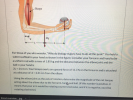 Biceps For those of you who wonder, "Why do biology majors have to do all this junk?" You hold a 1.80-N softball in your hand as shown in the figure. Consider your forearm and hand to be a uniform rod with a mass of 1.85 kg and the distance between the elbow joint and the ball in your hand is 2L = 24.4 cm. Your biceps exerts an upward force of 11.3 N on the forearm and is attached at...
Chapter 13: Appendicular Muscles POST-LABORATORY WORKSHEET The O corresponds to the Leaming Objectiveis) listed In the...
 Chapter 13: Appendicular Muscles POST-LABORATORY WORKSHEET The O corresponds to the Leaming Objectiveis) listed In the chapter opener outine Do You Know the Basics? Exercise 13.1t: Muscles That Move the Pectoral Girdle and Gienohumeral Jeint 1. Match the movements l isted in column A with the corresponding muscle that creates the movement isted ieoms 。 ColumnA Column B deltoid 1extends, adducts, and medialy rotates am texts and mediaty rotates arm; prime mover of arm abduction; extends and lateraly rotates arm...
You hold 1.80 N softball in your hand as shown in the figure. Consider your forearm and hand to b...
 please answer question 2
You hold 1.80 N softball in your hand as shown in the figure. Consider your forearm and hand to be a uniform rod with a mass of 1.25 kg and the distance between the elbow on t and the ball in your hand is 2L # 24.0 cm. Your biceps exerts an upward force of 14.0 N on the forearm and is attached at a distance of d :* 2.20 cm from the elbow. Baceps Mg...
please answer question 2
You hold 1.80 N softball in your hand as shown in the figure. Consider your forearm and hand to be a uniform rod with a mass of 1.25 kg and the distance between the elbow on t and the ball in your hand is 2L # 24.0 cm. Your biceps exerts an upward force of 14.0 N on the forearm and is attached at a distance of d :* 2.20 cm from the elbow. Baceps Mg...
Constants A 71.0 kg weight lifter is doing arm raises using a 7.50 kg weight in...
 Constants A 71.0 kg weight lifter is doing arm raises using a 7.50 kg weight in her hand. Her arm pivots around the elbow joint, starting 40.0 below the horizontal. (See the figure(Figure 1).) Biometric measurements have shown that both forearms and the hands together account for 6.40 % of a person's weight. Since the upper arm is held vertically, the biceps muscle always acts vertically and is attached to the bones of the forearm 5.50 cm from the elbow...
A 75.0 kg weight lifter is doing arm raises using a 7.50 kg weight in her...
 A 75.0 kg weight lifter is doing arm raises using a 7.50 kg weight in her hand. Her arm pivots around the elbow joint, starting 40.0 below the horizontal. (See the figure (Figure 1).) Biometric measurements have shown that both forearms and the hands together account for 5.75% of a person's weight. Since the upper arm is held vertically, the biceps muscle always acts vertically and is attached to the bones of the forearm 5.50 cm from the elbow Part...
1. Remember: When you lift your arm above your head, the scapula protracts, elevates, and upwardly...
1. Remember: When you lift your arm above your head, the scapula protracts, elevates, and upwardly rotates. When you bring your arm down to your side, the scapula retracts, depresses, and downwardly rotates. 2. What is the difference between the actions of the pectoralis minor and the serratus anterior? Which muscle likely contracts more when you lift your arm above your head? 3. List all the actions of the trapezius muscle on the neck. List all the actions of the...
Imagine that you are holding a 20 pound weight in a "curling" position, with your upper...
Imagine that you are holding a 20 pound weight in a "curling" position, with your upper arm vertical and your forearm horizontal. The main muscle holding your forearm in place is your biceps muscle. By looking at your arm and considering torques around your elbow joint, which of the following is your best guess for the tension in your biceps? a) 2lbs b)10lbs c)20lbs d)40lbs e)200 lbs
x 2) When your partner lifts the left foot of the floor without flexing the hip...
 x 2) When your partner lifts the left foot of the floor without flexing the hip or kne fic performs hip hiking, describe wha happens to the iliac crest. 196 3 . Clinical Kinesiology and Anatomy of the Trunk 5. For each of the motions of the pelvis A Place your open left hand in the correct orientation to represent the plane of a motion Place your right index finger to indicate the axis of that motion 3) What happens...
Which of the following situations best describes a business combination to be accounted for as a...
Which of the following situations best describes a business combination to be accounted for as a statutory merger? a) All of the outstanding stock of a company is acquired b) Cash or other consideration is exchanged for total net assets of another company. c) Two companies combine to form a new third company, and the original two companies are dissolved. d) One company transfers assets to another company it has created. What is the correct answer ?
So lost!!!!! Help! Problem: Assume that a 1.00 kg ball is thrown solely by the action of the forearm, which rotates ab...
So lost!!!!! Help! Problem: Assume that a 1.00 kg ball is thrown solely by the action of the forearm, which rotates about the elbow joint under the action of the triceps muscle, as shown in the figure. the ball is accelerated uniformly from rest to 10.0 m/s in .350 s, at which point it is released. The distance from the elbow to the ball is 31 cm. there is 2.5 cm between triceps muscle and axis of rotation(at elbow). A)...
 Biceps For those of you who wonder, "Why do biology majors have to do all this junk?" You hold a 1.80-N softball in your hand as shown in the figure. Consider your forearm and hand to be a uniform rod with a mass of 1.85 kg and the distance between the elbow joint and the ball in your hand is 2L = 24.4 cm. Your biceps exerts an upward force of 11.3 N on the forearm and is attached at...
 Chapter 13: Appendicular Muscles POST-LABORATORY WORKSHEET The O corresponds to the Leaming Objectiveis) listed In the chapter opener outine Do You Know the Basics? Exercise 13.1t: Muscles That Move the Pectoral Girdle and Gienohumeral Jeint 1. Match the movements l isted in column A with the corresponding muscle that creates the movement isted ieoms 。 ColumnA Column B deltoid 1extends, adducts, and medialy rotates am texts and mediaty rotates arm; prime mover of arm abduction; extends and lateraly rotates arm...
 please answer question 2
You hold 1.80 N softball in your hand as shown in the figure. Consider your forearm and hand to be a uniform rod with a mass of 1.25 kg and the distance between the elbow on t and the ball in your hand is 2L # 24.0 cm. Your biceps exerts an upward force of 14.0 N on the forearm and is attached at a distance of d :* 2.20 cm from the elbow. Baceps Mg...
please answer question 2
You hold 1.80 N softball in your hand as shown in the figure. Consider your forearm and hand to be a uniform rod with a mass of 1.25 kg and the distance between the elbow on t and the ball in your hand is 2L # 24.0 cm. Your biceps exerts an upward force of 14.0 N on the forearm and is attached at a distance of d :* 2.20 cm from the elbow. Baceps Mg...
 Constants A 71.0 kg weight lifter is doing arm raises using a 7.50 kg weight in her hand. Her arm pivots around the elbow joint, starting 40.0 below the horizontal. (See the figure(Figure 1).) Biometric measurements have shown that both forearms and the hands together account for 6.40 % of a person's weight. Since the upper arm is held vertically, the biceps muscle always acts vertically and is attached to the bones of the forearm 5.50 cm from the elbow...
 A 75.0 kg weight lifter is doing arm raises using a 7.50 kg weight in her hand. Her arm pivots around the elbow joint, starting 40.0 below the horizontal. (See the figure (Figure 1).) Biometric measurements have shown that both forearms and the hands together account for 5.75% of a person's weight. Since the upper arm is held vertically, the biceps muscle always acts vertically and is attached to the bones of the forearm 5.50 cm from the elbow Part...
 x 2) When your partner lifts the left foot of the floor without flexing the hip or kne fic performs hip hiking, describe wha happens to the iliac crest. 196 3 . Clinical Kinesiology and Anatomy of the Trunk 5. For each of the motions of the pelvis A Place your open left hand in the correct orientation to represent the plane of a motion Place your right index finger to indicate the axis of that motion 3) What happens...
Most questions answered within 3 hours.
-
Where is the error in this code sequence?
String s1 = "Hello";
String s2 = "ello";...
asked 11 months ago -
Financial data for Joel de Paris, Inc., for last year
follow:
Joel de Paris, Inc.
Balance...
asked 11 months ago -
Consider this reaction:
Al2(SO4)3 (aq)+ BaCl3
(aq) Al2Cl6 (aq)- +
3BaSO4(s) . What is the...
asked 11 months ago -
Suppose that Savneet is considering increasing her
recent random sample from 20 car rentals to 40...
asked 11 months ago -
Trucks arrive at an unloading terminal at an average rate of 120
per hour.
Trucks arrive...
asked 11 months ago -
Why are methanol and ethanol completely soluble in water while
octanol is not very little soluble....
asked 11 months ago -
A facilities manager at a university reads in a research report
that the mean amount of...
asked 11 months ago -
When the CuSO4 is rehydrated by adding water to the anhydrous
compound, is this an endothermic...
asked 11 months ago -
A ray of sunlight is passing from diamond into crown glass; the
angle of incidence is...
asked 11 months ago -
A block of mass 0.249 kg is placed on top of a light, vertical
spring of...
asked 11 months ago -
how do the kidneys compensate in the presences of acidosis
a) trigger hyperventilate
b) reserve acid...
asked 11 months ago -
Question 501 pts
The rental rate of capital to the firm increases. Which of the
following...
asked 11 months ago