Imagine that you are holding a 20 pound weight in a "curling" position, with your upper...
Imagine that you are holding a 20 pound weight in a "curling" position, with your upper arm vertical and your forearm horizontal. The main muscle holding your forearm in place is your biceps muscle. By looking at your arm and considering torques around your elbow joint, which of the following is your best guess for the tension in your biceps?
a) 2lbs
b)10lbs
c)20lbs
d)40lbs
e)200 lbs
Homework Answers
Dear student. feel Free to ask doubts in comment(give me a try before downvoting). Trust me ! I'll surely respond quickly and clear your doubt.
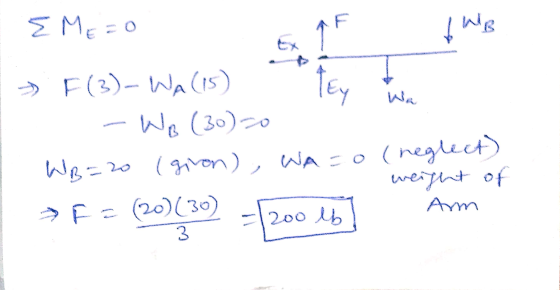
Hope you give thumbs up.
Thanks!
Add Answer to:
Imagine that you are holding a 20 pound weight in a "curling"
position, with your upper...
Constants A 71.0 kg weight lifter is doing arm raises using a 7.50 kg weight in...
 Constants A 71.0 kg weight lifter is doing arm raises using a 7.50 kg weight in her hand. Her arm pivots around the elbow joint, starting 40.0 below the horizontal. (See the figure(Figure 1).) Biometric measurements have shown that both forearms and the hands together account for 6.40 % of a person's weight. Since the upper arm is held vertically, the biceps muscle always acts vertically and is attached to the bones of the forearm 5.50 cm from the elbow...
A 75.0 kg weight lifter is doing arm raises using a 7.50 kg weight in her...
 A 75.0 kg weight lifter is doing arm raises using a 7.50 kg weight in her hand. Her arm pivots around the elbow joint, starting 40.0 below the horizontal. (See the figure (Figure 1).) Biometric measurements have shown that both forearms and the hands together account for 5.75% of a person's weight. Since the upper arm is held vertically, the biceps muscle always acts vertically and is attached to the bones of the forearm 5.50 cm from the elbow Part...
Part A A 75.0 kg weight lifter is doing arm raises using a 7.50 kg weight...
 Part A A 75.0 kg weight lifter is doing arm raises using a 7.50 kg weight in her hand. Her arm pivots around the elbow joint, starting 40.0° below the horizontal (See the figure(Figure 1).) Biometric measurements have shown that both forearms and the hands together account for 5.75 % of a person's weight. Since the upper arm is held vertically, the biceps muscle always acts vertically and is attached to the bones of the forearm 5.50 cm from the...
Consider a person holding a bag like in the diagram, palm facing upwards, forearm parallel to...
 Consider a person holding a bag like in the diagram, palm facing
upwards, forearm parallel to the floor, and upper arm making a
right angle with their forearm. Masses are added to the bag until
the subject can no longer comfortably keep the angle between their
upper arm and forearm at 90 degrees.
Weight of person: 170 lbs (756.5 N)
Body Segment and Percentage Amount of Total Body Weight
Head( 7.3%), Hand(0.7%), Trunk(50.7%) Thigh(10.3%), Upper
Arm(2.6%)
Calf(4.3%), (Forearm1.6%), Foot(1.5%)
The...
Consider a person holding a bag like in the diagram, palm facing
upwards, forearm parallel to the floor, and upper arm making a
right angle with their forearm. Masses are added to the bag until
the subject can no longer comfortably keep the angle between their
upper arm and forearm at 90 degrees.
Weight of person: 170 lbs (756.5 N)
Body Segment and Percentage Amount of Total Body Weight
Head( 7.3%), Hand(0.7%), Trunk(50.7%) Thigh(10.3%), Upper
Arm(2.6%)
Calf(4.3%), (Forearm1.6%), Foot(1.5%)
The...
Most of the motion generated by joints in the human body are examples of levers. An...
Most of the motion generated by joints in the human body are examples of levers. An example of a third class lever is the forearm; the force which generates the motion is located in between the pivot point and the resistance force. The elbow acts as the pivot point, the biceps muscle pulls up on the forearm to move the mass which is held in the hand. Imagine you are holding an object in your hand with your forearm horizontal...
Most of the motion generated by joints in the human body are examples of levers. An...
 Most of the motion generated by joints in the human body are examples of levers. An example of a third class lever is the forearm; the force which generates the motion is located in between the pivot point and the resistance force. The elbow acts as the pivot point, the biceps muscle pulls up on the forearm to move the mass which is held in the hand. Imagine you are holding an object in your hand with your forearm horizontal...
20 21 22 24 Figure shows an illustration of a human arm while lifting a metal...
 20 21 22 24 Figure shows an illustration of a human arm while lifting a metal sphere of weight 278 N. The forearm is horizontal and the arm is in equilibrium. The main forces med and the distances from the elbow joint are shown in the figure. biceps muscle metal sphere forearm elbow joint 0.04 m 0.15 m 1 18 N weight of the sphere 0.46 m Considering the moments about the elbow joint, calculate the size of the force...
Most of the motion generated by joints in the human body are examples of levers. An...
Most of the motion generated by joints in the human body are examples of levers. An example of a third class lever is the forearm; the force which generates the motion is located in‑between the pivot point and the resistance force. The elbow acts as the pivot point, the biceps muscle pulls up on the forearm to move the mass which is held in the hand. Imagine someone is holding an object in her hand with her forearm horizontal and...
Determine the maximum weight that can be held where the forearm is horizontal and the upper...
Determine the maximum weight that can be held where the forearm is horizontal and the upper arm is vertical, and where taking the rupture strength of muscle to be 7x10^5 N/m^2, the biceps diameter to be 8.0cm and the mechanical advantage of the forearm to be 0.17 for a lifting a weight with the hand.
2. Bill is holding a 12 kg barbell in his hand. His upper arm is perpendicular...
2. Bill is holding a 12 kg barbell in his hand. His upper arm is perpendicular to the ground, and his elbow is flexed to produce a 40º angle at the elbow joint. His forearm has a mass of 12 kg. The distance from the elbow joint to the weight in his hand is 35 cm. The center of mass (COM) of his forearm is located 14 cm from the elbow joint. Draw a free body diagram of this scenario....
 Constants A 71.0 kg weight lifter is doing arm raises using a 7.50 kg weight in her hand. Her arm pivots around the elbow joint, starting 40.0 below the horizontal. (See the figure(Figure 1).) Biometric measurements have shown that both forearms and the hands together account for 6.40 % of a person's weight. Since the upper arm is held vertically, the biceps muscle always acts vertically and is attached to the bones of the forearm 5.50 cm from the elbow...
 A 75.0 kg weight lifter is doing arm raises using a 7.50 kg weight in her hand. Her arm pivots around the elbow joint, starting 40.0 below the horizontal. (See the figure (Figure 1).) Biometric measurements have shown that both forearms and the hands together account for 5.75% of a person's weight. Since the upper arm is held vertically, the biceps muscle always acts vertically and is attached to the bones of the forearm 5.50 cm from the elbow Part...
 Part A A 75.0 kg weight lifter is doing arm raises using a 7.50 kg weight in her hand. Her arm pivots around the elbow joint, starting 40.0° below the horizontal (See the figure(Figure 1).) Biometric measurements have shown that both forearms and the hands together account for 5.75 % of a person's weight. Since the upper arm is held vertically, the biceps muscle always acts vertically and is attached to the bones of the forearm 5.50 cm from the...
 Consider a person holding a bag like in the diagram, palm facing
upwards, forearm parallel to the floor, and upper arm making a
right angle with their forearm. Masses are added to the bag until
the subject can no longer comfortably keep the angle between their
upper arm and forearm at 90 degrees.
Weight of person: 170 lbs (756.5 N)
Body Segment and Percentage Amount of Total Body Weight
Head( 7.3%), Hand(0.7%), Trunk(50.7%) Thigh(10.3%), Upper
Arm(2.6%)
Calf(4.3%), (Forearm1.6%), Foot(1.5%)
The...
Consider a person holding a bag like in the diagram, palm facing
upwards, forearm parallel to the floor, and upper arm making a
right angle with their forearm. Masses are added to the bag until
the subject can no longer comfortably keep the angle between their
upper arm and forearm at 90 degrees.
Weight of person: 170 lbs (756.5 N)
Body Segment and Percentage Amount of Total Body Weight
Head( 7.3%), Hand(0.7%), Trunk(50.7%) Thigh(10.3%), Upper
Arm(2.6%)
Calf(4.3%), (Forearm1.6%), Foot(1.5%)
The...
 Most of the motion generated by joints in the human body are examples of levers. An example of a third class lever is the forearm; the force which generates the motion is located in between the pivot point and the resistance force. The elbow acts as the pivot point, the biceps muscle pulls up on the forearm to move the mass which is held in the hand. Imagine you are holding an object in your hand with your forearm horizontal...
 20 21 22 24 Figure shows an illustration of a human arm while lifting a metal sphere of weight 278 N. The forearm is horizontal and the arm is in equilibrium. The main forces med and the distances from the elbow joint are shown in the figure. biceps muscle metal sphere forearm elbow joint 0.04 m 0.15 m 1 18 N weight of the sphere 0.46 m Considering the moments about the elbow joint, calculate the size of the force...
Most questions answered within 3 hours.
-
Where is the error in this code sequence?
String s1 = "Hello";
String s2 = "ello";...
asked 11 months ago -
Financial data for Joel de Paris, Inc., for last year
follow:
Joel de Paris, Inc.
Balance...
asked 11 months ago -
Consider this reaction:
Al2(SO4)3 (aq)+ BaCl3
(aq) Al2Cl6 (aq)- +
3BaSO4(s) . What is the...
asked 11 months ago -
Suppose that Savneet is considering increasing her
recent random sample from 20 car rentals to 40...
asked 11 months ago -
Trucks arrive at an unloading terminal at an average rate of 120
per hour.
Trucks arrive...
asked 11 months ago -
Why are methanol and ethanol completely soluble in water while
octanol is not very little soluble....
asked 11 months ago -
A facilities manager at a university reads in a research report
that the mean amount of...
asked 11 months ago -
When the CuSO4 is rehydrated by adding water to the anhydrous
compound, is this an endothermic...
asked 11 months ago -
A ray of sunlight is passing from diamond into crown glass; the
angle of incidence is...
asked 11 months ago -
A block of mass 0.249 kg is placed on top of a light, vertical
spring of...
asked 11 months ago -
how do the kidneys compensate in the presences of acidosis
a) trigger hyperventilate
b) reserve acid...
asked 11 months ago -
Question 501 pts
The rental rate of capital to the firm increases. Which of the
following...
asked 11 months ago